

Phase 1: Empathy & K-Culture Cold Open
Hello! It’s your Daily Hangul Editor.
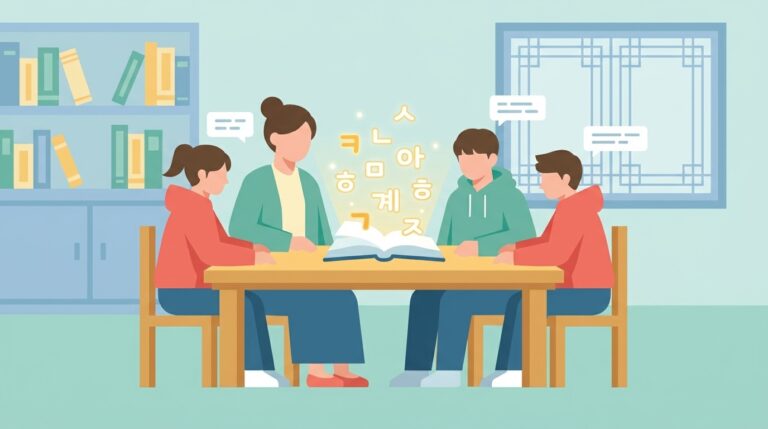
Picture this: You are at a beautiful, wooden retreat center in Paju Book City (파주출판도시), the heart of Korea’s publishing industry. Sunlight is filtering through the massive windows of a library cafe. You’ve been invited as a guest mentor for a ‘Youth Reading Camp’ (청소년 독서 캠프).
Suddenly, a Korean high school student sighs, closing a novel by Han Kang. They look up and say, “선생님, 이 문장 너무 뼈 때리는데요? 근데 정확히 무슨 뜻인지 설명은 못하겠어요.” (Teacher, this sentence totally ‘hits the bone’, but I can’t explain exactly what it means.)
If you’ve watched K-Dramas like Sky Castle, you know that Korean education can be fiercely competitive, with a massive focus on reading comprehension for the university entrance exam (수능). But recently, a new movement has sparked in Korea: focusing on ‘문해력’ (literacy/reading comprehension) not just to pass exams, but to genuinely understand the world. That’s why these reading camps are booming.
As an advanced (C2) Korean learner, your vocabulary needs to transcend basic transactional phrases. You need the language of empathy, critical analysis, and profound emotional reflection. Today, we are going to learn how to guide young minds, discuss literature like a native intellectual, and truly connect with the Korean reading culture.
Phase 2: Deep Dive into Key Expressions
Let’s explore the sophisticated vocabulary you need to discuss literature and deep ideas.
1. 행간을 읽다 (Reading between the lines)
- Pronunciation: [haeng-ga-neul ik-tta] ‘행’ sounds like ‘hang’, ‘간’ like ‘gahn’. Make sure to hit the tense [tta] at the end.
- Meaning: Literal: To read the space between lines. / Real nuance: To grasp the hidden meaning, context, or author’s true intention.
- K-Culture Moment: During a book club discussion, a mentor might ask students, “작가가 왜 이 단어를 썼을까? 행간을 읽어보자.” (Why did the author use this word? Let’s read between the lines.) It’s the ultimate skill required in both Korean literature and Korean society.
- Editor’s Insight: At a C2 level, you know that Korean is a high-context language. This phrase isn’t just for books; it’s used in politics and business (e.g., “대표님 말씀의 행간을 읽으셔야죠”).
- Situation Spectrum:
- Casual with teens: ✅ (As a guiding question)
- Professional Mentorship (Formal): ✅
- Using it to criticize someone: ⚠️ (Can sound condescending)
- 🤔 Think About It: Does the concept of ‘행간을 읽다’ essentially mean applying ‘Nunchi’ (눈치) to written text? How does a high-context culture influence its literature?
2. 마음에 와닿다 (To resonate deeply)
- Pronunciation: [ma-eu-me wa-dat-tta] ‘닿다’ changes to [닫따] due to consonant assimilation.
- Meaning: Literal: To touch the mind/heart. / Real nuance: To hit home, to resonate deeply with one’s personal experiences.
- K-Culture Moment: When a teen reads a coming-of-age novel like Almond (아몬드) and finally relates to the protagonist’s struggles, they will say, “이 구절이 제일 와닿았어요.” (This passage resonated with me the most.)
- Editor’s Insight: While ‘감동적이다’ (moving) is what you learn in textbooks, ‘와닿다’ is what Koreans actually say when a text feels personally relevant to their own life.
- Situation Spectrum:
- Sharing personal reflections (All levels): ✅
- Academic essays: ⚠️ (A bit too subjective; better for spoken discussions)
- 🤔 Think About It: Korean culture values shared emotional experiences (정). How does expressing that a text ‘touched my heart’ help build community in a reading camp?
3. 긴 여운이 남다 (Leaves a lingering impact)
- Pronunciation: [gin yeo-u-ni nam-tta]
- Meaning: Literal: A long lingering sound remains. / Real nuance: The emotional afterglow or profound impact that stays with you long after finishing a book or movie.
- K-Culture Moment: You walk out of a cinema after an indie K-Movie, or close the final page of a masterpiece web novel. Nobody speaks for a minute. That silence? That’s ‘여운’.
- Editor’s Insight: This is a highly poetic yet incredibly common phrase in Korean reviews (리뷰). If you want to sound like a sophisticated intellectual, use this instead of simply saying “It was good.”
- Situation Spectrum:
- Book reviews / Cultural discussions: ✅
- Everyday trivial matters: 🚫 (Too dramatic for finishing a good sandwich!)
Phase 3: Textbook vs. Real Korean
When mentoring Gen Z/Alpha teenagers at a camp, your Korean needs to bridge the gap between academic depth and modern slang.
[Sharing Your Opinion on a Book]
* 📖 Textbook Korean: 이 책은 매우 감동적이고 훌륭합니다. (This book is very moving and excellent.)
* 🗣️ Real Korean: 완전 띵작이에요. 문장 하나하나가 다 뼈 때리네요. (It’s a total masterpiece. Every single sentence hits close to home/hits the bone.)
* 💡 Why the difference?: ‘띵작’ (Masterpiece, replacing 명 with the visually similar 띵) and ‘뼈 때리다’ (hitting the bone = striking a painful but true chord) are essential slang for youth to express overwhelming resonance without sounding like a boomer (꼰대).
[Encouraging Critical Thinking]
* 📖 Textbook Korean: 책의 숨겨진 의미를 파악해 보십시오. (Please grasp the hidden meaning of the book.)
* 🗣️ Real Korean: 작가가 진짜 하고 싶은 말이 뭘까? 우리 같이 행간을 읽어볼까?
* 💡 Why the difference?: Using ‘우리 같이’ (let’s do it together) softens the instruction, reflecting the collaborative mentor-mentee dynamic rather than a strict teacher-student hierarchy.
Bottom Note: At a C2 level, mixing high-level vocabulary (행간) with soft, inclusive endings (-볼까?, -잖아) demonstrates ultimate fluency and emotional intelligence.
Phase 4: Cultural Context — K-Culture Deep Dive
4-1. Non-verbal Communication in Mentoring
When discussing deep topics with Korean teenagers, eye level and posture matter immensely. In traditional Korean classrooms, teachers stand at the podium. In modern reading camps, you’ll sit in a circle on the floor or around a low table. Leaning in slightly, making soft eye contact, and nodding thoughtfully (끄덕끄덕) while saying “음~ 그랬구나” (Ah, I see…) is the ultimate non-verbal ‘Nunchi’ to make students feel emotionally safe to share their thoughts.
4-2. The “Literacy Crisis” and K-Education
Why are “Reading Camps” so popular now? It’s a massive societal topic. Korean students study grueling hours for the CSAT’s Korean section (수능 국어), which involves reading impossibly complex, college-level texts about quantum physics or philosophy just to answer multiple-choice questions in 80 minutes.
Paradoxically, this has led to a generation that can decode complex texts for exams but refuses to read for pleasure, leading to a much-debated ‘문해력 저하’ (Decline in literacy). Reading camps are a desperate, beautiful attempt by Korean society to give teenagers their “right to read for joy” back. When you participate in these, you aren’t just teaching a language; you are participating in a cultural healing process.
Phase 5: Real-Life Roleplay Scenario
Setting: Saturday afternoon at the “Forest of Wisdom” library in Paju Book City. Towering bookshelves surround you. You are sitting with a small group of high schoolers.
Characters:
– YOU: A foreign guest mentor living in Korea, an avid reader.
– Jihoon (17): A bright but slightly cynical teenager who thinks classic literature is boring.
Dialogue:
지훈: 멘토님, 솔직히 고전문학은 너무 지루해요. 옛날 사람들이 쓴 글이 지금 제 인생에 무슨 도움이 되는지 모르겠어요.
(Menteo-nim, soljiki gojeonmunhageun neomu jiruhaeyo. Yennal saramdeuri sseun geuri jigeum je insaenge museun doumi doeneunji moreugesseoyo.)
[Mentor, honestly, classical literature is so boring. I don’t see how things written by people from the past help my life right now.]
YOU: 음, 지훈 학생 말이 맞아요. 처음엔 그렇게 느끼기 마련이죠.
(Eum, Jihoon haksaeng mari majayo. Cheoumen geureoke neukkigi maryeonijyo.)
[Hmm, you’re right, Jihoon. It’s natural to feel that way at first.]
지훈: 그쵸? 웹소설이 훨씬 전개도 빠르고 재밌잖아요.
(Geuchyo? Websoseori hwolssin jeongaedo ppareugo jaemitjanayo.)
[Right? Web novels have a much faster pace and are more fun.]
🔀 Your Turn! How do you respond as a sophisticated mentor?
– A) “그래도 학생은 책을 읽어야 합니다. 그게 공부니까요.” (But students must read books. That is studying.)
– B) “웹소설도 좋지! 하지만 고전문학의 행간을 읽다 보면, 인간의 본질에 대해 깊은 여운을 느낄 수 있단다.”
– C) “아 진짜? 나도 고전문학 노잼이라고 생각해. 대박!”✅ Best Choice: B — Acknowledges his interest (web novels) while beautifully utilizing advanced vocabulary (행간을 읽다, 여운) to gently guide him, fitting the exact role of a modern, empathetic mentor.
⚠️ Choice A & C Analysis: ‘A’ makes you sound like a strict, old-fashioned boomer (꼰대). ‘C’ uses slang (‘노잼’, ‘대박’) but loses the authority and depth expected of a C2-level mentor.
Phase 6: 10-Second Shadowing Drill
Practice your mentor voice! Speak slowly, thoughtfully, and with deep empathy.
😊 지훈아, / 책의 표면만 보지 말고, / 😌 작가가 숨겨놓은 / 행간을 한 번 읽어볼래?
(Jihun-a, / chae-gui pyomyeon-man boji malgo, / jakka-ga sumgyeo-noeun / haeng-ga-neul han beon ilgeo-bollae?)
Notice the gentle pause (/) and the soft, encouraging tone at the end.
Phase 7: K-Culture Mini Dictionary
| Korean | Romanization | English | Cultural Context |
|---|---|---|---|
| 문해력 | munhaeryeok | Literacy / Reading Comprehension | Currently one of the biggest buzzwords in Korean education and society. |
| 수능 국어 | suneung gugeo | CSAT Korean Section | The notoriously difficult reading test that Korean high schoolers dread. |
| 독후감 | dokhugam | Book Report | A staple homework assignment for Korean students during vacations. |
| 필사 | pilsa | Transcription / Hand-copying | A trendy hobby in Korea where people hand-write passages from books to meditate on the meaning. |
| 꼰대 | kkondae | Boomer / Condescending older person | What you want to avoid sounding like when mentoring youth! |
Phase 8: Traveler’s Survival Kit
Since Paju Book City or massive bookstores like Kyobo Bookstore (교보문고) in Gwanghwamun are must-visit spots for publishing and literature lovers, here are survival phrases for your literary journey in Korea.
🆘 Survival Expression #1: Finding a Book
– 🇰🇷 “소설 섹션은 어디에 있나요?” (Soseol seksyeoneun eodie innayo?)
– 🗣️ “Where is the fiction section?”
– 📍 Places: Kyobo Bookstore, Aladin Used Bookstore, Paju Book City.
– 💡 Pro Tip: Large bookstores in Korea have digital kiosks (도서검색대). Print the location slip, and it will give you the exact shelf number!🆘 Survival Expression #2: Asking for Recommendations
– 🇰🇷 “요즘 청소년들한테 제일 인기 있는 책이 뭐예요?” (Yojeum cheongsonyeondeulhante jeil ingi inneun chaegi mwoyeyo?)
– 🗣️ “What is the most popular book among teenagers these days?”
📌 Editor’s Travel Note:
– Independent Bookstores (독립서점): Korea is currently experiencing a massive boom in indie bookstores. Neighborhoods like Mangwon-dong or Haebangchon are filled with tiny shops curated by owners with specific tastes. They often host their own mini reading camps!
– Cafe Culture: In Korea, it is extremely common to buy a book and immediately sit at the bookstore’s cafe to read. Don’t be shy about grabbing a seat.
Phase 9: Critical Thinking Corner — “One Step Deeper”
🧠 Think Deeper: Media vs. Reality in Korean Education
If you watch Korean dramas, the youth are often depicted either as hyper-competitive academic monsters fighting for grades, or as rebels completely giving up on school. However, real life has much more nuance. The rise of ‘Youth Reading Camps’ (청소년 독서 캠프) reveals a society actively trying to cure itself. Educators and parents are realizing that grinding through multiple-choice questions doesn’t create thoughtful adults. By teaching teens to ‘read between the lines’ (행간을 읽다) of a novel, Korea is trying to teach them to read the emotions of the people around them. Literature is becoming a tool for empathy, not just a subject to conquer.
💬 Your Turn: How does your home culture encourage teenagers to read? Is it tied to academic success, or is it more about personal growth? Share your thoughts in the comments!
Phase 10: FAQ & Avoiding Misunderstandings
Q1: “Can I use slang like ‘뼈 때리다’ when talking to the camp director or older teachers?”
No. Slang is great for connecting with the teens, but when speaking to the camp organizers or older Korean educators, stick to standard vocabulary. Say “아주 깊은 인상을 받았습니다” (I was deeply impressed).
Q2: “Is it okay to ask teenagers about their CSAT (수능) scores or grades?”
Absolutely not. Unless they bring it up first, asking a high schooler about their grades or which university they are aiming for is highly stressful and considered intrusive. Focus the conversation strictly on the book and their feelings.
❌ Common Mistake #1: Treating teenagers like children.
✅ Do this instead: In Korean youth camps, it’s customary to treat high schoolers with a level of intellectual respect. Address them politely using their name + 학생 (e.g., “지훈 학생”), or gently use friendly language (반말/요 붙이기) only after establishing a warm rapport.
Phase 11: Summary & Action Items
One-Liner Summary: To mentor and connect with Korean youth through literature, go beyond basic reading and learn to “read between the lines” (행간을 읽다) to find what truly resonates (와닿다).
Action Mission:
– 🥉 Bronze (Solo): Read the 10-second shadowing drill aloud 3 times, focusing on an empathetic tone.
– 🥈 Silver (Online): Find an English translation of a Korean poem or book excerpt online. Write a comment in Korean on a forum using “이 구절이 마음에 와닿았어요.”
– 🥇 Gold (Real World): Visit a Korean bookstore (or Aladin US/online), pick up a youth novel, and try to find a sentence that leaves a “긴 여운” (lingering impact).
K-Culture Mission:
Search for the Korean novel Almond (아몬드) or Han Kang’s The Vegetarian (채식주의자) online. Read just the synopsis in Korean, and imagine you are discussing its themes at a reading camp in Paju Book City!
Phase 12: Quiz — Interactive Challenge
1. Situational Judgment: A student finishes reading a devastatingly sad but beautiful short story. You want to ask them how they feel. What is the most sophisticated (C2) question to ask?
– A) 책 재미있었어요?
– B) 다 읽고 나니 어떤 여운이 남나요?
– C) 이 책 얼른 외우세요.
2. Fill in the Blank:
“단어의 사전적 의미만 보지 말고, 문장의 ( ______ )을/를 읽어보세요.”
Hint: The space between lines.
3. True or False (K-Culture Edition):
“Korean high schoolers only read books to pass the CSAT (수능), so there are no youth reading camps in Korea.”
(Toggle for Answers)
- B (It asks about the emotional afterglow/impact, perfect for a deep discussion.)
- 행간 (haenggan)
- False. While the CSAT is a massive pressure, the recent trend focuses heavily on authentic reading camps and improving true literacy (문해력) beyond exams.
Frequently Asked Questions (FAQ)
Q: What does "행간을 읽다 (Reading between the lines)" mean in Korean and how do you pronounce it?
A: In Korean, "행간을 읽다 (Reading between the lines)" is pronounced [haeng-ga-neul ik-tta] and means: Literal: To read the space between lines. / Real nuance: To grasp the hidden meaning, context, or author's true intention.
Q: What does "마음에 와닿다 (To resonate deeply)" mean in Korean and how do you pronounce it?
A: In Korean, "마음에 와닿다 (To resonate deeply)" is pronounced [ma-eu-me wa-dat-tta] and means: Literal: To touch the mind/heart. / Real nuance: To hit home, to resonate deeply with one's personal experiences.
Q: What does "긴 여운이 남다 (Leaves a lingering impact)" mean in Korean and how do you pronounce it?
A: In Korean, "긴 여운이 남다 (Leaves a lingering impact)" is pronounced [gin yeo-u-ni nam-tta] and means: Literal: A long lingering sound remains. / Real nuance: The emotional afterglow or profound impact that stays with you long after finishing a book or movie.







