

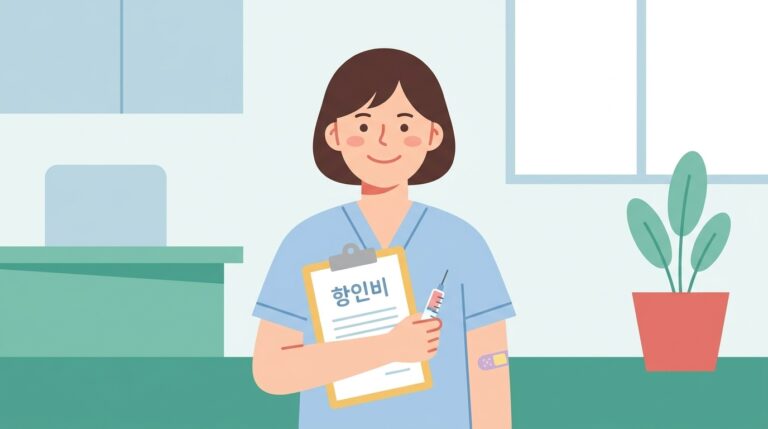
Ouch! The Shocking Truth About Getting a Shot in a Korean Hospital
Phase 1: Empathy (The Cold Open)
안녕하세요! Hello! I’m the Senior Editor at Daily Hangul.
Picture this: You are watching a K-Drama. The handsome CEO collapses from overwork. Cut to: him waking up in a luxurious VIP hospital bed, a pristine IV drip attached to his arm, while sad music plays.
But what happens when you catch a cold in Seoul and visit a local clinic? You might be shocked when the doctor casually tells you to go to the injection room… and the friendly nurse asks you to lower your pants! Wait, what? Yes, welcome to the world of the famous Korean “butt shot” (엉덩이 주사).
Being sick in a foreign country is legitimately scary. But knowing a few simple, everyday phrases will transform a terrifying hospital visit into a smooth, even cultural, experience. This guide is built directly from the real panic moments of my beginner (A2) students. Let’s dive into the real Korean medical experience!
Phase 2: Deep Dive into Key Expressions
1. 따끔해요!
- Pronunciation: [ttaggeumhaeyo] – “tta” is a sharp ‘t’ with no air puff, and “ggeum” sounds like ‘gum’.
- Meaning: Literal: “It is stinging.” / Real nuance: “Here comes the needle, brace yourself!”
- K-Culture Moment: Right before the needle goes in, the nurse will quickly tap your skin and say “따끔~” in a bright, almost cute sing-song voice. It’s a national reflex!
- Editor’s Insight: It’s not just a warning; it’s a verbal band-aid. Korean nurses use this cute tone to soften the psychological blow of the needle. It instantly makes the situation feel less scary.
- Situation Spectrum:
- 친구 사이(Casual): ✅ (Usually shortened to “따끔!”)
- 직장 동료(Semi-formal): ✅ (Nurse to patient)
- 직장 상사·어른(Formal): 🚫 (Not used to elders in a strictly formal business setting).
- 🤔 Think About It: Why do Koreans use a bright tone when warning about pain? Does your culture try to distract from pain, or warn you seriously?
2. 문지르지 말고 꾹 누르세요
- Pronunciation: [munjireuji malgo gguk nureuseyo]
- Meaning: Literal: “Don’t rub it, press firmly.”
- K-Culture Moment: After drawing blood or giving a shot, the nurse will slap a cotton ball (or a cute character band-aid) on it and give you this strict instruction.
- Editor’s Insight: Many foreigners instinctively rub the injection site to ease the pain. In Korea, nurses will quickly stop you, as rubbing can cause a bruise (멍). Just press it down like a button!
- Situation Spectrum:
- 친구 사이(Casual): ⚠️
- 직장 동료(Semi-formal): ✅ (Common in clinics)
- 직장 상사·어른(Formal): ✅
- 🤔 Think About It: Notice the grammar “~지 말고” (Don’t do A, but do B). It’s a very direct but caring way to give instructions in Korea. Do you have a similar structure in your language?
3. 수액 하나 놔주세요
- Pronunciation: [suaek hana nwajuseyo]
- Meaning: Literal: “Please place one IV.” / Real nuance: “I’m exhausted, I need a vitamin IV drip.”
- K-Culture Moment: In K-Dramas, exhausted characters get “Ringer” (링거) drips. In reality, ordinary office workers use their lunch break to get a quick vitamin IV when they feel a cold coming on or have a bad hangover.
- Editor’s Insight: You don’t have to be dying to get an IV in Korea! It’s seen as a quick energy boost. It shows how proactive Koreans are about recovering fast.
- Situation Spectrum:
- 친구 사이(Casual): ✅ (Talking to a friend: “나 오늘 수액 맞았어”)
- 직장 동료(Semi-formal): ✅ (Asking the doctor)
- 직장 상사·어른(Formal): ✅
- 🤔 Think About It: What does the casual use of IV drips tell us about Korea’s highly competitive work culture and the desire for “quick fixes”?
Phase 3: Textbook vs. Real Korean
[Warning about the pain]
* 📖 Textbook Korean: 아플 수 있습니다. (It may hurt.)
* 🗣️ Real Korean: 쪼~금 따끔해요~ (It’ll just pinch a tiny bit~)
* 💡 Why different?: The word “아프다” (to hurt) sounds too scary. “따끔” minimizes the fear and builds a friendly rapport between nurse and patient.
[Asking for a quick recovery]
* 📖 Textbook Korean: 피곤하니까 주사를 맞고 싶습니다. (Because I am tired, I want an injection.)
* 🗣️ Real Korean: 원장님, 링거 하나 놔주세요. (Doctor, please give me an IV.)
* 💡 Why different?: Koreans love efficiency. Naming the exact treatment (“Ringer/IV”) is very common and shows you know how to take care of yourself.
Bottom Note: For A2 learners, using “따끔해요” when a friend gets a paper cut is a great, witty way to show off your natural Korean skills!
Phase 4: Cultural Context — K-Culture Deep Dive
4-1. Non-verbal Cues: The “Distraction Tap”
When you get a shot in Korea, the nurse won’t just slowly insert the needle. They will rapidly tap or gently slap the area around the injection site right before the needle goes in. This isn’t because they are angry! It’s a clever Korean trick to confuse your nerves so you don’t feel the pinch of the needle.
4-2. K-Drama Connection: The Magical “Ringer”
Have you seen the dramatic K-Drama trope where the angry protagonist rips the IV needle out of their arm and storms out of the hospital?
Editor’s Warning: Please never do this! While it looks cool on TV, in real Korean hospitals, nurses will scold you. Always wait for them to politely tell you, “다 맞으셨어요” (You are all done) and remove it safely. Also, getting a “Ringer” (IV drip) isn’t just for rich CEOs; anyone can walk into a clinic and ask for one for about $30-$50!
Phase 5: Interactive Roleplay Scenario
- Setting: Friday 10 AM. A local clinic (내과 – Internal Medicine) in Hongdae. You have a terrible sore throat and mild fever. You are talking to the receptionist/nurse.
- Characters:
- YOU (Foreign Student): You just want some medicine so you can go back to studying.
- Nurse Kim (28): Fast, efficient, but very kind.
Nurse Kim: 어떻게 오셨어요? 📋
(eotteoke osyeosseoyo?)
[What brings you here today?]
YOU: 안녕하세요. 감기 때문에 왔어요.
(annyeonghaseyo. gamgi ttaemune wasseoyo.)
[Hello. I’m here because of a cold.]
Nurse Kim: 네, 여권이나 외국인 등록증 주세요. 열이 있나요?
(ne, yeogwonina waegugin deungnokjeung juseyo. yeori innayo?)
[Yes, please give me your passport or ARC. Do you have a fever?]
YOU: 조금 있어요. 그리고 목이 너무 아파요.
(jogeum isseoyo. geurigo mogi neomu apayo.)
[A little bit. And my throat hurts so much.]
Nurse Kim: 네, 저기 앉아서 잠깐만 기다리세요.
(ne, jeogi anjaseo jamkkanman gidariseyo.)
[Yes, please sit over there and wait a moment.]
(🎭 Stage Direction: 5 minutes later, after seeing the doctor very briefly, you return to the nurse)
Nurse Kim: 환자분, 처방전 여기 있습니다. 그리고 주사 맞고 가세요.
(hwanjabun, cheobangjeon yeogi itseumnida. geurigo jusa matgo gaseyo.)
[Patient, here is your prescription. And please get a shot before you go.]
YOU: 주사요? 많이 아파요? 🥺
(jusayo? mani apayo?)
[A shot? Does it hurt a lot?]
Nurse Kim: 아니요, 조금 따끔해요. 저기 주사실로 들어가세요.
(aniyo, jogeum ttaggeumhaeyo. jeogi jusasillo deureogaseyo.)
[No, it just pinches a little. Please go into the injection room over there.]
(🎭 Stage Direction: Inside the room, Nurse Kim holds a syringe)
Nurse Kim: 침대에 누우세요. 엉덩이 주사입니다. 💉
(chimdaee nuuseyo. eongdeongi jusaimnida.)
[Please lie on the bed. It’s a hip injection.]
YOU: 네? 팔이 아니고요? 😳
(ne? pari anigoyo?)
[Excuse me? Not the arm?]
Nurse Kim: 네, 한국에서는 감기에 엉덩이 주사가 직빵이에요! 바지 조금만 내리세요~
(ne, hangugeseoneun gamgie eongdeongi jusaga jikppang-ieyo! baji jogeumman naeriseyo~)
[Yes, in Korea, a hip shot is the best for a cold! Please lower your pants a little~]
🔀 Your Turn! How do you react?
– A) “아… 네.” (Ah… yes.) Proceeds to lower pants slightly.
– B) “안 돼요! 팔에 놔주세요!” (No! Put it in my arm!)
– C) “진짜요? 대박!” (Really? Awesome!)✅ Best Choice: A — It’s culturally completely normal in Korea. Trust the nurse! Hip shots absorb medicine faster.
⚠️ Choice B Analysis: Refusing aggressively will confuse the nurse and slow down the “Ppalli-ppalli” efficiency.
⚠️ Choice C Analysis: “대박” is a bit too casual for a medical setting!
Phase 6: 10-Second Shadowing Drill
😊 간호사님, / 수액 하나 / 놔주세요!
(ganhosanim, / suaek hana / nwajuseyo!)
(Brightly / Briefly pause between blocks)
🥺 주사… / 많이 아파요?
(jusa… / mani apayo?)
(Worried face / slightly dropping the end)
😊 아니요, / 조금 / 따끔해요~
(aniyo, / jogeum / ttaggeumhaeyo~)
(Reassuring tone / smiling)
Phase 7: K-Culture Mini Dictionary
| 한국어 | Romanization | 영어 | 맥락 설명 |
|---|---|---|---|
| 엉덩이 주사 | eongdeongi jusa | Hip/Butt injection | The standard Korean clinic remedy for severe colds and flu. |
| 수액 / 링거 | suaek / ringgeo | IV drip | Used for hydration, vitamins, or hangover cures by office workers. |
| 처방전 | cheobangjeon | Prescription | You must take this paper from the clinic directly to the pharmacy. |
| 원장님 | wonjangnim | Head Doctor | The most respectful way to address a doctor at a private local clinic. |
| 내과 | naegwa | Internal Medicine | The go-to clinic type for general sickness, colds, and stomach issues. |
Phase 8: Traveler Survival Kit
If you are traveling in Korea and feel sick, do not panic! Korean healthcare is amazing.
🆘 Survival Phrases #1: Finding the Pharmacy
– 🇰🇷 “근처에 약국이 어디 있어요?” (geuncheoe yakgugi eodi isseoyo?)
– 🗣️ Sound-alike: geun-cheo-eh yak-gook-ee uh-dee ih-suh-yo?
– 📍 Where to use: Hospital lobby, on the street, at convenience stores.
– 💡 Pro Tip: In Korea, clinics and pharmacies are usually in the exact same building! Look for the giant illuminated “약” (Yak) sign.📌 Editor’s Travel Note
– Cost: Clinics are surprisingly cheap! Even without Korean National Health Insurance, a basic consultation for a cold might only cost around 15,000-25,000 KRW ($12-$20).
– Speed: You usually do not need an appointment for a local clinic. Just walk in!
– Medicine: Korean medicine works fast but can be strong. If it upsets your stomach, tell the pharmacist: “위가 약해요” (My stomach is weak), and they will adjust it.
Phase 9: Think Deeper — Critical Thinking Corner
Media vs. Reality: The “Ppalli-Ppalli” Hospital
In K-Dramas, hospital rooms are the size of hotel suites, and doctors have time to sit and hold your hand. In reality, Korea’s local medical system is defined by extreme efficiency and speed—the famous “Ppalli-ppalli” (hurry up) culture. You might see the doctor for exactly 60 seconds. They will diagnose you, print a prescription for 5 different pills, order a hip injection, and send you out.
It might feel rushed or even a bit cold to a foreigner used to long doctor chats, but it’s precisely this efficiency that makes Korean healthcare so accessible, cheap, and effective. You don’t have to be sick for long!
💬 Your Turn: Have you ever experienced a hospital or clinic in a foreign country? How was the speed and efficiency compared to your home country? Tell us in the comments!
Phase 10: FAQ & Avoiding Mistakes
- Q: Do I need an appointment for a basic cold or flu?
A: No! For a local clinic (의원/내과), you just walk in, give your passport or ARC (Alien Registration Card), and wait. - Q: Can I refuse the hip injection?
A: Yes. You can say “주사는 안 맞을게요” (I won’t get the shot). They will just give you pills instead. No one will force you!
❌ Common Mistake #1: Going to a massive University Hospital (대학병원) for a simple stomachache or cold.
✅ Do this instead: Go to a local clinic (의원) first. Big hospitals require a referral slip (진료의뢰서), have huge wait times, and are very expensive without it.
Phase 11: Summary & Action Items
- One-Liner Summary: Brace for the “따끔” (pinch) and don’t panic when they mention the “엉덩이 주사” (hip shot)—it’s just the ultra-efficient Korean way of healing you fast!
-
Action Mission 3 Steps:
- 🥉 Bronze (Solo): Say “따끔해요” three times while lightly tapping your arm in the mirror.
- 🥈 Silver (Online): Write down the survival phrase for finding a pharmacy in your travel journal or digital notes.
- 🥇 Gold (Real World): Watch a K-Drama hospital scene this week and spot the “Ringer” (IV drip) or listen for the word “원장님”!
- K-Culture Mission: Open Google Maps or Naver Map, search for the area you want to stay in Seoul, and type “내과” (Internal Medicine). See how many clinics pop up on a single street!
Phase 12: Quiz — Interactive Challenge
1. Situational Judgment:
The nurse pulls out a tiny needle, taps your skin, and says “따끔해요~”. What should you do?
A) Yell “아파요!” and run away.
B) Relax and prepare for a tiny pinch.
C) Rub the spot vigorously before she injects.
(Toggle for Answer: B! And remember, don’t rub it after!)
2. True or False — K-Culture Edition:
In Korea, IV drips (수액) are strictly for life-threatening emergencies.
(Toggle for Answer: False! Ordinary office workers get them for hangovers, stress, and fatigue all the time!)
3. Fill in the Blank:
Don’t rub the injection site, just press it!
“________ 말고 꾹 누르세요.” (Hint: starts with ‘문’)
(Toggle for Answer: 문지르지)
Frequently Asked Questions (FAQ)
Q: What does "따끔해요!" mean in Korean and how do you pronounce it?
A: In Korean, "따끔해요!" is pronounced [ttaggeumhaeyo] and means: Literal: "It is stinging." / Real nuance: "Here comes the needle, brace yourself!"
Q: What does "문지르지 말고 꾹 누르세요" mean in Korean and how do you pronounce it?
A: In Korean, "문지르지 말고 꾹 누르세요" is pronounced [munjireuji malgo gguk nureuseyo] and means: Literal: "Don't rub it, press firmly."
Q: What does "수액 하나 놔주세요" mean in Korean and how do you pronounce it?
A: In Korean, "수액 하나 놔주세요" is pronounced [suaek hana nwajuseyo] and means: Literal: "Please place one IV." / Real nuance: "I'm exhausted, I need a vitamin IV drip."







