Phase 1: Empathy & The K-Culture Cold Open
Hello there! I’m the Lead Editor at Daily Hangul.
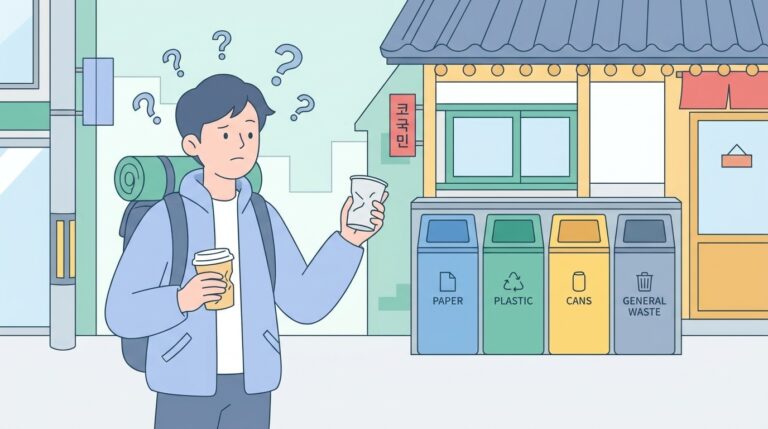
Picture this: You are walking down the vibrant streets of Myeongdong. You just finished eating a delicious, hot piece of street food—maybe a crispy Hotteok or a skewer of Tteokkochi. It was amazing! But now, you are holding a sticky paper cup and a wooden stick. You look left. You look right. You walk two more blocks.
Where on earth are all the trash cans?
If you have ever visited Korea or lived in a Korean apartment, you know that dealing with trash is practically an Olympic sport. From the mysterious disappearance of public garbage bins to the intense, almost spiritual practice of Bunlisugeo (recycling), throwing something away in Korea is never just ‘throwing it away.’ It is a cultural experience.
Trust me, as a tutor who has helped hundreds of expats settle in Seoul, I’ve seen students freeze in terror holding a plastic bottle, wondering if they need to peel off the label (Spoiler: You do).
This guide is born from real panic moments my beginner students have faced. Today, we’ll learn exactly what to say to survive the Korean Trash Game, completely stress-free!
Phase 2: Core Expressions Deep Dive
Let’s start with the absolute essentials for an A1 (Beginner) level.
1. 쓰레기통 어디 있어요? (Where is the trash can?)
- Pronunciation: [sseu-re-gi-tong eo-di i-sseo-yo?]
Sound-alike guide: ‘sseu’ sounds like a hissing ‘ss’ combined with ‘eu’ (the disgusted sound you make when you step in wet gum). ‘tong’ rhymes with pong.- Meaning: Literal: Trash can where is? / Real nuance: Please, for the love of God, where can I put this garbage?
- K-Culture Moment: You’ll use this in convenience stores after eating instant ramen, or asking a cafe barista where to leave your empty cup.
- Editor’s Insight: Koreans rarely say “Do you have a trash can?” They just ask where it is. Keep it simple and direct!
- Situation Spectrum:
- Friends (Casual): ✅ (Drop the ‘yo’ -> 쓰레기통 어디 있어?)
- Coworkers/Clerks (Semi-formal): ✅
- Boss/Elders (Formal): ⚠️ (Better to say: 쓰레기통이 어디에 있습니까?)
- 🤔 Think About It: In many Western countries, trash cans are on every corner. In Korea, you have to ask. How does your culture view public waste management compared to private responsibility?
2. 이거 버려주세요. (Please throw this away for me.)
- Pronunciation: [i-geo beo-ryeo-ju-se-yo.]
Sound-alike guide: ‘i-geo’ (ee-go) means ‘this’. ‘beo-ryeo’ sounds like ‘buh-ryo’.- Meaning: Literal: Throw this away for me / Real nuance: Can you take this trash off my hands?
- K-Culture Moment: You are checking out at a cafe, and you have an old receipt or an empty cup. You hand it to the cashier with a polite smile and say this.
- Editor’s Insight: The ending ‘~주세요’ (ju-se-yo) means ‘please do this for me’. It’s magic! It turns a command into a polite request.
- Situation Spectrum:
- Friends (Casual): ✅ (이거 버려줘)
- Coworkers/Clerks (Semi-formal): ✅
- Boss/Elders (Formal): 🚫 (Do not ask your boss to throw away your trash!)
- 🤔 Think About It: Korean is a highly action-oriented language. You don’t say “Can I leave this here?” you ask them directly to do the action for you politely.
3. 분리수거 해야 돼요? (Do I need to recycle this?)
- Pronunciation: [bul-li-su-geo hae-ya dwae-yo?]
Sound-alike guide: ‘bul-li’ (bull-lee). ‘su-geo’ (soo-guh).- Meaning: Literal: Do I have to do separate collection? / Real nuance: Do I need to separate the plastic, paper, and food?
- K-Culture Moment: You are at an Airbnb or a Sharehouse, eating late-night delivery fried chicken (Chimaek!). You ask your host this before cleaning up.
- Editor’s Insight: Bunlisugeo (분리수거) is the Holy Grail of Korean chores. Knowing this word alone will make Koreans instantly respect you.
- Situation Spectrum:
- Friends (Casual): ✅ (분리수거 해야 돼?)
- Coworkers/Clerks (Semi-formal): ✅
- Boss/Elders (Formal): ✅
- 🤔 Think About It: Why does Korea have such specific words for separating trash? It reflects a society living in high-density areas where collective rules are vital for survival.
Phase 3: Textbook vs. Real Korean
[Situation 1: Asking the cafe worker to toss your receipt]
* 📖 Textbook Korean: 이 영수증을 쓰레기통에 버려 주시겠습니까? (Would you please throw this receipt in the trash can?)
* 🗣️ Real Korean: 영수증 버려주세요. (Please throw away the receipt.)
* 💡 Why the difference?: Korean relies heavily on context. If you are holding the receipt out to them, you don’t need to say “in the trash can”—they know!
[Situation 2: Asking your roommate where to put a plastic bottle]
* 📖 Textbook Korean: 플라스틱은 어디에 버려야 합니까? (Where must one discard plastics?)
* 🗣️ Real Korean: 이거 어디(에) 버려요? (Where do I throw this? + pointing at the bottle)
* 💡 Why the difference?: Using “this” (이거) combined with body language is much more natural and efficient in everyday speech.
Phase 4: Cultural Context — K-Culture Deep Dive
4-1. Non-Verbal Elements: The Art of Nunchi at the Recycling Bin
When asking someone to throw something away for you (이거 버려주세요), never toss or slide it across the counter. Hand it to them using both hands (or your right hand supported by your left hand). This shows respect!
Also, use your Nunchi (social awareness). If the convenience store worker is extremely busy dealing with a long line, don’t ask them to throw away a massive bag of your personal trash. Take it with you!
4-2. K-Drama Tropes: Romance at the Garbage Station
If you watch a lot of K-Dramas (think My Liberation Notes or Reply 1988), you’ve probably noticed a recurring scene: The main character is wearing comfy sweatpants, hair in a messy bun, sorting their recycling late at night at the apartment complex’s designated garbage area. Suddenly, their crush or the handsome neighbor walks by!
Bunlisugeo (Recycling) is a universal shared experience in Korea. It shows characters in their most vulnerable, domestic state. But realistically? Taking out the trash is less about romance and more about making sure you didn’t accidentally put an eggshell in the food waste bag (which is illegal!).
Phase 5: Real-Life Roleplay Scenario
Setting: Friday night, 11:00 PM. You are staying at a cozy sharehouse in Hongdae. You and your Korean housemate just finished a glorious box of spicy delivery fried chicken (치킨). It’s time to clean up, but you are confused by the leftover bones, the cardboard box, and the pickled radish.
Characters:
– YOU: An absolute beginner in Korean, trying your best not to ruin the house rules.
– Minsu (28): Your friendly but slightly Type-A Korean housemate who strictly follows recycling laws.
Dialogue:
Minsu: 아~ 진짜 맛있다! 다 먹었어요? 😊
(A~ jinjja masitda! Da meogeosseoyo?)
[Ah~ that was really delicious! Did you eat it all?]
YOU: 네! 치킨 최고예요. 제가 정리할게요.
(Ne! Chikin choegoyeyo. Jega jeongnihalgeyo.)
[Yes! Chicken is the best. I will clean up.]
Minsu: 오, 고마워요!
(O, gomawoyo!)
[Oh, thank you!]
(🎭 Stage Direction: You grab the paper chicken box and start tossing the leftover chicken bones and the uneaten pickled radish into the same plastic bag.)
Minsu: 헉! 잠깐만요! 😱
(Heok! Jamkkanmanyo!)
[Gasp! Wait a minute!]
YOU: 네? 왜요?
(Ne? Waeyo?)
[Yes? Why?]
Minsu: 뼈는 음식물 쓰레기 아니에요! 일반 쓰레기예요.
(Ppyeoneun eumsingmul sseuregi anieyo! Ilban sseuregiyeyo.)
[Bones are not food waste! They are general waste.]
YOU: 아… 진짜요? 그럼 이거 어디 버려요?
(A… jinjjayo? Geureom igeo eodi beoryeoyo?)
[Ah… really? Then where do I throw this?]
🔀 YOUR TURN! Minsu looks worried. How should you ask for his help with the rest of the trash?
– A) “이거 버려주세요.” (Please throw this away for me.)
– B) “분리수거 어떻게 해요?” (How do I do the recycling?)
– C) “쓰레기통 어디 있어요?” (Where is the trash can?)✅ Best Choice: B — Reason: Asking “How do I do it?” shows you are willing to learn Korea’s specific rules.
⚠️ Choice A Analysis: Telling your housemate “throw this away for me” right after volunteering to clean up is a bit rude!
⚠️ Choice C Analysis: It’s okay, but just knowing where the bin is doesn’t solve the complex sorting problem you are facing.
(Assuming you chose B…)
Minsu: 박스는 종이, 무는 음식물, 뼈는 일반 쓰레기에요. 제가 도와줄게요!
(Bakseuneun jong-i, muneun eumsingmul, ppyeoneun ilban sseuregieyo. Jega dowajulgeyo!)
[The box is paper, the radish is food waste, the bones are general waste. I’ll help you!]
Phase 6: 10-Second Shadowing Drill
Let’s practice! Speak out loud with the right feeling. Pay attention to the pauses (/).
🥺 Politely asking for help:
죄송한데요, / 쓰레기통 / 어디 있어요?
(joe-song-han-de-yo, / sseu-re-gi-tong / eo-di i-sseo-yo?)
Excuse me, where is the trash can?😤 Proudly stating you will clean:
제가 / 분리수거 / 할게요!
(je-ga / bul-li-su-geo / hal-ge-yo!)
I will do the recycling!
Phase 7: K-Culture Mini Dictionary
Here are the must-know words for surviving the Korean trash system:
| Korean | Romanization | English | Cultural Context |
|---|---|---|---|
| 일반 쓰레기 | ilban sseuregi | General Waste | Anything that CANNOT be recycled or eaten by animals (e.g., bones, dirty tissues). |
| 음식물 쓰레기 | eumsingmul sseuregi | Food Waste | Leftover food. Rule of thumb: If an animal can eat it, it’s food waste. |
| 분리수거 | bul-li-su-geo | Recycling | The act of separating paper, plastic, vinyl, and cans. Mandatory in Korea! |
| 종량제 봉투 | jong-nyang-je bong-tu | Standardized Trash Bag | You CANNOT use normal plastic bags for trash. You must buy these specific government-mandated bags at convenience stores. |
| 눈치 | nunchi | Social awareness | Reading the room. e.g., Noticing how your neighbors separate their plastic bottles and copying them. |
Phase 8: Traveler’s Survival Kit
If you are traveling in Korea, you won’t deal with house chores much, but you WILL have garbage in your hands while wandering around Seoul.
🆘 Survival Phrases for Travelers
– 🇰🇷 “이거 버려주세요.” (i-geo beo-ryeo-ju-se-yo.) -> Please throw this away.
– 📍 Where to use: Handing an empty coffee cup back to the barista before you leave the cafe.
– 🇰🇷 “봉투 주세요.” (bong-tu ju-se-yo.) -> Please give me a bag.
– 📍 Where to use: At a convenience store when you buy things (since they don’t give bags automatically).📌 Editor’s Travel Note: The Missing Public Trash Cans
Why are there no trash cans on the streets of Seoul? In 1995, Korea implemented a strict policy where citizens had to pay for their household garbage bags. To avoid paying, people started dumping their house trash into public street bins! The government’s solution? Remove the public bins.
Pro Tip: If you buy a drink from a convenience store, drink it there and throw it away in their bins. Or, take your trash back to your hotel.
Phase 9: Critical Thinking Corner — “A Step Deeper”
🧠 Think Deeper: Food & Identity (The “Food Waste” Strictness)
Korea is globally famous for its incredible food, side dishes (banchan), and communal dining culture. But there is a flip side to a culture that loves abundant food: enormous amounts of food waste. Because South Korea is geographically small and densely populated, throwing all garbage into massive landfills isn’t sustainable. That’s why Korea processes over 95% of its food waste into animal feed or fertilizer! The strict rules about what is “general waste” (like onion skins or chicken bones) versus “food waste” reflect a society desperately trying to balance its love for massive feasts with environmental survival.
💬 Your Turn: Does your country have a strict recycling or compost system? Or do you put everything in one bin? Share your experience in the comments!
Phase 10: FAQ & Avoiding Mistakes
Q: If I buy something at a street food market, where do I throw the skewers?
A: Great question! Hand the empty skewers back to the stall owner you bought it from. They usually have a specific box or bag for them.
Q: Can I use any plastic bag I get from the supermarket for general trash at my Airbnb?
A: NO! ❌ This is a crucial mistake. You must use the specific Jongnyangje (종량제) bags. If your host didn’t provide them, you have to buy them at a local convenience store, specifying your district (e.g., “Mapo-gu trash bags, please”).
❌ Common Mistake #1: Throwing chicken bones, eggshells, or onion skins into the Food Waste bin.
✅ How to fix it: Animals can’t digest bones or eggshells, so they go into General Waste (일반 쓰레기)!
Phase 11: Summary & Action Items
✨ One-Liner Summary: Remember “쓰레기통 어디 있어요?” (Where is the trash can) to survive the streets, and never mess with the Bunlisugeo (Recycling) rules at home!
🎯 Action Mission 3 Steps:
– 🥉 Bronze (Solo): Look at the trash bin in your room right now and say “쓰레기통!” out loud 3 times.
– 🥈 Silver (Online): Look up “Korean convenience store trash cans” on Google Images to see how they separate the holes for liquid, plastic, and general waste.
– 🥇 Gold (Real Life): Next time you finish a drink at a Korean cafe, point to your cup and ask the staff “이거 버려주세요” with a warm smile.
🌟 K-Culture Mission:
Next time you watch a K-Drama, look closely at the background when characters are walking home at night. You will definitely spot piles of transparent bags filled with crushed plastic bottles and folded cardboard boxes. That’s Bunlisugeo in action!
Did you find this guide helpful? Have you ever had a funny or confusing moment with trash in Korea? Tell us below!
Phase 12: Quiz — Interactive Challenge
1. Situational Judgment: You are checking out of your hotel. You have an empty plastic water bottle. You approach the front desk. What is the most natural thing to say to the staff?
– A) 쓰레기통 어디 있어요? (Where is the trash can?)
– B) 플라스틱을 어디에 버려야 합니까? (Where must I discard plastic?)
– C) 이거 버려주세요. (Please throw this away for me.)
2. True or False — K-Culture Edition:
– In Korea, it is perfectly fine to throw chicken bones into the Food Waste (음식물 쓰레기) bag.
3. Fill in the Blank:
You want to show respect and ask “Where is the trash can?”
“___________ 어디 있어요?”
(Answers: 1. C is most natural if handing it directly, or A if you want to throw it yourself! B is way too robotic. / 2. False! Bones are General Waste. / 3. 쓰레기통)
Frequently Asked Questions (FAQ)
Q: What does "쓰레기통 어디 있어요? (Where is the trash can?)" mean in Korean and how do you pronounce it?
A: In Korean, "쓰레기통 어디 있어요? (Where is the trash can?)" is pronounced [sseu-re-gi-tong eo-di i-sseo-yo?] and means: Literal: Trash can where is? / Real nuance: Please, for the love of God, where can I put this garbage?
Q: What does "이거 버려주세요. (Please throw this away for me.)" mean in Korean and how do you pronounce it?
A: In Korean, "이거 버려주세요. (Please throw this away for me.)" is pronounced [i-geo beo-ryeo-ju-se-yo.] and means: Literal: Throw this away for me / Real nuance: Can you take this trash off my hands?
Q: What does "분리수거 해야 돼요? (Do I need to recycle this?)" mean in Korean and how do you pronounce it?
A: In Korean, "분리수거 해야 돼요? (Do I need to recycle this?)" is pronounced [bul-li-su-geo hae-ya dwae-yo?] and means: Literal: Do I have to do separate collection? / Real nuance: Do I need to separate the plastic, paper, and food?