

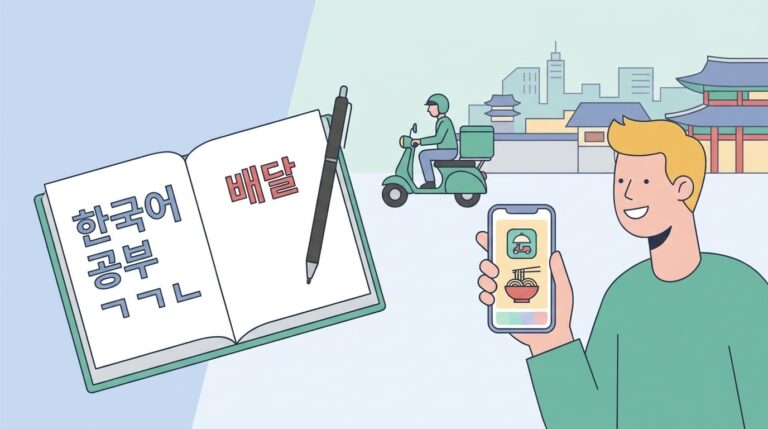
Phase 1: Empathy (The K-Drama Delivery Panic)
Hello! This is your Daily Hangul Editor.
Picture this: You’re in your cozy Seoul Airbnb. You’ve watched 200 episodes of K-Dramas, so you know exactly what to do at 11 PM on a Friday. You order crispy Korean fried chicken and a cold beer (Chimaek!). Your mouth is watering.
Suddenly, your phone rings. The caller ID says “Rider” (Delivery driver).
Your heart stops. Oh no. They can’t find my place. What do I say? Do I speak English? Do I just hang up and pray?
Don’t worry! I’ve seen countless beginner students freeze when the delivery driver calls to confirm the address. Today, I’m going to teach you the absolute basics of confirming your address and giving simple delivery instructions so you can get your food without the panic sweat.
This guide is based on real SOS messages I’ve received from my A1 students. Let’s make sure your Chimaek arrives perfectly!
Phase 2: Core Expressions Deep Dive
Here are the 3 magical phrases you need when the delivery driver calls or when you write instructions in the app.
1. 여기 [장소]예요. (I am at [Place].)
- Pronunciation: yeo-gi [jang-so]-ye-yo.
(Tip: ‘yeo-gi’ sounds like “yo, gee!” – it means “here”.)- Meaning: Literal: Here is [Place]. / Real nuance: “This is [Place] / I am currently at [Place].”
- K-Culture Moment: You’ll hear this in K-Dramas when the main character gets lost or calls a taxi/friend. “Where are you?” “Yeogi Hongdae-yeyo!” (I’m here at Hongdae!).
- Editor’s Insight: For A1 beginners, reading a full Korean street address is super hard. The easiest hack? Just say the name of your hotel, your apartment building, or a famous landmark nearby!
- Situation Spectrum:
- Casual (Friends): ✅ (Drop the ‘yo’ -> yeogi [jangso]-ya)
- Semi-formal (Delivery Riders, Taxi): ✅
- Formal (Bosses): ⚠️ (Use ‘yeogineun [jangso]imnida’)
- 🤔 Think About It: Why do Koreans just say “Here is…” instead of “I am at…”? In Korean, the subject “I” is almost always dropped if the context is obvious. It’s all about efficiency!
2. 문 앞에 놓아주세요. (Please leave it at the door.)
- Pronunciation: mun a-pe no-a-ju-se-yo.
(Tip: ‘mun’ sounds like ‘moon’. ‘ju-se-yo’ is the magic word for “please give/do”.)- Meaning: Literal: Door front-at put-please. / Real nuance: “Please leave the food in front of my door.”
- K-Culture Moment: Since 2020, “No-Contact Delivery” (비대면 배달) has become the absolute standard in Korea. Almost everyone selects this option on apps like Baedal Minjok or Yogiyo so they don’t have to interact in person.
- Editor’s Insight: This phrase is your best friend if you are too shy to meet the driver. Just say this, and wait for the quiet ding-dong!
- Situation Spectrum:
- App delivery request box: ✅
- Speaking to rider on the phone: ✅
- 🤔 Think About It: In many countries, leaving a package outside the door means it might get stolen. Why is this so common in Korea?
3. 비밀번호는 [번호]예요. (The password is [Number].)
- Pronunciation: bi-mil-beon-ho-neun [beon-ho]-ye-yo.
(Tip: ‘bi-mil’ means secret. ‘beon-ho’ means number. Secret number!)- Meaning: Literal: Secret number is [Number]. / Real nuance: “The entrance passcode is [Number].”
- K-Culture Moment: Almost every building in Korea—from luxury apartments to small villas—has a shared first-floor entrance (공동현관) with a digital keypad. If you don’t provide this, the rider will definitely call you!
- Editor’s Insight: You can just read the numbers one by one in Sino-Korean numbers (il, i, sam, sa…). If it’s too hard to say, you can text it to them through the app!
- Situation Spectrum:
- Giving instructions to delivery/friends: ✅
Phase 3: Textbook vs Real Korean
Let’s see how real people actually talk when confirming an address.
[Situation 1: Telling them where you are]
* 📖 Textbook Korean: 저는 서울특별시 강남구 역삼동 123-4번지에 있습니다. (I am located at 123-4 Yeoksam-dong, Gangnam-gu, Seoul.)
* 🗣️ Real Korean: 여기 역삼역 3번 출구 쪽 신라스테이 호텔이에요. (I’m here at the Shilla Stay Hotel near Yeoksam Station Exit 3.)
* 💡 Why the difference?: Drivers navigate by landmarks and building names, not just abstract numbers. Giving a major landmark is much more helpful and efficient!
[Situation 2: How to receive the food]
* 📖 Textbook Korean: 음식을 가져오시면 저에게 직접 전달해 주시길 바랍니다. (When you bring the food, I hope you hand it to me directly.)
* 🗣️ Real Korean: 문 앞에 두고 벨 눌러주세요! (Leave it at the door and ring the bell, please!)
* 💡 Why the difference?: The Ppal-i Ppal-i (Hurry, hurry) culture! Riders want to drop it off and run to their next order. Direct hand-offs take too much time.
Bottom Note: As an A1 learner, don’t worry about memorizing your exact 30-syllable Korean street address to speak out loud. Focus on memorizing your building name or room number (호 – ho).
Phase 4: Cultural Context — K-Culture Deep Dive
4-1. Non-Verbal Tips: The Power of “Photo Texts”
If you can’t explain your address in Korean, don’t panic! Korea has a massive text-messaging culture. If the rider calls and you can’t speak, you can text them a screenshot of your map or a photo of the building entrance.
4-2. K-Food Connection: The Delivery App Ecosystem
Ordering delivery (Baedal) is practically a national sport in Korea. Apps like Baemin (배달의민족) or Yogiyo (요기요) are designed for ultimate convenience.
Have you noticed how in K-Dramas, friends gather at the Han River and order Jajangmyeon (black bean noodles) or Pizza, and it arrives right at their picnic spot? That’s because Korean addresses are incredibly precise, and delivery drivers know every alleyway. But for tourists, the biggest hurdle is the 공동현관 (Main Entrance Door). Remember, the rider needs to get inside your building to leave it at your door!
Phase 5: Real-Life Roleplay Scenario
Let’s put you in the hot seat.
- Setting: Friday, 10:30 PM. You are in a cute Airbnb in Hongdae. You ordered spicy Tteokbokki on an app.
- Characters:
- YOU: A hungry traveler with A1 Korean skills.
- Rider (NPC): A fast-speaking delivery driver who is currently outside a building, slightly confused.
(Your phone rings. You take a deep breath and answer.)
YOU: 여보세요?
(yeo-bo-se-yo?)
[Hello?]
Rider: 아, 배달인데요. 여기 주소가 101동 맞으세요? 건물이 안 보여서요.
(a, bae-dal-in-de-yo. yeogi ju-so-ga baeg-il-dong ma-jeu-se-yo? geon-mul-i an bo-yeo-seo-yo.)
[Ah, this is delivery. Is the address building 101? I can’t see the building.]
(🎭 Stage Direction: You hear traffic and a scooter engine revving in the background.)
YOU: 아, 잠시만요. 여기 홍대역 근처 블루 게스트하우스예요.
(a, jam-si-man-yo. yeogi hong-dae-yeok geun-cheo beul-lu ge-seu-teu-ha-u-seu-ye-yo.)
[Ah, one moment. Here is ‘Blue Guesthouse’ near Hongdae station.]
Rider: 아! 블루 게스트하우스요? 네, 찾았습니다. 어떻게 해드릴까요?
(a! beul-lu ge-seu-teu-ha-u-seu-yo? ne, cha-jat-seum-ni-da. eo-tteo-ke hae-deu-ril-kka-yo?)
[Ah! Blue Guesthouse? Yes, I found it. How should I handle the food?]
🔀 Your Turn! How do you reply?
– A) “제가 갈게요!” (I will go!)
– B) “문 앞에 놓아주세요.” (Please leave it at the door.)
– C) “아니요, 괜찮아요.” (No, it’s okay.)✅ Best Choice: B — This is the safest, most common response. They will leave it and text you a photo!
⚠️ Choice C Analysis: Saying “it’s okay” here is confusing. He is asking what to do with the food, not offering a favor.
YOU: 문 앞에 놓아주세요.
(mun a-pe no-a-ju-se-yo.)
[Please leave it at the door.]
Rider: 1층 공동현관 비밀번호가 어떻게 되죠?
(il-cheung gong-dong-hyeon-gwan bi-mil-beon-ho-ga eo-tteo-ke doe-jyo?)
[What is the 1st-floor main entrance password?]
YOU: 비밀번호는 일-이-삼-사 예요.
(bi-mil-beon-ho-neun il-i-sam-sa-ye-yo.)
[The password is 1-2-3-4.]
Rider: 네, 알겠습니다. 맛있게 드세요!
(ne, al-get-seum-ni-da. ma-sit-ge deu-se-yo!)
[Yes, understood. Enjoy your meal!]
Phase 6: 10-Second Shadowing Drill
Practice this out loud so your tongue remembers it when the phone rings!
😊 여기 / [호텔 이름] / 이에요!
(yeo-gi / [Hotel Name] / i-e-yo!)
🥺 비밀번호는 / 일-이-삼-사 / 예요.
(bi-mil-beon-ho-neun / il-i-sam-sa / ye-yo.)
🙏 문 앞에 / 놓아주세요.
(mun a-pe / no-a-ju-se-yo.)
(Tone: Polite and slightly hurried, just like a local!)
Phase 7: K-Culture Mini Dictionary
| Korean | Romanization | English | Context |
|---|---|---|---|
| 배달 | bae-dal | Delivery | The word for delivery. Often combined: Baedal-app, Baedal-food. |
| 라이더 | ra-i-deo | Rider | What Koreans call food delivery drivers (usually on scooters). |
| 공동현관 | gong-dong-hyeon-gwan | Shared Entrance | The main entrance of an apartment/building that requires a passcode. |
| 리뷰 이벤트 | ri-byu i-ben-teu | Review Event | If you promise to leave a 5-star review, restaurants send free cheese balls or cola! |
| 1층 | il-cheung | 1st Floor | Ground floor. (Remember: Korea counts the ground floor as the 1st floor!) |
Phase 8: Traveler’s Survival Kit
If you are visiting Korea, addressing can be confusing. Keep these survival tips handy!
🆘 Survival Phrase #1: Using your phone
– 🇰🇷 “여기 주소예요.” (yeo-gi ju-so-ye-yo.)
– 🗣️ Meaning: “Here is the address.”
– 📍 Where to use: In a taxi, showing your phone to the driver.
– 💡 Pro Tip: Don’t try to pronounce long Korean street names. Just pull up KakaoMap or Naver Map, point to the screen, and say this phrase!📌 Editor’s Travel Note: Tipping?
– No Tip Culture: You do NOT tip delivery drivers in Korea! The delivery fee (배달비 – baedal-bi) is already included in your app payment. Giving cash at the door will confuse them.
– Address Direction: In English, we write “Room 101, Blue Bldg, Hongdae-street, Seoul”. In Korean, it’s backwards! Big to small: “Seoul, Hongdae-street, Blue Bldg, Room 101”.
Phase 9: Critical Thinking Corner — “A Step Deeper”
Food & Identity: The Trust of “Leave it at the door”
In many Western countries, leaving hot food or Amazon packages in a public hallway for hours might result in theft. However, in Korea, high-rise apartments have packages piled up in front of doors all day long. This “No-Contact Delivery” culture isn’t just about the Ppal-i Ppal-i (speed) mindset; it is deeply rooted in Korea’s unique high-trust society regarding personal belongings (just like leaving your laptop on a cafe table!). The phrase “문 앞에 놓아주세요” (Leave it at the door) is a symbol of modern Korean urban trust.
💬 Your Turn: Do people leave delivery packages at the door in your country? How would you feel leaving your dinner in the hallway? Share in the comments!
Phase 10: FAQ & Mistake Prevention
Q: If I see the delivery driver, what should I say?
A: Keep it simple! Just bow your head slightly and say “감사합니다” (gam-sa-ham-ni-da – Thank you) or “수고하세요” (su-go-ha-se-yo – Keep up the good work!).
Q: Can I text the driver in English?
A: Mostly no. Some riders use translation apps, but it’s best to copy-paste Korean phrases like 문 앞에 놓아주세요 into the delivery app’s request box.
❌ Common Mistake #1: Reading an address backwards.
If you translate your English address directly and say “Room 201, Seoul…” the driver will be very confused. Always start with the City -> District -> Building name.❌ Common Mistake #2: Forgetting the building’s entrance code.
If you order food to an Airbnb, you must write down the first-floor entrance code in the delivery notes. Otherwise, your food will be trapped outside the building!
Phase 11: Summary & Action Items
- One-Liner Summary: To avoid delivery panic, remember your building name and simply say “문 앞에 놓아주세요” (Leave it at the door).
-
Action Mission:
- 🥉 Bronze: Say “문 앞에 놓아주세요” out loud 3 times right now.
- 🥈 Silver: Look up the name of your dream hotel in Korea and say “여기 [Hotel name] 이에요!”
- 🥇 Gold (K-Culture Mission): Download Naver Map or KakaoMap. Find a random restaurant in Seoul and look at how the Korean address is written from Big to Small!
Did you ever have a funny food delivery fail in your country or in Korea? Tell me below! 👇
Phase 12: Quiz — Interactive Challenge
1. The delivery rider calls and asks where you are. You are at Namsan Tower. What is the most natural A1 response?
– A) 저는 대한민국 서울특별시 용산구 남산공원길에 있습니다.
– B) 여기 남산타워예요.
– C) 남산타워 문 앞에 놓아주세요.
2. True or False: You should always prepare a $2~3 cash tip for the Korean delivery driver.
– True / False
3. Fill in the blank:
The 1st-floor entrance is locked! You need to tell the driver the password.
“_______________ 일-이-삼-사 예요!”
– A) 라이더는
– B) 배달은
– C) 비밀번호는
🚨 Click here for the answers!
1. B (Saying “Here is Namsan Tower” is natural and easy! A is too robotic, C means “leave it at the door of Namsan Tower” which makes no sense.)
2. False (There is absolutely no tipping culture in Korea!)
3. C (비밀번호 means password.)
Frequently Asked Questions (FAQ)
Q: What does "여기 [장소]예요. (I am at [Place].)" mean in Korean and how do you pronounce it?
A: In Korean, "여기 [장소]예요. (I am at [Place].)" is pronounced [yeo-gi [jang-so] and means: Literal: Here is [Place]. / Real nuance: "This is [Place] / I am currently at [Place]."
Q: What does "문 앞에 놓아주세요. (Please leave it at the door.)" mean in Korean and how do you pronounce it?
A: In Korean, "문 앞에 놓아주세요. (Please leave it at the door.)" is pronounced [mun a-pe no-a-ju-se-yo.] and means: Literal: Door front-at put-please. / Real nuance: "Please leave the food in front of my door."
Q: What does "비밀번호는 [번호]예요. (The password is [Number].)" mean in Korean and how do you pronounce it?
A: In Korean, "비밀번호는 [번호]예요. (The password is [Number].)" is pronounced [bi-mil-beon-ho-neun [beon-ho] and means: Literal: Secret number is [Number]. / Real nuance: "The entrance passcode is [Number]."







