

Phase 1: Empathy (Immersive Opening)
Hello! I’m the Lead Editor of Daily Hangul.
Imagine this: You are watching a K-Drama. The main characters are walking down a beautifully lit street. Suddenly, small white flakes start falling from the sky. The male lead stops, looks at the female lead, and says something incredibly romantic. The subtitle simply says, “It’s the first snow.”
But if you’re a K-Drama veteran, you know that first snow (첫눈) in Korea is never just weather. It’s a cultural phenomenon. It means romance, confessions, and magic!
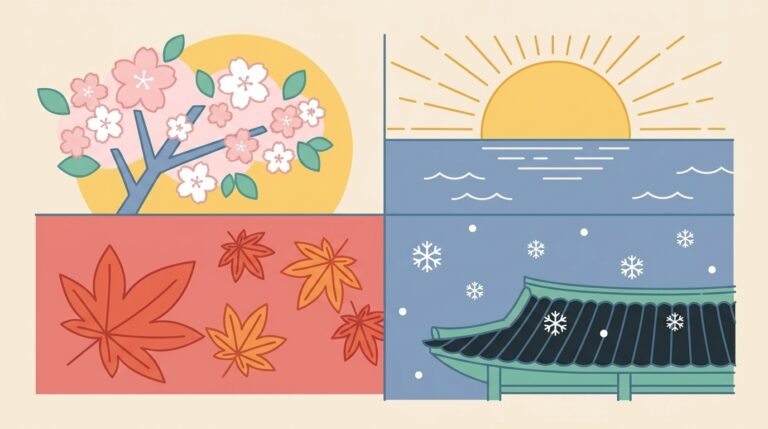
In Korea, the four seasons are distinct, and they dictate everything from what we eat (cold noodles in summer, hot stews in winter) to what we listen to (BTS’s “Spring Day” charting every spring!). That’s why asking “What is your favorite season?” is one of the most common, safe, and engaging icebreakers you can use in Korea.
Whether you’re trying to make small talk with your Korean language partner, a barista in Seoul, or just want to understand your favorite idol’s live stream better, this guide is for you. Let’s learn how to sound like a natural!
Phase 2: Deep Dive into Core Expressions
1. 어느 계절을 좋아해요?
- Pronunciation: Eoneu gyejeoreul joahaeyo? [uh-neu gyeh-juhl-eul jo-ah-hae-yo?]
(Tip: The ‘eo’ in 어느 sounds like the ‘uh’ in ‘uh-oh’, and the ‘eu’ sounds like the sound you make when you see something gross, ‘eugh’.)- Meaning: Which season do you like?
- K-Culture Moment: You are at a fan meeting, and there’s a 3-second silence between you and your bias. You need a quick, polite question. This is the perfect icebreaker!
- Editor’s Insight: The word ‘어느’ (which) is super useful. You can use it to ask about anything from seasons to movies to food. It’s polite, friendly, and shows you’re interested in the other person’s preferences.
- Situation Spectrum:
- Casual (Friends): ✅ (Say: 어느 계절 좋아해? – Drop the ‘요’)
- Semi-formal (Coworkers): ✅
- Formal (Boss/Elders): ⚠️ (Better to say: 어느 계절을 가장 좋아하십니까?)
- 🤔 Think About It: In many cultures, asking about the weather is just filler talk. In Korea, asking about someone’s favorite season is often a gentle way to understand their personality. Does your culture have a similar “personality-revealing” small talk question?
2. 저는 [봄/여름/가을/겨울]을 좋아해요.
- Pronunciation: Jeoneun [bom/yeoreum/gaeul/gyeoul]-eul joahaeyo.
(Tip: 봄 = bom (rhymes with dome), 여름 = yuh-reum, 가을 = gah-eul, 겨울 = gyuh-ool)- Meaning: I like [Spring/Summer/Autumn/Winter].
- K-Culture Moment: Whenever a K-Pop idol introduces themselves on a radio show, they might share a TMI (Too Much Information) of the day: “I like winter because I love wearing cozy sweaters!”
- Editor’s Insight: ‘좋아해요’ is your best friend as an A1 beginner. It means “I like.” Just pop the season right in front of it.
- Situation Spectrum:
- Casual (Friends): ✅ (Say: 나는 [계절] 좋아해)
- Semi-formal (Coworkers): ✅
- Formal (Boss/Elders): ✅
- 🤔 Think About It: Notice how the verb ‘좋아해요’ comes at the very end of the sentence? Korean is an SOV (Subject-Object-Verb) language. You have to listen until the very end of a Korean sentence to know exactly what the person is feeling!
3. 날씨가 진짜 좋네요!
- Pronunciation: Nalssiga jinjja jonneyo! [nal-ssi-gah jeen-jja jon-neh-yo!]
- Meaning: The weather is really nice! (Literal: Weather really good is!)
- K-Culture Moment: Sitting by the Han River with a picnic mat, eating fried chicken. Everyone looks at the sky and sighs happily, saying this exact phrase.
- Editor’s Insight: The ending ‘~네요’ (-neyo) adds a feeling of mild surprise or personal realization. It’s like saying, “Wow, the weather is nice, isn’t it?” It invites the other person to agree with you.
- Situation Spectrum:
- Casual (Friends): ✅
- Semi-formal (Coworkers): ✅
- Formal (Boss/Elders): ✅
- 🤔 Think About It: Why do Koreans love emphasizing “realness” with words like 진짜 (really) or 너무 (too much)? It shows emotional investment in the conversation!
Phase 3: Textbook vs. Real Korean
[Asking “What is your favorite season?”]
* 📖 Textbook Korean: 당신이 가장 좋아하는 계절은 무엇입니까? (What is the season that you like the most?)
* 🗣️ Real Korean: 무슨 계절 제일 좋아해요? (What season do you like the most?)
* 💡 Why the difference?: Koreans rarely use “당신” (you) in real life. It sounds like a translated textbook or a heated argument in a drama! We usually drop the subject “you” completely.
[Saying “I really like Autumn”]
* 📖 Textbook Korean: 저는 가을을 매우 좋아합니다. (I like Autumn very much.)
* 🗣️ Real Korean: 전 가을 진짜 좋아해요! (I really like Autumn!)
* 💡 Why the difference?: In spoken Korean, “저는” is often shortened to “전”. And “매우” (very) is almost entirely replaced by “진짜” (really) or “완전” (totally) in everyday conversation.
Phase 4: Cultural Context — K-Culture Deep Dive
4-1. Non-verbal Element: The “Weather Nod”
When talking about the weather or seasons in Korea, it’s very natural to look around, look at the sky, or gently nod as if you are “feeling” the air. If someone says, “날씨가 진짜 좋네요” (The weather is really nice), you shouldn’t just stare into their eyes. Look up at the sky, smile, and say “네, 맞아요” (Yes, that’s right). It shows shared empathy—a core part of Nunchi (reading the room).
4-2. The K-Drama Tropes of Seasons
If you watch K-Dramas, you already know Korean seasons!
– Spring (봄): Cherry blossoms falling in slow motion. This means a new, innocent romance is beginning (think Crash Landing on You or Goblin).
– Summer (여름): Sudden rain showers (장마). The male lead suddenly appears with an umbrella, or they both run under a single jacket.
– Autumn (가을): Trench coats, fallen yellow ginkgo leaves, and a slightly melancholic mood. Often signifies a breakup or deep longing.
– Winter (겨울): The ultimate romantic season. Confessing your love on the day of the first snow (첫눈) guarantees your love will come true!
Critical Point: While K-Dramas make Korean winter look incredibly romantic, the reality is that the Siberian winds are freezing! Real Koreans survive winter by wrapping themselves in black “Long Paddings” (롱패딩) from head to toe. It looks less like a romantic drama and more like a colony of marching penguins!
Phase 5: Real-Life Roleplay Scenario
Setting: It’s a crisp, sunny October afternoon. You are sitting at a trendy rooftop cafe in Seongsu-dong (the Brooklyn of Seoul) with your Korean language exchange partner, Minji. The autumn breeze is perfect.
Characters:
– YOU: A beginner Korean learner, visiting Seoul for the first time in Autumn.
– Minji (28): Your friendly Korean language partner who loves coffee and chatting.
Dialogue:
Minji: 와, 오늘 날씨가 진짜 좋네요! 🍂
(Wa, oneul nalssiga jinjja jonneyo!)
[Wow, the weather is really nice today!]
(🎭 Stage Direction: Minji takes a sip of her iced Americano and looks happily at the sky)
YOU: 네, 너무 좋아요.
(Ne, neomu joayo.)
[Yes, it’s so good.]
Minji: OO씨(Your name)는 어느 계절을 제일 좋아해요?
(OO-ssineun eoneu gyejeoreul jeil joahaeyo?)
[Which season do you like the most?]
🔀 Your Turn! How should you answer?
– A) 당신은요? (What about you?)
– B) 저는 가을을 좋아해요. (I like Autumn.)
– C) 여름. (Summer.)✅ Best Choice: B — It’s polite, uses the exact grammar we learned, and keeps the conversation flowing smoothly. After saying this, you can ask, “민지 씨는요?” (What about you, Minji?).
⚠️ Choice A Analysis: Using “당신” is a big no-no! It sounds confrontational.
⚠️ Choice C Analysis: Just saying “여름” is 반말 (informal/casual language). Since Minji is using “요”, you should reply politely!
YOU (Choosing B): 저는 가을을 좋아해요. 민지 씨는요?
(Jeoneun gaeureul joahaeyo. Minji ssineunyo?)
[I like Autumn. What about you, Minji?]
Minji: 아, 저는 겨울을 좋아해요. 눈을 좋아하거든요!
(A, jeoneun gyeoureul joahaeyo. Nuneul joahageodeunyo!)
[Ah, I like winter. Because I like snow!]
Phase 6: 10-Second Shadowing Drill
Speak out loud! Follow the pauses (/) and the emotions.
😊 밝게 (Brightly)
저는 / 봄을 / 정말 좋아해요!
(Jeo-neun / bom-eul / jeong-mal jo-a-hae-yo!)
🥺 애교 섞어서 (Slightly cute/pleading)
여름은 / 너무 / 더워요.mu / deo-wo-yo.)
(Yeo-reum-eun / neo
😌 편안하게 (Relaxed)
날씨가 / 진짜 / 좋네요.
(Nal-ssi-ga / jin-jja / jon-ne-yo.)
Phase 7: K-Culture Mini Dictionary
| Korean | Romanization | English | Cultural Context |
|---|---|---|---|
| 첫눈 | cheotnun | First snow | Culturally significant. A day to confess love, listen to specific songs, or eat fried chicken and beer. |
| 벚꽃 | beotkkot | Cherry blossom | The symbol of Korean Spring. Couples flock to Yeouido Park or Seokchon Lake for dates. |
| 장마 | jangma | Monsoon season | Usually late June to July. Koreans love eating crispy Pajeon (scallion pancakes) and Makgeolli on rainy days! |
| 롱패딩 | rongpaeding | Long padded jacket | The unofficial winter uniform of South Korea. Everyone wears these black sleeping-bag-like coats to survive the freezing wind. |
Phase 8: Traveler Survival Kit
Seasons affect how you travel! Here are the absolute must-know phrases when dealing with Korean weather in shops, cafes, or taxis.
🆘 Survival Expression #1: Hot vs. Iced
– 🇰🇷 “따뜻한 거 주세요.” (Ttatteuthan geo juseyo.) / “아이스로 주세요.” (Aiseuro juseyo.)
– 🗣️ Pronunciation: [tta-tteut-han guh ju-seh-yo] / [ah-ee-seu-ro ju-seh-yo]
– 📍 Where to use: Cafes!
– 💡 Pro Tip: Koreans famously love “Ah-Ah” (Iced Americano) even in freezing winter! This is jokingly called “얼죽아” (Eol-juk-a: Even if I freeze to death, Iced Americano). Which team are you on?🆘 Survival Expression #2: Adjusting the AC/Heater
– 🇰🇷 “너무 추워요 / 더워요.” (Neomu chuwoyo / deowoyo.)
– 🗣️ Pronunciation: [nuh-moo choo-wuh-yo / duh-wuh-yo]
– 📍 Where to use: Taxis, restaurants, or indoor spaces.
– 💡 Pro Tip: If you say this while shivering or fanning yourself, the taxi driver or restaurant owner will immediately adjust the temperature for you.
Phase 9: Critical Thinking Corner — “A Step Deeper”
Media vs Reality: The K-Drama Illusion
When you watch a K-Drama, Korean winters look like a magical wonderland filled with stylish wool coats and gentle snowfalls. Spring looks like an endless canopy of pink cherry blossoms. However, living in Korea brings a different reality! Spring often brings “Yellow Dust” (황사) and poor air quality, requiring masks. Winter is piercingly cold due to Siberian winds, forcing everyone to abandon fashion for the practical “Long Padding.”
🧠 Think Deeper:
Media everywhere romanticizes reality. Does your country have a season that looks beautiful in movies but is actually quite tough to live through in real life?💬 Your Turn: How is the weather represented in your culture’s movies compared to reality? Tell us in the comments!
Phase 10: FAQ & Mistake Prevention
Q: Can I drop the particles (‘은/는/이/가’) when talking?
Yes! In spoken Korean, especially casually, “저는 여름을 좋아해요” easily becomes “저 여름 좋아해요.” It sounds very natural and local.
Q: Is it okay to say “봄이 좋아해요”?
No. This is a very common mistake! ‘좋아하다’ (to like) requires an object particle (을/를).
– ❌ 봄이 좋아해요. (X)
– ✅ 봄을 좋아해요. (O)
❌ Common Mistake #1: Translating “You” as “당신” (Dangsin)
Using “당신” to mean “you” is the quickest way to make a Korean feel uncomfortable. It is only used between older married couples, in poetic songs, or when you want to start a street fight!
✅ Do this instead: Drop the subject entirely (e.g., “어느 계절 좋아해요?”) or use their name + 씨 (e.g., “민지 씨는요?”).
Phase 11: Summary & Action Items
One-Liner Summary: To talk about your favorite season, simply say “저는 [Season]을 좋아해요!”
Action Mission:
– 🥉 Bronze (Solo): Look out your window right now and say “날씨가 진짜 좋네요!” (or “너무 안 좋네요” if it’s raining) 3 times.
– 🥈 Silver (Online): Go to your favorite K-Pop idol’s Instagram or YouTube video and leave a comment: “OO오빠/언니, 무슨 계절 제일 좋아해요?” (What season do you like the most?)
– 🥇 Gold (Real Life): Next time you order coffee at a Korean cafe or meet a Korean friend, ask them about their favorite season!
🎵 Special K-Culture Mission:
Search for the song “Spring Day” (봄날) by BTS. Listen to the lyrics and try to catch the word “봄” (Spring) and “겨울” (Winter). (Hint: The song starts with comparing missing someone to a cold winter!)
Phase 12: Quiz — Interactive Challenge
1. Situational Judgment:
You meet your Korean boss in the elevator in December. It is freezing outside. What is the most natural thing to say?
– A) 당신은 겨울 좋아합니까?
– B) 날씨가 진짜 춥네요!
– C) 저는 여름을 좋아해요.
2. Fill in the Blank:
A: 어느 계절( ) 좋아해요?
B: 저는 가을( ) 좋아해요.
3. True or False – K-Culture Edition:
In Korea, eating cold noodles (Naengmyeon) is only done in the summer. (T/F)
(Answers below – no peeking!)
Click to reveal answers
1. B – Commenting on the cold weather (“날씨가 진짜 춥네요!”) is the perfect, safe elevator small talk with a boss. (A uses the forbidden word ‘당신’!).
2. 을, 을 – “어느 계절을 좋아해요? 저는 가을을 좋아해요.”
3. False! While historically popular in summer, “Iced Noodles” (Naengmyeon) was actually traditionally eaten in the winter while sitting on a heated floor (Ondol)! Nowadays, Koreans eat it year-round, especially after Korean BBQ.
Frequently Asked Questions (FAQ)
Q: What does "어느 계절을 좋아해요?" mean in Korean and how do you pronounce it?
A: In Korean, "어느 계절을 좋아해요?" is pronounced [Eoneu gyejeoreul joahaeyo? [uh-neu gyeh-juhl-eul jo-ah-hae-yo?] and means: Which season do you like?
Q: What does "저는 [봄/여름/가을/겨울]을 좋아해요." mean in Korean and how do you pronounce it?
A: In Korean, "저는 [봄/여름/가을/겨울]을 좋아해요." is pronounced [Jeoneun [bom/yeoreum/gaeul/gyeoul] and means: I like [Spring/Summer/Autumn/Winter].
Q: What does "날씨가 진짜 좋네요!" mean in Korean and how do you pronounce it?
A: In Korean, "날씨가 진짜 좋네요!" is pronounced [Nalssiga jinjja jonneyo! [nal-ssi-gah jeen-jja jon-neh-yo!] and means: The weather is really nice! (Literal: Weather really good is!)







