

Master the Korean Laundromat: Don’t Shrink Your Favorite Shirt!
Phase 1: Empathy (Welcome to the K-Drama Laundromat)
안녕하세요! I am the Lead Editor of Daily Hangul, your veteran tutor and local culture navigator.
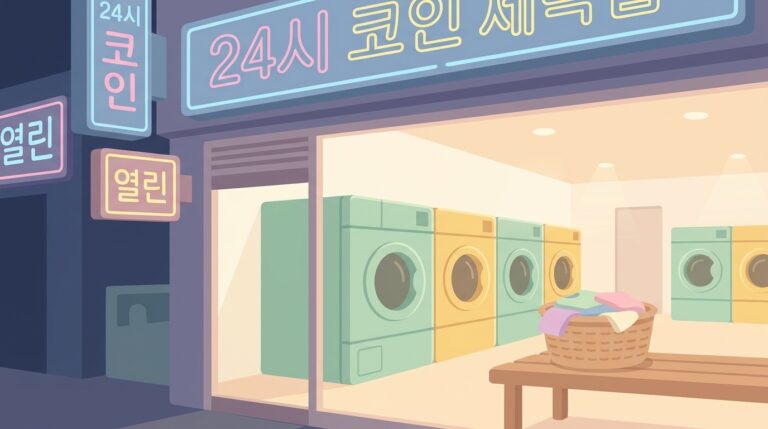
Picture this: It’s 11 PM in Seoul. A buzzing neon sign reads ’24시 코인 빨래방’ (24-Hour Coin Laundromat). You walk in, and it feels just like a scene from your favorite K-Drama—cozy lighting, the hum of machines, maybe someone sipping banana milk in the corner. It’s perfectly aesthetic.
But then, reality hits. You stand in front of a massive machine. There are 15 different buttons, all in Hangul. 표준? 섬세? 헹굼? You stare at your favorite BTS concert hoodie, terrified you might accidentally select a boiling hot cycle and shrink it to doll-size.
Don’t panic! I’ve seen countless students bring me photos of laundromat panels, asking for help. Today, we are going to decode those buttons together. By the end of this guide, you won’t just wash your clothes safely—you’ll navigate the space like a true Seoulite.
Phase 2: Deep Dive into Core Expressions
Let’s look at the top 3 expressions you need when choosing your laundry cycle.
1. 표준 코스로 할게요.
- Pronunciation: pyojun koseuro halgeyo / [pyo-joon ko-su-ro hal-ge-yo]
- Meaning: I will use the standard cycle. (Literal: By standard course I will do.)
- K-Culture Moment: You’re at the dry cleaner (세탁소) or talking to a helpful local at the coin wash. ‘표준’ (Standard) is your safe word. It’s the default setting that washes your everyday cotton shirts and jeans safely.
- Editor’s Insight: The word ‘코스’ (course/cycle) is Konglish! We use it for laundry cycles, set menus at restaurants, and even travel routes. ‘-로 할게요’ is the magic A2 grammar pattern meaning ‘I will go with [Noun]’.
- Situation Spectrum:
- Friends (Casual): ✅ (표준 코스로 할게)
- Strangers/Staff (Semi-formal): ✅ (표준 코스로 할게요)
- Boss/Elders (Formal): ⚠️ (Use -하겠습니다 if it’s a very formal setting, but rare for laundry!)
- 🤔 Think About It: Why does Korean use the word ‘Course’ for laundry? It reflects a modern, systematic approach to daily tasks. Does your language borrow English words for home appliances?
2. 이거 울 코스로 돌려도 돼요?
- Pronunciation: igeo ul koseuro dollyeodo dwaeyo? / [ee-go ool ko-su-ro dol-lyeo-do dwae-yo?]
- Meaning: Can I run this on the wool cycle?
- K-Culture Moment: You bought a gorgeous knitted sweater from an underground shopping mall in Gangnam. You want to ask the laundromat owner if it’s safe to machine-wash.
- Editor’s Insight: Here’s a crucial local slang—Koreans don’t usually say ‘wash the machine’ (세탁기를 작동하다). We say ‘돌리다’ (to spin/run). “세탁기 돌려요” literally means “I spin the washing machine.”
- Situation Spectrum:
- Friends (Casual): ✅ (울 코스로 돌려도 돼?)
- Strangers/Staff (Semi-formal): ✅ (울 코스로 돌려도 돼요?)
- Boss/Elders (Formal): 🚫
- 🤔 Think About It: ‘-아/어도 돼요?’ is the polite way of asking for permission. Notice how Koreans often ask for confirmation even when reading instructions, valuing collective reassurance!
3. 건조기는 중온으로 할게요.
- Pronunciation: geonjogineun jung-oneuro halgeyo / [geon-jo-gi-neun joong-on-eu-ro hal-ge-yo]
- Meaning: I’ll set the dryer to medium heat.
- K-Culture Moment: In Korea, hanging laundry on a drying rack (건조대) in the living room is a deeply rooted culture. But coin laundromats changed the game with massive dryers (건조기). You have High (고온), Medium (중온), and Low (저온) heat.
- Editor’s Insight: ‘온’ (on) means temperature (like in 온수 – hot water). ‘중’ (jung) means middle. If you don’t want your clothes to shrink, always go for ‘중온’ (medium) or ‘저온’ (low)!
- Situation Spectrum:
- Friends (Casual): ✅
- Strangers/Staff (Semi-formal): ✅
- Boss/Elders (Formal): ⚠️
- 🤔 Think About It: Many Korean appliances still use Hanja (Chinese characters) for settings like 고, 중, 저 (High, Mid, Low). It saves space on buttons!
Phase 3: Textbook vs. Real Korean
Let’s see how language changes from the classroom to the Hongdae laundromat.
[Starting the Wash]
* 📖 Textbook: 세탁기를 작동시키세요. (Please operate the washing machine.)
* 🗣️ Real Korean: 세탁기 돌리세요. (Spin the washing machine.)
* 💡 Why different?: ‘돌리다’ (to spin) focuses on the visual action of the drum spinning, making the language much more visual and efficient.
[Choosing the Cycle]
* 📖 Textbook: 어떤 세탁 코스를 선택하시겠습니까? (Which washing course will you select?)
* 🗣️ Real Korean: 뭐로 할래요? / 무슨 코스 쓸 거예요? (What will you go with? / What cycle will you use?)
* 💡 Why different?: Koreans love efficiency. We drop formal verbs like ‘선택하다’ (to select) and just use the all-purpose verb ‘하다’ (to do).
Phase 4: Cultural Context — K-Culture Deep Dive
4-1. The ‘Nunchi’ of the Laundromat
Laundromats in Korea are public yet intimate spaces. Nunchi (눈치) is crucial here. If someone’s laundry is done but they aren’t there, you shouldn’t just toss their clothes out immediately. Usually, laundromats provide a plastic basket. The polite ‘nunchi’ move is to wait 5-10 minutes, then carefully place their clean clothes in the basket so you can use the machine.
4-2. The 1인 가구 (Single-Person Household) Sanctuary
If you watch K-Dramas featuring young professionals or college students (like Because This Is My First Life), you’ll notice the coin laundromat is a recurring set. Why? Because over 30% of households in Korea are single-person (1인 가구). Many live in small one-room apartments (원룸) where large washing machines or dryers don’t fit. The laundromat is a modern communal well—a place to do chores, grab a coffee from the vending machine, and maybe meet a neighbor.
Phase 5: Real-Life Roleplay Scenario
Setting: Saturday morning, 10 AM. A sunny, aesthetic coin laundromat in Yeonnam-dong. You’ve successfully loaded your clothes, but you are staring blankly at the touch screen. A friendly local waiting for her laundry notices your hesitation.
Characters:
– YOU: An international student trying not to ruin your favorite clothes.
– Ji-eun (28): A local resident, sipping an iced Americano.
Dialogue:
YOU: 저기요… 혹시 이거 어떻게 하는지 아세요?
(jeogiyo… hoksi igeo eotteoke haneunji aseyo?)
[Excuse me… do you happen to know how to do this?]
(🎭 Stage Direction: You point at the screen with a slightly panicked smile)
Ji-eun: 아, 네! 어떤 옷이에요?
(a, ne! eotteon osieyo?)
[Ah, yes! What kind of clothes are they?]
YOU: 그냥 티셔츠랑 청바지예요.
(geunyang tisyeocheurang cheongbajiyeyo.)
[Just t-shirts and jeans.]
Ji-eun: 그럼 그냥 표준 코스 하시면 돼요.
(geureom geunyang pyojun koseu hasimyeon dwaeyo.)
[Then you can just do the standard cycle.]
YOU: 아, 표준 코스요. 물 온도는요?
(a, pyojun koseuyo. mul ondoneunyo?)
[Ah, standard cycle. What about the water temperature?]
Ji-eun: 보통 온수로 많이 해요. 때가 잘 빠지거든요.
(botong onsuro mani haeyo. ttaega jal ppajigeodeunyo.)
[Usually, people do warm water. It removes dirt well.]
YOU: 그렇군요! 건조기도 써야 되는데…
(geureokunyo! geonjogido sseoya doeneunde…)
[I see! I need to use the dryer too…]
Ji-eun: 청바지 있으니까 중온으로 돌리세요. 고온은 옷이 줄어들 수 있어요.
(cheongbaji isseunikka jung-oneuro dolliseyo. go-oneun osi jureodeul su isseoyo.)
[Since you have jeans, run it on medium heat. High heat can shrink clothes.]
🔀 Your Turn! How should you respond to thank her?
– A) “수고하세요!” (Keep up the good work!)
– B) “정말 감사합니다! 덕분에 살았어요.” (Thank you so much! You saved me.)
– C) “사랑해요!” (I love you!)✅ Best Choice: B — It shows sincere gratitude with a natural, slightly dramatic Korean flair (“You saved my life”).
⚠️ Choice A Analysis: “수고하세요” is only for workers/staff. Ji-eun is just a customer!
YOU: 정말 감사합니다! 덕분에 살았어요.
(jeongmal gamsahamnida! deokbune sarasseoyo.)
[Thank you so much! You saved me.]
Ji-eun: 아니에요~ 빨래 잘 하세요!
(anieyo~ ppallae jal haseyo!)
[No worries~ Have a good wash!]
Phase 6: 10-Second Shadowing Drill
Time to practice your speaking! Pay attention to the pauses (/) and the emotion tags.
- 🥺 살짝 곤란한 표정으로 (Slightly troubled):
저기요 / 이거 / 표준 코스로 / 어떻게 해요?
(jeogiyo / igeo / pyojun koseuro / eotteoke haeyo?) -
😊 밝게 (Brightly):
건조기는 / 중온으로 / 할게요!
(geonjogineun / jung-oneuro / halgeyo!) -
🧐 궁금한 표정으로 (Curiously):
이거 / 울 코스로 / 돌려도 돼요?
(igeo / ul koseuro / dollyeodo dwaeyo?)
Phase 7: K-Culture Mini Dictionary
| 한국어 (Korean) | Romanization | English | Context |
|---|---|---|---|
| 코인 세탁소 | koin setakso | Coin Laundromat | The common term for 24-hour self-service laundromats. |
| 1인 가구 | irin gagu | 1-person household | A major demographic in Korea, driving the coin laundry business. |
| 뽀송뽀송하다 | pposongpposonghada | Soft and dry | An adorable onomatopoeic word used to describe perfectly dried, warm laundry! |
| 섬유유연제 | seomyuyuyeonje | Fabric softener | Koreans take their laundry scents very seriously. Downy is super popular. |
Phase 8: Traveler Survival Kit
If you’re traveling in Korea and need to do laundry midway through your trip, keep these handy!
🆘 Survival Phrases TOP 3
– 🇰🇷 “동전 교환기 어디 있어요?” (dongjeon gyohwangi eodi isseoyo?)
– 🗣️ English: Where is the coin exchange machine?
– 📍 Use when: You only have a 10,000 won bill but need 500 won coins.
- 🇰🇷 “세제가 안 나와요.” (sejaega an nawayo.)
- 🗣️ English: The detergent isn’t coming out.
- 📍 Use when: The auto-dispenser seems broken.
🇰🇷 “이거 세탁기 돌려도 돼요?” (igeo setakgi dollyeodo dwaeyo?)
- 🗣️ English: Can I put this in the washing machine?
- 📍 Use when: Checking with a dry cleaner or friend if a clothing item is machine-wash safe.
📌 Editor’s Travel Note
– Cash vs. Card: While Korea is a card-centric society, many older coin laundromats still require 500-won coins. However, modern ones use a kiosk where you can tap your credit card or use KakaoPay!
– Detergent: Good news! In 90% of Korean coin laundromats, detergent and fabric softener are injected automatically during the cycle. You usually don’t need to buy them separately.
Phase 9: Critical Thinking — “One Step Deeper”
Language & Power: The Hidden Politeness in Asking
Notice how in the roleplay, the learner asks, “이거 울 코스로 돌려도 돼요?” (Can I run this on the wool cycle? – Is it okay if I do?). In Korean, asking for help or checking information is often framed around seeking permission or validation (‘-아/어도 되다’), rather than direct demands. It’s not a sign of weakness; it’s a social lubricant. It respects the other person’s expertise and space.
💬 Your Turn:
In your culture, do people talk to strangers at the laundromat? Is it considered a social space or a place where everyone ignores each other? Let me know in the comments!
Phase 10: FAQ & Avoiding Misunderstandings
Q: “Can I leave my laundry and go to a cafe?”
Yes! It’s very common. Korea is incredibly safe, and no one will steal your laundry. BUT, you must return before your cycle ends. If you leave your finished laundry sitting in a machine while others are waiting, it’s considered very bad manners.
Q: “What if I accidentally press the wrong cycle?”
Coin laundry machines in Korea lock the door and cannot be easily canceled once the water starts. Double-check before you hit the ‘시작’ (Start) button!
❌ Common Mistake #1: Confusing 세탁 (Wash) and 건조 (Dry).
✅ How to fix: Remember, 세탁 ends with a sharp ‘k’ sound, like ‘clean’. 건조 sounds like ‘dry zone’. Always check if you are looking at the Washer (세탁기) or Dryer (건조기) panel!
Phase 11: Summary & Action Items
One-Liner Summary: To wash safely in Korea, remember: 표준 (Standard) for washing, and 중온 (Medium heat) for drying!
Action Mission:
– 🥉 Bronze (Solo): Read the 3 core expressions out loud 3 times right now.
– 🥈 Silver (Online): Check the tag on the shirt you’re wearing and write in the comments which cycle it needs (e.g., “제 셔츠는 표준 코스예요!”).
– 🥇 Gold (Field): Next time you pass by a Korean laundromat, walk in, look at the panel, and try to find the words 표준, 울, and 중온!
K-Culture Mission:
Go watch an episode of the K-Drama Do Do Sol Sol La La Sol or Because This Is My First Life and spot the coin laundromat scene. Notice how the characters interact in that space!
Phase 12: Quiz — Interactive Challenge
1. Situational Judgment:
You are washing your expensive wool sweater. What should you press?
– A) 고온 건조 (High-heat dry)
– B) 표준 코스 (Standard wash)
– C) 울/섬세 코스 (Wool/Delicate wash)
(Answer: C. Never use A or B for wool!)
2. Fill in the Blank:
Koreans don’t say “operate the washing machine.” They say “세탁기를 _____” (Spin the washing machine).
(Answer: 돌려요 / doll-yeo-yo)
3. True or False – K-Culture Edition:
In Korean coin laundromats, you must always bring your own liquid detergent from home.
(Answer: False. Most modern machines inject it automatically!)
Good luck with your laundry, and stay 뽀송뽀송 (soft and dry)! See you in the next lesson. 😊
Frequently Asked Questions (FAQ)
Q: What does "표준 코스로 할게요." mean in Korean and how do you pronounce it?
A: In Korean, "표준 코스로 할게요." is pronounced [pyojun koseuro halgeyo / [pyo-joon ko-su-ro hal-ge-yo] and means: I will use the standard cycle. (Literal: By standard course I will do.)
Q: What does "이거 울 코스로 돌려도 돼요?" mean in Korean and how do you pronounce it?
A: In Korean, "이거 울 코스로 돌려도 돼요?" is pronounced [igeo ul koseuro dollyeodo dwaeyo? / [ee-go ool ko-su-ro dol-lyeo-do dwae-yo?] and means: Can I run this on the wool cycle?
Q: What does "건조기는 중온으로 할게요." mean in Korean and how do you pronounce it?
A: In Korean, "건조기는 중온으로 할게요." is pronounced [geonjogineun jung-oneuro halgeyo / [geon-jo-gi-neun joong-on-eu-ro hal-ge-yo] and means: I'll set the dryer to medium heat.







