

Phase 1: Empathy (The Immerse Cold Open)
Hello! I’m the Lead Editor at Daily Hangul.
Have you ever noticed that almost every K-Drama featuring a chaebol (wealthy heir) has a mandatory scene of them aggressively swimming freestyle in an empty, dimly lit luxury pool? From Boys Over Flowers to True Beauty, the pool is where our protagonists go to brood. But what happens when you step out of the drama and into a real Korean public swimming pool?
Suddenly, you are faced with strict lane hierarchies, mandatory swimming caps, and a tight-knit community of ajummas who can swim the butterfly stroke faster than an Olympic athlete. If you are an upper-intermediate (C1) learner living in or visiting Korea, simply knowing the word “수영” (swimming) isn’t enough. You need to navigate the nuances of the strokes, the slang of the pool, and the unwritten social rules.
Knowing this vocabulary won’t just keep you afloat; it will give you the ultimate ‘insider’ status when joining a local gym, hanging out at a Gapyeong pool villa with your Korean colleagues, or surviving the summer at the Han River pools.
Note: This guide is built from the real-life struggles (and minor embarrassments) of foreign expats trying to navigate Korea’s intense swimming class culture!
Phase 2: Core Expressions Deep Dive
1. 자유형 (Freestyle) vs 개헤엄 (Doggy Paddle)
- Pronunciation: [Ja-yu-hyeong] (sounds like ‘ja-you’ + the ‘hyoung’ in young) / [Gae-he-eom]
- Meaning: Literal: Free style / Dog swim. Real nuance: Freestyle vs. The survival paddle.
- K-Culture Moment: If you go to a company retreat (워크숍) at a pool villa, people will inevitably race. If you boast that you can do jayuhyeong, they expect sleek K-Drama lap swimming. If you start doing gaeheeom (keeping your head above water like a dog), your coworkers will burst into laughter and tease you affectionately.
- Editor’s Insight: While ‘자유형’ is the technical term you use when signing up for classes, ‘개헤엄’ is the self-deprecating slang you use when you want to lower expectations about your swimming skills.
- Situation Spectrum:
- 친구 사이(Casual): ✅ (Both)
- 직장 동료(Semi-formal): ✅ (Both, use 개헤엄 to break the ice)
- 직장 상사·어른(Formal): ⚠️ (Stick to 자유형 in formal settings)
- 🤔 Think About It: Koreans love self-deprecation to build rapport. Why does claiming you can only do ‘개헤엄’ make you more approachable in a Korean social setting than boasting about your Olympic-level freestyle?
2. 접영 (Butterfly Stroke)
- Pronunciation: [Jeob-yeong] (sounds like ‘job-young’)
- Meaning: Butterfly stroke.
- K-Culture Moment: In a local public pool (구민체육센터), the lanes are strictly divided: Beginner, Intermediate, Advanced, and Master (연수반). The Master lane is dominated by locals who have been swimming together for 10 years. Doing jeobyeong gracefully is considered the ultimate ‘flex’ and the unofficial requirement to be respected by the pool regulars.
- Editor’s Insight: The word itself is formal, but the cultural weight it carries is massive. It’s the “final boss” of Korean swimming classes.
- Situation Spectrum:
- 친구 사이(Casual): ✅
- 직장 동료(Semi-formal): ✅
- 직장 상사·어른(Formal): ✅
- 🤔 Think About It: Why do Korean public pools have such strict, visible ranking systems (from absolute beginner to master) even for a leisure activity? How does this reflect the societal emphasis on constant self-improvement (자기계발)?
3. 맥주병 (Beer Bottle) / 물개 (Seal)
- Pronunciation: [Maek-ju-byeong] (sounds like ‘mac-ju’ + ‘byong’) / [Mul-gae]
- Meaning: Literal: Beer bottle / Seal. Real nuance: Someone who sinks like a rock vs. An excellent swimmer.
- K-Culture Moment: On a summer trip to Yangyang (Korea’s surfing capital), if a friend asks if you want to go deep into the water, you can wave your hands defensively and say, “저 완전 맥주병이에요!” (I’m a total beer bottle!). Conversely, if you swim effortlessly, you’ll be praised as “완전 물개다!” (You’re totally a seal!).
- Editor’s Insight: These are the most crucial idiomatic expressions for water sports. Native speakers rarely say “저는 수영을 매우 잘합니다” (I swim very well)—it sounds like a textbook. They say they are a mulgae.
- Situation Spectrum:
- 친구 사이(Casual): ✅
- 직장 동료(Semi-formal): ✅
- 직장 상사·어른(Formal): 🚫 (Too slangy for a formal interview, but okay at a company retreat)
Phase 3: Textbook vs. Real Korean
[Explaining your swimming skill level]
* 📖 Textbook Korean: 저는 수영을 못 합니다. (I cannot swim.)
* 🗣️ Real Korean: 저 완전 맥주병이에요. 물에 뜨지도 못해요. (I’m a total beer bottle. I can’t even float.)
* 💡 Why the difference?: Koreans use vivid metaphors (맥주병) to make conversations more colorful, self-effacing, and empathetic.
[Asking what stroke someone is doing]
* 📖 Textbook Korean: 당신은 평영을 합니까? (Do you do breaststroke?)
* 🗣️ Real Korean: 평영 할 줄 아세요? / 오, 평영(개구리헤엄) 치시네요! (Do you know how to do breaststroke? / Oh, you’re doing the frog swim!)
* 💡 Why the difference?: Asking directly with ‘당신’ is unnatural and aggressive. Using the honorific ‘-시-‘ with the verb ‘치다’ (to strike/do) or ‘할 줄 알다’ (know how to) is the native way.
Phase 4: Cultural Context — K-Culture Deep Dive
4-1. Non-verbal Context & Nunchi at the Pool
In Korea, swimming pools are governed by intense Nunchi (눈치 – the ability to read the room).
* Mandatory Showering: If you enter a Korean public pool without washing with soap in the facility’s showers first, the veteran regulars will scold you. You cannot just come in your swimsuit from home.
* The Swim Cap Rule: Indoor pools require strict adherence to wearing a swim cap (수모). Even if you are bald, no cap means no entry.
* Pacing in the Lane: If someone touches your toes from behind while swimming 자유형, Nunchi dictates you must pause at the end of the lane and let them pass.
4-2. K-Travel & K-Food Connection: The Han River Parks
During summer, the Hangang (Han River) Outdoor Pools open up. Here, you’ll see a mix of serious lap swimmers doing 배영 (backstroke) and teenagers doing 개구리헤엄 (frog swim). But the most important part of Korean water sports? The post-swim food. After swimming, it is practically a national law to eat cup noodles (컵라면) by the water. The phrase “수영 후 라면은 국룰이죠” (Ramen after swimming is a national rule) is something every insider knows.
Phase 5: Real-Life Roleplay Scenario
Scenario A: The Company Retreat (워크숍)
Setting: A luxury pool villa in Gapyeong. It’s Friday afternoon. The team has just finished a barbecue, and people are jumping into the pool. You are standing by the edge with your coworker, Minsu.
Characters:
* YOU: An expat working at a Korean tech company.
* 민수 (Minsu, 32): Your friendly, slightly overly enthusiastic Korean coworker.
민수: OO씨, 물에 안 들어와요? 빨리 들어와요! 🏊♂️
(OO-ssi, mul-e an deureowayo? Ppal-li deureowayo!)
[OO, aren’t you coming in the water? Come in quickly!]
(🎭 Stage Direction: Minsu is treading water and splashing towards you)
YOU: 아, 저는 수영을 잘 못해서요. 여기서 구경할게요.
(Ah, jeo-neun suyeong-eul jal mothaeseoyo. Yeogiseo gugyeonghalgeyo.)
[Ah, I’m not good at swimming. I’ll just watch from here.]
민수: 에이~ 자유형 못 해요? 그냥 들어와서 개헤엄이라도 쳐요!
(Ei~ jayuhyeong mot haeyo? Geunyang deureowaseo gaeheeom-irado chyeoyo!)
[Hey~ you can’t do freestyle? Just come in and do the doggy paddle at least!]
🔀 Your Turn! How do you respond?
* A) “저는 평영을 할 수 있습니다.” (I can do breaststroke.)
* B) “저 완전 맥주병이라서 물에 들어가면 큰일 나요!” (I’m a total beer bottle, so if I go in the water, it’ll be a disaster!)
* C) “물개처럼 수영할 테니까 비키세요!” (I’m going to swim like a seal, so get out of the way!)✅ Best Choice: B — It uses high-level cultural slang (맥주병), shows humility, and perfectly fits the casual banter of a team retreat.
⚠️ Choice C Analysis: Hilarious, but highly risky unless you are extremely close with Minsu and actually can swim like an Olympian.
Scenario B: Bonus — The Public Pool Reception
Setting: Registering for classes at the local neighborhood pool (구민체육센터).
Staff: 처음 오셨어요? 어느 반으로 등록해 드릴까요?
(Cheoeum osyeosseoyo? Eoneu ban-euro deungnokhae deurilkkayo?)
[Is this your first time? Which class should I register you for?]
YOU: 자유형이랑 배영은 할 줄 아는데, 평영을 배우고 싶어요. 중급반 맞나요?
(Jayuhyeong-irang baeyeong-eun hal jul aneunde, pyeongyeong-eul baeugo sipeoyo. Junggeup-ban mannayo?)
[I know how to do freestyle and backstroke, but I want to learn breaststroke. Is that the intermediate class?]
Phase 6: 10-Second Shadowing Drill
Practice your intonation and pacing! Read aloud following the emotional tags and pauses.
- 🥺 Self-deprecatingly: 저 완전 / 맥주병이라서 / 개헤엄밖에 / 못 쳐요~
(jeo wanjeon / maekjubyeong-iraseo / gaeheeom-bakke / mot chyeyo~)
“I’m a total beer bottle, so I can only do the doggy paddle~” - 😤 Impressively: 우리 부장님은 / 접영을 / 진짜 / 물개처럼 하셔!
(uri bujangnim-eun / jeobyeong-eul / jinjja / mulgae-cheoreom hasyeo!)
“Our department head does the butterfly stroke exactly like a seal!”
Phase 7: K-Culture Mini Dictionary
| 한국어 | Romanization | English | Cultural Context |
|---|---|---|---|
| 수영장 텃세 | suyeongjang teotse | Pool territoriality | The phenomenon where long-time regulars at public pools act bossy toward newcomers. |
| 수모 | sumo | Swim cap | Absolutely mandatory in Korean indoor pools. No cap, no swim. |
| 연수반 | yeonsuban | Master class | The highest level lane in a Korean pool. Expect intense butterfly stroke drills here. |
| 래쉬가드 | raeshwigadeu | Rash guard | Extremely popular swimwear in Korea for sun protection and modesty, even indoors. |
Phase 8: Traveler Survival Kit
Visiting a pool, water park like Caribbean Bay, or surfing in Yangyang? Save these cards!
🆘 Survival Phrase #1: Navigating the Lanes
* 🇰🇷 “초급 레인이 어디예요?” (chogeup rein-i eodiyeyo?)
* 🗣️ Meaning: Where is the beginner lane?
* 📍 Use: Indoor public pools.🆘 Survival Phrase #2: Renting Gear
* 🇰🇷 “수모 하나 대여할 수 있나요?” (sumo hana daeyeohal su innayo?)
* 🗣️ Meaning: Can I rent a swim cap?
* 📍 Use: Hotel pools or public pools when you forgot yours.🆘 Survival Phrase #3: Avoiding Collisions
* 🇰🇷 “먼저 가세요.” (meonjeo gaseyo.)
* 🗣️ Meaning: Please go ahead.
* 📍 Use: When someone touches your toes from behind in a swimming lane. Let them pass!📌 Editor’s Travel Note
* Dress Code: Unlike Western countries, Koreans heavily prefer wearing Rash guards (long-sleeved swim shirts) at water parks and beaches to prevent tanning and maintain modesty. However, in indoor fitness pools, standard one-piece swimsuits and speedos/jammers are the norm.
Phase 9: Critical Thinking Corner — “한 발 더 깊이”
🧠 Think Deeper: Language & Power — The Hierarchy of the Pool
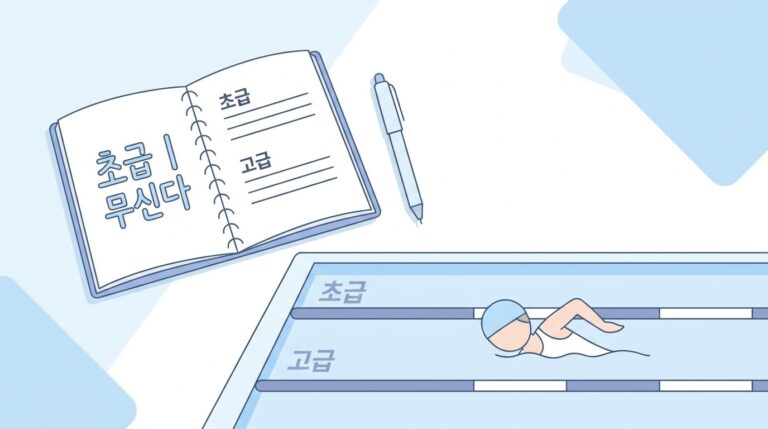
In Korean public swimming pools, lanes are strictly labeled: 초급 (Beginner), 중급 (Intermediate), 고급 (Advanced), and 연수 (Master). This isn’t just about safety; it’s a micro-reflection of Korean society’s deep-rooted hierarchical system and its obsession with upward mobility. Moving from the freestyle-only lane to the butterfly (접영) lane represents a tangible elevation in social status within that local community. The veterans in the Master lane often command respect and unofficially enforce the pool rules, showing how hierarchy naturally forms based on seniority and skill in Korean culture.
💬 Your Turn: Does your culture strictly separate leisure activities by skill level, or is it more of a “free-for-all”? Share in the comments!
Phase 10: FAQ & Common Mistakes
- Q: Can I wear a bikini to an indoor lap pool in Seoul?
- A: No. While totally fine for a hotel pool or a beach in Jeju, wearing a two-piece bikini to a local 구민체육센터 (public gym pool) will attract intense staring and a scolding from the lifeguards. Stick to athletic one-pieces.
- Q: I have a tattoo. Can I go swimming?
- A: Maybe. At hotel pools or the Han River, it’s generally fine. However, conservative public gym pools or saunas might ask you to cover them with a rash guard or waterproof tape, as tattoos can still carry a stigma among older generations.
❌ Common Mistake #1: Jumping into the pool dry.
✅ Do this instead: In Korea, you must take a full shower with soap and wash your hair in the locker room showers before putting your swimsuit on and entering the pool deck.
Phase 11: Summary & Action Items
- One-Liner Summary: From struggling like a maekjubyeong (beer bottle) to mastering jeobyeong (butterfly), swimming in Korea is all about understanding the lane hierarchy and cultural etiquette!
-
Action Mission:
- 🥉 Bronze: Stand in front of a mirror and declare “저 완전 맥주병이에요!” 3 times with a dramatic, self-deprecating sigh.
- 🥈 Silver: Write a post in a Korean learning community asking members what their favorite swimming stroke (자유형, 평영, 배영, 접영) is in Korean.
- 🥇 Gold: Next time you go to a pool or beach with Korean friends, use the word 물개 or 맥주병 to describe someone’s swimming skills!
- 🏊♂️ K-Culture Mission: Watch an episode of a K-Drama (like Weightlifting Fairy Kim Bok-joo) and spot the differences in Korean pool culture compared to your home country.
Phase 12: Quiz — Interactive Challenge
1. Situational Judgment: You are at a local Korean pool swimming 자유형 (freestyle). Someone taps your foot from behind. What should you do?
* A) Swim faster to prove you are a 물개.
* B) Stop at the end of the lane and say “먼저 가세요” (Please go ahead).
* C) Tell the lifeguard they are bothering you.
(Answer: B. It’s standard pool Nunchi to let the faster swimmer pass.)
2. Fill in the Blank:
“물에 뜨지도 못해요. 저 완전 ( )이에요.”
(Answer: 맥주병 – maekjubyeong)
3. True or False: K-Culture Edition
“You can wear your street clothes over your swimsuit, take them off at the poolside, and jump straight into the water at a Korean public pool.”
(Answer: FALSE. You must shower with soap in the locker room before entering the pool deck.)
Frequently Asked Questions (FAQ)
Q: What does "자유형 (Freestyle) vs 개헤엄 (Doggy Paddle)" mean in Korean and how do you pronounce it?
A: In Korean, "자유형 (Freestyle) vs 개헤엄 (Doggy Paddle)" is pronounced [Ja-yu-hyeong] and means: Literal: Free style / Dog swim. Real nuance: Freestyle vs. The survival paddle.
Q: What does "접영 (Butterfly Stroke)" mean in Korean and how do you pronounce it?
A: In Korean, "접영 (Butterfly Stroke)" is pronounced [Jeob-yeong] and means: Butterfly stroke.
Q: What does "맥주병 (Beer Bottle) / 물개 (Seal)" mean in Korean and how do you pronounce it?
A: In Korean, "맥주병 (Beer Bottle) / 물개 (Seal)" is pronounced [Maek-ju-byeong] and means: Literal: Beer bottle / Seal. Real nuance: Someone who sinks like a rock vs. An excellent swimmer.






