

Phase 1: Empathy (Immersive Opening)
Hello there! I’m your Daily Hangul editor.
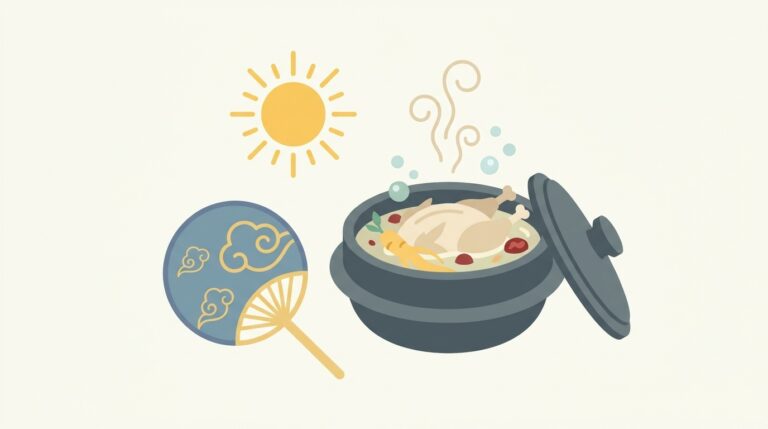
Picture this: It’s mid-July in Seoul. The humidity is sitting at a suffocating 90%, the cicadas are screaming at the top of their lungs, and you’re sweating just from blinking. You look across the street, seeking refuge in a cool, air-conditioned cafe. But instead, your eyes catch something inexplicable. Outside a traditional Korean restaurant, a line of locals wraps around the block. And what are they waiting for in this 35°C (95°F) heat? A boiling, bubbling stone pot of chicken soup.
Welcome to Boknal (복날), the peak of the Korean summer.
If you’ve ever watched a K-Drama where characters sit around a boiling pot, sweat dripping down their faces, yelling “Ah, siwonhada!” (Ah, how refreshing!), you might have thought the subtitles were broken. How can boiling soup be refreshing? Today, we are going to dive deep into the cultural phenomenon of Chobok (초복), Jungbok (중복), and Malbok (말복) – the three hottest days of the year – and the survival language you need to endure the Korean summer like a true local. I’ve seen countless students stare in horror at a bowl of Samgyetang (ginseng chicken soup) in July. By the end of this post, you won’t just understand it; you’ll be craving it.
Phase 2: Core Expressions Deep Dive
1. 이열치열 (Fighting Fire with Fire)
- Pronunciation: [I-yeol-chi-yeol] (Sounds like: ee-yuhl-chee-yuhl)
- Meaning: (Literal) Controlling heat with heat. (Real nuance) Fighting fire with fire; overcoming the summer heat by eating hot, sweat-inducing foods.
- K-Culture Moment: You’re at a company lunch. Your boss orders the spiciest, most boiling stew on the menu while wiping sweat with a towel, proudly proclaiming, “Iyeolchiyeol!”
- Editor’s Insight: This isn’t just a phrase; it’s a philosophy. It has a slightly dramatic, traditional vibe, but young people use it humorously too when doing intense workouts in the heat or eating spicy food.
- Situation Spectrum:
- Friends (Casual): ✅
- Coworkers (Semi-formal): ✅
- Boss/Elders (Formal): ✅ (They will love it if you say this!)
- 🤔 Think About It: Why do Koreans embrace the heat rather than run from it? Does your culture have a concept of “leaning into the discomfort” to build resilience?
2. 몸보신하다 (To Rejuvenate Your Body)
- Pronunciation: [Mom-bo-sin-ha-da] (Sounds like: mohm-boh-sheen-ha-da)
- Meaning: (Literal) To protect and nourish the body. (Real nuance) To eat highly nutritious food to restore lost energy and stamina.
- K-Culture Moment: Think of that classic K-Drama scene where the caring mother brings a giant, bubbling pot of chicken and abalone to her exhausted child who has been studying for the Suneung (college entrance exam) all night.
- Editor’s Insight: This word feels “nurturing.” It implies that you care about someone’s health or you recognize your own body is running on empty.
- Situation Spectrum:
- Friends (Casual): ✅
- Coworkers (Semi-formal): ✅
- Boss/Elders (Formal): ⚠️ (Better to suggest them getting Mombosin: “몸보신 좀 하셔야죠”)
- 🤔 Think About It: Food in Korea isn’t just fuel; it’s medicine. What is the ultimate “healing” food in your home country when you feel drained?
3. 더위를 먹다 (To Suffer from the Heat)
- Pronunciation: [Deo-wi-reul meok-da] (Sounds like: duh-wee-reul mawk-dah)
- Meaning: (Literal) To eat the heat. (Real nuance) To suffer from heat exhaustion; feeling dizzy, lethargic, or losing your appetite due to extreme summer heat.
- K-Culture Moment: You’re watching your favorite K-Pop idol’s summer V-Live. They look a bit tired, drinking from a giant water bottle, saying to the fans, “우리 아미, 더위 먹지 조심해요~” (Army, be careful not to eat the heat~).
- Editor’s Insight: Yes, in Korean, you “eat” the heat, just like you “eat” age (나이를 먹다) or “eat” a shock (충격을 먹다). It perfectly captures that heavy, sick feeling when the sun drains you.
- Situation Spectrum:
- Friends (Casual): ✅
- Coworkers (Semi-formal): ✅
- Boss/Elders (Formal): ⚠️ (Use polite form: “더위 먹은 것 같습니다”)
- 🤔 Think About It: Why does the Korean language use the verb “to eat” (먹다) for abstract, negative concepts like heat, fear, or age?
Phase 3: Textbook vs. Real Korean
[Situation 1: Suggesting summer health food]
* 📖 Textbook Korean: 오늘 보양식을 먹으러 갑시다. (Let’s go eat health food today.)
* 🗣️ Real Korean: 오늘 초복인데 삼계탕 각? (It’s Chobok today, Samgyetang angle?)
* 💡 Why is it different?: Using “각” (angle) is a popular slang among MZ generation meaning “Is it the right situation/time for [something]?” It’s quick, witty, and much less stiff than “먹으러 갑시다.”
[Situation 2: Expressing extreme fatigue from the heat]
* 📖 Textbook Korean: 날씨가 너무 더워서 피곤합니다. (I am tired because the weather is too hot.)
* 🗣️ Real Korean: 아, 더위 먹었나 봐. 기 빨려… (Ah, I think I ate the heat. My energy is getting sucked out…)
* 💡 Why is it different?: “기 빨린다” (Energy is drained) vividly describes the physical sensation of the humid Korean summer. It shows you understand the somatic experience of the culture.
Bottom Note: For B2 level learners, “삼계탕 각?” is safe to use with close friends, while “기가 빨려요” can be used with friendly coworkers to show you’re really adapting to the vibe!
Phase 4: Cultural Context — K-Culture Deep Dive
4-1. Non-verbal Communication: The “Ah~” of Relief
When Koreans eat boiling soup on a hot day, it is a full-body experience. Do not just sit quietly and sip! It is culturally expected to show your appreciation for the heat.
– Action: Take a sip of the bubbling broth, close your eyes slightly, and let out a deep, satisfied “Ahhh~” (크으~).
– Nunchi (눈치) Check: If your boss takes you to a Samgyetang place and you look miserable sweating over the bowl, they might feel bad. Show them you are “embracing” the heat by wiping your sweat with the provided towel and enthusiastically digging in.
4-2. The K-Food Connection: “시원하다” (The Great Paradox)
In Korean food culture, the word 시원하다 (siwonhada) usually means “cool” or “refreshing” (like a cool summer breeze). However, when eating hot, savory broths, Koreans say “시원하다!”
– Why? It means the broth is hitting the spot, detoxifying the body, and “clearing out” your system, causing you to sweat and ultimately cool down.
– Critical Viewpoint: Why must Koreans eat together? Eating Samgyetang on Boknal is rarely a solo activity. It’s a communal endurance test. Sweating together over a boiling pot builds Jeong (정 – deep emotional connection). It’s a synchronized ritual to survive the season as a collective unit.
Phase 5: Practical Roleplay Scenario
Scenario A: The Samgyetang Initiation
- Setting: Friday, 12:00 PM. A famous traditional Samgyetang restaurant near Gyeongbokgung Palace. The line outside was 30 minutes long. The AC is blasting, but the steam from hundreds of boiling stone pots makes the room feel like a sauna.
- Characters:
- YOU: An expat working in Seoul, currently regretting wearing a button-down shirt.
- Team Leader Kim (45): Your enthusiastic Korean boss who treats the team like family.
[Dialogue Begins]
Team Leader Kim: 어휴, 밖은 완전 찜통이네. 땀 좀 봐! 💦
(Eohyu, bakkeun wanjeon jjimtong-ine. Ttam jom bwa!)
[Whew, it’s a total sauna outside. Look at the sweat!]
YOU: 네, 팀장님. 진짜 더위 먹을 것 같아요.
(Ne, timjangnim. Jinjja deowi meogeul geot gatayo.)
[Yes, Team Leader. I really feel like I’m going to suffer from heat exhaustion.]
Team Leader Kim: 그러니까 오늘 제대로 몸보신해야지! 이모님, 여기 삼계탕 두 그릇이요!
(Geureonikka oneul jedaero mombosinhaeyaji! Imonim, yeogi samgyetang du geureusiyo!)
[That’s why we need to properly rejuvenate today! Auntie (Waitress), two bowls of Samgyetang here!]
YOU: 근데 오늘같이 더운 날 뜨거운 걸 먹어요?
(Geunde oneulgachi deoun nal tteugeoun geol meogeoyo?)
[But eating something hot on a day as hot as today?]
Team Leader Kim: 에이, 한국의 여름은 이열치열이지! 먹고 나면 엄청 시원해져.
(Ei, hangugui yeoreumeun iyeolchiyeoriji! Meokgo namyeon eomcheong siwonhaejyeo.)
[Hey, the Korean summer is about fighting fire with fire! You’ll feel super refreshed after eating it.]
(The waitress places two violently boiling pots of chicken in front of you.)
Team Leader Kim: 자, 인삼주도 한 잔씩 줄 텐데, 국물에 넣어서 먹어봐.
(Ja, insamjudo han janssik jul tende, gungmure neo-eoseo meogeobwa.)
[Here, they’ll give us a shot of ginseng wine each, try putting it into the broth.]
YOU: 아, 국물에 넣는 거군요. 신기하네요!
(A, gungmure neonneun geogunyo. Singihaneyo!)
[Ah, so you put it in the broth. Fascinating!]
🔀 YOUR TURN! Decision Point!
Team Leader Kim pushes a plate of spicy Kkakdugi (radish kimchi) toward you and says: “많이 먹어! 이거 먹어야 오후에 일하지!” (Eat up! You need to eat this to work in the afternoon!)
- A) “아니요, 너무 뜨거워서 못 먹겠어요.” (No, it’s too hot to eat.)
- B) “네! 이열치열로 제대로 몸보신하겠습니다!” (Yes! I will properly rejuvenate by fighting fire with fire!)
- C) “팀장님 삼계탕 각이네요. 대박!” (Team Leader, this is totally a Samgyetang angle. Daebak!)
✅ Best Choice: B — You acknowledge the culture (Iyeolchiyeol), express gratitude (Mombosin), and use excellent formal language suitable for a boss.
⚠️ Choice A Analysis: Too direct. It will kill the mood and reject his hospitality.
⚠️ Choice C Analysis: “각” and “대박” are way too casual for a 45-year-old Team Leader. Save this for your peers!
(Assuming you chose B)
Team Leader Kim: 하하하! 그래, 외국인이 이열치열도 알고 다 컸네!
(Hahaha! Geurae, oegugini iyeolchiyeoldo algo da keonne!)
[Hahaha! Wow, a foreigner knowing ‘Iyeolchiyeol’, you’ve grown up!]
YOU: (Wiping sweat) 크으~ 국물이 진짜 시원하네요!
(Keu-eu~ gungmuri jinjja siwonhaneyo!)
[Ahhh~ The broth is really refreshing!]
Scenario B: Bonus Roleplay (Convenience Store Survival)
Sometimes, Samgyetang is too much, and you just want a cold drink.
Clerk: 어서 오세요. (Welcome.)
YOU: 사장님, 혹시 얼음컵 어디 있어요? (Boss, by any chance, where are the ice cups?)
Clerk: 저기 냉동고 안에 있어요. 커피는 1+1 행사 중이에요. (They are in the freezer over there. The coffee is on a 1+1 event.)
YOU: 아, 그럼 두 개 가져올게요. 감사합니다! (Ah, then I’ll bring two. Thank you!)
Phase 6: 10-Second Shadowing Drill
Take a deep breath and read this aloud, following the emotion tags and pauses!
😫 아휴~ / 오늘 / 너무 덥네요.
(Ahyu~ / oneul / neomu deomneyo.)
[Whew~ / today / is so hot.]
😊 우리 / 점심에 / 이열치열로 / 몸보신하러 갈까요?
(Uri / jeomsime / iyeolchiyeollo / mombosinhareo galkkayo?)
[Shall we / go rejuvenate our bodies / for lunch / by fighting fire with fire?]
Phase 7: K-Culture Mini Dictionary
| Korean | Romanization | English | Cultural Context |
|---|---|---|---|
| 복날 | Boknal | Dog Days of Summer | The three hottest days of the lunar calendar year: Chobok, Jungbok, and Malbok. |
| 찜통더위 | jjimtong deowi | Steamer Heat | Used to describe the incredibly humid, suffocating heat of Korea, feeling like a bamboo steamer. |
| 인삼주 | insamju | Ginseng Liquor | A small shot of alcohol given at Samgyetang restaurants. You can drink it or pour it into the boiling soup to remove any chicken smell. |
| 대기표 | daegipyo | Waiting ticket | A number ticket you pull from a machine at famous restaurants. Essential during Boknal! |
Phase 8: Traveler Survival Kit
If you find yourself near a famous Samgyetang street (like in Bukchon or Myeongdong) during Boknal, you need these phrases to survive the chaos.
🆘 Survival Phrase #1
– 🇰🇷 “여기 번호표 뽑아야 돼요?” (yeogi beonhopyo ppobaya dwaeyo?)
– 🗣️ English Guide: Do I need to pull a number ticket here?
– 📍 Where to use: Outside a crowded restaurant.🆘 Survival Phrase #2
– 🇰🇷 “국물 좀 더 주실 수 있나요?” (gungmul jom deo jusil su innayo?)
– 🗣️ English Guide: Could you give me a little more broth?
– 📍 Where to use: Mid-meal when you’ve enthusiastically slurped all the liquid.🆘 Survival Phrase #3
– 🇰🇷 “뼈 담는 통은 어디 있어요?” (ppyeo damneun tong-eun eodi isseoyo?)
– 🗣️ English Guide: Where is the bone bucket?
– 📍 Where to use: When you start disassembling your whole chicken.📌 Editor’s Travel Note
– Table Etiquette: At a Samgyetang restaurant, there is a small metal bucket on the table. Do not throw napkins in it! That is strictly for chicken bones.
– Personal Preference: The chicken is stuffed with jujubes (dates) and ginseng. Many Koreans do not eat the ginseng because they believe it has already “transferred its nutrients” to the broth. Feel free to leave it if it’s too bitter!
Phase 9: Critical Thinking Corner — “One Step Deeper”
Food & Identity: The Communal Sweat
🧠 Think Deeper:
In many Western cultures, extreme heat is an individual problem to solve—turn on the AC, drink an iced beverage alone, and stay indoors. In Korea, summer heat is a collective hurdle. Eating a boiling pot of Samgyetang in a crowded restaurant while everyone is collectively sweating is deeply connected to Korea’s communal identity. It is an act of shared endurance. By experiencing the same physical discomfort (the intense heat of the soup) and the resulting relief (the cooling sweat) together, Koreans reaffirm their social bonds. The “we” (우리) is strengthened when “we” overcome the heat together.💬 Your Turn: How does your culture deal with extreme weather? Is it an individual survival mission, or do people come together to share a specific food or tradition? Let me know in the comments!
Phase 10: FAQ & Avoiding Misunderstandings
Q: Do I have to eat hot food on Boknal? What if I hate it?
Absolutely not! While Samgyetang is the traditional choice, modern Koreans who dislike hot food often eat Naengmyeon (Cold Buckwheat Noodles) or even fried chicken. As long as it’s “Mombosin” (high energy) food, you’re good!
Q: Can I say “시원하다” (refreshing) when taking a cold shower?
Yes! You can use it for cold things (ice water, cold showers, cool breeze) AND hot things (soups, hot saunas, massages). It essentially means “my body feels relieved of stress or heaviness.”
❌ Common Mistake #1: Translating “I’m hot” as “나는 뜨겁다” (Naneun tteugeopda).
✅ Do this instead: Say “아, 더워!” (Ah, deowo!). “뜨겁다” is for touching a hot object (like the stone pot). “덥다” is for feeling the hot weather.❌ Common Mistake #2: Trying to leave a tip at a Samgyetang restaurant because the staff was working hard in the heat.
✅ Do this instead: Korea has a strict no-tip culture. If you try to leave money on the table, the Auntie will chase you down the street thinking you forgot your change. Just say “잘 먹었습니다!” (I ate well!) with a big smile.
Phase 11: Summary & Action Items
📌 One-Liner Summary: Survive the Korean summer by embracing the heat with Iyeolchiyeol (이열치열) and rejuvenating your stamina with Mombosin (몸보신) on Boknal!
🚀 Action Mission 3-Step:
– 🥉 Bronze (Solo): Say “아유, 더위 먹었나 봐” out loud while sighing dramatically in front of your mirror.
– 🥈 Silver (Online): Go to YouTube, search for a Samgyetang Mukbang, and leave a comment: “와, 진짜 몸보신 되겠네요!” (Wow, that looks like it will really rejuvenate the body!)
– 🥇 Gold (Real Life): Next time you eat something hot or spicy, look at your friends, wipe your forehead, and confidently declare: “이열치열!”
🎬 K-Culture Mission:
Go to Google Maps/Naver Map and search for “명동 삼계탕” (Myeongdong Samgyetang). Look at the photos of the bubbling pots and imagine the steam hitting your face. Where would you sit? What would you order?
Phase 12: Quiz — Interactive Challenge
1. Situational Judgment:
Your Korean language partner says they feel dizzy and tired because they walked outside for 3 hours in August. What is the most empathetic Korean response?
– A) “이열치열 하세요!” (Do Iyeol치yeol!)
– B) “더위 먹었나 봐요. 시원한 물 좀 드세요.”
– C) “날씨가 참 시원하네요.”
2. Fill in the Blank:
한국의 여름은 열은 열로 다스리는 ( _________ ) 문화가 있습니다.
(Hint: Fighting fire with fire – 4 characters)
3. True or False – K-Culture Edition:
At a traditional Korean restaurant, if the soup is boiling hot and tastes amazing, you should say “진짜 뜨겁다!” to compliment the chef. (True/False)
(Highlight the blank space below to see the answers)
Click here for answers!
1. B (They are suffering from the heat, so offering cold water and saying they “ate the heat” is perfect empathy. Telling them to eat boiling soup right now might be cruel!)
2. 이열치열 (Iyeolchiyeol)
3. False. You should say “크으~ 국물이 진짜 시원하다!” (The broth is really refreshing!) to show you truly understand Korean food culture.
Frequently Asked Questions (FAQ)
Q: What does "이열치열 (Fighting Fire with Fire)" mean in Korean and how do you pronounce it?
A: In Korean, "이열치열 (Fighting Fire with Fire)" is pronounced [I-yeol-chi-yeol] and means: (Literal) Controlling heat with heat. (Real nuance) Fighting fire with fire; overcoming the summer heat by eating hot, sweat-inducing foods.
Q: What does "몸보신하다 (To Rejuvenate Your Body)" mean in Korean and how do you pronounce it?
A: In Korean, "몸보신하다 (To Rejuvenate Your Body)" is pronounced [Mom-bo-sin-ha-da] and means: (Literal) To protect and nourish the body. (Real nuance) To eat highly nutritious food to restore lost energy and stamina.
Q: What does "더위를 먹다 (To Suffer from the Heat)" mean in Korean and how do you pronounce it?
A: In Korean, "더위를 먹다 (To Suffer from the Heat)" is pronounced [Deo-wi-reul meok-da] and means: (Literal) To eat the heat. (Real nuance) To suffer from heat exhaustion; feeling dizzy, lethargic, or losing your appetite due to extreme summer heat.







