Welcome to Daily Hangul: Navigating Stress and Mental Wellness in Korean
Hello, learners! I’m the lead editor of Daily Hangul, your veteran tutor and local culture navigator based right here in Seoul.
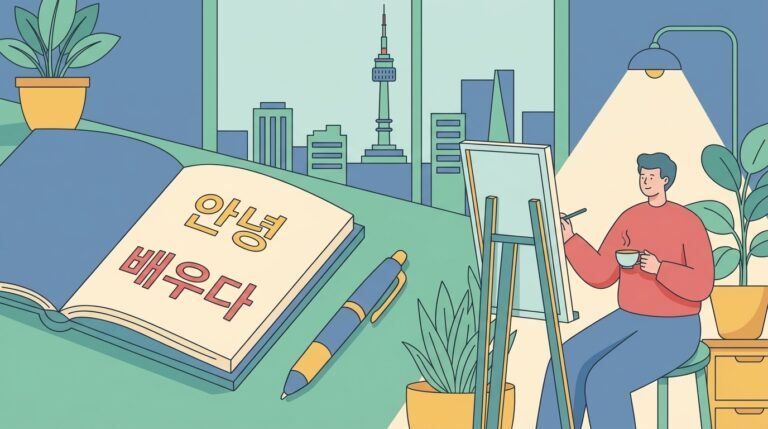
Picture this: You’re watching a K-Drama like My Mister or Daily Dose of Sunshine. The protagonist sits alone at a pojangmacha (street tent), letting out a heavy sigh over a glass of soju, or perhaps they finally step into a bright, modern counseling clinic. For a long time, the Korean approach to stress was simply to endure it silently—a concept deeply tied to the cultural trait of han (한). But today? If you walk through the trendy alleys of Yeonnam-dong or Seongsu, you’ll find ‘Drawing Cafes’ (드로잉 카페), meditation tea houses, and accessible therapy workshops packed with millennials and Gen Z.
Mental health is no longer a taboo subject in Korea; it’s a rapidly evolving conversation. As an advanced (C1) Korean learner, you need the vocabulary to express your inner world accurately. Saying “스트레스 받아요” (I’m stressed) is textbook, but it doesn’t capture the nuanced, physical way Koreans describe emotional bandwidth. Let’s dive deep into the real language of Korean mental care.
Phase 2: Core Expressions Deep Dive
Here are the top three advanced expressions to articulate your mental state and healing process.
1. 마음이 답답해요
- Pronunciation: [ma-eum-i dap-dap-hae-yo] / Sounds like the heavy thud of a book dropping on a desk.
- Meaning: (Literal) My mind/heart is stuffy. vs (Real Nuance) I feel emotionally suffocated, frustrated, or heavily burdened.
- K-Culture Moment: You’ll hear this in therapy sessions or late-night talks between friends. It’s not just anger; it’s the physical sensation of having too much on your plate and no outlet. It’s closely related to Hwabyung (화병), a culturally recognized syndrome of repressed anger.
- Editor’s Insight: Use this when you feel trapped by a situation. It’s much more evocative and mature than simply saying “I’m sad” or “I’m angry.”
- Situation Spectrum:
- Close Friends (Casual): ✅ (답답해 죽겠어 – I’m so frustrated I could die)
- Coworkers (Semi-formal): ✅ (요즘 일이 안 풀려서 좀 답답하네요)
- Boss/Elders (Formal): ⚠️ (Use cautiously, as it might sound like you are complaining about them)
- 🤔 Think About It: Why do Koreans often use physical descriptors (like ‘stuffy’ or ‘blocked’) to describe emotional states? How does your native language bridge the physical and emotional?
2. 마음의 여유가 없어요
- Pronunciation: [ma-eum-ui yeo-yu-ga eop-seo-yo] / Slide through the ‘yeo-yu’ smoothly, like running out of breath.
- Meaning: (Literal) I have no extra space in my mind. vs (Real Nuance) I have no emotional bandwidth / I’m completely overwhelmed.
- K-Culture Moment: When a K-Drama character rejects a confession of love because they are struggling with debt or career stress, this is the exact phrase they use.
- Editor’s Insight: This is an incredibly polite and sophisticated way to set boundaries. Whether you’re declining a party invitation or explaining why you haven’t been keeping in touch, it commands respect and understanding.
- Situation Spectrum:
- Close Friends (Casual): ✅
- Coworkers (Semi-formal): ✅
- Boss/Elders (Formal): ✅ (Very appropriate for professional settings)
- 🤔 Think About It: The concept of yeoyu (여유 – spare time/space/composure) is considered highly virtuous in Korea. What happens to a society when the ‘Palli-palli’ (hurry up) culture destroys yeoyu?
3. 속마음을 털어놓다
- Pronunciation: [song-ma-eum-eul teo-reo-no-ta] / Emphasize the ‘teo’, like you are literally shaking dust off a rug.
- Meaning: (Literal) To shake out and lay down one’s inner mind. vs (Real Nuance) To open up, vent, or confess one’s true feelings.
- K-Culture Moment: This is the core goal of psychological counseling (심리 상담) or art therapy (미술 치료). In K-Pop fandoms, when an idol writes a deeply personal post on Weverse, fans say “속마음을 털어놔줘서 고마워” (Thank you for opening up to us).
- Editor’s Insight: Sok-ma-eum refers to your deepest, hidden feelings, contrasting with your outward facade.
- Situation Spectrum:
- Close Friends (Casual): ✅
- Therapy/Counseling: ✅
- Boss/Elders (Formal): 🚫 (Too intimate for hierarchical relationships)
- 🤔 Think About It: Does the presence of a specific word for “inner mind” suggest that hiding one’s true feelings is a societal norm?
Phase 3: Textbook vs. Real Korean
[Situation 1: Expressing Severe Work Stress]
* 📖 Textbook Korean: 저는 회사 일 때문에 스트레스를 많이 받았습니다. (I received a lot of stress because of work.)
* 🗣️ Real Korean: 아, 요즘 회사 때문에 멘탈 털려요 / 번아웃 온 것 같아요. (Ah, my mental state is getting robbed because of work / I think I’ve hit burnout.)
* 💡 Why the difference?: The younger generation treats “mental health” as a tangible resource that can be “robbed” (털리다) or “drained” by the intense corporate culture.
[Situation 2: Getting Therapy/Taking a Break]
* 📖 Textbook Korean: 저는 심리 상담을 받고 미술 치료를 합니다. (I receive psychological counseling and do art therapy.)
* 🗣️ Real Korean: 요즘 멘탈 케어 중이에요. / 주말에 드로잉 카페 가서 힐링하려고요. (I’m doing mental care these days. / I’m going to a drawing cafe this weekend to heal.)
* 💡 Why the difference?: Using Konglish terms like “Mental Care” and “Healing” makes the concept feel more like a modern wellness trend rather than a clinical medical issue, reducing the stigma.
Phase 4: Cultural Context — K-Culture Deep Dive
4-1. Non-Verbal Subtext: The Power of the Sigh
In a counseling context, or when talking to a friend about burnout, Koreans often communicate through deep, audible exhales called hansum (한숨). While sighing in some cultures is considered rude, in Korea, a shared sigh is a profound expression of empathy. Also, remember Nunchi (눈치). A good counselor or friend will read your nunchi—noticing what you aren’t saying—and might gently prompt you with, “힘든 거 알아요, 천천히 말해요” (I know it’s hard, take your time).
4-2. The “Healing Cafe” Phenomenon
In Korea, therapy isn’t limited to a doctor’s couch. If you feel overwhelmed, you can visit a Drawing Cafe (드로잉 카페) where you pay to paint on a canvas while sipping Earl Grey tea in complete silence. There are also Bulmeong (불멍 – spacing out looking at fire) cafes and even places designed specifically for taking naps. This reflects a societal adaptation: in a hyper-competitive city like Seoul, people are actively commercializing and seeking out “quiet sanctuaries” to process their emotions.
Phase 5: Real-Life Roleplay Scenario
Setting: Saturday afternoon, 3 PM. A sunlit “Drawing Cafe” in Yeonnam-dong. You and your Korean friend, Min-ji, are wearing aprons, painting on canvases. You’ve been sighing a lot lately due to a difficult project at work.
Characters:
– YOU: An expat professional in Seoul, currently experiencing mild burnout.
– Min-ji (29): Your close Korean friend. Very observant (good nunchi) and empathetic.
Dialogue:
Min-ji: 00씨, 오늘 그림 색깔이 되게 어둡네요. 무슨 일 있어요?
(00-ssi, oneul geurim saekkkari doege eodumneyo. museun il isseoyo?)
[00, your painting colors are really dark today. Is something wrong?]
YOU: 아… 티 나요? 사실 요즘 좀 지쳐서요.
(A… ti nayo? sasil yojeum jom jichyeoseoyo.)
[Ah… is it obvious? Actually, I’ve been a bit exhausted lately.]
Min-ji: 프로젝트 때문에 그렇죠? 저번 주부터 계속 야근했잖아요.
(Peurojekteu ttaemune geureotjyo? jeobeon jubuteo gyesok yageunhaetjanayo.)
[It’s because of the project, right? You’ve been working overtime since last week.]
YOU: 네. 진짜 마음의 여유가 하나도 없어요. 멘탈이 바사삭 부서진 느낌?
(Ne. jinjja maeumui yeoyuga hanado eopseoyo. mentari basasak buseojin neukkim?)
[Yeah. I really have zero emotional bandwidth. I feel like my mental state crumbled like a pastry.]
Min-ji: (🎭 Puts down her paintbrush) 에고… 그래서 제가 오늘 여기 오자고 한 거예요. 아무 생각 하지 말고 그냥 칠해봐요.
(Ego… geuraeseo jega oneul yeogi ojago han geoyeyo. amu saenggak haji malgo geunyang chilhaebwayo.)
[Oh no… That’s why I suggested coming here today. Don’t think about anything and just paint.]
🔀 Your Turn! How do you respond to Min-ji’s comforting words?
– A) “네, 그림을 그리니까 스트레스가 없어졌습니다.” (Textbook, but robotic)
– B) “고마워요. 민지 씨한테 속마음을 털어놓으니까 훨씬 답답한 게 풀리네요.”
– C) “대박! 이거 진짜 재밌다!”✅ Best Choice: B — This is the perfect C1-level response. It acknowledges her effort, uses advanced vocabulary (속마음을 털어놓다), and beautifully describes the relief of emotional tension (답답한 게 풀리다).
⚠️ Choice C Analysis: Too abrupt a mood shift. It ignores the emotional depth of Min-ji’s comfort.
Min-ji: 다행이네요. 가끔은 이렇게 머리를 비우는 시간이 필요해요. 우리 끝나고 맛있는 거 먹으러 갈까요?
(Dahaeng-ineyo. Gakkeumeun ireoke meorireul biuneun sigani piryohaeyo. Uri kkeunnago masinneun geo meogeureo galkkayo?)
[I’m glad. Sometimes we need time to just empty our heads. Shall we go eat something delicious after this?]
YOU: 좋아요. 매운 떡볶이 어때요? 스트레스 풀리게!
(Joayo. Maeun tteokbokki eottaeyo? Seuteureseu pullige!)
[Sounds good. How about spicy tteokbokki? To relieve the stress!]
Min-ji: 콜! 제가 진짜 맛있는 집 알아요.
(Kol! jega jinjja masinneun jip arayo.)
[Deal! I know a really delicious place.]
Phase 6: 10-Second Shadowing Drill
Let’s practice the rhythm and emotion of releasing stress.
😌 고마워요. / 민지 씨한테 / 속마음을 털어놓으니까 / 훨씬 답답한 게 풀리네요.
(gomawoyo. / minji ssihante / songmaeumeul teoreonoeunikka / hwolssin dapdapan ge pullineyo.)
Tip: Take a soft, relieved breath before saying “훨씬” (much more) to emphasize that the heavy feeling in your chest has lifted!
Phase 7: K-Culture Mini Dictionary
| Korean | Romanization | English | Cultural Context |
|---|---|---|---|
| 힐링 | hilling | Healing | Used casually for anything that relaxes you (good food, nice views, petting a dog). |
| 멍때리기 | meong-ttaerigi | Spacing out | The act of blanking your mind to rest your brain. There is even an annual ‘Spacing Out’ competition in Seoul! |
| 소확행 | sohwakhaeng | Small, certain happiness | Finding joy in trivial things (like eating a perfect pastry) to counter uncontrollable life stress. |
| 화병 | hwabyeong | Hwabyung | A culturally bound syndrome in Korea where repressed anger manifests as physical chest pain. |
| 위로 | wiro | Comfort / Consolation | A very profound concept in Korean counseling; offering empathetic comfort rather than quick solutions. |
Phase 8: Traveler’s Survival Kit
Whether you’re moving to Korea or just visiting, dealing with travel anxiety or sensory overload in crowded Seoul is real. Here are expressions you can use at a pharmacy (약국) or a healing cafe.
🆘 Survival Phrases for Mental Care
– 🇰🇷 “마음이 편안해지는 차 있나요?” (ma-eu-mi pyeo-nan-hae-ji-neun cha in-na-yo?)
– 🗣️ Meaning: Do you have a tea that makes the mind peaceful?
– 📍 Where to use: Traditional tea houses in Insadong, cafes.
– 💡 Pro Tip: Ask for Camomile or Daechoo-cha (Jujube tea), famous for calming nerves.🆘 Survival Phrase for Pharmacies
– 🇰🇷 “수면 유도제 주세요.” (su-myeon yu-do-je ju-se-yo)
– 🗣️ Meaning: Please give me a mild sleep aid.
– 📍 Where to use: Pharmacies (Yakguk).
– 💡 Pro Tip: In Korea, strong sleeping pills require a prescription, but you can buy mild, over-the-counter sleep aids (수면 유도제) easily if jet lag or stress keeps you awake.
📌 Editor’s Travel Note:
If you want to experience art therapy casually, search for “드로잉 카페” (Drawing Cafe) or “도자기 공방” (Ceramics Workshop) on KakaoMap. You don’t need a medical diagnosis to attend; they are popular date spots and solo healing destinations!
Phase 9: Critical Thinking — “One Step Deeper”
🧠 Think Deeper: Media vs Reality & The Generational Shift
If you watch older K-Dramas, characters handle stress by drinking heavily, crying in the rain, or suffering in silence. Seeking psychological help was heavily stigmatized, viewed as a flaw on one’s permanent record. However, Millennials and Gen Z have radically changed this landscape. By rebranding therapy as “Mental Care” and blending it with daily leisure (like art therapy workshops and healing cafes), young Koreans have normalized mental wellness. It’s a fascinating example of how language adapts to lower social barriers—using English loan words like “burnout” or “healing” creates a psychological distance from the heavy, traditional stigma of “정신과” (Psychiatry).
💬 Your Turn: How has the conversation around mental health changed in your culture over the last decade? Do you have “healing spaces” like drawing cafes? Share in the comments!
Phase 10: FAQ & Avoiding Misunderstandings
Q: Can I tell my boss “저 번아웃 왔어요” (I have burnout)?
Maybe. In progressive tech companies or startups, yes. But in traditional corporate environments, it’s safer to use the C1 expression we learned: “요즘 마음의 여유가 좀 없습니다” (I don’t have much bandwidth these days) and ask for a short leave.
Q: Is it okay to cry during art therapy or counseling in Korea?
Yes, absolutely. The concept of catharsis (카타르시스) is highly valued in Korean therapy. Releasing your han (pent-up sorrow) is encouraged.
❌ Common Mistake: Using physical illness words for mental stress incorrectly.
Saying “마음이 아파요” (My heart hurts) is understood, but it sounds very poetic, like a ballad song about a breakup. If you are stressed from work, “답답해요” or “지쳐요” (exhausted) is much more natural.
Phase 11: Summary & Action Items
🌟 One-Liner Summary: To speak like a sophisticated local, move beyond “스트레스” and express your emotional bandwidth using words like dapdaphaeyo and yeoyu.
🚀 Action Missions:
– 🥉 Bronze: Stand in front of a mirror, take a deep hansum (sigh), and practice saying “아, 마음의 여유가 없네…”
– 🥈 Silver: Leave a comment on a Daily Hangul post or your favorite K-Pop idol’s Weverse saying, “항상 속마음을 털어놔줘서 고마워요” (Thank you for always opening up).
– 🥇 Gold: Search KakaoMap for a local ‘드로잉 카페’ or traditional tea house, go there, and order a calming tea in Korean!
🎨 K-Culture Mission:
Watch an episode of Daily Dose of Sunshine (정신병동에도 아침이 와요) on Netflix. Pay close attention to how the nurses and patients talk about their “inner mind” (속마음). Can you catch them using the words we learned today?
Phase 12: Interactive Challenge Quiz
1. Situational Judgment: Your Korean friend looks totally exhausted after studying for exams all night. You want to suggest doing something relaxing. Which is the most natural Korean phrasing?
A) 병원에 가서 심리 치료를 받으세요.
B) 우리 주말에 멍때리기 하면서 힐링할까요?
C) 스트레스를 파괴합시다!
2. Fill in the Blank:
“요즘 너무 바빠서 주위를 둘러볼 [ ______ ]가 없어요.”
(I’ve been so busy lately I have no bandwidth to look around.)
3. True or False — K-Culture Edition:
In modern Seoul, you must have a doctor’s prescription to visit a ‘Drawing Cafe’ for art therapy. (T/F)
👀 Click here for Answers!
- B (A is too clinical and intense, C sounds like an anime villain. B perfectly uses modern slang ‘멍때리기’ and ‘힐링’).
- 마음의 여유 (Emotional bandwidth / room in one’s mind).
- False! Drawing cafes are popular commercial leisure spaces where anyone can go to paint and drink coffee to relieve stress.
Enjoyed this lesson? Don’t forget to take a deep breath today. Your mental health matters! See you in the next Daily Hangul post! 😊
Frequently Asked Questions (FAQ)
Q: What does "마음이 답답해요" mean in Korean and how do you pronounce it?
A: In Korean, "마음이 답답해요" is pronounced [ma-eum-i dap-dap-hae-yo] and means: (Literal) My mind/heart is stuffy. vs (Real Nuance) I feel emotionally suffocated, frustrated, or heavily burdened.
Q: What does "마음의 여유가 없어요" mean in Korean and how do you pronounce it?
A: In Korean, "마음의 여유가 없어요" is pronounced [ma-eum-ui yeo-yu-ga eop-seo-yo] and means: (Literal) I have no extra space in my mind. vs (Real Nuance) I have no emotional bandwidth / I'm completely overwhelmed.
Q: What does "속마음을 털어놓다" mean in Korean and how do you pronounce it?
A: In Korean, "속마음을 털어놓다" is pronounced [song-ma-eum-eul teo-reo-no-ta] and means: (Literal) To shake out and lay down one's inner mind. vs (Real Nuance) To open up, vent, or confess one's true feelings.