

Hello there! I’m your Head Editor at Daily Hangul.
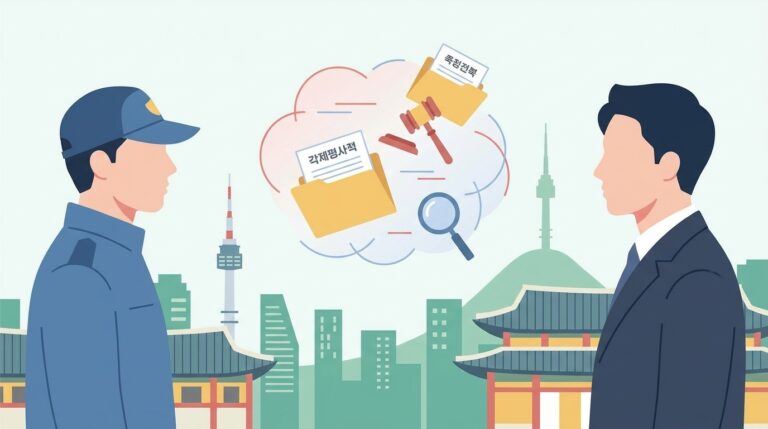
Let me paint a picture for you. You’re watching an intense K-Drama—maybe Stranger (비밀의 숲) or The Fiery Priest (열혈사제). The gritty detective slams a mountain of case files onto a polished desk. The impeccably dressed prosecutor smirks and says, “We’re taking over this case.” The tension is palpable.
In the subtitles, it usually just says, “Jurisdiction dispute.” But if you’re a C2-level Korean learner or a true K-Culture aficionado, you know there is a massive, real-world socio-political earthquake behind that scene.
Today, we are diving deep into the Crime & Justice (범죄와 사법) module, specifically tackling a very hot topic in modern Korean society: The adjustment of investigative powers between the police and the prosecution, and the resulting fears of an ‘investigative vacuum’ (검경 수사권 조정에 따른 수사 공백 우려).
Why learn this? Because to truly converse like a highly educated native in Seoul—whether you’re debating current events at a Yeouido café or decoding the subtext of the evening news—you need to understand this dynamic. It’s the ultimate key to unlocking Korean legal thrillers and reading the pulse of Korean society.
Let’s dive into the vocabulary that will upgrade you from a language learner to a local insider.
Phase 2: Core Expressions Deep Dive
1. 수사권 조정 (Adjustment of Investigative Powers)
- Pronunciation: su-sa-gwon jo-jeong [su-sa sounds like ‘sue’ + ‘sa’ (as in saga), gwon rhymes with ‘gone’, jo-jeong rhymes with ‘joe-jung’]
- Meaning: Literal: Adjustment of investigation rights. / Real Nuance: The highly controversial legal reform redistributing power from the prosecution to the police.
- K-Culture Moment: You’ll hear news anchors saying this with a grave tone every time a major reform bill passes. In K-Dramas, it’s the underlying reason why police chiefs and chief prosecutors are constantly having secret dinners in expensive traditional Korean restaurants (Hanjeongsik).
- Editor’s Insight: Think of 수사권 (investigative power) as the ultimate ‘One Ring’ of the Korean justice system. 조정 (adjustment) sounds polite, but in reality, it’s a fierce tug-of-war.
- Situation Spectrum:
- Casual with friends: ✅ (When discussing news/dramas)
- Semi-formal (Coworkers): ✅
- Formal/Debate: ✅✅ (Essential vocabulary)
- 🤔 Think About It: Why does Korea have such a centralized prosecution system in the first place? How does the historical context of rapid democratization influence the public’s fear of giving one agency too much power?
2. 수사 공백 (Investigative Vacuum / Loophole)
- Pronunciation: su-sa gong-baek [gong sounds like a ringing gong, baek sounds like ‘beck’]
- Meaning: Literal: Investigation blank space. / Real Nuance: The dangerous delay or blind spot in solving crimes caused by administrative confusion between cops and prosecutors.
- K-Culture Moment: Imagine a victim’s family protesting in front of the police station holding signs because their fraud case has been stalled for months. The media labels this tragic delay as a 수사 공백.
- Editor’s Insight: 공백 means a void or blank space. It’s used often in Korean to describe a lack of leadership or action (e.g., 권력 공백 – power vacuum). When you use this term, you instantly sound like someone who critically analyzes social issues.
- Situation Spectrum:
- Casual: ⚠️ (A bit heavy for casual chitchat)
- Semi-formal: ✅
- Formal: ✅✅
- 🤔 Think About It: When bureaucratic systems change, the vulnerable often suffer first. Does your home country have a specific term for when justice is delayed due to red tape?
3. 밥그릇 싸움 (Turf War / Protecting One’s Interests)
- Pronunciation: bap-geu-reut ssa-um [bap sounds like ‘bop’, geu-reut is tricky—think of the ‘eu’ as the sound of disgust, ssa-um means fight]
- Meaning: Literal: Rice bowl fight. / Real Nuance: A turf war to protect one’s livelihood, authority, or vested interests.
- K-Culture Moment: A taxi driver listening to the radio news about the police and prosecutors arguing will likely shake his head and mutter, “에휴, 또 밥그릇 싸움 하네” (Sigh, another turf war).
- Editor’s Insight: This is arguably one of the most important socio-cultural idioms in Korean. Rice (밥) historically equals survival. Threatening someone’s power is like trying to take their rice bowl. It implies a cynical view from the public that the authorities are fighting for their own power, not for the people.
- Situation Spectrum:
- Casual: ✅✅
- Semi-formal: ✅
- Formal: 🚫 (Do not use this in a formal academic paper; use 이권 다툼 instead).
- 🤔 Think About It: Food metaphors are deeply embedded in the Korean language. How does equating ‘jurisdictional power’ to a ‘rice bowl’ reflect Korea’s agrarian history and the modern competitive society?
Phase 3: Textbook vs. Real Korean
[Describing Delayed Justice]
* 📖 Textbook Korean: 수사가 지연되고 있습니다. (The investigation is being delayed.)
* 🗣️ Real Korean: 사건이 경찰이랑 검찰 사이에서 핑퐁 치고 있어요. (The case is playing ping-pong between the police and prosecutors.)
* 💡 Why the difference?: Koreans love using English sports metaphors (like Ping-Pong) to vividly describe bureaucratic buck-passing. It captures the frustrating back-and-forth perfectly.
[Criticizing Institutional Greed]
* 📖 Textbook Korean: 두 기관이 권력을 차지하기 위해 갈등하고 있습니다. (The two institutions are conflicting to seize power.)
* 🗣️ Real Korean: 전형적인 밥그릇 싸움이죠 뭐. (It’s just your typical turf war.)
* 💡 Why the difference?: C2 fluency requires cynicism! Using 밥그릇 싸움 shows you understand the public’s exhaustion with political posturing.
Phase 4: Cultural Context — K-Culture Deep Dive
4-1. Non-Verbal Dynamics: The Bow & The Stare
In Korea, hierarchy dictates non-verbal language. Historically, prosecutors passed the bar exam (an elite path) while police officers often started from the bottom. In dramas, notice how the police chief might give a slight 45-degree bow to a younger prosecutor, while the prosecutor merely nods. The current legal reforms aim to make them “cooperating agencies” rather than a hierarchy. If you watch a K-Drama made before 2020 vs. after 2022, you will notice a subtle shift in how detectives make eye contact with prosecutors—it’s getting fiercer, reflecting the shifting power dynamics.
4-2. The Evolution of the K-Drama Hero
Let’s talk about Media vs Reality. In the early 2000s K-Dramas, prosecutors were the ultimate righteous heroes fighting corrupt politicians. However, as real-life public sentiment shifted—viewing the prosecution as holding monopolistic, unchecked power—the K-Drama landscape changed.
Now, prosecutors are often depicted as the ultimate villains (corrupt, power-hungry), while the scrappy, underdog police detective is the true hero (think The Roundup / 범죄도시). The real-world 수사권 조정 (reform) is a direct response to this public sentiment. But here is the critical twist: the recent “investigative vacuum” (수사 공백) means cases are piling up at police stations due to lack of manpower. So now, dramas are starting to reflect that frustration too. Art imitates bureaucracy!
Phase 5: Real-Life Roleplay Scenario
Setting: Friday night, 8 PM. A slightly upscale, dimly lit Izakaya in Yeouido (Seoul’s political and financial hub). You are having highballs with your Korean friends, including Ji-hoon, a corporate lawyer.
Characters:
– YOU: An expat professional living in Seoul for 5 years. You read the Korean news daily.
– Ji-hoon (35): A sharp, slightly cynical Korean corporate lawyer.
Dialogue:
Ji-hoon: 요즘 전세 사기 사건들 뉴스 봤어? 피해자들이 피눈물 흘리는데 수사가 너무 안 넘어가.
(yogeum jeonse sagi sageondeul nyuseu bwasseo? pihaeja-deul-i pi-nun-mul heullineunde susaga neomu an neomeoga.)
[Did you see the news about the housing lease fraud cases lately? The victims are shedding tears of blood, but the investigation isn’t moving forward.]
YOU: 봤어. 경찰에서 사건 처리가 엄청 밀려 있다며?
(bwasseo. gyeongchareseo sageon cheoriga eomcheong millyeo itdabmyeo?)
[I saw it. I heard the case processing is massively backlogged at the police stations?]
Ji-hoon: 맞아. 수사권 조정 이후로 경찰 업무가 폭탄 수준이야. 전문 수사 인력도 부족하고.
(maja. susagwon jojeong ihuro gyeongchal eommuga poktan sujun-iya. jeonmun susa illyeok-do bujokhago.)
[Exactly. Since the adjustment of investigative powers, the police workload is at a bomb-level. There’s a lack of specialized investigators too.]
YOU: 결국 그 수사 공백 때문에 범죄자들만 시간 벌어주는 꼴이네.
(gyeolguk geu susa gongbaek ttaemune beomjoeja-deul-man sigan beoleojuneun kkol-ine.)
[In the end, that investigative vacuum just ends up buying time for the criminals.]
Ji-hoon: 내 말이 그 말이야! 제도를 바꿨으면 후속 조치도 제대로 해야지.
(nae mari geu mariya! jedoreul bakkwosseumyeon husok jochido jedaero haeyaji.)
[That’s exactly what I’m saying! If they change the system, they need to do the follow-up measures properly.]
🔀 Your Turn! How do you respond to Ji-hoon’s frustration?
– A) “한국의 사법 시스템은 참 복잡하네요.” (The Korean judicial system is very complex.)
– B) “진짜 전형적인 탁상행정이야. 위에서 지들 밥그릇 싸움 하느라 바쁘지.”
– C) “경찰이 일을 안 하는 거 아니야?”✅ Best Choice: B — “It’s typical desk-bound administration. The people at the top are too busy fighting their turf wars.” This uses high-level idioms (탁상행정 – armchair administration, 밥그릇 싸움 – turf war) that perfectly match a C2 socio-political conversation. It shows deep empathy with the systemic issue.
⚠️ Choice A Analysis: It’s grammatically perfect, but a bit too detached and textbook-like for a conversation among close friends.
🚫 Choice C Analysis: Blaming the police directly ignores the systemic nuance you just discussed, making you sound uninformed about the structural 수사 공백.
Phase 6: 10-Second Shadowing Drill
Let’s practice delivering a sophisticated critique. Pay attention to the pauses (/) and the emotion!
😤 제도를 / 바꾸는 건 좋은데, / 결국 수사 공백 때문에 / 시민들만 / 피해를 보잖아요.
(je-do-reul / ba-kku-neun geon jo-eun-de, / gyeol-guk su-sa gong-baek ttae-mu-ne / si-min-deul-man / pi-hae-reul bo-ja-na-yo.)
[Changing the system is fine, but ultimately, because of the investigative vacuum, it’s only the citizens who suffer damages.]
Phase 7: K-Culture Mini Dictionary
| Korean | Romanization | English | Context |
|---|---|---|---|
| 검경 | geom-gyeong | Prosecution & Police | Portmanteau of 검찰 (Prosecution) and 경찰 (Police). Used constantly in news. |
| 탁상행정 | tak-sang-haeng-jeong | Armchair administration | When politicians make laws at their desks without knowing the reality on the ground. |
| 전관예우 | jeon-gwan-ye-u | Privileges of former post | The controversial practice where retired judges/prosecutors become highly paid lawyers and receive favorable treatment from their former colleagues. A massive K-Drama trope! |
| 송치 | song-chi | Forwarding a case | When police finish investigating and send the case to the prosecution for indictment. |
Phase 8: Traveler’s Survival Kit (Emergency Edition)
While you won’t be debating prosecution reform as a tourist, you will interact with the police if you face an emergency. If you are a victim of a crime in Korea (like theft), the bureaucratic process can feel like a 수사 공백 if you don’t know what to ask for!
🆘 Survival Expression #1: Filing a Report
– 🇰🇷 “사건 접수증 받을 수 있나요?” (sageon jeopsujeung badeul su innayo?)
– 🗣️ English Guide: Can I get a police report receipt?
– 📍 Where to use: Police station (경찰서) or local precinct (파출소).
– 💡 Pro Tip: If you lose your passport or get pickpocketed, travel insurance companies require this document. Do not leave the station without asking for the 사건 접수증 (Incident Receipt).📌 Editor’s Travel Note
– Emergency Numbers: Dial 112 for Police.
– Language Barrier: If you need to explain a complex situation to the police, call 1330 (Korea Travel Helpline). They provide 24/7 free interpretation services specifically for foreigners in distress!
Phase 9: Critical Thinking — “One Step Deeper”
Language & Power (언어와 권력)
In Korea, state power is deeply encoded in language. Notice how the prosecution is called 검찰 (Geom-chal), meaning ‘investigating authority’, and they refer to their internal organization as 검찰청 (Supreme Prosecutors’ Office). Historically, prosecutors often used highly formalized, archaic Sino-Korean words (Hanja) in legal documents to maintain an aura of unapproachable authority—a linguistic gatekeeping.
The debate over 수사권 조정 isn’t just about legal statutes; it’s a democratization of language and power. As police gain more independent authority, we are seeing a push for “Easy Legal Korean” so average citizens aren’t intimidated by the system.
💬 Your Turn: Does the legal system in your home country use overly complex language to maintain authority? How do citizens push back against it? Share your thoughts in the comments!
Phase 10: FAQ & Avoiding Misunderstandings
Q: Can I use “밥그릇 싸움” (turf war) in a business meeting?
A: No. It is highly colloquial and carries a cynical, critical tone. If you are in a formal business meeting discussing corporate restructuring, use “부서 간의 이권 다툼” (conflict of interest between departments) instead.
Q: If I’m talking to a police officer, should I mention the “investigative vacuum”?
A: Probably not. Frontline officers are incredibly stressed right now due to the heavy workload caused by these exact reforms. Mentioning 수사 공백 to them might sound accusatory, as if you are blaming them for being slow, rather than the system.
❌ Common Mistake #1: Translating “Sue” directly to “고소하다” for everything.
✅ Do this instead: In Korean law, 고소 (go-so) is when the victim reports a crime. 고발 (go-bal) is when a third party reports it. And suing for money in civil court is 민사 소송 (min-sa so-song). Don’t mix them up!
Phase 11: Summary & Action Items
One-Liner Summary: To understand Korea’s modern justice system and your favorite K-Dramas, master the terms 수사권 조정 (reform) and 수사 공백 (the resulting bureaucratic delay), and don’t be afraid to call out a 밥그릇 싸움 (turf war)!
Action Mission:
– 🥉 Bronze (Solo): Practice saying the shadowing drill sentence in front of a mirror with genuine frustration!
– 🥈 Silver (Online): Go to Naver News (네이버 뉴스), search “수사 공백”, and read the headlines of three articles. Can you spot the vocabulary?
– 🥇 Gold (Action): The next time you watch a Korean crime drama, pause it when the prosecutor and police clash, and explain the real socio-political context to your friends!
Phase 12: Interactive Challenge — The “Geom-Gyeong” Quiz
1. Fill in the Blank:
The news anchor announces: “시민들은 두 기관의 끝없는 _______ 에 피로감을 느끼고 있습니다.” (Citizens are feeling fatigue from the endless [turf war] between the two agencies.)
Hint: It involves a rice bowl.
2. True or False – K-Culture Edition:
In modern Korean society, it is widely accepted that prosecutors are always the infallible “good guys,” which is why dramas never depict them as corrupt. (T / F)
3. Situational Judgment:
You are drinking with your Korean professor, and you want to bring up the delayed police investigations you read about. Which is the most C2-level, appropriate way to start?
A) 교수님, 경찰들이 일을 왜 안 합니까? (Professor, why don’t the police work?)
B) 교수님, 최근 수사권 조정 이후 수사 공백 문제에 대해 어떻게 생각하시나요? (Professor, what do you think about the issue of the investigative vacuum following the recent adjustment of investigative powers?)
(Answers: 1. 밥그릇 싸움 / 2. False. The perception has shifted, leading to complex, morally grey depictions. / 3. B – Highly respectful and academically sound!)
How did you do? Let me know in the comments below if you’ve noticed this power struggle in your favorite K-Drama! Until next time, keep your Korean sharp and your nunchi sharper. ✌️
Frequently Asked Questions (FAQ)
Q: What does "수사권 조정 (Adjustment of Investigative Powers)" mean in Korean and how do you pronounce it?
A: In Korean, "수사권 조정 (Adjustment of Investigative Powers)" is pronounced [su-sa-gwon jo-jeong [su-sa sounds like 'sue' + 'sa' (as in saga] and means: Literal: Adjustment of investigation rights. / Real Nuance: The highly controversial legal reform redistributing power from the prosecution to the police.
Q: What does "수사 공백 (Investigative Vacuum / Loophole)" mean in Korean and how do you pronounce it?
A: In Korean, "수사 공백 (Investigative Vacuum / Loophole)" is pronounced [su-sa gong-baek [gong sounds like a ringing gong, baek sounds like 'beck'] and means: Literal: Investigation blank space. / Real Nuance: The dangerous delay or blind spot in solving crimes caused by administrative confusion between cops and prosecutors.
Q: What does "밥그릇 싸움 (Turf War / Protecting One's Interests)" mean in Korean and how do you pronounce it?
A: In Korean, "밥그릇 싸움 (Turf War / Protecting One's Interests)" is pronounced [bap-geu-reut ssa-um [bap sounds like 'bop', geu-reut is tricky—think of the 'eu' as the sound of disgust, ssa-um means fight] and means: Literal: Rice bowl fight. / Real Nuance: A turf war to protect one’s livelihood, authority, or vested interests.







