Phase 1: Empathy & The Scene
Hello, learners! I’m the Lead Editor at Daily Hangul.
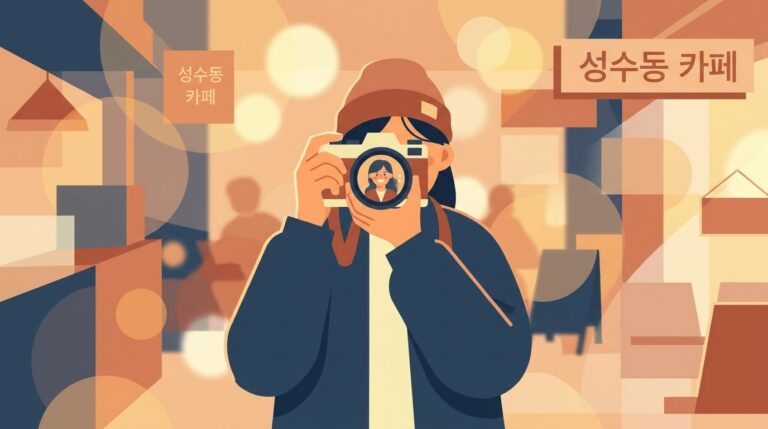
Let’s set the scene: You are at a hyper-trendy cafe in Seongsu-dong. The aesthetic is perfect—exposed concrete, minimalist furniture, and a stunning flat-white on the table. Your Korean friend hands you their phone, strikes a pose, and says, “배경 좀 싹 날려줘!”
You freeze. Fly the background? Blow it away? Are you supposed to clear the tables behind them?
No, they are asking you for the holy grail of Korean café photography: the out-of-focus or bokeh effect. In Korea, where capturing the Insaeng-shot (인생샷, the photo of a lifetime) is a high-stakes social activity, knowing how to direct and take photos isn’t just a hobby—it’s a crucial survival skill. By mastering this specific C1-level vocabulary, you’re not just taking a picture; you’re speaking the cultural language of aesthetics. Let’s dive in and upgrade you to ‘Insider’ status!
Phase 2: Deep Dive into Core Expressions
Here are the top expressions you need when directing or taking portrait photos with that beautiful, blurry background.
1. 배경을 날리다 (To blur the background)
- Pronunciation: baegyeong-eul nallida [sounds like: beh-gyong-eul nal-li-da]
- Meaning: Literal: To make the background fly away. / Real nuance: To blur the background heavily (create bokeh).
- K-Culture Moment: You’ll hear this exact phrase on variety shows or behind-the-scenes K-Pop jacket shoots when the photographer wants to isolate the idol from a busy street background.
- Editor’s Insight: This is the most native, idiomatic way to describe an out-of-focus shot. Saying “흐리게 하다” (to make blurry) sounds like you have a smudged lens. “날리다” sounds intentional and professional.
- Situation Spectrum:
- Casual (Friends): ✅ (배경 싹 날려줘!)
- Semi-formal (Coworkers): ⚠️ (배경을 좀 날려주시겠어요?)
- Formal (Boss/Elders): 🚫 (Use ‘아웃포커스로 찍어주세요’ instead)
- 🤔 Think About It: Why use a dynamic verb like ‘날리다’ (to fly/blow away) for a visual effect? Doesn’t it reflect the fast-paced, highly selective nature of modern digital culture, where we instantly “delete” or “blow away” what we don’t want to see?
2. 피사체(인물) 위주로 살려주세요 (Make the subject pop)
- Pronunciation: pisache(inmul) wijuro sallyeojuseyo [sounds like: pi-sa-che wi-ju-ro sal-lyuh-ju-se-yo]
- Meaning: Literal: Please save it centered on the subject. / Real nuance: Please make the subject stand out/pop against the background.
- K-Culture Moment: When K-Drama directors are setting up a deeply emotional crying scene, they want all the focus on the actor’s face, completely “saving” (살리다) the subject while the world blurs out around them.
- Editor’s Insight: “살리다” (to save/revive) is widely used in fashion, art, and food to mean “to highlight or bring out the best feature.”
- Situation Spectrum:
- Casual: ✅ (나만 딱 살려줘)
- Semi-formal: ✅ (인물만 살려주세요)
- Formal: ✅
- 🤔 Think About It: How does the word ‘살리다’ in Korean contrast with your native language when talking about enhancing a photo?
3. 심도를 얕게 세팅할게요 (I’ll set a shallow depth of field)
- Pronunciation: simdo-reul yatge setinghalgeyo [sounds like: shim-do-reul yat-geh se-ting-hal-ge-yo]
- Meaning: Literal/Real nuance: I will use a shallow depth of field.
- K-Culture Moment: This is C1/C2 level camera jargon. If you join a university photography club (동아리) in Seoul, this is the exact terminology the upperclassmen (선배) will use.
- Editor’s Insight: Use this if you are holding a DSLR or mirrorless camera. Using professional jargon instantly builds trust with the person you are photographing.
- Situation Spectrum:
- Casual: ⚠️ (A bit too technical for a quick smartphone pic)
- Semi-formal/Formal: ✅ (Perfect for hobbyists or pros)
Phase 3: Textbook vs. Real Korean
Let’s see how language shifts from the classroom to the streets of Hongdae.
[When asking to blur the background]
* 📖 Textbook: 배경을 흐리게 찍어 주세요. (Please take it with the background blurry.)
* 🗣️ Real Korean: 뒷배경 좀 아웃포커싱으로 빡세게 날려줘. (Nuke the background with out-of-focusing.)
* 💡 Why the difference?: Koreans love intensity in casual speech. “빡세게” (intensely/hard) emphasizes the desire for that creamy, cinematic bokeh effect that hides the messy café crowds.
[When explaining the vibe you want]
* 📖 Textbook: 분위기 있는 사진을 찍고 싶어요. (I want to take a moody photo.)
* 🗣️ Real Korean: 완전 인스타 감성으로, 느낌 알지? (Total Insta-vibe, you know the feeling, right?)
* 💡 Why the difference?: “감성” (aesthetic/vibe) is the buzzword of the decade. The standard of a good portrait in Korea is often dictated by social media trends rather than traditional photography rules.
Phase 4: Cultural Context — K-Culture Deep Dive
4-1. Non-Verbal Cues & “Nunchi” in Photography
Taking a portrait in Korea isn’t just about clicking a button; it involves your whole body. If you want to show you are taking the photo seriously, you must use the “Manner Legs” (매너다리)—spreading your legs wide to lower your eye level, making the subject look taller. Combine this with tapping the screen to lock focus and adjusting the exposure slider down just a bit. Your subject’s Nunchi will immediately tell them: “Ah, this person knows what they are doing.”
4-2. The “Instagram Boyfriend/Girlfriend” Phenomenon
If you stroll through Seoul Forest or Bukchon Hanok Village, you will see a familiar trope: one person posing, and their partner (often humorously dubbed the “인스타 남자친구” – Insta-boyfriend) contorting into bizarre shapes to get the perfect angle. In Korea, taking great portraits of your friends or significant other is an act of affection. Knowing how to blur out the distracting background elements (like a garbage can or a photobombing tourist) to make them the sole star of the frame is the ultimate expression of care.
Phase 5: Real-Life Roleplay Scenario
Setting: A trendy rooftop cafe in Yeonnam-dong. The golden hour sun is setting. You and your Korean friend, Minji, who takes her Instagram feed very seriously, are trying to get the perfect shot before the sun goes down.
Characters:
– YOU: An advanced Korean learner, currently holding an expensive camera (or the latest iPhone Pro).
– Minji (28): Your stylish friend who has already changed her pose three times.
Dialogue:
Minji: 야, 여기 햇빛 너무 예쁘다. 나 한 장만 찍어주라!
(Ya, yeogi haetbit neomu yeppeuda. Na han jangman jjigeojura!)
[Hey, the sunlight here is so pretty. Take a picture of me!]
YOU: 오, 위치 딱 좋은데? 거기 서 봐.
(O, wichi ttak joeunde? Geogi seo bwa.)
[Oh, the spot is perfect. Stand there.]
Minji: 근데 뒤에 사람들 너무 많아서 지저분하게 나올 것 같아.
(Geunde dwie saramdeul neomu manaseo jijeobunhage naol geot gata.)
[But there are too many people behind me, I think it’ll look messy.]
YOU: 걱정 마. 내가 조리개 열어서 뒷배경 싹 날려줄게.
(Geokjeong ma. Naega jorigae yeoreoseo dwitbaegyeong ssak nallyeojulge.)
[Don’t worry. I’ll open the aperture and completely blow out the background.]
Minji: 대박! 역시 너밖에 없다. 나만 딱 살려줘!
(Daebak! Yeoksi neobakke eopda. Naman ttak sallyeojwo!)
[Awesome! You’re the best. Make sure only I stand out!]
🔀 Your Turn! How do you direct her to pose?
– A) 웃으세요. (Just smile.)
– B) 뒤돌아보다가 자연스럽게 쳐다봐. (Look back naturally like you’re turning around.)
– C) 가만히 있어봐. (Just stand still.)✅ Best Choice: B — The “natural candid” (자연스러운 샷) is highly prized in Korean aesthetics.
YOU: (Following Choice B) 뒤돌아보다가 자연스럽게 쳐다봐. 하나, 둘, 셋!
(Dwidorabodaga jayeonseureopge chyeodabwa. Hana, dul, set!)
[Look back naturally like you’re turning around. One, two, three!]
Minji: (Posing) 찍었어? 확인해 볼래.
(Jjigeosseo? Hwaginhae bollae.)
[Did you take it? Let me check.]
YOU: 어때? 심도를 얕게 했더니 분위기 장난 아니지?
(Eottae? Simdoreul yatge haetdeoni bunwigi jangnan aniji?)
[How is it? I used a shallow depth of field, the vibe is crazy right?]
Minji: 와, 미쳤다! 진짜 아웃포커싱 대박. 프사(프로필 사진) 바꿔야겠다!
(Wa, micheotda! Jinjja autpokeosing daebak. Peusa bakkwoyagetda!)
[Wow, insane! The bokeh is amazing. I need to change my profile pic!]
YOU: 마음에 든다니 다행이네. 건졌네 건졌어.
(Maeume deundani dahaengine. Geonjeotne geonjeosseo.)
[Glad you like it. We definitely salvaged a good one.]
Phase 6: 10-Second Shadowing Drill
Let’s practice the flow. Pay attention to the pauses (/) and the emotional tone!
😎 Confident & Reassuring:
걱정 마요! / 뒷배경은 / 제가 싹 / 날려드릴게요!
(geokjeong mayo! / dwitbaegyeong-eun / jega ssak / nallyeodeurilgeyo!)
Phase 7: K-Culture Mini Dictionary
| Korean | Romanization | English | Context |
|---|---|---|---|
| 아웃포커싱 | autpokeosing | Out-of-focus / Bokeh | Konglish term universally used in Korea for a blurred background. |
| 인생샷 | insaengsyat | Shot of a lifetime | The ultimate goal of any photo session; a photo so good it defines your life. |
| 건지다 | geonjida | To salvage/rescue | Used when you take 100 photos and finally “salvage” 1 perfect shot to post. |
| 프사 | peusa | Profile Picture | Abbreviation for 프로필 사진 (Profile Photo) on KakaoTalk or Instagram. |
| 감성 | gamseong | Aesthetic / Vibe | Often used to describe visually pleasing, moody, or trendy elements. |
Phase 8: Traveler’s Survival Kit
Even if you aren’t doing a professional photoshoot, knowing how to ask a local to take your photo is vital for any trip to Korea.
🆘 Survival Expressions for Photos
– 🇰🇷 “저기요, 사진 한 장만 찍어주시겠어요?” (Jeogiyo, sajin han jangman jjigeojusigesseoyo?)
– 🗣️ Meaning: Excuse me, could you take a picture for me?
– 📍 Where to use: Tourist spots, cafes, streets.
– 💡 Pro Tip: Koreans are generally incredible at taking photos. Hand them your phone, tell them “배경 나오게 예쁘게 찍어주세요” (Please capture the background beautifully), and watch them squat down to get you the perfect angle!
📌 Editor’s Travel Note:
– Safety: Korea is incredibly safe regarding petty theft. Handing your expensive smartphone to a stranger to take a photo is standard practice. They will not run away with it!
– Shutter Sound: In Korea, all smartphone cameras make a loud shutter sound by law to prevent secretly taking photos. Don’t be alarmed if your phone suddenly clicks loudly when connected to a Korean cellular network.
Phase 9: Critical Thinking Corner — “A Step Deeper”
Media vs Reality: The Visual Culture of South Korea
🧠 Think Deeper:
The obsession with capturing the perfect Insaeng-shot with beautiful out-of-focus backgrounds reflects more than just a love for photography; it shows a highly curated visual culture. In Korea, presentation (how things appear to others) is deeply tied to social respect and self-expression. Blurring the messy background to highlight a pristine subject mirrors a societal desire to present one’s best, most polished self to the world, often filtering out the chaotic realities of daily life.💬 Your Turn: Do you feel the pressure to curate a “perfect” image on social media in your own culture? How does photography play a role in your social life? Share your thoughts in the comments!
Phase 10: FAQ & Mistake Prevention
Q: Can I use “아웃포커싱” (Out-focusing)? Isn’t that incorrect English?
Yes, you absolutely should! It is a Konglish term, but it is the standard vocabulary in Korea. If you say “bokeh” to an average Korean, they likely won’t understand.
Q: What if I take a bad photo for a Korean friend?
The golden rule: It’s better to take 50 average photos rapidly than 1 perfect one slowly. Just hold the shutter button down and let them choose!
❌ Common Mistake #1: Saying “흐리게 찍어주세요” (Make it blurry).
✅ Do this instead: This makes it sound like you want the whole photo out of focus. Always say “배경을 흐리게 (or 날려서) 찍어주세요” to specify that only the background should be blurred.
Phase 11: Summary & Action Items
- One-Liner Summary: To master portrait photography in Korea, tell your subject you will “blow away the background” (배경을 날리다) and “save the subject” (인물을 살리다) with “out-focusing” (아웃포커싱)!
-
Action Missions:
- 🥉 Bronze: Look at your favorite portrait photo and say to yourself: “이 사진, 배경 진짜 잘 날아갔다!”
- 🥈 Silver: Leave a comment on an aesthetic Instagram post from a Korean creator using the word “감성” or “인생샷”.
- 🥇 Gold: Next time you are in Korea or with a Korean friend, offer to take their photo and use the phrase: “제가 아웃포커싱으로 배경 싹 날려드릴게요!”
- K-Culture Mission: Watch a music show performance on YouTube. Find the “Ending Fairy” (엔딩요정 – the idol who gets the close-up at the end) and notice how the camera dramatically blurs out the other members in the background.
Phase 12: Quiz — Interactive Challenge
1. Situational Judgment:
You are at Gyeongbokgung Palace. You want the palace slightly blurred while you remain in sharp focus. What do you say to the Korean passing by?
A) “궁궐을 다 날려버리세요!” (Destroy the palace!)
B) “배경은 아웃포커싱으로 살짝 날려주세요.”
C) “제가 살려줄게요.”
2. Fill in the Blank:
“사진 너무 잘 나왔다! 완전 ( ______ ) 건졌어!” (The photo came out so well! I totally got a shot of a lifetime!)
3. T/F – K-Culture Edition:
If you ask a stranger in Seoul to take your photo, you must give them a small tip for their time. (True / False)
👀 Click here for Answers!
- B – A is technically asking them to blow up a historical monument! ‘날리다’ needs context. B is perfect.
- 인생샷 (Insaeng-shot)
- False – Korea is strictly a non-tipping culture. Just say “정말 감사합니다!” with a big smile.
Frequently Asked Questions (FAQ)
Q: What does "배경을 날리다 (To blur the background)" mean in Korean and how do you pronounce it?
A: In Korean, "배경을 날리다 (To blur the background)" is pronounced [baegyeong-eul nallida [sounds like: beh-gyong-eul nal-li-da] and means: Literal: To make the background fly away. / Real nuance: To blur the background heavily (create bokeh).
Q: What does "피사체(인물) 위주로 살려주세요 (Make the subject pop)" mean in Korean and how do you pronounce it?
A: In Korean, "피사체(인물) 위주로 살려주세요 (Make the subject pop)" is pronounced [pisache(inmul] and means: Literal: Please save it centered on the subject. / Real nuance: Please make the subject stand out/pop against the background.
Q: What does "심도를 얕게 세팅할게요 (I'll set a shallow depth of field)" mean in Korean and how do you pronounce it?
A: In Korean, "심도를 얕게 세팅할게요 (I'll set a shallow depth of field)" is pronounced [simdo-reul yatge setinghalgeyo [sounds like: shim-do-reul yat-geh se-ting-hal-ge-yo] and means: Literal/Real nuance: I will use a shallow depth of field.