

Phase 1: Empathy & K-Culture Cold Open
Hello! I’m your Senior Editor at Daily Hangul.
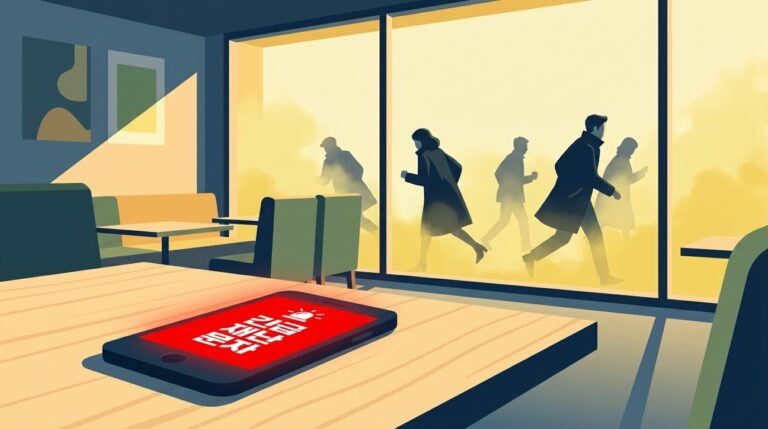
Picture this: You’re at a hip, industrial-style cafe in Seongsu-dong, sipping on an iced Americano. The vibe is immaculate, the playlist is pure K-R&B, and suddenly… BEEEEEP! BEEEEEP!
Every single smartphone in the cafe goes off at the exact same terrifying pitch. It’s the infamous Korean Emergency Alert (재난문자). You freeze. Is it an earthquake? A zombie outbreak straight out of Train to Busan? You frantically try to translate the barrage of Korean characters on your screen, but Papago is struggling with the complex, formal terminology. Meanwhile, you look around, and the locals are… just taking another sip of their coffee?
Welcome to Korea, where public safety alerts are a daily occurrence, ranging from mundane heatwave warnings to heart-stopping emergencies like a Chemical Leak (화학 물질 누출).
As an advanced C2 learner, you already know your casual daily phrases. But if a real crisis hits—like the toxic gas scenario brilliantly portrayed in the hit K-Movie Exit (엑시트)—you need to instantly decode high-level, Sino-Korean (Hanja) disaster vocabulary. Relying on textbook translations during a crisis isn’t just inconvenient; it’s dangerous.
This guide is built on real experiences of expats who survived the initial panic of Korean emergency alerts. Let’s upgrade your survival Korean so you can navigate a crisis with the cool, calm Nunchi of a true local.
Phase 2: Core Expressions Deep Analysis
When a chemical leak occurs, official broadcasts and alerts switch to a highly rigid, bureaucratic register of Korean. Let’s break down the three lifesavers.
1. 화학 물질 누출이 발생했으니 대피소로 이동하시기 바랍니다.
- Pronunciation: hwahak muljil nuchuri balsaenghaesseuni daepisoro idonghasigi baramnida.
- Sound-alike guide: hwah-hak mul-jil noo-chool-ee bal-saeng-haess-euni dae-pee-so-ro ee-dong-ha-shee-gee ba-ram-nee-da. (Think of the crisp, robotic cadence of a subway announcer).
- Meaning: (Literal) As a chemical substance leak has occurred, we hope you relocate to the evacuation shelter. / (Real nuance) Toxic leak! Evacuate to a shelter IMMEDIATELY.
- K-Culture Moment: You’ll hear this exact sentence structure echoing from apartment complex loudspeakers (관리사무소 방송) or subway PA systems. It’s the ultimate “serious business” tone in Korea.
- Editor’s Insight: Notice the use of ~하시기 바랍니다 (please do ~). Even when your life is in imminent danger, Korean officialdom maintains a polite, distancing formality. It’s an institutional command masked as a polite request.
- Situation Spectrum:
- Official Broadcasts (Emergency): ✅
- Talking to a friend (Casual): 🚫
- Giving directions to a crowd (Formal/Urgent): ⚠️
- 🤔 Think About It: Why does the Korean government use highly formal, emotionless language (~하시기 바랍니다) instead of direct, urgent commands (e.g., “Run!”) during a crisis? How does this compare to emergency protocols in your home country?
2. 유독 가스가 퍼지고 있으니, 창틀을 테이프로 밀폐하세요.
- Pronunciation: yudok gaseuga peojigo isseuni, changteureul teipeuro milpyehaseyo.
- Sound-alike guide: yoo-dok gas-uh-ga puh-jee-go iss-euni, chang-teul-eul tape-uh-ro meel-pyeh-ha-se-yo.
- Meaning: (Literal) As toxic gas is spreading, please seal the window frames with tape. / (Real nuance) Tape your windows shut to stop the poison gas from getting in.
- K-Culture Moment: This is a classic scene from K-Disaster movies. Characters frantically taping up windows in a high-rise apartment while the camera pans out to show a yellow smog engulfing Seoul.
- Editor’s Insight: The word 밀폐 (milpye – sealing/airtight) is a C2-level Hanja word. In daily life, you’d just say “꽉 닫다” (close tightly), but disaster instructions use highly specific, technical terms to ensure absolute clarity and zero legal ambiguity.
- Situation Spectrum:
- Official Instructions (Formal): ✅
- News Reports (Formal): ✅
- Screaming at your roommate (Casual): 🚫
- 🤔 Think About It: “밀폐” is used over “꽉 닫다”. How does the reliance on Sino-Korean (Hanja) words in official Korean affect the accessibility of information for children or foreigners during a disaster?
3. 젖은 수건으로 호흡기를 막고 바람의 반대 방향으로 피하십시오.
- Pronunciation: jeojeun sugeoneuro hoheupgireul makgo baramui bandae banghyangeuro pihasipsio.
- Sound-alike guide: juh-jeun soo-gun-eu-ro ho-heup-gee-reul mak-go ba-ram-eh ban-dae bang-hyang-eu-ro pee-ha-ship-see-oh.
- Meaning: (Literal) Block your respiratory tract with a wet towel and escape in the opposite direction of the wind. / (Real nuance) Cover your nose and mouth with a wet towel and run cross-wind!
- K-Culture Moment: Every Korean learns this in their mandatory school fire drills (소방훈련) and Civil Defense training (민방위). It’s practically muscle memory for Korean men who have served in the military.
- Editor’s Insight: “호흡기” (respiratory system) instead of “코와 입” (nose and mouth) is another example of clinical terminology. Also, note the ~하십시오 ending—the highest level of formal command, rarely used in daily conversation but standard for public safety.
- Situation Spectrum:
- Emergency Manuals: ✅
- Safety Training Seminars: ✅
- Daily Conversation: 🚫
- 🤔 Think About It: Korea has a highly militarized history, resulting in routine, nationwide Civil Defense drills. Does your country have similar nationwide, coordinated disaster training embedded in daily civilian life?
Phase 3: Textbook vs. Real Korean
When the siren wails, nobody uses textbook Korean. Here is how the clinical language transforms into real, adrenaline-fueled street Korean.
[Telling your friend about the alert]
* 📖 Textbook Korean: 현재 유독 화학 물질이 누출되었습니다.
* 🗣️ Real Korean: 야, 근처 공장에서 가스 샜대! (Hey, they say gas leaked from a nearby factory!)
* 💡 Why the difference?: Koreans use the quoted speech “~대” (short for 다고 해) to rapidly relay information they just read on an alert or heard from someone else.
[Commanding an immediate evacuation]
* 📖 Textbook Korean: 신속하게 대피소로 이동하시기 바랍니다.
* 🗣️ Real Korean: 당장 나가! 빨리 튀어! (Get out right now! Bounce!)
* 💡 Why the difference?: “튀다” is a common slang meaning “to run away/bounce.” In a life-or-death situation, politeness levels (존댓말) drop instantly among friends or even strangers to prioritize raw speed.
[Instructing to block the gas]
* 📖 Textbook Korean: 창문을 밀폐하십시오.
* 🗣️ Real Korean: 문 틈 싹 다 막아! (Block up all the door gaps!)
* 💡 Why the difference?: Replacing the Hanja word “밀폐” with native Korean verbs “막다” (to block) and “싹 다” (slang for “completely/all of it”) makes it actionable and visceral.
Bottom Note: At the
C2level, knowing both the high-register Hanja terminology (to understand the alerts) and the visceral slang (to communicate with panicked friends) is the mark of true fluency.
Phase 4: Cultural Context — K-Culture Deep Dive
4-1. The Non-Verbal “Nunchi” of a Disaster
In Korea, Nunchi (눈치) saves lives. When an emergency text arrives, observe the “Ajumma Index.” If older Korean women (Ajummas) simply glance at their phones and continue eating their Samgyeopsal, it’s likely just a fine dust (미세먼지) warning. However, if the locals suddenly stop talking, grab their coats, and head for the stairs without waiting for the bill—do not ask questions. Just follow them. You are witnessing peak survival Nunchi.
4-2. The “Exit” Reality (Media vs. Real Life)
If you’ve watched the movie Exit (엑시트) starring Jo Jung-suk and Yoona, you know the premise: a lethal chemical gas fills the streets of Seoul, forcing the heroes to parkour their way up to the highest rooftops.
Critical Perspective: While the movie is thrilling, it highlights a real, controversial issue in modern Korea. In the drama, reaching the rooftop saves them. In reality, many apartment and commercial building rooftops in Korea are strictly locked to prevent suicides or trespassing. In recent years, due to fire and chemical leak safety concerns, there has been a massive push to install automatic door-release systems tied to fire alarms. So, if you ever find yourself in a chemical leak scenario, moving to higher ground is indeed the correct protocol (as many toxic gases are heavier than air), but be prepared that not every K-Drama rooftop escape is possible in real life!
Phase 5: Real-Life Roleplay Scenario
Setting: It’s 10 PM on a Friday. You are inside a massive, windowless underground PC Bang (PC방) in Gangnam with your Korean gamer friend, Min-jae. The air smells heavily of ramen and energy drinks. Suddenly, everyone’s phone screeches with the emergency alert sound.
Characters:
– YOU: An expat who reads Korean well but is currently hyper-focused on your game.
– Min-jae (28, Local Friend): A Seoul native who is usually unbothered by alerts, but something feels different this time.
Dialogue:
Min-jae: 아 씨, 한타 중인데 재난문자 뭐야? 알림 좀 꺼놔야지.
(A ssi, hanta jung-inde jaenanmunja mwoya? allim jom kkeonwayaji.)
[Ugh, we’re in the middle of a team fight, what’s with this emergency alert? I need to turn these notifications off.]
(🎭 Stage Direction: Min-jae aggressively clicks his mouse, annoyed by the interruption)
YOU: 야, 이번엔 좀 긴급 같은데? ‘화학 물질 누출’이라고 쓰여 있어.
(Ya, ibeonen jom gingeup gateunde? ‘hwahak muljil nuchul’irago sseuyeo isseo.)
[Hey, this one looks urgent though? It says ‘Chemical substance leak’.]
Min-jae: 에이, 또 어디 공장에서 가스 조금 샜나 보지. 강남역 한복판인데 뭔 일 있겠어?
(Ei, tto eodi gongjang-eseo gaseu jogeum saenna boji. gangnamyeok hanbokaninde mwon il itgesseo?)
[Ah, probably just a little gas leaked at some factory again. We’re right in the middle of Gangnam, what could happen?]
YOU: 아니, 자세히 봐봐. ‘인근 주민은 즉시 고지대로 대피하십시오’래.
(Ani, jasehi bwabwa. ‘ingeun jumin-eun jeuksi gojidaero daepihasipsio’rae.)
[No, look closely. It says ‘Nearby residents must immediately evacuate to higher ground’.]
(🎭 Stage Direction: People around you start taking off their headsets. A faint smell of something acidic hits the air)
Min-jae: 헐… 야, 냄새 안 나냐? 진짜 샜나 봐. 어떻게 해?
(Heol… ya, naemsae an nanya? jinjja saenna bwa. eotteoke hae?)
[Whoa… hey, do you smell that? It really must have leaked. What do we do?]
🔀 Your Turn! How do you respond?
– A) “빨리 지하철역으로 도망치자! 방독면 있을 거야!” (Let’s run to the subway station! There’ll be gas masks!)
– B) “문자에서 고지대로 가라잖아! 우리 지하니까 무조건 위로 뛰어야 돼!” (The text said go to higher ground! We’re underground, we have to run UP no matter what!)
– C) “사장님한테 환풍기 좀 세게 틀어달라고 하자.” (Let’s ask the owner to turn up the ventilation fan.)✅ Best Choice: B — Reasoning: You correctly comprehended the C2 vocabulary “고지대” (high ground/altitude). Since chemical gases often sink, running into an underground subway station (Choice A) could be a fatal trap, even if there are gas masks there. Turning on ventilation (Choice C) will just suck the toxic gas inside.
YOU: 문자에서 고지대로 가라잖아! 우리 지하니까 무조건 위로 뛰어야 돼! 겉옷으로 입 막아!
(Munjaeseo gojidaero garajana! uri jihanikka mujogeon wiro ttwieoya dwae! geotoseuro ip maga!)
[The text said to go to higher ground! We’re underground, so we absolutely have to run up! Cover your mouth with your jacket!]
Min-jae: 알았어! 야, 계단 쪽으로 뛰어!
(Arasseo! ya, gyedan jjogeuro ttwieo!)
[Got it! Hey, run towards the stairs!]
Phase 6: 10-Second Shadowing Drill
Practice the official announcer’s cadence. This helps you instantly recognize the tone in a real emergency.
🚨 [단호하고 침착하게 / Firm and Calm]
현재 / 인근 화학 공장에서 / 유독 물질 누출이 / 의심되오니, /
(hyeonjae / ingeun hwahak gongjang-eseo / yudok muljil nuchuri / uisimdoeoni, /)
주민 여러분은 / 젖은 수건으로 / 호흡기를 보호하고, / 즉시 / 대피하시기 바랍니다.
(jumin yeoreobuneun / jeojeun sugeoneuro / hoheupgireul bohohago, / jeuksi / daepihasigi baramnida.)
Phase 7: K-Culture Mini Dictionary
| 한국어 | Romanization | English | Cultural Context |
|---|---|---|---|
| 재난문자 | jaenan munja | Emergency Alert Text | The loud, vibrating push notifications sent by the government. Overuse has led to “alert fatigue” among Koreans. |
| 방독면 | bangdongmyeon | Gas Mask | Found in literal glass cabinets on every subway platform in Korea, a stark reminder of the country’s armistice status. |
| 대피소 | daepiso | Evacuation Shelter | Usually designated basements or subway stations. Look for the official green and yellow “대피소” signs on buildings. |
| 민방위 | minbangwi | Civil Defense | Mandatory disaster/war readiness training for Korean men who have completed active military duty. |
| 고지대 | gojidae | High Ground | Essential vocabulary for flood or chemical leak situations. Opposed to 저지대 (low ground). |
Phase 8: Traveler’s Survival Kit
Even as an advanced learner, panic can freeze your brain. Memorize these survival lines for disaster navigation.
🆘 Survival Expressions
– 🇰🇷 “이 근처에 가장 가까운 대피소가 어디예요?” (i geuncheo-e gajang gakkaun daepisoga eodiyeyo?)
– 🗣️ English meaning: Where is the nearest evacuation shelter around here?
– 📍 Where to use: Asking police officers, subway workers, or locals on the street.
– 💡 Pro Tip: If you can’t speak, look for the app “안전디딤돌” (Emergency Ready App). It’s the official government app that provides alerts in English and maps out shelters.📌 Editor’s Travel Note
– Subway Gas Masks: In every Korean subway station, you will see a cabinet labeled 구호용품 (Relief Supplies). Inside are flashlights, water, and gas masks. They are NOT locked with a key—you just smash the plastic or turn the emergency knob to open it.
– Air Raid Sirens: On the 15th of certain months, Korea conducts nationwide Civil Defense drills. Sirens will wail, and traffic is stopped for 15 minutes. Don’t panic; just wait it out in a cafe.
Phase 9: Critical Thinking — “One Step Deeper”
🧠 Think Deeper: The Illusion of Safety — Media vs. Reality
Korea is often lauded as one of the safest countries in the world; you can leave your laptop at a cafe, and no one will touch it. However, this high level of social trust sometimes breeds a dangerous complacency regarding institutional disasters. Because Koreans receive jaenan munja (emergency texts) almost daily for minor things like heavy rain warnings or local COVID cases, a phenomenon known as “Alert Fatigue (안전 불감증 – Insensibility to safety)” is widespread.
When a real disaster strikes—like a chemical leak or a tragic crowd crush—this fatigue can delay reaction times. K-Dramas often depict a highly coordinated government response sweeping in to save the day, but reality requires individuals to have sharp critical thinking and an independent survival instinct. The language used in these alerts is so clinical and heavily reliant on Hanja that it fails to convey the raw urgency needed to break through this societal complacency.
💬 Your Turn: Does your country experience “Alert Fatigue”? How do people in your culture react when a public alarm goes off? Share your thoughts in the comments!
Phase 10: FAQ & Avoiding Mistakes
Q: Should I always follow the crowd when an alert goes off?
A: Maybe. Nunchi is great for gauging the mood, but don’t blindly follow the crowd into a confined space during a chemical leak. Trust official instructions regarding wind direction and altitude first.
Q: Can I use “~하시기 바랍니다” when giving instructions to my coworkers in an emergency?
A: No. That phrasing sounds like an automated robot. If you need to warn coworkers, use “~해야 돼요!” (We have to ~!) or “빨리 피하세요!” (Evacuate quickly!).
❌ Common Mistake #1: Confusing the type of shelter needed.
Many expats assume “disaster = go underground (지하).” While true for bombings or tornadoes, running underground during a toxic gas leak (which is often heavier than air) or a flood is incredibly dangerous. Always check if the alert says “고지대” (high ground) or “지하 대피소” (underground shelter).❌ Common Mistake #2: Relying entirely on machine translation during an alert.
Translators can hallucinate or mistranslate complex Hanja terms under pressure. Memorize the keywords: 누출 (leak), 대피 (evacuate), 밀폐 (seal), and 호흡기 (respiratory tract).
Phase 11: Summary & Action Items
One-Liner Summary: Surviving a crisis in Korea requires decoding the highly formal, Hanja-heavy language of emergency alerts while using quick, visceral slang to mobilize those around you.
Action Mission 3 Steps:
– 🥉 Bronze (Solo): Download the “안전디딤돌 (Emergency Ready App)” on your phone right now. It provides Korean alerts in English.
– 🥈 Silver (Online): Look up a clip of the K-Movie Exit (엑시트) on YouTube and try to pick out the disaster vocabulary they use.
– 🥇 Gold (Action): The next time you take the Korean subway, locate the “구호용품” (Relief Supplies) cabinet and mentally note how to open it.
💬 Engagement: Have you ever received a terrifying emergency alert while traveling? What was your initial reaction? Let me know below!
Phase 12: Quiz — Interactive Challenge
1. Situational Judgment:
You receive an alert: “인근 공장 화학 물질 누출. 즉시 창문을 밀폐하십시오.” What should you do in your apartment?
– A) Open the windows to let the fresh air in.
– B) Grab some tape and seal the gaps in your windows completely shut.
– C) Run down to the underground parking lot.
2. Fill in the Blank:
To tell your friend to run away quickly using real Korean slang, you say: “빨리 ( _____ )!”
– A) 이동하시기 바랍니다
– B) 튀어
– C) 걸어가
3. True or False — K-Culture Edition:
In Korea, you need a special key provided by the station master to open the gas mask cabinets in the subway. (T/F)
(Answers: 1. B, 2. B, 3. False – They are designed to be opened easily in an emergency without a key by breaking the seal or turning a knob.)
Frequently Asked Questions (FAQ)
Q: What does "화학 물질 누출이 발생했으니 대피소로 이동하시기 바랍니다." mean in Korean and how do you pronounce it?
A: In Korean, "화학 물질 누출이 발생했으니 대피소로 이동하시기 바랍니다." is pronounced [hwahak muljil nuchuri balsaenghaesseuni daepisoro idonghasigi baramnida.] and means: (Literal) As a chemical substance leak has occurred, we hope you relocate to the evacuation shelter. / (Real nuance) Toxic leak! Evacuate to a shelter IMMEDIATELY.
Q: What does "유독 가스가 퍼지고 있으니, 창틀을 테이프로 밀폐하세요." mean in Korean and how do you pronounce it?
A: In Korean, "유독 가스가 퍼지고 있으니, 창틀을 테이프로 밀폐하세요." is pronounced [yudok gaseuga peojigo isseuni, changteureul teipeuro milpyehaseyo.] and means: (Literal) As toxic gas is spreading, please seal the window frames with tape. / (Real nuance) Tape your windows shut to stop the poison gas from getting in.
Q: What does "젖은 수건으로 호흡기를 막고 바람의 반대 방향으로 피하십시오." mean in Korean and how do you pronounce it?
A: In Korean, "젖은 수건으로 호흡기를 막고 바람의 반대 방향으로 피하십시오." is pronounced [jeojeun sugeoneuro hoheupgireul makgo baramui bandae banghyangeuro pihasipsio.] and means: (Literal) Block your respiratory tract with a wet towel and escape in the opposite direction of the wind. / (Real nuance) Cover your nose and mouth with a wet towel and run cross-wind!







