

Phase 1: Empathy (The K-Culture Cold Open)
Hello! I’m the Lead Editor at Daily Hangul.
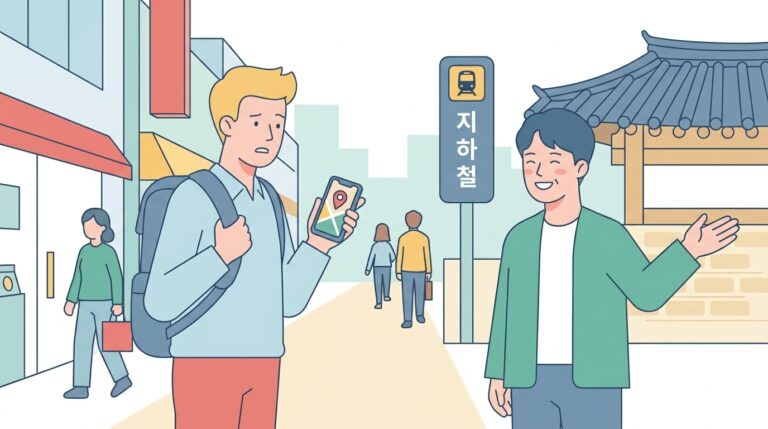
Picture this: You are standing in the middle of a bustling street in Myeongdong. Your map app says “You have arrived,” but all you see is an endless sea of neon signs and cosmetic shops. The cafe you’re looking for is nowhere to be found. You finally gather the courage to stop a busy-looking local. You expect them to just point and walk away. Instead, they look at your phone, nod, and say, “Follow me.” They walk you three blocks, right to the cafe’s doorstep, smile, and disappear into the crowd.
If you’ve watched K-Dramas, you might have seen a scene where a kind stranger (or the handsome male lead) takes a lost person by the wrist and leads them to their destination. You might think, “That only happens in dramas!” But in Korea, this happens in real life all the time.
This isn’t just basic politeness; this is Jeong (정)—the deep, invisible cultural thread of warmth, connection, and collective responsibility in Korea. When someone asks for help, Jeong kicks in.
But to unlock this magic, you need to know how to ask! Today, we’re not just learning left and right; we’re learning how to navigate the streets of Korea like a true insider.
Phase 2: Deep Dive into Core Expressions
1. 저기요, 길 좀 물어봐도 될까요?
- Pronunciation: Jeogiyo, gil jom mureobwado doelkkayo? [juh-gee-yo, geel johm moo-ruh-bwa-doh dwel-kka-yo?]
- Meaning: Excuse me, can I ask for directions? (Literal: Excuse me, is it okay if I ask the road a little?)
- K-Culture Moment: This is your golden icebreaker. In Korea, you don’t just say “Hello” to a stranger on the street. You start with “Jeogiyo” (Excuse me / Hey there).
- Editor’s Insight: Think of “Jeogiyo” as a gentle tap on the shoulder. It gets their attention politely. Adding “jom” (a little) softens your request, making you sound less demanding and more approachable.
- Situation Spectrum:
- Casual (Strangers your age): ✅
- Semi-formal (Shop owners): ✅
- Formal (Elderly people): ⚠️ (Better to use “어르신, 죄송하지만…” – Sir/Madam, excuse me but…)
- 🤔 Think About It: Why do Koreans use words like “a little” (좀) when asking for favors? How does softening a request relate to the concept of Nunchi (reading the room)?
2. 이쪽으로 쭉 가세요
- Pronunciation: Ijjogeuro jjuk gaseyo [ee-jjoh-goo-roh jjook gah-seh-yo]
- Meaning: Go straight this way.
- K-Culture Moment: You’ll hear this constantly from taxi drivers and locals. “Jjuk” is an onomatopoeic word that means “straight ahead without stopping.”
- Editor’s Insight: Listen to how people say “jjuk.” If they say “jjjuuuuuk,” it means you have to walk for a long time!
- Situation Spectrum:
- Casual: ✅
- Semi-formal: ✅
- Formal: ✅
- 🤔 Think About It: Does your language have words where stretching the sound changes the meaning (like far vs. faaaaar)?
3. 제가 데려다 드릴게요 (The Ultimate ‘Jeong’ Phrase)
- Pronunciation: Jega deryeoda deurilkkeyo [jeh-gah deh-ryuh-dah doo-reel-kkeh-yo]
- Meaning: I’ll take you there. / I’ll walk you there.
- K-Culture Moment: You’re lost in a subway station, looking completely bewildered. A kind college student approaches you and drops this line.
- Editor’s Insight: This phrase is the absolute embodiment of Jeong. Rather than giving complicated directions, they take responsibility for your journey. If you hear this, you’ve just experienced true Korean warmth!
- Situation Spectrum:
- Casual: ✅
- Semi-formal: ✅
- Formal: ✅
- 🤔 Think About It: In your home country, if a stranger offered to walk you to your destination, how would you feel? Is it seen as kind or suspicious? In Korea, it’s a common act of hospitality.
Phase 3: Textbook vs. Real Korean
[Situation 1: Stopping someone on the street]
* 📖 Textbook Korean: 실례합니다. (Sillyehamnida – Excuse me, I am committing a rudeness.)
* 🗣️ Real Korean: 저기요! (Jeogiyo – Over there / Excuse me!)
* 💡 Why is it different?: “실례합니다” sounds like you are about to ask a very formal, serious question. “저기요” is the universal, casual attention-grabber used everywhere from streets to restaurants.
[Situation 2: Asking where something is]
* 📖 Textbook Korean: 서울역은 어디에 있습니까? (Seoulyeogeun eodie itseumnikka? – Where is Seoul Station located?)
* 🗣️ Real Korean: 서울역 어떻게 가요? (Seoulyeok eotteoke gayo? – How do I go to Seoul Station?)
* 💡 Why is it different?: Koreans prefer action-oriented questions. Instead of asking for the abstract location, they ask for the method to get there.
[Situation 3: Giving Directions]
* 📖 Textbook Korean: 동쪽으로 100미터 가십시오. (Dongjjogeuro baengmiteo gasipsio – Go 100 meters to the east.)
* 🗣️ Real Korean: 저기 다이소 보이죠? 다이소 끼고 도세요. (Jeogi daiso boijyo? Daiso kkigo doseyo – You see that Daiso over there? Turn at the Daiso.)
* 💡 Why is it different?: Korean addresses and streets can be complex, so locals rely heavily on prominent landmarks (like Daiso, Olive Young, or Starbucks) to navigate.
Bottom Note: For A2 learners, sticking to “[Place] 어떻게 가요?” (How do I go to [Place]?) is your ultimate cheat code. It’s polite, natural, and works every single time!
Phase 4: Cultural Context — K-Culture Deep Dive
4-1. Non-Verbal Elements: The “Open Hand” Point
In Korea, pointing with a single index finger can sometimes be perceived as rude or aggressive, especially toward older people. When giving directions, Koreans will often use an open palm, facing upward, gesturing in the direction you need to go. It looks like they are presenting the road to you on a silver platter!
4-2. K-Travel & The “Map App” Reality
The Google Maps Trap:
If you’re planning a trip to Korea, here is a survival secret: Google Maps doesn’t work well for walking directions in Korea due to national security laws regarding map data.
If you ask a local for directions, they won’t open Google Maps. They will immediately pull out Naver Map (네이버 지도) or KakaoMap (카카오맵).
Survival Tip: Handing your phone with Naver Map open to a local and pointing at the screen while looking slightly desperate is a universally understood language. They will gladly help you figure it out!
Phase 5: Real-Life Roleplay Scenario
Setting: Friday evening, 6:30 PM. Exit 9 of Hongdae Station. It’s incredibly crowded. You are trying to find a famous BBQ restaurant your friend recommended, but the alleys all look the same. You spot a friendly-looking local holding an iced Americano.
Characters:
– YOU: A traveler exploring Hongdae for the first time.
– Min-ji (25): A local university student waiting for her friends.
Dialogue:
YOU: 저기요… 길 좀 물어봐도 될까요? 🗺️
(Jeogiyo… gil jom mureobwado doelkkayo?)
[Excuse me… can I ask for directions?]
Min-ji: 네, 어디 찾으세요?
(Ne, eodi chajeuseyo?)
[Yes, where are you looking for?]
YOU: 여기 ‘돼지상회’ 어떻게 가요?
(Yeogi ‘Dwaejisanghoe’ eotteoke gayo?)
[How do I get to ‘Dwaejisanghoe’ here?]
(🎭 Stage Direction: You show her your phone screen with the restaurant name.)
Min-ji: 아, 돼지상회요! 여기서 쭉 가다가… 음…
(Ah, Dwaejisanghoeyo! Yeogiseo jjuk gadaga… eum…)
[Ah, Dwaejisanghoe! You go straight from here, and then… um…]
(🎭 Stage Direction: Min-ji looks down the alley, clearly realizing it’s complicated to explain.)
Min-ji: 저도 그쪽으로 가요. 제가 데려다 드릴게요!
(Jeodo geujjogeuro gayo. Jega deryeoda deurilkkeyo!)
[I’m going that way too. I’ll take you there!]
🔀 Your Turn! How should you respond?
– A) “아니요, 괜찮아요. 저 혼자 갈 수 있어요.” (No, it’s okay. I can go alone.)
– B) “진짜요? 아, 너무 감사합니다!” (Really? Ah, thank you so much!)
– C) “왜요?” (Why?)✅ Best Choice: B — Reason: Accept the Jeong! Expressing pleasant surprise (“진짜요?” – Really?) followed by gratitude is the perfect way to acknowledge their kindness.
⚠️ Choice A & C Analysis: ‘A’ might sound a bit cold, rejecting their kind offer too bluntly. ‘C’ sounds suspicious and defensive, which might offend their good intentions.
YOU: 진짜요? 아, 너무 감사합니다! ✨
(Jinjjayo? Ah, neomu gamsahamnida!)
[Really? Ah, thank you so much!]
Min-ji: 아니에요. 한국 여행 처음이세요?
(Anieyo. Hanguk yeohaeng cheoeumiseyo?)
[Not at all. Is it your first trip to Korea?]
YOU: 네, 길 찾기가 조금 어려워요.
(Ne, gil chatgiga jogeum eoryeowoyo.)
[Yes, finding the way is a bit difficult.]
Min-ji: 맞아요, 홍대가 길이 좀 복잡해요. 다 왔어요! 저기 2층이에요.
(Majayo, Hongdaega giri jom bokjaphaeyo. Da wasseoyo! Jeogi icheungieyo.)
[Right, Hongdae streets are a bit complicated. We are here! It’s on the 2nd floor over there.]
YOU: 우와, 정말 감사합니다. 좋은 하루 보내세요!
(Uwa, jeongmal gamsahamnida. Joeun haru bonaeseyo!)
[Wow, thank you so much. Have a great day!]
Min-ji: 네, 맛있게 드세요!
(Ne, masitge deuseyo!)
[Yes, enjoy your meal!]
Phase 6: 10-Second Shadowing Drill
Practice reading this out loud. Pay attention to the pauses (/) and the emotion tags!
🥺 저기요, / 명동역은 / 어떻게 가요?
(Jeo-gi-yo, / myeong-dong-yeo-geun / eo-tteo-ke ga-yo?)
[Excuse me, how do I go to Myeongdong Station?]
Coach’s Tip: Make your voice go slightly up at the end of “가요?” (ga-yo?). Sound a little lost and polite, and the locals will practically rush to help you!
Phase 7: K-Culture Mini Dictionary
| 한국어 (Korean) | Romanization | English | Cultural Context |
|---|---|---|---|
| 정 | jeong | Deep affection/Connection | The collective emotional bond that makes Koreans go out of their way to help strangers. |
| 길치 | gilchi | Bad with directions | A funny slang term combining ‘길’ (road) and ‘치’ (person lacking a skill). “저 길치예요” (I am bad with directions). |
| 핫플 | hatpeul | Hot place | Short for ‘Hot Place’. A trendy spot everyone is visiting (cafes, pop-ups). |
| 쭉 | jjuk | Straight (Sound word) | Used heavily when telling someone to keep walking in a straight line without turning. |
Phase 8: Traveler’s Survival Kit
🆘 Survival Expressions for Getting Lost
– 🇰🇷 “여기 어딘지 아세요?” (Yeogi eodinji aseyo?)
– English: Do you know where this is?
– 📍 Where to use: When showing a picture or address on your phone.
– 🇰🇷 “[장소] 가주세요.” ([Place] gajuseyo.)
– English: Please go to [Place].
– 📍 Where to use: The ultimate Taxi survival phrase. Just add the place name!
– 🇰🇷 “걸어서 얼마나 걸려요?” (Georeoseo eolmana geollyeoyo?)
– English: How long does it take on foot?📌 Editor’s Travel Note
– Must-Have Apps: Delete Google Maps for walking in Korea. Download Naver Map or KakaoMap (both have English settings!). Also, Subway Korea is a lifesaver for navigating the massive metro system.
– Address System: Korea uses a road-name address system, but many older places are still known by their neighborhood (Dong) names. If you are lost, finding the nearest Subway Station Exit (e.g., “Gangnam Station Exit 3”) is the absolute best meeting point.
Phase 9: Critical Thinking — “One Step Deeper”
Media vs Reality & The Fast-Paced City (미디어 vs 현실)
🧠 Think Deeper:
Have you noticed that Koreans rarely use street names (like “Walk down Elm Street”) when giving directions? Instead, they rely heavily on landmarks: “Turn at the Olive Young,” or “Go past the CU convenience store.”Why? Korea rebuilt itself incredibly fast over the past few decades. Neighborhoods change, buildings are torn down and rebuilt, and street names can feel abstract. Landmarks are visual, immediate, and practical. Furthermore, the act of saying “I’ll take you there” (제가 데려다 드릴게요) reflects Jeong—a subconscious feeling that “since you asked me, you are now my responsibility until you are safe.”
💬 Your Turn: In your culture, how do people usually give directions? Do they use North/South/East/West, street names, or landmarks? Tell us in the comments!
Phase 10: FAQ & Avoiding Misunderstandings
Q: Can I just thrust my phone into someone’s face to ask for directions?
No! While showing your phone is great, always, always say “저기요” (Jeogiyo) or “죄송한데요” (Joesonghandeyo – I’m sorry but…) first to be polite.
Q: If a Korean offers to walk me there, do I have to tip them?
Absolutely NOT! Korea is a strict no-tip culture. Tipping someone who helped you out of Jeong might actually confuse or offend them. A big smile and “정말 감사합니다!” (Thank you so much!) is the best payment.
❌ Common Mistake #1: Asking “어디에 있어요?” (Where is it?) for places that are far away.
✅ Do this instead: Use “어떻게 가요?” (How do I get there?). It prompts the listener to give you the method of travel (subway, bus, walking), which is much more helpful!
Phase 11: Summary & Action Items
🎯 One-Liner Summary: To ask for directions like a pro, grab their attention with “Jeogiyo,” ask “어떻게 가요?”, and embrace the warm culture of Jeong if they offer to guide you!
🔥 Action Mission:
– 🥉 Bronze (Solo): Stand in front of a mirror and practice asking your reflection: “저기요, 서울역 어떻게 가요?”
– 🥈 Silver (Online): Open Google Street View (or Naver Map street view) of a Korean street, imagine you are lost, and say the phrases out loud.
– 🥇 Gold (Real Life): Download Naver Map right now and try searching for your favorite K-Drama filming location or K-Pop agency in English!
💖 K-Culture Mission:
The next time you watch a K-Drama, pay close attention to the street scenes. Can you spot someone using a map app or giving directions by pointing with an open hand?
Phase 12: Interactive Quiz
1. Fill in the Blank:
You want to politely get someone’s attention on the street to ask for directions.
“_____, 길 좀 물어봐도 될까요?”
A) 안녕 (Annyeong)
B) 야 (Ya)
C) 저기요 (Jeogiyo)
2. True or False – K-Culture Edition:
“If a local walks you to your destination, it is polite to give them a $5 tip to show appreciation.”
(T / F)
3. Situational Judgment:
You show your map to a local, and they say: “저도 그쪽으로 가요. 제가 데려다 드릴게요!”
What does this mean?
A) “I am also lost. Let’s find it together.”
B) “I’m going that way too. I’ll walk you there!”
C) “Go straight and turn left.”
(Answers: 1: C, 2: False – No tipping in Korea!, 3: B)
Leave your scores in the comments below! Stay safe, never be afraid to ask for help, and experience the beauty of Jeong. 화이팅 (Fighting)! 🇰🇷✨
Frequently Asked Questions (FAQ)
Q: What does "저기요, 길 좀 물어봐도 될까요?" mean in Korean and how do you pronounce it?
A: In Korean, "저기요, 길 좀 물어봐도 될까요?" is pronounced [Jeogiyo, gil jom mureobwado doelkkayo? [juh-gee-yo, geel johm moo-ruh-bwa-doh dwel-kka-yo?] and means: Excuse me, can I ask for directions? (Literal: Excuse me, is it okay if I ask the road a little?)
Q: What does "이쪽으로 쭉 가세요" mean in Korean and how do you pronounce it?
A: In Korean, "이쪽으로 쭉 가세요" is pronounced [Ijjogeuro jjuk gaseyo [ee-jjoh-goo-roh jjook gah-seh-yo] and means: Go straight this way.
Q: What does "제가 데려다 드릴게요 (The Ultimate 'Jeong' Phrase)" mean in Korean and how do you pronounce it?
A: In Korean, "제가 데려다 드릴게요 (The Ultimate 'Jeong' Phrase)" is pronounced [Jega deryeoda deurilkkeyo [jeh-gah deh-ryuh-dah doo-reel-kkeh-yo] and means: I'll take you there. / I'll walk you there.







