

Phase 1: Empathy (Immersive Opening)
Hello! I am the Lead Editor of Daily Hangul.
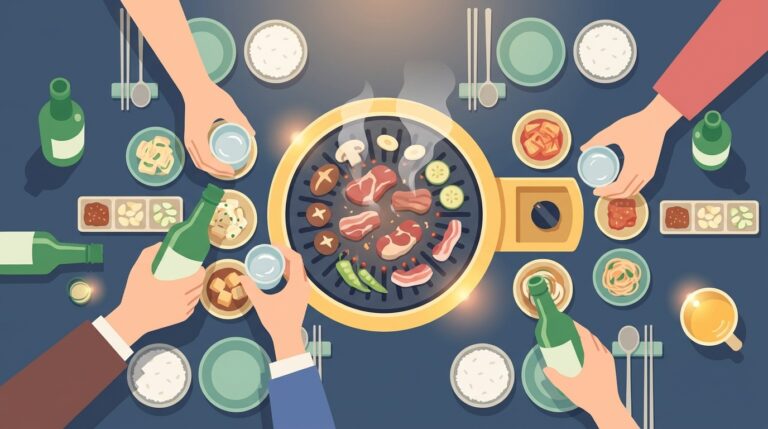
Picture this: You are watching a popular K-Drama like Misaeng (Incomplete Life) or Work Later, Drink Now. The scene shifts to a smoky Korean BBQ restaurant. Green soju bottles line the table, meat is sizzling on the grill, and suddenly, the boss stands up. He holds up a small glass, delivers a passionate one-liner, and shouts something. The entire table echoes his shout in perfect unison, clinking glasses, and downing their drinks. The subtitles simply read: “Cheers!”
But was it really just “Cheers”?
If you’ve ever worked in Korea, done business with Koreans, or simply gone out for drinks with local friends, you’ve likely encountered Hoesik (회식, Company Dinners). This isn’t just a meal; it’s an extension of the workplace, a bonding ritual, and sometimes, a test of your Nunchi (social awareness). At the heart of this ritual is the Geonbaesa (건배사, proposing a toast).
Not knowing how to navigate this moment might leave you awkwardly holding your glass, wondering when to drink. But mastering it? That makes you an instant “Inssa” (Insider). This guide is built from the real-life panic moments of my B2-level students who found themselves at a Gangnam BBQ joint, completely lost when their manager suddenly pointed at them and said, “Hey, why don’t you propose a toast?”
Let’s dive into the real, unfiltered world of Korean toasting culture.
Phase 2: In-Depth Analysis of Core Expressions
1. 위하여! (Wihayeo!)
- Pronunciation: [wi-ha-yeo] – ‘wi’ sounds like ‘we’, ‘ha’ like a laugh, ‘yeo’ sounds like the ‘yo’ in ‘yonder’.
- Meaning: Literal: “For…!” / Real nuance: “To our success!” or “Cheers!”
- K-Culture Moment: This is the ultimate K-Drama corporate dinner staple. Usually, a senior member will give a short speech about how hard everyone worked, then raise their glass and shout “Our team, wihayeo!” Everyone else raises their glasses and repeats “Wihayeo!”
- Editor’s Insight: This feels very traditional, slightly formal, and a bit dramatic. You wouldn’t use this at a casual pub with your best buddies; it’s reserved for group gatherings where a collective goal is being celebrated.
- Situation Spectrum:
- Close Friends (Casual): 🚫 (Too formal/cheesy)
- Coworkers (Semi-formal): ✅
- Boss/Elders (Formal): ✅
- 🤔 Think About It: Why does a toast in Korea sound like a battle cry for a shared goal? How does this reflect Korea’s collectivist corporate culture compared to individual-focused toasting in your home country?
2. 짠~ (Jjan~)
- Pronunciation: [jjan] – Make a sharp, tense ‘J’ sound, almost like a quick ‘Tz’. It’s an onomatopoeia for the sound of glasses clinking.
- Meaning: Literal: Clink! / Real nuance: “Cheers!” (Casual)
- K-Culture Moment: Think of K-Pop idols doing a casual live stream, having a late-night snack, holding up a can of beer to the camera and saying “Jjan!” to their fans.
- Editor’s Insight: This is arguably the most common way friends toast in Korea. It’s cute, casual, and friendly. It removes the heavy burden of a formal toast and just focuses on the joy of sharing a drink.
- Situation Spectrum:
- Close Friends (Casual): ✅
- Coworkers (Semi-formal): ⚠️ (Only if you are close and the vibe is very casual)
- Boss/Elders (Formal): 🚫
- 🤔 Think About It: “Jjan” is technically a sound effect. Do you use sound effects as actual verbs or greetings in your native language?
3. 원샷! (Won-syat!)
- Pronunciation: [won-syat] – Sounds like “One shot” but with a shorter, softer ‘t’ at the end. No hard English ‘T’ release.
- Meaning: Literal: One shot. / Real nuance: Bottoms up! (Drink it all in one go!)
- K-Culture Moment: The team is getting hyped. Someone mixes a perfect ‘Somaek’ (Soju + Beer), hands it to you, and the table starts chanting: “Won-syat! Won-syat!”
- Editor’s Insight: It’s pure Konglish (Korean-English). While it encourages downing your drink, modern Korean culture has become much more respectful of personal alcohol limits. You might hear it a lot, but you don’t have to empty your glass if you can’t.
- Situation Spectrum:
- Close Friends (Casual): ✅
- Coworkers (Semi-formal): ✅
- Boss/Elders (Formal): ⚠️ (Usually the boss says it to hype the team, not the other way around)
- 🤔 Think About It: When everyone is pressured to finish their drink at the exact same pace, what does this tell us about the desire for “group harmony” (and the potential downsides of it) in Korean social settings?
Phase 3: Textbook vs. Real Korean
Here is how what you learn in the classroom differs from what you hear at a bustling Hongdae pub or a Gangnam company dinner.
[Situation 1: Suggesting a Toast]
* 📖 Textbook Korean: 우리 다 같이 건배합시다. (Let us all toast together.)
* 🗣️ Real Korean: 자, 한잔 하시죠! (Right, let’s have a drink!)
* 💡 Why the difference?: Koreans use “자” (Ja – kind of like “Well then/Right”) to smoothly transition the mood and gather attention. “한잔 하다” (to have a glass) sounds much more natural and less robotic than explicitly announcing a “toast.”
[Situation 2: Hyping Up the Mood]
* 📖 Textbook Korean: 오늘 기분 좋게 술을 마십시다. (Let us drink happily today.)
* 🗣️ Real Korean: 오늘 한번 제대로 달려봅시다! (Let’s really run [drink hard] today!)
* 💡 Why the difference?: “달리다” literally means “to run,” but in Korean drinking slang, it means going all out and drinking continuously through the night (1st round, 2nd round, etc.). It reflects the high-energy, work-hard-play-hard culture.
Bottom Note: For B2 learners, using “자, 한잔 하시죠!” will instantly make you sound fluent and socially adept without stepping into overly aggressive slang territory.
Phase 4: Cultural Context — K-Culture Deep Dive
4-1. The Non-Verbal Rules of Hoesik
Language is only 50% of communication at a Korean company dinner. The rest is Nunchi (눈치) and body language.
* Two Hands Rule: When someone older or higher in rank pours a drink for you, always hold your glass with both hands. When you pour for them, hold the bottle with your right hand and lightly support your right elbow or forearm with your left hand.
* The Head Turn: In K-Dramas, you’ll often see a younger character turn their head away from their senior while taking a sip. This is a sign of respect—you never drink facing an elder directly.
* Never an Empty Glass: In Korea, pouring your own drink is considered mildly sad or bad luck (called 자첨 – Jacheom). You pour for others, and they pour for you. If you see a colleague’s glass is empty, you offer to fill it!
4-2. The K-Drama Connection
Let’s talk about the K-Drama trope. You’ve seen the scene in My Mister or Itaewon Class: The boss gives a long, emotional speech about the company’s struggles. The workers look deeply moved. The boss says, “For our future!” and the workers echo it.
* Critical View: While this happens, modern Hoesik is changing. Millennials and Gen Z workers in Korea often dislike the forced, emotional loyalty pledges of the past. Nowadays, toasts are becoming shorter, wittier, and less authoritative. Using a trendy acronym for a toast (like “마무리” – 마음 먹은 대로, 부설 없이, 리드하자!) is popular among middle managers trying to look ‘cool,’ though younger staff might secretly cringe!
Phase 5: Interactive Roleplay Scenario
Setting: Friday 7:30 PM. A lively Samgyeopsal (Pork Belly) restaurant in Yeouido. The smell of roasted meat fills the air. You are seated with your Korean team after completing a major project.
Characters:
– YOU: A foreign employee who has been working in Seoul for 6 months. You want to leave a good impression.
– Manager Kim (45, Boss): Strict at work but gets very sentimental after a few drinks.
– Min-su (30, Coworker): Your friendly desk-mate who is guiding you through your first Hoesik.
Dialogue:
Manager Kim: 자, 다들 잔 채우세요. 이번 프로젝트, 정말 고생 많았습니다.
(Ja, dadeul jan chae-useyo. Ibeon peurojekteu, jeongmal gosaeng maneat-seumnida.)
[Right, everyone fill your glasses. You all worked really hard on this project.]
(🎭 Stage Direction: Manager Kim stands up, holding his soju glass high.)
Min-su: (Whispering to you) 야, 눈치껏 빨리 잔 들어!
(Ya, nunchikkeot ppalli jan deureo!)
[Hey, read the room, raise your glass quickly!]
Manager Kim: 우리 글로벌 마케팅 팀의 완벽한 성공을…!
(Uri geullobeol maketing tim-ui wanbyeokan seonggong-eul…!)
[To the perfect success of our Global Marketing Team…!]
Manager Kim: 위하여!!!
(Wihayeo!!!)
[FOR!!! / CHEERS!!!]
🔀 Your Turn! How do you respond?
– A) (Sit still and take a sip quietly)
– B) “위하여!” (Shout it loudly with everyone, clink glasses, and turn your head slightly to drink)
– C) “오예! 짠~ 대박!” (Oh yeah! Jjan~ Daebak!)✅ Best Choice: B — Reason: In a formal Hoesik, echoing the “Wihayeo” is the standard protocol. Adding the polite head-turn shows you deeply understand Korean etiquette.
⚠️ Choice C Analysis: “Jjan” and “Daebak” are for close friends. Doing this in front of Manager Kim might make Min-su spit out his drink in shock!
Phase 6: 10-Second Shadowing Drill
Let’s practice a safe, polite, yet energetic phrase you can use if YOU are asked to make a toast.
😊 오늘 / 정말 / 수고하셨습니다! / 한잔 하시죠! / 위하여!
(oneul / jeongmal / sugo-hasyeot-seumnida! / hanjan hasijyo! / wihayeo!)
Focus:
– Pause at the / marks.
– Say “sugo-hasyeot-seumnida” with genuine gratitude.
– Raise your energy on “wihayeo!”
Phase 7: K-Culture Mini Dictionary
| Korean | Romanization | English | Contextual Meaning |
|---|---|---|---|
| 회식 | hoesik | Company Dinner | The Korean corporate tradition of eating and drinking together after work to build team bonding. |
| 건배사 | geonbaesa | Toasting Speech | A short speech made before drinking. Usually expected from the highest-ranking person, or playfully pushed onto the youngest! |
| 소맥 | somaek | Soju + Beer | A popular mixed drink (Soju + Maekju). The golden ratio is a serious point of pride for many Koreans. |
| 눈치 | nunchi | Social Sense | The subtle art of reading the room. Knowing when to pour a drink for the boss requires good Nunchi. |
| 막내 | maknae | The Youngest | The youngest or most junior team member. At a Hoesik, the Maknae often grills the meat and sets the table. |
Phase 8: Traveler Survival Kit
Even if you aren’t on a business trip, you will definitely visit a Korean BBQ restaurant or a pub while traveling in Korea. Here is your survival kit!
🆘 Survival Expressions for the Restaurant
– 🇰🇷 “여기요! 소주 한 병 더 주세요!” (Yeogiyo! Soju han byeong deo juseyo!)
– 🗣️ English: “Excuse me! One more bottle of soju, please!”
– 📍 Where to use: Any bustling Korean restaurant or pub.
– 💡 Pro Tip: Don’t just make eye contact. In a loud Korean BBQ place, you MUST raise your hand and confidently shout “Yeogiyo!” (Over here!). It’s not considered rude; it’s necessary.📌 Editor’s Travel Note
– Calling the staff: Look for a small call button (벨 – Bell) on your table. Pressing it is the most polite and efficient way to get service!
– Paying the bill: In Korea, you rarely ask for the check at the table. You take the bill to the front counter to pay on your way out.
– Tipping: DO NOT TIP. Tipping is not a part of Korean culture and might confuse the staff.
Phase 9: Critical Thinking Corner — “One Step Deeper”
Food, Drink, and Identity: The Psychology of “Pouring”
🧠 Think Deeper:
In many Western cultures, when you order a drink, it is your drink. You manage your own glass. However, in Korea, alcohol is almost always ordered in bottles to be shared. You pour for your neighbor, and they pour for you. This reflects the deep-rooted Korean concept of Jeong (정 – affection/bond) and collective identity. By never letting your companion’s glass go empty, you are silently saying, “I am looking out for you.” It shifts the focus from individual enjoyment to mutual care.💬 Your Turn: Does your culture have a specific dining or drinking ritual that forces people to look after one another? Share it with us in the comments!
Phase 10: FAQ & Common Mistakes
Q: “Can I use ‘Jjan~’ with my boss?”
No. Unless your boss is explicitly extremely casual and considers you a close personal friend, ‘Jjan’ is too cute and informal. Stick to clinking glasses silently or echoing their “Wihayeo!”
Q: “What if I don’t drink alcohol? Can I still attend a Hoesik?”
Yes! Korean drinking culture has evolved significantly. It is perfectly acceptable to fill your soju glass with water or Sprite (사이다) and simply clink glasses with everyone. The act of participating in the toast is what matters, not the alcohol itself.
❌ Common Mistake #1: Pouring your own drink at a group dinner.
✅ Do this instead: If you want a drink, pour for someone else first. They will immediately notice your glass is empty and pour for you in return. It’s the beautiful unspoken dance of Korean dining!
Phase 11: Summary & Action Items
One-Liner Summary: A successful Korean company dinner toast isn’t just about the words “Wihayeo” or “Jjan”; it’s about sharing the team’s energy, reading the room (Nunchi), and mutually looking after each other’s glasses.
Action Mission:
– 🥉 Bronze (Solo): Stand in front of a mirror with a cup of water, hold it with two hands, and practice saying “위하여!” with a bright smile.
– 🥈 Silver (Online): Leave a comment below translating “Cheers to our team!” into Korean.
– 🥇 Gold (Real Life): The next time you are with a Korean friend at a cafe or restaurant, initiate a clink by saying “짠~ (Jjan)!”
🎬 K-Culture Special Mission: Watch an episode of a Korean drama this week (like Queen of Tears or Hospital Playlist) and count how many times characters pour drinks for each other. Notice how they hold the bottles!
Phase 12: Interactive Challenge — Quiz
1. Situational Judgment:
You are at a company dinner. The CEO of the company raises his glass and says, “To a great year, Wihayeo!” What is your best physical action?
– A) Yell “Jjan!” and down the drink looking right into his eyes.
– B) Say “Wihayeo!”, clink glasses using two hands, and slightly turn your head away to drink.
– C) Pour your own drink while he is talking.
2. Fill in the Blank:
A: 오늘 프로젝트 끝나서 너무 기분 좋다! 우리 술 한잔 할까?
B: 좋아! 오늘 제대로 한번 ( _____ )!
(Hint: A slang word meaning “to run / to drink hard” learned in Phase 3)
3. True or False – K-Culture Edition:
“It is considered polite to pour your own drink at a Korean dinner because you shouldn’t bother others to do it for you.”
(Answers: 1: B, 2: 달려보자/달립시다, 3: False – Always pour for others and let them pour for you!)
Frequently Asked Questions (FAQ)
Q: What does "위하여! (Wihayeo!)" mean in Korean and how do you pronounce it?
A: In Korean, "위하여! (Wihayeo!)" is pronounced [wi-ha-yeo] and means: Literal: "For...!" / Real nuance: "To our success!" or "Cheers!"
Q: What does "짠~ (Jjan~)" mean in Korean and how do you pronounce it?
A: In Korean, "짠~ (Jjan~)" is pronounced [jjan] and means: Literal: Clink! / Real nuance: "Cheers!" (Casual)
Q: What does "원샷! (Won-syat!)" mean in Korean and how do you pronounce it?
A: In Korean, "원샷! (Won-syat!)" is pronounced [won-syat] and means: Literal: One shot. / Real nuance: Bottoms up! (Drink it all in one go!)







