

Phase 1: Welcome to the “Rules” of the Jungle
Hello! This is your Daily Hangul Editor, your personal veteran tutor and cultural navigator.
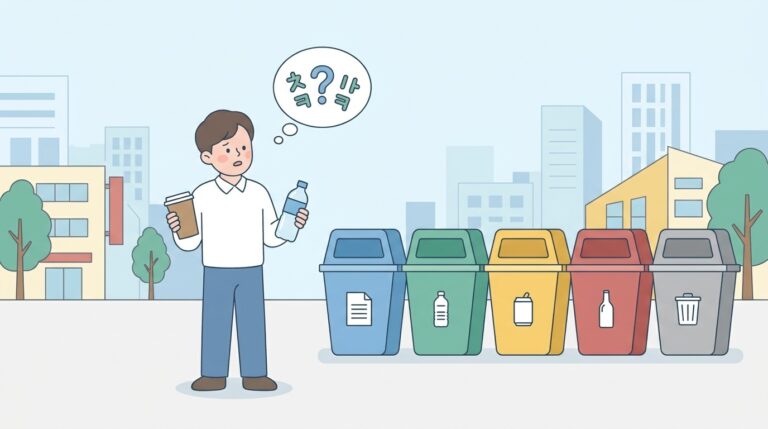
Picture this: You are watching a tense K-Drama. The main character is furiously chasing down a villain through the neon-lit streets of Seoul. Suddenly, they reach a crosswalk… and stop. Because the light is red. Even in the middle of a high-stakes chase, they won’t jaywalk! Or perhaps you’ve experienced this yourself: You just finished a delicious delivery of Korean fried chicken, and now you’re staring in absolute panic at five different recycling bins, wondering where the chicken bone goes.
Welcome to Korea, a country where “법을 준수하다” (beop-eul junsuhada – obeying the law) and following public rules aren’t just about avoiding the police—they are the ultimate test of your Nunchi (social awareness).
If you don’t know the rules, you might accidentally end up paying a fine (벌금) or getting some serious side-eyes on the subway. But don’t worry! This guide is built from the real-life panic moments of my B1-level students. By the end of this post, you’ll know exactly how to navigate Korean rules like a true local!
Phase 2: Core Expressions – The Law of the Land
Let’s break down the essential expressions you need when talking about rules and laws in Korea.
1. 법을 지키다 (vs. 법을 준수하다)
- Pronunciation: beop-eul jikida [sounds like: bup-eul jee-kee-dah]
- Meaning: Literal: To protect the law / Real nuance: To follow/obey the law
- K-Culture Moment: You’ll hear “법을 지키다” in everyday conversations, like a friend warning you not to speed. However, “법을 준수하다” (junsuhada) is the formal, Sino-Korean version. You’ll see “준수” written on stern public signs or hear it on the SBS 8 O’Clock News.
- Editor’s Insight: “지키다” is a beautiful word. It means “to protect” or “to keep” (like keeping a promise). In Korean, we don’t just ‘follow’ the rules; we ‘protect’ them to keep social harmony.
- Situation Spectrum:
- Friends (Casual): ✅ (법 좀 지켜라! – Follow the law, man!)
- Co-workers (Semi-formal): ✅ (법을 지켜야죠. – We must follow the law.)
- Formal/Signs (Formal): ⚠️ (Better to use 준수하다)
- 🤔 Think About It: Why does Korean use the word “protect” (지키다) for both “keeping a promise” and “obeying the law”? How does this reflect the Korean mindset about social contracts?
2. 벌금을 내다
- Pronunciation: beolgeum-eul naeda [beol-geum sounds like ‘bowl’ + ‘gum’]
- Meaning: Literal: To pay penalty money / Real nuance: To get fined
- K-Culture Moment: In a travel reality show, when a celebrity accidentally brings a banned food item through Incheon Airport customs, the sad background music plays, and the caption reads: “벌금 당첨” (Won a fine!).
- Editor’s Insight: If you break a minor rule like smoking in a non-smoking area (금연구역), you don’t go to jail, but you will definitely “벌금을 내다” (pay a fine).
- Situation Spectrum:
- Friends (Casual): ✅ (너 그러다 벌금 낸다! – You’re gonna pay a fine doing that!)
- Co-workers (Semi-formal): ✅ (벌금 내야 해요. – You have to pay a fine.)
- Boss/Elders (Formal): ✅ (벌금을 내셔야 합니다. – You must pay a fine.)
- 🤔 Think About It: “벌” (Beol) means punishment, and “금” (Geum) means gold/money. Can you think of other Korean words that end in “금”? (Hint: 현금 – cash, 세금 – tax!)
3. 무단횡단하면 안 돼요
- Pronunciation: mudan-hoengdan-hamyeon an dwaeyo
- Meaning: Literal: If you cross without permission, it doesn’t work / Real nuance: Don’t jaywalk! / Jaywalking is not allowed.
- K-Culture Moment: You’re in Myeongdong. It’s 2 AM. The road is completely empty. But 10 Koreans are standing patiently at the crosswalk waiting for the green man. Why? Because “무단횡단” is deeply frowned upon (and heavily fined).
- Editor’s Insight: “~면 안 돼요” (If you do ~, it is not okay) is the most natural way to say “You are not allowed to…” or “Don’t do…” in Korean. It’s softer than a direct “DON’T!”
- Situation Spectrum:
- Friends (Casual): ✅ (무단횡단하면 안 돼! – Don’t jaywalk!)
- Strangers (Semi-formal): ✅ (무단횡단하시면 안 돼요. – You shouldn’t jaywalk here.)
- 🤔 Think About It: Korean often uses “~면 안 되다” (It becomes bad/unacceptable if you do X) instead of a direct “Stop doing X”. Why do you think Korean prefers this indirect warning style?
Phase 3: Textbook vs. Real Korean
Let’s see how the strict rules translate from textbook vocabulary to real-life street talk.
[Warning someone about a rule]
* 📖 Textbook Korean: 규칙을 준수하십시오. (Please abide by the rules.)
* 🗣️ Real Korean: 안 지키면 큰일 나요. (If you don’t follow it, you’re in big trouble.)
* 💡 Why the difference?: “큰일 나다” (A big thing happens = to be in trouble) is the universal Korean way to exaggerate a warning in daily life.
[Stopping someone from smoking]
* 📖 Textbook Korean: 이곳은 금연 구역입니다. (This is a non-smoking area.)
* 🗣️ Real Korean: 여기서 담배 피우시면 안 돼요. (You can’t smoke here.)
* 💡 Why the difference?: Koreans rarely use formal nouns like ‘금연구역’ when speaking. They use verbs with the polite prohibition form (~시면 안 돼요).
[Talking about getting a ticket]
* 📖 Textbook Korean: 교통 법규 위반으로 벌금을 냈습니다. (I paid a fine for violating traffic laws.)
* 🗣️ Real Korean: 아, 딱지 끊겼어요. (Ah, I got a ticket.)
* 💡 Why the difference?: “딱지” literally means a sticker or a hard paper card. Getting a traffic ticket is colloquially called “딱지를 끊기다” (to have a ticket cut/issued).
Bottom Note: At a B1 level, you should understand formal words like ‘준수하다’ for reading signs, but stick to ‘지키다’ and ‘~면 안 돼요’ for your speaking!
Phase 4: Cultural Context — K-Culture Deep Dive
4-1. Non-verbal Rule: The Art of Apologizing to Authorities
If you accidentally break a rule (like holding a coffee cup on a Seoul city bus—which is illegal!) and the bus driver tells you off, do not argue. The best response is non-verbal Nunchi. Slightly bow your head, avoid intense direct eye contact (which can seem confrontational in Korea), and say “아, 죄송합니다” (Ah, I’m sorry). Korean rules are strict, but a quick, polite apology usually diffuses the tension immediately.
4-2. K-Travel & K-Food: The Strict Unspoken Laws
Traveling in Korea is incredibly safe, largely because the laws are strictly observed by the public. But for tourists, some rules are surprising:
1. The “No Cup” Bus Law: In Seoul, it is legally forbidden to board a city bus with a takeout cup containing liquids. If you have a half-finished Iced Americano, the driver will literally close the door on you!
2. The Recycling (분리수거) Law: Whether you are staying in an Airbnb or eating at a Han River convenience store, you must separate your trash. Plastics, paper, cans, and food waste (음식물 쓰레기) all go into different bins. Fines for failing to recycle properly can reach up to 1,000,000 KRW!
Phase 5: Real-Life Roleplay Scenario
Setting: It’s Friday, 7:50 PM. You and your Korean friend, Min-soo (32, energetic, always in a rush), are late for a K-Pop concert. You are standing at a small crosswalk in Hongdae. The concert starts in 10 minutes. The pedestrian light is red, but there are absolutely no cars on the road.
Characters:
– YOU: An exchange student who wants to be on time but doesn’t want to break the law.
– Min-soo: Your impatient Korean friend.
Min-soo: 아, 늦겠다! 야, 차 안 오는데 그냥 건너자! 🏃♂️
(A, neutgetda! Ya, cha an oneunde geunyang geonneoja!)
[Ah, we’re gonna be late! Hey, no cars are coming, let’s just cross!]
YOU: 어? 그래도 돼? 경찰한테 걸리면 어떡해?
(Eo? Geuraedo dwae? Gyeongchal-hante geollimyeon eotteokhae?)
[Huh? Is that okay? What if we get caught by the police?]
Min-soo: 에이, 괜찮아. 눈치껏 건너면 돼. 빨리 와!
(Ei, gwaenchana. Nunchikkeot geonneomyeon dwae. Ppalli wa!)
[Come on, it’s fine. Just cross with Nunchi (tactfully). Hurry up!]
(🎭 Stage Direction: Min-soo steps one foot onto the road… but then you notice a police car parked right around the corner!)
🔀 Your Turn! How do you respond?
– A) “그래, 빨리 건너자!” (Okay, let’s cross fast!)
– B) “안 돼! 저기 경찰 있어. 벌금 내기 싫어!”
– C) “무단횡단은 법을 준수하지 않는 행동입니다.”✅ Best Choice: B — “No! There’s a police officer over there. I don’t want to pay a fine!” (An dwae! Jeogi gyeongchal isseo. Beolgeum naegi sileo!). This is perfectly natural and saves you both!
⚠️ Choice A Analysis: You might get a ticket! (딱지 끊겨요!)
⚠️ Choice C Analysis: This is mathematically correct but sounds like a robot or a police PSA. Your friend will burst out laughing.
Min-soo: (Spots the police car) 헉, 진짜네! 와… 너 덕분에 살았다. 큰일 날 뻔했네.
(Heok, jinjja-ne! Wa… neo deokbune saratda. Keunil nal ppeonhaetne.)
[Gasp, you’re right! Wow… you saved us. We were almost in big trouble.]
YOU: 거봐, 한국에서는 법을 잘 지켜야지! 기다리자.
(Geobwa, hangugeseoneun beobeul jal jikyeoyaji! Gidarija.)
[See, you have to follow the law well in Korea! Let’s wait.]
Phase 6: 10-Second Shadowing Drill
Read this out loud and imagine you are warning a friend who is about to do something illegal. Pay attention to the pauses (/) and the emotion!
😤 단호하게 (Firmly):
여기서 / 무단횡단하시면 / 안 돼요! / 벌금 / 내야 해요!
(yeogiseo / mudan-hoengdan-hasimyeon / an dwaeyo! / beolgeum / naeya haeyo!)
“You shouldn’t jaywalk here! You have to pay a fine!”
Phase 7: K-Culture Mini Dictionary
| 한국어 (Korean) | Romanization | English | Cultural Context |
|---|---|---|---|
| 분리수거 | bun-ri-su-geo | Recycling | The strict separation of trash. A daily “rule” all Koreans and expats must follow. |
| 과태료 / 벌금 | gwataeryo / beolgeum | Fine / Penalty | What you pay if you break a public rule (like illegal parking or not recycling). |
| 눈치 | nunchi | Social awareness | The unspoken rule of reading the room. E.g., Not talking loudly on the subway. |
| 금연구역 | geum-yeon-guyeok | Non-smoking area | Most streets in Seoul are non-smoking. Look for the designated smoking booths! |
Phase 8: Traveler’s Survival Kit
If you are traveling to Korea, you must know these phrases to avoid accidentally breaking rules or getting fined!
🆘 Survival Phrases for the Law-Abiding Tourist
– 🇰🇷 “여기는 금연구역인가요?” (yeogineun geum-yeon-guyeok-ingayo?)
– 🗣️ Meaning: Is this a non-smoking area?
– 📍 Where to use: Streets, outside cafes, parks.
- 🇰🇷 “이 쓰레기는 어디에 버려요?” (i sseuregineun eodie beoryeoyo?)
- 🗣️ Meaning: Where do I throw this trash away?
- 📍 Where to use: Convenience stores, Airbnbs.
🇰🇷 “여기 사진 찍어도 돼요?” (yeogi sajin jjigeodo dwaeyo?)
- 🗣️ Meaning: Am I allowed to take photos here?
- 📍 Where to use: Museums, stores, exhibits.
📌 Editor’s Travel Note:
– Transportation: Remember, NO food or drinks in open cups on Seoul buses.
– Tipping: Korea has NO tipping culture. Giving a tip breaks the social rule and might confuse the waiter!
Phase 9: Critical Thinking Corner — “한 발 더 깊이”
Language & Power: The Polite Command
Have you noticed that in Korean, even strict rules are often phrased softly? Instead of “Don’t jaywalk” (무단횡단 금지), people will say “무단횡단하시면 안 됩니다” (It is not acceptable if you jaywalk).
Korean grammar uses heightening polite forms (높임법) not just to show respect to elders, but also to soften the blow of a command. In Korean society, directly ordering a stranger to do something is considered aggressive. Therefore, public laws and rules are often expressed using conditional sentences (“If you do this, it is not good”) to maintain a polite, respectful distance between the authority and the citizen.
💬 Your Turn: Does your native language use polite phrasing for strict laws, or is it direct and to the point? Share your thoughts in the comments!
Phase 10: FAQ & Avoiding Common Mistakes
Q: If a police officer stops me, what level of politeness should I use?
Always use formal language (존댓말 – jondaetmal). Use sentences ending in ~요 or ~습니다. Never use casual language (반말 – banmal) with authorities, even if you are older than them!
Q: Can I drink alcohol by the Han River?
Yes! Drinking in public spaces like parks is generally legal in Korea (unlike in the US or Canada). However, you must clean up your trash perfectly (분리수거), or you will face a fine.
❌ Common Mistake #1: Saying “법을 준수해!” to a friend.
✅ How to fix it: “준수하다” is too formal and bookish. Tell your friend: “법 좀 지켜!” (Follow the law!)
Phase 11: Summary & Action Items
One-Liner Summary: In Korea, protecting the law (법을 지키다) and avoiding fines (벌금) requires knowing the polite way to say “You shouldn’t do that” (~면 안 돼요).
Action Mission 3 Steps:
– 🥉 Bronze (Solo): Say “여기서 담배 피우시면 안 돼요” 3 times in front of a mirror, using your best polite-but-firm voice.
– 🥈 Silver (Online): Go to a Korean language forum and write one thing that is “illegal” or “banned” in your country using “~면 안 돼요”.
– 🥇 Gold (Real World): Next time you watch a K-Drama, spot a scene where someone gets a fine (벌금) or a ticket (딱지) and shout the word out loud!
K-Culture Mission:
Next time you visit a Korean convenience store or restaurant, observe the trash bins. Try to successfully separate your trash into plastic (플라스틱) and general waste (일반쓰레기) without asking for help!
Phase 12: Quiz — Interactive Challenge
1. Fill in the blank:
You are on a Seoul city bus. Your friend tries to get on with an open cup of iced coffee. You grab their arm and say:
“야! 버스에 커피 들고 타면 ( _______ )!”
A) 안 돼
B) 지켜
C) 벌금
2. Situational Judgment:
A tourist asks you if they can smoke right outside the subway exit. What is the most natural Korean response?
A) 법을 준수하십시오! (Abide by the law!)
B) 여기서 담배 피우시면 안 돼요. 금연구역이에요. (You shouldn’t smoke here. It’s a non-smoking area.)
C) 무단횡단입니다. (It’s jaywalking.)
3. True or False – K-Culture Edition:
It is perfectly fine to drink a can of beer at the Han River Park, as long as you clean up your trash. (T/F)
Answers (Click to reveal!)
1. A) 안 돼 – “If you get on the bus with coffee, it’s not allowed!”
2. B – It’s polite, clear, and uses the correct vocabulary for a non-smoking area.
3. True! Public drinking is generally allowed in Korea, but strict recycling rules apply to your empty cans!
Enjoyed learning how to survive the Korean rulebook? Hit the share button and save a friend from a fine! 🚓✨
Frequently Asked Questions (FAQ)
Q: What does "법을 지키다 (vs. 법을 준수하다)" mean in Korean and how do you pronounce it?
A: In Korean, "법을 지키다 (vs. 법을 준수하다)" is pronounced [beop-eul jikida [sounds like: bup-eul jee-kee-dah] and means: Literal: To protect the law / Real nuance: To follow/obey the law
Q: What does "벌금을 내다" mean in Korean and how do you pronounce it?
A: In Korean, "벌금을 내다" is pronounced [beolgeum-eul naeda [beol-geum sounds like 'bowl' + 'gum'] and means: Literal: To pay penalty money / Real nuance: To get fined
Q: What does "무단횡단하면 안 돼요" mean in Korean and how do you pronounce it?
A: In Korean, "무단횡단하면 안 돼요" is pronounced [mudan-hoengdan-hamyeon an dwaeyo] and means: Literal: If you cross without permission, it doesn't work / Real nuance: Don't jaywalk! / Jaywalking is not allowed.







