

Hello! Daily Hangul Editor here.
Phase 1: Empathy (Immersive Open)
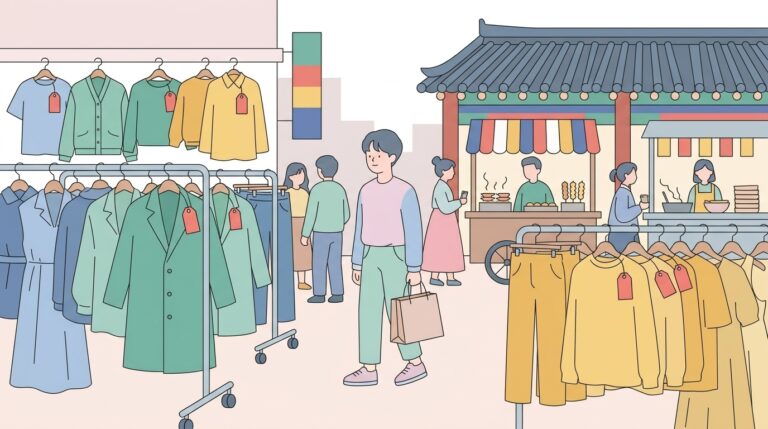
Picture this: You are walking down the vibrant, neon-lit streets of Hongdae or Myeongdong. You spot a jacket in a boutique window that looks exactly like the one your favorite K-Pop idol wore at the airport last week. You walk in, check the price tag, and… gasp! It’s a bit pricey. But wait, there’s a big red sign next to it. Is it a discount? Is it a special promotion?
If you’ve watched any K-Dramas, you know the shopping montage scenes. The heroine runs through the racks, grabs an outfit, and triumphantly buys it. But in real life, especially as a traveler, standing in a busy Korean shop trying to figure out if you’re getting a good deal can be intimidating.
You might want to ask, “Is this on sale?” but your translation app gives you a super formal, robotic sentence that makes the shop owner stare at you in confusion. Don’t worry! This guide is based on real questions from my A1 beginner students who wanted to shop like confident locals. Let’s learn how to navigate the fast-paced K-fashion world without breaking a sweat!
Phase 2: Core Expressions Deep Dive
Let’s look at the top 3 expressions you need for your shopping spree.
1. 이거 세일해요? (Is this on sale?)
- Pronunciation: igeo se-il-hae-yo? [ee-guh say-eel-hay-yo?]
- Meaning: Literal: “This sale doing?” / Real: “Is this on sale?”
- K-Culture Moment: You’ll hear this non-stop during the massive summer and winter sales in Seoul’s underground shopping malls (like Goto Mall in Gangnam).
- Editor’s Insight: Notice anything familiar? Yes, “세일” (se-il) sounds exactly like the English word “sale.” Koreans use a lot of “Konglish” (Korean-English) in fashion and commerce. It’s short, punchy, and everyone understands it immediately.
- Situation Spectrum:
- Casual (Friends/Street shops): ✅
- Semi-formal (Department stores): ✅
- Formal (High-end luxury boutiques): ⚠️ (Better to ask if there are promotions)
- 🤔 Think About It: Why do you think Koreans adopted the English word “sale” instead of using a traditional Korean word? How does using English words make a brand feel in your country?
2. 이거 얼마예요? (How much is this?)
- Pronunciation: igeo eol-ma-ye-yo? [ee-guh uhl-ma-yay-yo?]
- Meaning: Literal: “This how much is?”
- K-Culture Moment: The ultimate survival phrase. Whether you are buying tteokbokki from a street vendor or a cute phone case in Myeongdong, this is your go-to sentence.
- Editor’s Insight: Just point at the item and say this. No need for complex grammar. If you can’t understand the numbers they say back, just politely hand them your phone with the calculator app open. They will happily type the price for you!
- Situation Spectrum:
- Casual: ✅
- Semi-formal: ✅
- Formal: ✅
- 🤔 Think About It: In Korean, the subject (“this”) comes first, and the question word (“how much”) comes right before the verb. It gets straight to the point.
3. 조금만 깎아주세요 (Please give me a little discount)
- Pronunciation: jogeum-man kka-kka-ju-se-yo [jo-geum-mahn kkah-kkah-joo-say-yo]
- Meaning: Literal: “Just a little, cut it down please.”
- K-Culture Moment: This is the magic phrase for traditional markets like Dongdaemun or Namdaemun. Use it with a bright smile!
- Editor’s Insight: “깎다” (kkakta) literally means “to peel” (like an apple) or “to cut/shave.” You are asking them to shave off a bit of the price.
- Situation Spectrum:
- Casual (Traditional Markets/Street stalls): ✅
- Semi-formal (Brand shops/Franchises): 🚫 (Never use this here! Prices are fixed.)
- 🤔 Think About It: Bargaining in Korean traditional markets is deeply tied to the concept of “정” (Jeong – human affection/connection). It’s not just about money; it’s a playful interaction. Do you bargain in your home country?
Phase 3: Textbook vs. Real Korean
[Asking about a discount]
* 📖 Textbook Korean: 할인을 하고 있습니까? (Are you currently offering a discount?)
* 🗣️ Real Korean: 이거 세일해요? (Is this on sale?)
* 💡 Why it’s different: “할인” (hal-in) is the formal Korean word for discount, mostly used on official signs or in banks. On the street, the Konglish word “세일” (sale) is much faster and more natural.
[Trying to get a cheaper price]
* 📖 Textbook Korean: 가격을 인하해 주시겠습니까? (Would you reduce the price?)
* 🗣️ Real Korean: 아유~ 이모~ 쪼금만 깎아주세요~ (Aww~ Auntie~ please give me a little discount~)
* 💡 Why it’s different: Haggling in Korea relies on emotional connection. Calling the shop owner “이모” (Auntie) and stretching your words playfully makes them much more likely to lower the price!
Bottom Note: As an A1 beginner, keep it simple. Sticking to “이거 세일해요?” is perfect and sounds very natural.
Phase 4: Cultural Context — K-Culture Deep Dive
4-1. Non-Verbal Language in Korean Shopping
When asking “이거 얼마예요?” (How much is this?), avoid pointing with just your index finger, as it can seem a bit rude in formal settings. Instead, gesture toward the item with your whole hand open, palm facing up. Also, remember to read the room (Nunchi). If the shop owner is incredibly busy dealing with a massive crowd, wait for a brief pause before asking your question.
4-2. The “Free Size” K-Fashion Phenomenon
If you shop for clothes in Korea, you will see the word “프리사이즈” (Free Size) everywhere. In K-fashion, especially in underground malls or street boutiques, clothes often come in only one size. Don’t be confused! “Free Size” usually corresponds to a standard women’s Small or Medium. It doesn’t mean the clothes are free of charge!
Also, if you want to try on clothes (especially white shirts or dresses), you must be careful. Many shops won’t allow you to try on white tops to prevent makeup stains (K-Beauty foundations are no joke!). If they do allow it, they will hand you a face cover (페이스 커버) – a thin white hood you must wear over your head while changing to protect the garment.
Phase 5: Interactive Roleplay Scenario
Setting: Saturday afternoon, Gangnam Station Underground Shopping Mall. The air is filled with upbeat K-Pop music, and colorful clothes line the endless hallways. You’ve found the perfect oversized sweater.
Characters:
– YOU: A K-fashion enthusiast trying to buy a nice outfit without spending all your travel money.
– Shop Owner (이모 – Eemo): A friendly, fast-talking woman in her 50s who calls all her young customers “언니” (Unni/Sister) regardless of where they are from.
Dialogue:
이모 (Owner): 어서 오세요! 천천히 보세요~
(eoseo oseyo! cheoncheonhi boseyo~)
[Welcome! Take your time looking around~]
YOU: 안녕하세요. 이거 세일해요?
(annyeonghaseyo. igeo seilhaeyo?)
[Hello. Is this on sale?]
이모 (Owner): 네! 언니, 그거 오늘만 세일이에요.
(ne! eonni, geugeo oneulman seirieyo.)
[Yes! Sister, that’s on sale just for today.]
YOU: 우와. 이거 얼마예요?
(uwa. igeo eolmayeyo?)
[Wow. How much is this?]
이모 (Owner): 원래 4만 원인데, 3만 원에 줄게요.
(wollae 3man woninde, 3man wone julgeyo.)
[It was originally 40,000 won, but I’ll give it to you for 30,000 won.]
YOU: 입어봐도 돼요?
(ibeobwado dwaeyo?)
[Can I try it on?]
이모 (Owner): 그럼요! 저기서 입어보세요.
(geureomyo! jeogiseo ibeoboseyo.)
[Of course! Try it on over there.]
(You try it on. It looks amazing.)
YOU: 사이즈가 딱 맞아요!
(saijeuga ttak majayo!)
[The size is perfect!]
🔀 YOUR TURN! How do you reply next to secure the deal?
– A) “너무 비싸요. 안 사요.” (Too expensive. I’m not buying it.)
– B) “현금으로 할게요. 조금만 깎아주세요~” (I’ll pay in cash. Please give me a little discount~)
– C) “할인을 하고 있습니까?” (Are you currently offering a discount?)✅ Best Choice: B — In underground malls, offering to pay in cash (현금) is the golden ticket to asking for a small discount!
⚠️ Choice A Analysis: This is too direct and a bit rude. Even if it’s expensive, Koreans usually say “조금 더 볼게요” (I’ll look around a bit more) and walk away politely.
Phase 6: 10-Second Shadowing Drill
Practice these lines out loud! Pay attention to the pauses (/) and the emotion.
- 😊 Brightly & Politely:
저기요 / 이거 / 세일해요?
(jeogiyo / igeo / se-il-hae-yo?)
[Excuse me, is this on sale?] -
🥺 Playfully & Cute (Aegyo):
이모~ / 쪼~~~금만 / 깎아주세요!
(imo~ / jjo~~~geum-man / kka-kka-ju-se-yo!)
[Auntie~ Please give me just a liiiitle discount!]
Phase 7: K-Culture Mini Dictionary
| Korean | Romanization | English | Context |
|---|---|---|---|
| 세일 | se-il | Sale | Used everywhere from street shops to department stores. |
| 득템 | deuk-tem | Great catch / Good deal | Internet slang. Used when you find a great item at a low price. “오늘 득템했어요!” (I got a great deal today!) |
| 프리사이즈 | peu-ri-sa-i-jeu | Free Size | “One size fits all,” but usually fits a standard S or M. |
| 신상 | sin-sang | New arrival | Short for 신상품 (new product). Usually NOT on sale! |
| 이모 | i-mo | Auntie | An affectionate term for older female workers/shop owners. |
Phase 8: Traveler Survival Kit
Shopping in Korea is thrilling, but you need these tools in your pocket!
🆘 Survival Expressions TOP 3
1. 🇰🇷 “카드 돼요?” (ka-deu dwae-yo?) – Do you take credit cards?
2. 🇰🇷 “입어봐도 돼요?” (i-beo-bwa-do dwae-yo?) – Can I try this on?
3. 🇰🇷 “다른 색깔 있어요?” (da-reun saek-kkal i-sseo-yo?) – Do you have this in another color?📌 Editor’s Travel Note
– Cash vs. Card: Korea is a cashless society! You can use cards for almost everything. However, in traditional markets or underground malls, paying in cash (현금) might get you a 5-10% discount!
– Tax-Free: Look for “Tax-Free” signs in stores like Olive Young or department stores. If you bring your passport, they often deduct the tax right at the cashier. No need to wait at the airport!
Phase 9: Critical Thinking — “One Step Deeper”
Language in the Global Era: Konglish in K-Fashion
When you walk around Seoul, you’ll notice how deeply English is woven into Korean daily life, especially in fashion. Words like “세일” (Sale), “원피스” (One-piece/Dress), and “맨투맨” (Man-to-man/Sweatshirt) are standard Korean vocabulary now. Some purists argue that this “Konglish” damages the purity of the Korean language. However, from a practical standpoint, it reflects Korea’s rapid globalization and desire for modern, trendy expression. Language is alive, and “Konglish” is a unique hybrid that bridges global trends with local culture.
💬 Your Turn: Does your native language borrow a lot of English words for fashion or shopping? Let me know in the comments!
Phase 10: FAQ & Avoiding Misunderstandings
Q: Can I haggle (깎아주세요) everywhere in Korea?
A: NO! Only use this in traditional markets (like Namdaemun) or underground shopping malls. If you try to haggle in Zara, H&M, Olive Young, or a department store, they will be very confused because prices are strictly fixed in corporate systems.
Q: Do I need to tip the shop worker if they were very helpful?
A: NO! There is absolutely no tip culture in South Korea. Tipping might actually cause panic because the worker won’t know how to process the extra cash in their register.
❌ Common Mistake #1: Pointing at an item with a single index finger and saying “How much?” without a greeting.
✅ Do this instead: Make eye contact, say “안녕하세요” (Hello) first, gesture to the item with an open hand, and ask “이거 얼마예요?”
Phase 11: Summary & Action Items
💡 One-Liner Summary: Use “이거 세일해요?” to check for discounts, and “이거 얼마예요?” to navigate the K-fashion world like a pro!
🎯 Action Mission:
– 🥉 Bronze (Solo): Stand in front of your mirror, hold up a piece of clothing, and say “이거 세일해요?” 3 times out loud.
– 🥈 Silver (Online): Go to a K-fashion website (like Musinsa) and look for the word “세일”.
– 🥇 Gold (Real Life): The next time you visit a Korean market or store, ask the staff “이거 얼마예요?” instead of using a translator app!
🇰🇷 K-Culture Mission: Watch a Korean shopping vlog on YouTube and count how many times you hear the word “세일” (se-il) or “얼마예요” (eol-ma-ye-yo)!
Phase 12: Interactive Quiz
1. Situational Judgment: You are in a high-end department store in Seoul (like Lotte or Hyundai). You see a beautiful coat. What is the most appropriate thing to say?
– A) 아줌마! 이거 얼마예요? (Middle-aged woman! How much is this?)
– B) 깎아주세요. (Give me a discount.)
– C) 저기요, 이거 얼마예요? (Excuse me, how much is this?)
(Answer: C. Never yell “Ajumma” in a nice store, and haggling (B) is strictly prohibited in department stores!)
2. True or False – K-Culture Edition:
“If a tag says ‘Free Size’, it means you can take the clothes for free.”
(Answer: False! It means ‘One size fits all’, usually a standard Small/Medium.)
3. Fill in the blank:
You want to try on a jacket. You say: “___________ 돼요?” (___ dwae-yo?)
(Answer: 입어봐도 – ibeobwado)
Happy Shopping and see you in the next lesson!
Frequently Asked Questions (FAQ)
Q: What does "이거 세일해요? (Is this on sale?)" mean in Korean and how do you pronounce it?
A: In Korean, "이거 세일해요? (Is this on sale?)" is pronounced [igeo se-il-hae-yo? [ee-guh say-eel-hay-yo?] and means: Literal: "This sale doing?" / Real: "Is this on sale?"
Q: What does "이거 얼마예요? (How much is this?)" mean in Korean and how do you pronounce it?
A: In Korean, "이거 얼마예요? (How much is this?)" is pronounced [igeo eol-ma-ye-yo? [ee-guh uhl-ma-yay-yo?] and means: Literal: "This how much is?"
Q: What does "조금만 깎아주세요 (Please give me a little discount)" mean in Korean and how do you pronounce it?
A: In Korean, "조금만 깎아주세요 (Please give me a little discount)" is pronounced [jogeum-man kka-kka-ju-se-yo [jo-geum-mahn kkah-kkah-joo-say-yo] and means: Literal: "Just a little, cut it down please."






