

Hello! I’m your Daily Hangul Editor.
Have you ever watched a K-Drama like Because This Is My First Life or Work Later, Drink Now? The protagonist clinks a soju glass at a pojangmacha (street tent) to celebrate finally signing a lease for that charming rooftop room (옥탑방) with a sweeping view of Seoul. But let me tell you a secret: what the drama doesn’t show is the nerve-wracking 30 minutes right before that, sitting in a real estate office (부동산), staring at a lease agreement full of complex legal jargon, and sweating bullets.
Finding a home in Korea is a thrilling milestone, but the real estate system—with its unique Jeonse (huge lump-sum deposit) and Wolse (monthly rent with a still-sizable deposit) concepts—can be a minefield for expats. If you don’t know the right expressions, you might end up paying for repairs that aren’t your fault, or worse, risking your precious deposit.
But don’t worry! I’ve been there, helping countless expat friends navigate their housing contracts in Seoul. Today, I’m going to equip you with the essential “survival Korean” for the real estate office. These are the exact phrases that will make the realtor (공인중개사) think, “Oh, this person knows how things work in Korea!” Let’s secure your K-Drama dream home safely.
Phase 2: Deep Dive into Core Expressions
1. 특약 사항에 이 내용을 추가해 주실 수 있나요?
- Pronunciation: Teugyak sahange i naeyongeul chugahae jusil su innayo?
(Sound-alike guide: ‘Teuk’ sounds like a sharp, short ‘took’. ‘Gyak’ sounds like ‘gyahk’.)- Meaning:
- Literal: Can you add this content to the special agreement matters?
- Real nuance: “I need this specific condition written in the contract to protect myself, please.”
- K-Culture Moment: In Korea, the standard contract form is quite basic. The real magic (and protection) happens in the 특약 사항 (Special Clauses). Imagine you have a pet puppy. The landlord verbally says “Sure, dogs are fine.” But if it’s not in the teugyak, you could be evicted later! Asking this politely but firmly shows you are a savvy tenant.
- Editor’s Insight: This phrase is your best friend. It sounds incredibly professional and polite. You’re not demanding; you’re using the soft “~해 주실 수 있나요?” (Could you please do ~ for me?), which Koreans use to maintain harmony while negotiating.
- Situation Spectrum:
- Casual friends: 🚫 (Too formal)
- Semi-formal (Realtor): ✅ (Perfect)
- Formal (Landlord): ✅ (Perfect)
- 🤔 Think About It: Why is a verbal agreement almost meaningless in Korean real estate, despite the culture valuing interpersonal trust (정 – Jeong)? How does your home country handle specific lease conditions?
2. 도배랑 장판은 새로 해 주시는 거죠?
- Pronunciation: Dobaerang jangpaneun saero hae jusineun geojyo?
(Sound-alike guide: ‘Do-bae’ rhymes with ‘go say’. ‘Jang-pan’ sounds like ‘Jang-pahn’.)- Meaning:
- Literal: You are doing the wallpaper and flooring newly for me, right?
- Real nuance: “I expect the wallpaper and floors to be replaced before I move in, as is customary.”
- K-Culture Moment: Unlike many Western countries where apartments are painted, Korean homes almost exclusively use wallpaper (도배) and linoleum/vinyl flooring (장판). When a new tenant moves in, especially if the current state is dirty, it’s a common negotiation point to ask the landlord to replace them.
- Editor’s Insight: The ending “~는 거죠?” (You are doing ~, right?) is a classic Korean negotiation tactic. Instead of asking “Will you do it?”, you frame it as an expected assumption. It’s polite pressure!
- Situation Spectrum:
- Casual friends: 🚫
- Semi-formal (Realtor/Landlord): ✅
- Formal Boss: 🚫
- 🤔 Think About It: Koreans love their heated floors (온돌 – Ondol). How do you think this traditional floor-heating system influenced the modern preference for jangpan (vinyl flooring) over carpets?
3. 전입신고와 확정일자는 언제 받을 수 있나요?
- Pronunciation: Jeonipsingowa hwakjeongiljaneun eonje badeul su innayo?
(Sound-alike guide: ‘Jeon-ip’ sounds like ‘John-eep’. ‘Hwak’ sounds like ‘hwahk’.)- Meaning:
- Literal: When can I receive the move-in notification and fixed date?
- Real nuance: “I know the law. When can I officially register my address to legally protect my deposit?”
- K-Culture Moment: If you’re putting down a $10,000+ deposit (Wolse) or a $100,000+ deposit (Jeonse), you must do this. By going to the local community center (주민센터) and getting your move-in reported (전입신고) and a date stamped (확정일자), you secure your legal right to your money if the building goes bankrupt.
- Editor’s Insight: Just saying “전입신고 (Jeon-ip-sin-go)” makes you sound like a local. Some shady landlords try to prevent tenants from doing this to avoid taxes. Asking this upfront filters out the bad apples.
- Situation Spectrum:
- Casual friends: 🚫
- Semi-formal (Realtor): ✅ (Essential!)
- Formal (Landlord): ✅
- 🤔 Think About It: The Jeonse system exists almost nowhere else in the world. Why do you think a system where the tenant gives the landlord a massive loan instead of monthly rent became so popular in Korea’s rapid economic growth period?
Phase 3: Textbook vs. Real Korean
Let’s see how the language transforms from the textbook to the bustling real estate office in Gangnam.
[Situation 1: Discussing the Maintenance Fee]
* 📖 Textbook Korean: 관리비는 한 달에 얼마입니까? (Gwanribineun han dare eolmaimnikka?) – How much is the maintenance fee per month?
* 🗣️ Real Korean: 관리비에 인터넷이랑 수도세 포함인가요? (Gwanribie inteonesirang sudose pohamingayo?) – Are internet and water included in the maintenance fee?
* 💡 Why the difference?: In Korea, especially for studio apartments (원룸), landlords often list a lower rent but hike up the gwanribi (maintenance fee). Savvy locals always check exactly what is included (gas, water, internet) to calculate the real monthly cost.
[Situation 2: Trying to Negotiate the Price]
* 📖 Textbook Korean: 가격을 깎아 주십시오. (Gagyeogeul kkakka jusipsio.) – Please cut the price.
* 🗣️ Real Korean: 보증금 올리고 월세 조금 낮출 수 있을까요? (Bojeunggeum olligo wolse jogeum natchul su isseulkkayo?) – Could we raise the deposit and lower the monthly rent a bit?
* 💡 Why the difference?: You can’t just ask them to “cut the price” in real estate. The Korean system is flexible: you can negotiate to pay a higher lump-sum deposit (보증금) in exchange for a cheaper monthly rent (월세). This is called “adjusting the ratio.”
Bottom Note: At a B2 level, you want to sound practical and solution-oriented. Avoid begging for discounts; instead, offer structural compromises like adjusting the deposit-to-rent ratio!
Phase 4: Cultural Context — K-Culture Deep Dive
4-1. Non-Verbal Communication: The Power of the Dojang (도장)
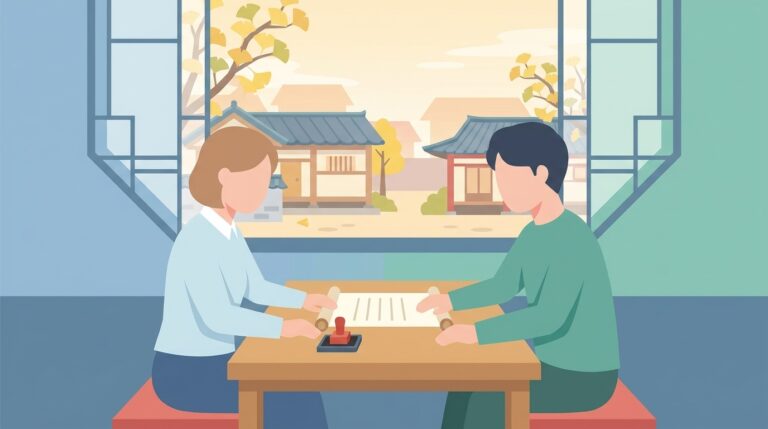
In Western countries, a signature is the ultimate legally binding mark. In Korea, while signatures (서명) are widely accepted now, real estate contracts still heavily feature the Dojang (도장 – Personal Seal). When you sit at the table, the realtor will ask, “도장 가져오셨죠?” (Did you bring your seal?). Stamping the red ink onto the contract is a ceremonial and serious moment.
Nunchi Tip: When signing, wait for the realtor to explain each section. Nod along (even if you’re reading the English translation on your phone), and use two hands when handing over your ID card or bank transfer receipt to the landlord. It sets a respectful tone for your future relationship.
4-2. K-Culture Link: The K-Drama Real Estate Tropes
If you watch K-Dramas, you’ll notice a few recurring housing tropes.
– The Rooftop Romance (옥탑방): It looks romantic with fairy lights and BBQ parties, but in reality, real estate agents will warn you: “여름엔 덥고 겨울엔 추워요” (It’s boiling in summer and freezing in winter).
– The Scary-but-Sweet Building Owner (건물주 할머니): Dramas often feature an older lady who yells about sorting the recycling properly but leaves warm kimchi at the protagonist’s door. This reflects the deep-rooted Korean concept of Jeong (정 – unspoken affection/attachment) between landlord and tenant.
– Critical View: Dramas make finding a house look like it takes one afternoon. In reality, you’ll visit 5-10 real estate offices (부동산) because each agent holds different “exclusive” listings (매물).
Phase 5: Interactive Roleplay Scenario
Setting: Saturday morning, 11:00 AM. A small, slightly cluttered real estate office (부동산) near Hongdae. There’s a large map of the neighborhood on the wall, and the smell of instant Maxim mixed coffee fills the air. You are sitting across from the realtor, Mr. Kim, and the landlord, Mrs. Park, an elegant older woman.
Characters:
– YOU (The Reader): An expat who found a great 1-bedroom apartment but noticed the wallpaper in the bedroom is slightly torn.
– Mr. Kim (55, Realtor): Friendly, talks fast, wants to close the deal smoothly.
– Mrs. Park (65, Landlord): Stern but fair. She cares deeply about her building.
Dialogue:
Mr. Kim: 자, 그럼 계약서 내용 확인해 보겠습니다. 보증금 1천만 원에 월세 60만 원 맞죠?
(Ja, geureom gyeyakseo naeyong hwaginhae bogesseumnida. Bojeunggeum ilcheonman wone wolse yuksipman won matjyo?)
[Translation] Alright, let’s check the contract details. The deposit is 10 million won, and the monthly rent is 600,000 won, correct?
YOU: 네, 맞습니다. 그런데 관리비는 5만 원에 인터넷 포함인 거죠?
(Ne, matseumnida. Geureonde gwanribineun oman wone inteonet pohamin geojyo?)
[Translation] Yes, that’s correct. And the 50,000 won maintenance fee includes the internet, right?
Mrs. Park: 네, 인터넷이랑 수도세 다 포함이에요. 가스랑 전기만 따로 내면 돼요.
(Ne, inteonesirang sudose da pohamieyo. Gaseurang jeonggiman ttaro naemyeon dwaeyo.)
[Translation] Yes, internet and water are all included. You just pay for gas and electricity separately.
Mr. Kim: 학생, 집주인 아주머니가 아주 좋으신 분이야. 집도 깨끗하고.
(Haksaeng, jipjuin ajumeoniga aju joeusin buniya. Jiptto kkaekkeuthago.)
[Translation] Student, the landlady is a very good person. The house is clean, too.
(🎭 Stage Direction: You remember the torn wallpaper in the bedroom. Now is the time to negotiate before stamping the contract!)
🔀 YOUR TURN! How should you respond?
– A) “방 벽지가 더러워요. 바꿔주세요.” (The room wallpaper is dirty. Change it.)
– B) “감사합니다. 그런데 입주 전에 도배는 새로 해 주시는 거죠?” (Thank you. By the way, you’ll be putting up new wallpaper before I move in, right?)
– C) “벽지가 좀 찢어졌던데, 제 보증금에서 깎아주시면 안 될까요?” (The wallpaper was a bit torn, could you deduct it from my deposit?)✅ Best Choice: B — It uses the soft negotiation tactic we learned! It assumes the positive action politely without being accusatory.
⚠️ Choice A Analysis: Too direct and blunt. In Korean culture, saving the other person’s face (기분/체면) is crucial. Calling her house “dirty” might make her refuse to sign.
⚠️ Choice C Analysis: Rent deductions for repairs aren’t common in Korea; usually, the landlord just fixes it directly.
YOU: 감사합니다. 그런데 입주 전에 도배는 새로 해 주시는 거죠?
(Gamsahamnida. Geureonde ipju jeone dobaeneun saero hae jusineun geojyo?)
[Translation] Thank you. By the way, you’ll be putting up new wallpaper before I move in, right?
Mrs. Park: 음… 원래 도배 한 지 2년밖에 안 됐는데.
(Eum… wonrae dobae han ji inyeonbakke an dwaenneunde.)
[Translation] Hmm… It’s only been two years since I last wallpapered it.
Mr. Kim: 에이, 사장님. 그래도 새로 들어오는데 침실 벽지 정도는 해 주시죠. 제가 특약에 넣겠습니다.
(Ei, sajangnim. Geuraedo saero deureoonneunde chimsil byeokji jeongdoneun hae jusijyo. Jaega teugyage neokgesseumnida.)
[Translation] Ay, Madam. Still, someone new is moving in, you should at least do the bedroom wallpaper. I’ll put it in the special conditions.
Mrs. Park: 알았어요. 침실 벽지만 새로 해 줄게요.
(Arasseoyo. Chimsil byeokjiman saero hae julgeyo.)
[Translation] Alright. I’ll redo just the bedroom wallpaper.
YOU: 감사합니다! 예쁘게 잘 쓰겠습니다.
(Gamsahamnida! Yeppeuge jal sseugesseumnida.)
[Translation] Thank you! I will take good care of the place (Lit: I will use it beautifully).
(🎭 Stage Direction: Mr. Kim smiles, types rapidly on his computer to add the clause, and brings out the red ink pad for your Dojang!)
Bonus Roleplay: The Moving Day (이사하는 날)
(Scenario: You are moving in, and you need to ask the convenience store clerk about trash bags.)
YOU: 안녕하세요. 혹시 여기 종량제 봉투 파나요?
(Annyeonghaseyo. Hoksi yeogi jongnyangje bongtu panayo?)
[Translation] Hello. Do you happen to sell volume-based garbage bags here?
Clerk: 네, 몇 리터짜리 드릴까요?
(Ne, myeot riteojjari deurilkkayo?)
[Translation] Yes, how many liters would you like?
YOU: 10리터짜리 열 장 주세요. 아, 음식물 쓰레기 봉투도요!
(Simniteojjari yeol jang juseyo. Ah, eumsikmul sseuregi bongtudoyo!)
[Translation] Ten of the 10-liter ones, please. Ah, and food waste bags too!
(In Korea, throwing away trash requires highly specific, district-coded bags purchased at the local convenience store!)
Phase 6: 10-Second Shadowing Drill
Practice making your requests sound natural, polite, and confident. Pay attention to the pauses (/) and the intonation tags.
🥺 Polite but firm:
저기요, / 특약 사항에 / 이 내용을 / 꼭 추가해 주실 수 / 있나요?
(jeogiyo, / teugyak sahange / i naeyongeul / kkok chugahae jusil su / innayo?)😊 Bright and expectant:
입주 전에 / 도배랑 장판은 / 새로 / 해 주시는 거죠?
(ipju jeone / dobaerang jangpaneun / saero / hae jusineun geojyo?)
Phase 7: K-Culture Mini Dictionary
| Korean | Romanization | English | Context |
|---|---|---|---|
| 보증금 | bojeunggeum | Security Deposit | A massive lump sum paid to the landlord, fully refundable at the end of the lease. |
| 전세 | jeonse | Key Money Lease | A unique Korean system: a huge deposit (often 50-80% of house value) with ZERO monthly rent. |
| 월세 | wolse | Monthly Rent | Paying a monthly fee alongside a smaller (but still thousands of dollars) deposit. |
| 공인중개사 | gonginjunggaesa | Real Estate Agent | Licensed professional. People usually just call their office ‘부동산’ (Budongsan). |
| 관리비 | gwanribi | Maintenance Fee | Monthly building fee. Always check what utilities are included in this! |
| 특약 | teugyak | Special Clause | Specific conditions added to the end of a contract. Your ultimate legal shield. |
Phase 8: Traveler/Expat Survival Kit
Even if you’re not signing a lease today, if you are planning to stay in an Airbnb or move to Korea for studies/work, these expressions are lifesavers for your accommodation.
🆘 Survival Phrases for Housing
– 🇰🇷 “여기 수압 좀 확인해 봐도 될까요?” (yeogi suap jom hwaginhae bwado doelkkayo?)
– 🗣️ Meaning: Can I check the water pressure here?
– 📍 Where to use: House viewing.
– 💡 Pro Tip: Koreans ALWAYS turn on the bathroom sink and flush the toilet during house viewings to check water pressure. It’s totally normal!
- 🇰🇷 “보일러 켜는 법 좀 알려주세요.” (boilleo kyeoneun beop jom allyeojuseyo.)
- 🗣️ Meaning: Please show me how to turn on the boiler (floor heating).
- 📍 Where to use: Moving in, or arriving at your Airbnb in winter.
📌 Editor’s Settlement Note
– Useful Apps: Dabang (다방) and Zigbang (직방) are the top apps for browsing apartments, though beware of ‘fake listings’ (허위 매물) meant to lure you into the office.
– Brokerage Fee (복비): You have to pay the real estate agent a legally capped fee (복비) for their service. It’s usually paid on the day you move in and sign the final papers.
Phase 9: Critical Thinking Corner — “A Step Deeper”
Language & Power: “Above the Creator, the Building Owner”
There is a popular modern proverb in Korea: “조물주 위에 건물주” (Above the Creator sits the Building Owner). It reflects the immense socioeconomic power that landlords hold in a country where real estate prices have skyrocketed. This power dynamic is deeply woven into the language used during a lease agreement.
Notice how the tenant usually uses highly polite, honorific language (존댓말) and indirect requests (“~해 주실 수 있나요?”), while older landlords might use a slightly lower level of politeness (반말) or a very casual tone, as seen in our roleplay. However, the law strongly protects tenants, which is why asserting your rights politely through 특약 (Special clauses) and 확정일자 (Fixed dates) is how you level the playing field without breaking cultural harmony.
💬 Your Turn: How does the relationship between landlords and tenants work in your country? Is it purely a business transaction, or is there a social hierarchy attached to it? Share in the comments!
Phase 10: FAQ & Avoiding Misunderstandings
Q: Can I bargain on the rent price in Korea?
Yes and no. You generally can’t say “Give me a 10% discount.” However, you can negotiate the structure! For every 10,000,000 KRW ($7,500) you add to the deposit (보증금), the monthly rent (월세) usually drops by 50,000 KRW ($35).
Q: Do I really need a traditional stamp (도장) to sign a contract?
Nowadays, a signature (서명) is legally acceptable for most Wolse contracts. However, for large Jeonse contracts or buying property, a registered personal seal (인감도장) is still preferred. Plus, getting a customized Dojang made in Insadong is a cool expat milestone!
❌ Common Mistake #1: Paying the deposit (보증금) to the real estate agent.
✅ Do this instead: ONLY wire money to the bank account that exactly matches the landlord’s name on the property registry (등기부등본). The agent will check this for you, but the money must go directly to the owner.❌ Common Mistake #2: Moving in and forgetting to report your address.
✅ Do this instead: Go to the local community center (주민센터) on your exact move-in day to file the 전입신고 (Move-in report). If the building is auctioned off, this is the only way your deposit is protected by law!
Phase 11: Summary & Action Items
One-Liner Summary: Protect your deposit and ensure a comfortable K-Home by negotiating polite “Special Clauses” (특약 사항) and officially registering your move-in (전입신고).
Action Mission:
– 🥉 Bronze (Solo): Stand in front of a mirror and practice asking: “특약 사항에 추가해 주세요!” with a polite smile.
– 🥈 Silver (Online): Check out a Korean real estate app like Zigbang. Find a room you like and try to identify the 보증금 (Deposit) and 월세 (Rent) numbers.
– 🥇 Gold (Real World): If you live in Korea, walk past a local real estate office (부동산) and try to read the handwritten signs on the window (e.g., 원룸, 투룸, 전세, 월세).
K-Culture Mission: Watch an episode of a slice-of-life K-Drama (like Reply 1988 or Age of Youth). Pay attention to scenes where characters talk about their rent, deposits, or interactions with their landlords. You’ll view the drama through a whole new lens!
Phase 12: Interactive Quiz — Test Your Knowledge!
1. Situation Judgment: You are signing a contract and want to ensure the landlord fixes the broken air conditioner before you move in. What is the most culturally appropriate and effective thing to say?
– A) 에어컨 안 고치면 계약 안 해요. (If you don’t fix the AC, I won’t sign.)
– B) 에어컨 수리 내용을 특약 사항에 추가해 주실 수 있나요? (Could you please add the AC repair details to the special clauses?)
– C) 관리비에서 에어컨 수리비를 뺄게요. (I will deduct the AC repair cost from the maintenance fee.)
2. True or False – K-Culture Edition:
In Korea, it is common for the monthly rent (Wolse) to completely cover utilities like gas and electricity. (T/F)
3. Fill in the Blank:
To legally protect your massive deposit, you must go to the community center and get your ____________ (Move-in report) and 확정일자 (Fixed date).
(Answers: 1. B – Polite and legally binding! / 2. False – Gas and electricity are almost always paid separately based on usage. / 3. 전입신고 – jeonipsingo)
How did you do? Ready to sign your first lease in Seoul? If you have any wild housing stories from your time abroad, drop them in the comments below! See you in the next lesson.
Frequently Asked Questions (FAQ)
Q: What does "특약 사항에 이 내용을 추가해 주실 수 있나요?" mean in Korean and how do you pronounce it?
A: In Korean, "특약 사항에 이 내용을 추가해 주실 수 있나요?" is pronounced [Teugyak sahange i naeyongeul chugahae jusil su innayo?] and means: Literal: Can you add this content to the special agreement matters?
Q: What does "도배랑 장판은 새로 해 주시는 거죠?" mean in Korean and how do you pronounce it?
A: In Korean, "도배랑 장판은 새로 해 주시는 거죠?" is pronounced [Dobaerang jangpaneun saero hae jusineun geojyo?] and means: Literal: You are doing the wallpaper and flooring newly for me, right?
Q: What does "전입신고와 확정일자는 언제 받을 수 있나요?" mean in Korean and how do you pronounce it?
A: In Korean, "전입신고와 확정일자는 언제 받을 수 있나요?" is pronounced [Jeonipsingowa hwakjeongiljaneun eonje badeul su innayo?] and means: Literal: When can I receive the move-in notification and fixed date?







