

Hello! This is your Daily Hangul Editor.
Imagine this: You are watching a hit K-Drama like Hometown Cha-Cha-Cha or Welcome to Samdal-ri. The protagonist, a stressed-out Seoulite who survives on iced americanos and the city’s ppal-li ppal-li (hurry up) lifestyle, suddenly moves to a quiet, breezy seaside village. At first, they are frustrated by the slow buses and nosy neighbors. But eventually? They fall in love with the warmth of the locals.
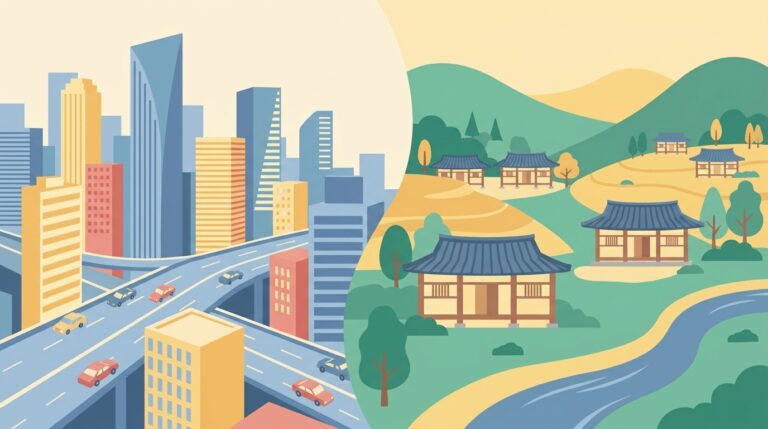
As someone who has lived in the hyper-connected concrete jungle of Seoul for over a decade, but also loves escaping to the peaceful mountains of Gangwon-do on weekends, I can tell you this: the contrast between Korean city life (도시 생활) and country life (시골 생활) is a massive part of modern Korean identity.
If you want to travel beyond Seoul or talk to your Korean friends about where they grew up, you need more than just “It is big” or “It is quiet.” You need the B1-level vocabulary and cultural nuance to express the vibe. This guide is based on real questions from intermediate learners who wanted to sound like a local, not a textbook. Let’s dive in!
Phase 2: Deep Dive into Core Expressions
Here are the top 3 expressions you need to compare city and country life like a true native.
1. 서울이 시골보다 훨씬 복잡하긴 해요.
- Pronunciation: [seou-ri sigol-boda hwol-ssin bok-ja-pa-gin hae-yo.]
(Think of ‘hwol-ssin’ as a sharp exhale of breath to emphasize ‘much’.)- Meaning: Seoul is definitely much more crowded/complex than the countryside.
- K-Culture Moment: You are sitting at a cafe in a quiet rural town with a local friend, sipping tea, looking at the empty streets. You sigh and say this, acknowledging why you needed this weekend getaway.
- Editor’s Insight: The grammar
A-이/가 B-보다 훨씬...means “A is much more… than B.” Adding-기/긴 해요(It is indeed / I admit that) makes you sound incredibly fluent. It shows you are agreeing with an unsaid point: “Yes, Seoul is convenient, but I admit it’s way too crowded.”- Situation Spectrum:
- Casual with friends: ✅ (Drop the ‘요’: 복잡하긴 해)
- Coworkers (Semi-formal): ✅
- Elders/Bosses (Formal): ✅
- 🤔 Think About It: In Korea, the word
복잡하다means “complicated,” but it’s the most common word used for “crowded” or “congested traffic.” Why do you think Koreans associate large crowds directly with “complexity”?2. 도시는 편리한 반면에, 시골은 여유로워요.
- Pronunciation: [do-si-neun pyeol-li-han ban-myeo-ne, si-go-reun yeo-yu-ro-wo-yo.]
- Meaning: While the city is convenient, the countryside is relaxed/leisurely.
- K-Culture Moment: An interviewer on a Korean travel vlog asks you why you chose to visit a small town instead of staying in Gangnam. You drop this sentence, and the editors immediately put a 😲 emoji on the screen.
- Editor’s Insight:
-(으)ㄴ/는 반면에(on the other hand / while) is a perfect B1 grammar point for contrasting two things. The word여유롭다(to have room to spare, to be relaxed) is the absolute opposite of the city’s ppal-li ppal-li culture. It’s the ultimate compliment for a rural destination.- Situation Spectrum:
- Casual with friends: ✅
- Coworkers (Semi-formal): ✅
- Elders/Bosses (Formal): ✅
- 🤔 Think About It: The concept of
여유(leisure/spare time/space) is something modern Koreans actively seek out, often creating terms like “water-mung” (staring blankly at water). Does your culture have a specific word for the peace found outside the city?3. 역시 시골 인심이 최고네요!
- Pronunciation: [yeok-si si-gol in-si-mi choe-go-ne-yo!]
- Meaning: As expected, countryside generosity is the best!
- K-Culture Moment: You go to a traditional market in the countryside, order a $5 bowl of noodles, and the grandmother serving you gives you an extra plate of dumplings for free because “you look hungry.”
- Editor’s Insight:
인심(Insim) translates to “generosity” or “good-heartedness.” When paired with시골(countryside), it represents the stereotype that rural folks are much warmer and more generous with food and favors than cold city dwellers.- Situation Spectrum:
- Casual with friends: ✅
- Traditional Market Vendors: ✅ (They will love it!)
- Business meetings: 🚫 (A bit too folksy for a corporate setting)
- 🤔 Think About It: Why is food so closely tied to “generosity” in Korean culture? How does this reflect Korea’s history before its rapid urbanization?
Phase 3: Textbook vs. Real Korean
Let’s compare what you learn in a classroom with how people actually talk on the streets of Seoul vs. a rural village.
[Describing City Traffic]
* 📖 Textbook Korean: 서울은 차가 많아서 길이 막힙니다. (There are many cars in Seoul, so the roads are blocked.)
* 🗣️ Real Korean: 서울은 어딜 가나 차가 꽉 막혀요. (Everywhere you go in Seoul, traffic is totally jammed.)
* 💡 Why the difference?: Koreans love using strong adverbs like 꽉 (tightly) to add emotional emphasis to everyday frustrations.
[Describing the Countryside Vibe]
* 📖 Textbook Korean: 시골은 공기가 맑고 조용합니다. (The countryside has clean air and is quiet.)
* 🗣️ Real Korean: 시골 오니까 완전 힐링돼요. (Coming to the countryside is totally healing.)
* 💡 Why the difference?: “Healing” (힐링) is a Konglish word that has become the ultimate buzzword for taking a mental break from the hyper-competitive city society.
Bottom Note: For B1 learners, using Konglish terms like
힐링돼요naturally in a sentence shows a deep understanding of modern Korean lifestyle trends!
Phase 4: Cultural Context — K-Culture Deep Dive
4-1. Non-Verbal Communication: The City “Nunchi” vs. Country “Jeong”
In Seoul, 눈치 (Nunchi – the ability to read the room) often means staying out of people’s way. You walk fast, don’t block the escalators, and avoid making unnecessary eye contact on the subway. It’s polite indifference.
However, in the countryside, the culture shifts to 정 (Jeong – unspoken affection/attachment). A local might stare at you longer, ask personal questions (“How old are you? Are you married?”), or give you extra side dishes without you asking. To a foreigner, this can feel intrusive at first, but adjusting your non-verbal cues—smiling warmly and bowing slightly instead of looking away—will unlock a completely different side of Korea.
4-2. K-Drama Connection: The “City Slicker Meets Country Bumpkin” Trope
If you watch K-Dramas, you already know this trope well. A successful but miserable professional from Seoul gets exiled or takes a break in a rural village. They bring their big-city habits: demanding fast service, talking strictly business, and refusing to share food.
But real-life rural Korea isn’t always a romantic comedy! While dramas show picturesque oceans and cute local cafes, reality means no late-night delivery apps (배달의민족 doesn’t always reach the mountains!), buses that come only once every two hours, and everything closing by 8 PM. When you visit these places, leave your city expectations behind and embrace the slower pace.
Phase 5: Real-Life Roleplay Scenario
Setting: A sunny Saturday afternoon. You took an intercity bus to a traditional market in Gangneung (a coastal city in Gangwon-do). You are sitting at a small stall eating kalguksu (knife-cut noodles) with your Korean friend, Min-ji.
Characters:
– YOU: An intermediate Korean learner who usually lives in Seoul.
– Min-ji (28): Your Korean friend who dragged you here for a “healing” trip.
– Market Grandma (NPC): The warm-hearted vendor running the stall.
Dialogue:
Min-ji: 어때? 서울보다 여기가 훨씬 낫지? 🍜
(eottae? seoul-boda yeogi-ga hwol-ssin nat-ji?)
[How is it? It’s way better here than Seoul, right?]
YOU: 응, 서울은 너무 복잡한데, 여기는 조용해서 완전 힐링돼.
(eung, seou-reun neo-mu bok-ja-pan-de, yeogi-neun jo-yong-hae-seo wan-jeon hil-ling-dwae.)
[Yeah, Seoul is so crowded, but it’s quiet here so it’s totally healing.]
Min-ji: 그치? 공기도 맑고 너무 좋아.
(geu-chi? gong-gi-do mal-go neo-mu jo-a.)
[Right? The air is clear and it’s so nice.]
(🎭 Stage Direction: The Market Grandma suddenly places a huge plate of fresh seafood pancakes on your table.)
Grandma: 학생들, 멀리서 왔나 보네. 이거 서비스니까 많이 먹어~ 🥞
(hak-saeng-deul, meol-li-seo wan-na bo-ne. i-geo seo-bi-seu-ni-kka ma-ni meo-geo~)
[Students, looks like you came from afar. This is on the house (service), eat up!]
🔀 Your Turn! How do you respond?
– A) “아니요, 저희 이거 주문 안 했어요.” (No, we didn’t order this.)
– B) “우와! 역시 시골 인심이 최고네요! 감사합니다!” (Wow! As expected, countryside generosity is the best! Thank you!)
– C) “얼마예요? 돈 드릴게요.” (How much is it? I’ll give you money.)✅ Best Choice: B — Embracing the
서비스(freebie) with a big smile and complimenting the인심is the perfect way to make the Grandma’s day.
⚠️ Choice A & C Analysis: Rejecting “service” or trying to pay for it in a rural market can actually hurt the vendor’s feelings. It breaks the flow of정(Jeong).
Phase 6: 10-Second Shadowing Drill
Read this out loud. Pay attention to the pauses (/) and the intonation!
😲 와, / 서울은 엄청 복잡한 반면에, / 여기는 너무 평화롭네요.
(wa, / seo-u-reun eom-cheong bok-ja-pan ban-myeo-ne, / yeo-gi-neun neo-mu pyeong-hwa-rom-ne-yo.)
Wow, while Seoul is incredibly crowded, here is so peaceful.
- Tone: Amazed, taking a deep breath of fresh air.
- Tip: Stretch out the ‘엄~~~청’ (eom-cheong) to emphasize how crazy Seoul can be!
Phase 7: K-Culture Mini Dictionary
| Korean | Romanization | English | Context |
|---|---|---|---|
| 시골 인심 | sigol insim | Countryside generosity | The stereotype that rural people are more giving and warm-hearted. |
| 힐링 | hilling | Healing | Konglish term for taking a mental break, often by escaping the city. |
| 핫플 | hatpeul | Hot place | A trendy spot (cafe, restaurant). Cities are full of them, but rural areas have “hidden hot-peuls.” |
| 서비스 | seobiseu | Service (Freebie) | Food or items given for free by restaurant owners. A core part of Korean hospitality. |
| 귀농 | gwinong | Returning to farming | The growing trend of city dwellers moving to the countryside to farm and escape the rat race. |
Phase 8: Traveler’s Survival Kit (Rural Trip Edition)
Taking a trip outside of Seoul? You won’t have the luxury of subways every 3 minutes. Here is your survival kit.
🆘 Survival Phrases TOP 3
– 🇰🇷 “다음 버스는 언제 와요?” (da-eum beo-seu-neun eon-je wa-yo?)
– When does the next bus come? (Crucial for rural bus stops without digital signs!)
– 🇰🇷 “여기서 카카오택시 잡혀요?” (yeo-gi-seo ka-ka-o-taek-si ja-pyeo-yo?)
– Can I catch a Kakao Taxi from here?
– 🇰🇷 “배달되는 곳 있어요?” (bae-dal-doe-neun got i-sseo-yo?)
– Is there any place that delivers here? (Don’t assume delivery apps work everywhere!)📌 Editor’s Travel Note
– Apps: While Naver Maps is king in Seoul, in deep rural areas, buses might be delayed. Always ask locals or the terminal staff for the true schedule.
– Payment: Korea is a cashless society, but rural traditional markets (오일장) often prefer cash or account transfers (계좌이체) for small items.
– Dialects (Saturi): Don’t panic if you don’t understand the grandmother at the market! Many Koreans from Seoul also struggle to understand strong rural dialects.
Phase 9: Critical Thinking — “One Step Deeper”
Media vs Reality: The Romanticized Countryside
🧠 Think Deeper:
K-Dramas have beautifully romanticized the Korean countryside. Shows like Summer Strike or Hometown Cha-Cha-Cha present rural towns as perfect sanctuaries filled with pastel-colored houses, quirky but lovable neighbors, and endless free time. However, the reality of rural Korea involves a rapidly aging population, lack of infrastructure, and young people migrating to Seoul for jobs. The contrast between the media’s “aesthetic healing spaces” and the harsh reality of regional depopulation is a massive social issue in Korea today. When we travel outside of Seoul, it’s important to appreciate the beauty while also recognizing it as a real, living community, not just a drama set.💬 Your Turn: Does your country’s media romanticize country life? How different is it from reality? Share your thoughts in the comments!
Phase 10: FAQ & Avoiding Misunderstandings
Q: Can I use “시골” (Sigol) to describe any city outside of Seoul?
No! This is a very common mistake. Calling major cities like Busan, Daegu, or Daejeon “시골” is highly offensive to the locals. “시골” strictly refers to rural, agricultural, or very small towns. For major cities outside Seoul, use “지방” (jibang – provinces/regions).
Q: Is it okay if an older person in the countryside asks my age or if I am married right away?
Yes. In Seoul, this is becoming less common due to privacy awareness. But in the countryside, this is a sign of 정. They want to know where to place you in the social hierarchy so they can treat you like family.
❌ Common Mistake #1: Assuming everyone in Korea speaks the standard Seoul dialect you hear in audiobooks.
✅ Do this instead: Embrace the local rhythm. If you don’t understand a local dialect, politely smile and say, “죄송해요, 제가 외국인이라서 잘 못 알아들었어요.” (Sorry, I’m a foreigner so I couldn’t understand well.) They will usually switch to a softer, more standard accent for you!
Phase 11: Summary & Action Items
- One-Liner Summary: Seoul may be “훨씬 복잡하고 편리” (much more crowded and convenient), but the countryside offers “여유” (leisure) and amazing “인심” (generosity)!
Your Action Mission:
– 🥉 Bronze (Solo): Stand in your room and say “아~ 완전 힐링돼요” while stretching your arms.
– 🥈 Silver (Online): Drop a comment below contrasting your hometown with a big city using “-는 반면에”.
– 🥇 Gold (Real World): Next time you travel outside of a major Korean city, compliment a restaurant owner by saying “사장님, 인심이 너무 좋으세요!” (Boss, your generosity is so great!)
🎬 K-Culture Mission: Watch one episode of a countryside-based K-Drama (like Our Blues or Welcome to Samdal-ri). Notice how the characters dress and talk differently when they are in Seoul versus when they are in their hometown.
Phase 12: Interactive Challenge — Quiz Time!
1. Fill in the Blank:
“도시는 편리한 (______), 시골은 조용해요.”
(Hint: “While/On the other hand”)
2. Situational Judgment:
You are visiting Busan (the second largest city in Korea) with a friend from Seoul. You look around the massive skyscrapers and say:
“와! 여기 완전 시골이네요!” (Wow! It’s totally the countryside here!)
Why is this a terrible mistake?
3. True or False – K-Culture Edition:
If a grandmother at a rural market gives you extra food for free, you should leave a tip on the table before you leave. (T/F)
(Answers: 1. 반면에 2. Busan is a massive metropolis, not “시골”. Calling it that will anger the locals! Use “지방” if referring to non-Seoul areas. 3. False! Korea has no tipping culture. Leaving money for “service” might confuse or offend her. Just say thank you and eat well!)
How did you do? Let us know in the comments below! 👇
Frequently Asked Questions (FAQ)
Q: What does "서울이 시골보다 훨씬 복잡하긴 해요." mean in Korean and how do you pronounce it?
A: In Korean, "서울이 시골보다 훨씬 복잡하긴 해요." is pronounced [seou-ri sigol-boda hwol-ssin bok-ja-pa-gin hae-yo.] and means: Seoul is definitely much more crowded/complex than the countryside.
Q: What does "도시는 편리한 반면에, 시골은 여유로워요." mean in Korean and how do you pronounce it?
A: In Korean, "도시는 편리한 반면에, 시골은 여유로워요." is pronounced [do-si-neun pyeol-li-han ban-myeo-ne, si-go-reun yeo-yu-ro-wo-yo.] and means: While the city is convenient, the countryside is relaxed/leisurely.
Q: What does "역시 시골 인심이 최고네요!" mean in Korean and how do you pronounce it?
A: In Korean, "역시 시골 인심이 최고네요!" is pronounced [yeok-si si-gol in-si-mi choe-go-ne-yo!] and means: As expected, countryside generosity is the best!







