

Phase 1: Empathy & The K-Culture Cold Open
Hello! I’m your Daily Hangul Editor.
Picture this: You are watching your favorite K-Drama. The main leads have just met under a cherry blossom tree, or maybe they just survived a chaotic group project in college. The guy shyly takes out his phone and says, “Can I get your number?”
But wait, the subtitles say “Can I get your number,” yet what he actually mumbled sounded nothing like the word “number” you learned in your textbook! Or imagine you are in Seoul, waiting outside a famous BBQ restaurant (K-Food time! 🥩), and the digital waiting machine asks you to input your phone number. Panic sets in. Do I use Hana, Dul, Set? Or Il, I, Sam? How do I say the dash?
If you’ve ever felt overwhelmed by Korean numbers, you are not alone! Numbers are notoriously tricky in Korean. But today, we are going to unlock one of the most practical survival skills for your life (and social life) in Korea: Asking and answering phone numbers.
By the end of this post, you’ll sound like a friendly local, whether you’re making a new friend at a cafe or securing your spot at a Michelin-starred K-Food joint.
Phase 2: Deep Dive into Core Expressions
Let’s look at the absolute must-know phrases.
1. 전화번호가 어떻게 되세요?
- Pronunciation: [jeonhwabeonhoga eotteoke doeseyo?]
- Sound-alike guide: juhn-hwa-bun-ho-ga uht-toh-keh dweh-seh-yo?
- Meaning: (Literal) How does your phone number become? / (Real nuance) What is your phone number?
- K-Culture Moment: You’re at a language exchange meetup in Hongdae. You hit it off with someone and want to stay in touch. This is the politest, most natural way to ask for their digits without sounding aggressive.
- Editor’s Insight: You might wonder why we don’t just say “What is” (뭐예요?). In Korean, asking “How does it become?” (어떻게 되세요?) is a softer, more indirect way to ask for personal information. It shows respect and good Nunchi (social tact).
- Situation Spectrum:
- Casual (Friends): ⚠️ (Too formal, see Phase 3!)
- Semi-formal (New acquaintances/Coworkers): ✅
- Formal (Boss/Elders): ✅
- 🤔 Think About It: Why does Korean culture prefer indirect questions for personal information? Does your native language have a similar way to “soften” direct questions?
2. 제 번호는 공일공(010) – 일이삼사(1234) – 오육칠팔(5678)이에요.
- Pronunciation: [je beonhoneun gong-il-gong-e il-i-sam-sa-e o-yuk-chil-pal-ieyo.]
- Sound-alike guide: The “- ” (dash) sounds like “eh” (like the ‘e’ in ‘egg’).
- Meaning: My number is 010-1234-5678.
- K-Culture Moment: You’re at an Olive Young store, and the cashier asks for your number to earn points. You confidently rattle off your number!
- Editor’s Insight: The golden rule of phone numbers: Always use Sino-Korean numbers (일, 이, 삼, 사…). Never use Native Korean numbers (하나, 둘, 셋…). Also, almost every mobile number in Korea starts with 010 (gong-il-gong)!
- Situation Spectrum:
- Casual: ✅
- Semi-formal: ✅
- Formal: ✅
3. 카톡 하세요? / 카톡 아이디가 뭐예요?
- Pronunciation: [katok haseyo? / katok aidiga mwoyeyo?]
- Meaning: Do you use KakaoTalk? / What is your KakaoTalk ID?
- K-Culture Moment: This is the ultimate Gen Z / Millennial move. Instead of asking for a phone number, Koreans usually exchange KakaoTalk IDs right away.
- Editor’s Insight: KakaoTalk (카톡) is the oxygen of Korean communication. SMS text messages are mostly used for delivery notices and spam. If you want to make friends, you need KakaoTalk.
- Situation Spectrum:
- Casual: ✅
- Semi-formal: ✅
- Formal: 🚫 (Stick to asking for a phone number or business card)
Phase 3: Textbook vs. Real Korean
Let’s compare what you studied with what you’ll actually hear on the streets of Seoul.
[Asking for a number]
* 📖 Textbook Korean: 당신의 전화번호는 무엇입니까? (What is your phone number?)
* 🗣️ Real Korean: 전화번호가 어떻게 되세요? (How does your phone number become?) OR 연락처 좀 알려주세요. (Please let me know your contact info.)
* 💡 Why the difference?: The word “당신” (You) is almost never used in spoken Korean unless you are picking a fight or writing a poetic song lyric. We drop the “You” entirely!
[Among friends or dating]
* 📖 Textbook Korean: 우리 전화번호를 교환합시다. (Let us exchange our phone numbers.)
* 🗣️ Real Korean: 번호 교환할까요? (Shall we exchange numbers?) / 카톡 친추할까요? (Shall we add each other on Katalk?)
* 💡 Why the difference?: “친추” is a slang abbreviation for 친구 추가 (Friend Add). Young Koreans love shortening words for efficiency.
Bottom Note: For A2 learners, sticking to “전화번호가 어떻게 되세요?” and “카톡 하세요?” is the perfect balance of polite and natural.
Phase 4: Cultural Context — K-Culture Deep Dive
4-1. The Non-Verbal “Phone Handoff”
When Koreans ask for someone’s number (especially in a casual setting like a cafe or bar), they don’t just stand there with a pen and paper.
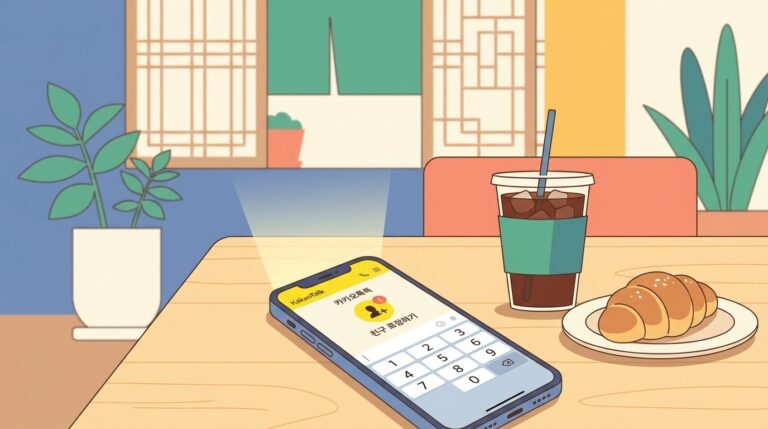
The move: They will open the dialpad or the KakaoTalk “Add Friend” screen on their smartphone and physically hand the phone over to you. You simply type your number/ID in and hand it back! It’s efficient, avoids mishearing the numbers, and breaks the ice.
4-2. K-Food & K-Travel Survival: The “Waiting” Machine
In the past, you’d write your name on a clipboard outside a busy restaurant. Today, Korea runs on digital waitlist machines like Tableling or Catchtable.
When you go to a hot K-Food spot, you’ll see an iPad at the door. You must enter your Korean phone number (010-XXXX-XXXX). The machine will then send you a KakaoTalk message when your table is ready. If you are a tourist without a Korean number, you usually have to go inside and politely ask the staff: “외국인이라서 번호가 없어요” (I don’t have a number because I’m a foreigner).
Phase 5: Real-Life Roleplay Scenario
Setting: Saturday afternoon, 3 PM. You are at a trendy cafe in Seongsu-dong (the Brooklyn of Seoul). You’ve been chatting with a friendly local you met while waiting in line for the cafe’s famous salt bread.
Characters:
* YOU: An A2 Korean learner visiting Seoul.
* Min-ji (28): A friendly, outgoing local who loves helping tourists.
Dialogue:
Min-ji: 소금빵 진짜 맛있죠?
(sogeumbbang jinjja masitjyo?)
[The salt bread is really good, right?]
YOU: 네! 정말 맛있어요.
(ne! jeongmal masisseoyo.)
[Yes! It’s really delicious.]
Min-ji: 저 이제 가야 해요. 만나서 반가웠어요!
(jeo ije gaya haeyo. mannaseo bangawosseoyo!)
[I have to go now. It was nice meeting you!]
YOU: 저도 반가웠어요.
(jeodo bangawosseoyo.)
[It was nice meeting you too.]
🔀 YOUR TURN! You want to stay in touch. What do you say?
– A) 당신의 번호를 주세요! (dangsin-ui beonhoreul juseyo!)
– B) 전화번호가 어떻게 되세요? (jeonhwabeonhoga eotteoke doeseyo?)
– C) 번호 따도 돼요? (beonho ttado dwaeyo?)✅ Best Choice: B — It’s perfectly polite and natural.
⚠️ Choice A Analysis: Sounds like a robot or a police officer demanding a number.
⚠️ Choice C Analysis: “번호 따다” is slang for picking someone up romantically. It might make things awkward if you just want to be friends!
(Assuming you chose B)
Min-ji: 아, 네! 카톡 하세요? 제 번호는 공일공에, 일이삼사에, 오육칠팔이에요.
(a, ne! katok haseyo? je beonhoneun gong-il-gong-e, il-i-sam-sa-e, o-yuk-chil-pal-ieyo.)
[Ah, yes! Do you use KakaoTalk? My number is 010-1234-5678.]
YOU: 네, 카톡 해요! 제가 메시지 보낼게요.
(ne, katok haeyo! jega mesiji bonaelgeyo.)
[Yes, I use KakaoTalk! I will send you a message.]
Phase 6: 10-Second Shadowing Drill
Let’s practice the rhythm of Korean phone numbers. The secret is the “에” (e) sound for the dash!
😊 제 번호는 / 공일공에 / 일이삼사에 / 오육칠팔 / 이에요.
(je beonho-neun / gong-il-gong-e / il-i-sam-sa-e / o-yuk-chil-pal / i-e-yo.)
Pro-tip: Read the numbers in chunks of four. Don’t rush, just keep a steady beat!
Phase 7: K-Culture Mini Dictionary
| Korean | Romanization | English | Cultural Context |
|---|---|---|---|
| 연락처 | yeollakcheo | Contact information | More formal than just “번호” (number). Often used in business. |
| 카톡 | katok | KakaoTalk | The #1 messenger app in Korea. Used for everything from dating to business. |
| 공일공 | gong-il-gong | 010 | The prefix for almost every mobile phone in South Korea. |
| 번호를 따다 | beonhoreul ttada | To get someone’s digits | Slang. Usually used in romantic/flirting contexts (e.g., getting a number at a bar). |
Phase 8: Traveler Survival Kit 🆘
Even if you don’t plan on making friends, you will need numbers for everyday survival in Korea, especially at convenience stores or cafes!
🆘 Survival Phrases for Shops
– 🇰🇷 Staff: “포인트 적립하시나요?” (pointeu jeongnipasinayo?) – Do you collect points?
– 🇰🇷 Staff: “전화번호 입력해 주세요.” (jeonhwabeonho imnyeokae juseyo.) – Please enter your phone number.
– 🗣️ Your response: “아니요, 괜찮아요.” (aniyo, gwaenchanayo) – No, it’s okay. (If you don’t have a Korean number).📍 Where you’ll hear this: CU, GS25, Olive Young, Mega Coffee, Paris Baguette.
💡 Pro Tip: If you have a Korean SIM card with a number, you can punch it into the keypad on the counter to earn points. It’s a great way to practice your number recall!
Phase 9: Critical Thinking — “One Step Deeper”
Language & Power: The Art of Indirectness
Have you noticed how Korean relies heavily on indirect phrasing? Instead of asking “What is your number?” (direct, focused on the object), we ask “How does your number become?” (어떻게 되세요?). This isn’t just about grammar; it’s a reflection of traditional Korean values where directness can be perceived as aggressive or demanding. By asking “how does it become,” you are giving the other person conversational space and respecting their boundaries. It’s the linguistic equivalent of a slight bow.
💬 Your Turn: Does your culture value directness (getting straight to the point) or indirectness (softening the request) when asking for personal info? Share in the comments!
Phase 10: FAQ & Avoiding Common Mistakes
Q: Can I use Native Korean numbers (하나, 둘, 셋) for my phone number?
No! This is the most common mistake. Phone numbers, bus numbers, and subway lines ALWAYS use Sino-Korean numbers (일, 이, 삼, 사… / il, i, sam, sa…).
Q: Should I ask for an Instagram handle instead?
Yes! “인스타 하세요?” (insuta haseyo? – Do you use Insta?) is extremely common among people in their 20s and 30s. It feels slightly less private than giving out a phone number.
❌ Common Mistake #1: Saying the word “dash” (대시) or “minus” (마이너스) when reading a phone number.
✅ Do This Instead: Use “에” (e). (e.g., 010 에 1234 에…)❌ Common Mistake #2: Using “당신” (You).
✅ Do This Instead: Just drop the subject completely! “전화번호가 어떻게 되세요?” implicitly means “your” number because of the context.
Phase 11: Summary & Action Items
One-Liner Summary: To get someone’s number politely, drop the “you,” ask “어떻게 되세요?”, and remember to read your digits using Sino-Korean numbers with an “에” for the dash!
Action Mission:
* 🥉 Bronze (Solo): Write your own phone number down and read it out loud in Korean 3 times. Don’t forget the “에”!
* 🥈 Silver (Online): Comment your favorite K-Drama character’s made-up phone number below in Hangul!
* 🥇 Gold (Real World): Next time you are at a Korean restaurant or cafe, listen closely to see if the staff asks another customer for their number (“번호 입력해주세요”).
K-Culture Mission:
Download KakaoTalk if you haven’t already! Familiarize yourself with the interface, because it’s your golden ticket to socializing in Korea.
What’s the hardest thing about Korean numbers for you? Let’s chat in the comments! 👇
Phase 12: Interactive Quiz
1. You are at a business meeting and need to ask for a client’s contact info. Which is the best choice?
* A) 연락처가 어떻게 되세요?
* B) 번호 따도 돼요?
* C) 당신의 번호는 무엇입니까?
2. True or False: You should read the phone number 010-1234 using ‘Hana, Dul, Set, Net’.
* True
* False
3. Fill in the blank: In a phone number, the dash (-) is pronounced as ____.
* A) 마이너스 (mainuseu)
* B) 에 (e)
* C) 의 (ui)
(Answers: 1: A, 2: False – use Il, I, Sam, Sa, 3: B)
Frequently Asked Questions (FAQ)
Q: What does "전화번호가 어떻게 되세요?" mean in Korean and how do you pronounce it?
A: In Korean, "전화번호가 어떻게 되세요?" is pronounced [jeonhwabeonhoga eotteoke doeseyo?] and means: (Literal) How does your phone number become? / (Real nuance) What is your phone number?
Q: What does "제 번호는 공일공(010) - 일이삼사(1234) - 오육칠팔(5678)이에요." mean in Korean and how do you pronounce it?
A: In Korean, "제 번호는 공일공(010) - 일이삼사(1234) - 오육칠팔(5678)이에요." is pronounced [je beonhoneun gong-il-gong-e il-i-sam-sa-e o-yuk-chil-pal-ieyo.] and means: My number is 010-1234-5678.
Q: What does "카톡 하세요? / 카톡 아이디가 뭐예요?" mean in Korean and how do you pronounce it?
A: In Korean, "카톡 하세요? / 카톡 아이디가 뭐예요?" is pronounced [katok haseyo? / katok aidiga mwoyeyo?] and means: Do you use KakaoTalk? / What is your KakaoTalk ID?







