

Hello! I’m the Lead Editor of Daily Hangul, your personal Korean tutor and local culture navigator.
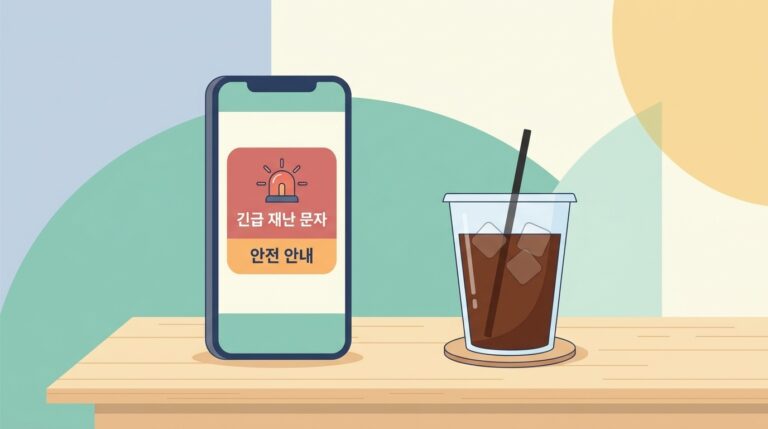
Imagine this: You’re sitting in a trendy cafe in Hongdae, sipping your perfectly aesthetic Iced Americano. Suddenly—BEEEEEEP! BEEEEEEP! Every single smartphone in the cafe goes off at the exact same time with a deafening siren.
Did a zombie outbreak just happen like in Train to Busan? Is it a war?
You look around in panic, but the Korean students next to you calmly glance at their screens, swipe away the notification, and go back to studying.
Welcome to Korea’s ‘Jaenan Munja’ (Emergency Alert Text) system! While most of these loud alerts are just warnings for heavy rain or a missing person, sometimes, the ground actually starts to shake. Earthquakes (지진) in Korea aren’t as common as in neighboring countries, but they do happen.
Today, we’re going to learn the absolute beginner (A1) survival phrases for when the ground shakes. Knowing these won’t just make you sound like a local; it might actually keep you safe!
Phase 2: Core Survival Expressions Deep Dive
Let’s learn the 3 absolute essential phrases you need to know. At an A1 level, we keep it short, loud, and clear!
1. 지진이에요! (It’s an earthquake!)
- Pronunciation: [ji-jin-i-e-yo]
- Sound guide: “jee” (like Jeep) + “jeen” (like blue jeans) + “ee-eh-yo”.
- Meaning: “It is an earthquake!” (지진 = earthquake, 이에요 = it is)
- K-Culture Moment: In K-Dramas, when a disaster strikes, you rarely hear long, poetic sentences. People just point and yell the noun! You might hear locals dropping the polite ending and just shouting, “어? 지진이다!” (Oh? Earthquake!)
- Editor’s Insight: You don’t need complex grammar in an emergency. Just yelling “지진!” is enough to get everyone’s attention.
- Situation Spectrum:
- Casual / Emergency: ✅
- Semi-formal / Strangers: ✅
- Formal: ✅ (In emergencies, politeness rules bend!)
- 🤔 Think About It: Why is it so important to have a short, punchy word for natural disasters? Does your language have a one-syllable or two-syllable word for earthquake?
2. 도와주세요! (Please help me!)
- Pronunciation: [do-wa-ju-se-yo]
- Sound guide: “doh-wah” (like Homer Simpson’s ‘D’oh’ + ‘wah’) + “joo-seh-yo”.
- Meaning: Please help (me)!
- K-Culture Moment: Think of every thriller K-Drama where the protagonist is trapped. This is the exact phrase they scream. It’s the ultimate survival phrase for ANY situation in Korea.
- Editor’s Insight: This phrase is magic. Koreans are generally very quick to help foreigners in distress. If you shout this, people will turn around.
- Situation Spectrum:
- Anyone, anywhere, anytime: ✅
- 🤔 Think About It: Notice the “주세요 (ju-se-yo / please give)” at the end? In Korean, you “give” help. It shows how action and transaction are built into the language!
3. 밖으로 나가요! (Let’s go outside!)
- Pronunciation: [ba-kkeu-ro na-ga-yo]
- Sound guide: “bah-kkoo-roh” + “nah-gah-yo” (like ‘nah’ and Lady ‘Gaga’).
- Meaning: Literal: Go toward the outside. / Real meaning: Evacuate outside!
- K-Culture Moment: You’ll hear this from security guards or shop owners if a building needs to be evacuated.
- Editor’s Insight: “밖 (bak)” means outside. If you forget everything else, just point at the door and say “밖! 밖! (Bak! Bak!)”
- Situation Spectrum:
- Friends / Coworkers: ✅
- Bosses (In an emergency): ⚠️ (Add ‘요’ at the end to be safe!)
- 🤔 Think About It: In Korean culture, moving as a group is common. Notice how “나가요” can mean “I go out” OR “Let’s go out” depending entirely on the context?
Phase 3: Textbook vs. Real Korean
When the ground shakes, nobody talks like a textbook. Here is what you’ll actually hear:
[Reacting to the Shaking]
* 📖 Textbook Korean: 지진이 발생했습니다. (An earthquake has occurred.)
* 🗣️ Real Korean: 어? 흔들려! (eo? heundeullyeo! / Huh? It’s shaking!)
* 💡 Why the difference?: Textbooks teach news-anchor Korean. In real life, people react to the immediate physical sensation (흔들리다 = to shake).
[Checking on Someone]
* 📖 Textbook Korean: 당신은 어디가 다치셨습니까? (Where are you injured?)
* 🗣️ Real Korean: 괜찮아요?! (gwaen-chan-a-yo?! / Are you okay?!)
* 💡 Why the difference?: “괜찮아요” is the Swiss Army knife of Korean. It works for “I’m fine,” “No thanks,” and “Are you hurt?”
Phase 4: Cultural Context — K-Culture Deep Dive
4-1. Non-Verbal Cues: The Power of ‘Nunchi’ (눈치) in a Crisis
If you feel a rumble, before you dive under a table and scream, use your Nunchi (눈치)—the Korean art of reading the room. Look at the locals. Koreans are very accustomed to minor building vibrations (sometimes it’s just a heavy truck or subway underneath).
* If the locals are calmly continuing to grill their Samgyeopsal (pork belly)… you are fine.
* If the locals drop their tongs and run… YOU RUN!
4-2. The “Jaenan Munja” (Emergency Text) Culture
As a traveler or expat, your phone will get loud, scary siren alerts. These are sent by the government. K-Pop idols even mention them on live streams: “Ah, the emergency text just went off! Everyone, be careful of the heatwave today!” It shows how Korea’s high-tech infrastructure is deeply woven into daily life and collective care.
Phase 5: Real-Life Roleplay Scenario
Setting: Friday night, 7 PM. A bustling Korean BBQ restaurant in Gangnam. Smoke fills the air, and K-Pop is blasting. You are having dinner with some local friends.
Characters:
* YOU: An A1 Korean learner, a bit nervous but excited for BBQ.
* Minsu (32): Your friendly Korean buddy who is currently manning the grill.
(Suddenly, the tables vibrate. The glasses of Soju rattle!)
Minsu: 어? 야, 테이블 흔들려! 😨
(eo? ya, teibeul heundeullyeo!)
[Huh? Hey, the table is shaking!]
YOU: 지진이에요?
(ji-jin-i-e-yo?)
[Is it an earthquake?]
Minsu: (Checks his phone as a loud siren goes off) 와, 재난문자 왔어. 지진이래!
(wa, jaenanmunja wasseo. jijinirae!)
[Wow, an emergency text came. It says it’s an earthquake!]
🔀 YOUR TURN! How do you react?
– A) “고기 더 주세요!” (More meat please!)
– B) “대피소 어디에요? 밖으로 나가요!” (Where is the shelter? Let’s go outside!)
– C) “대박…” (Awesome / Wow…)✅ Best Choice: B — Prioritize safety! Asking for the shelter (대피소) or suggesting to go outside is the smartest move.
⚠️ Choice C Analysis: While “대박” means “Wow/Unbelievable,” using it during an actual emergency might make you look like you don’t understand the gravity of the situation!
(🎭 Stage Direction: Minsu turns off the stove immediately—safety first!—and grabs his jacket.)
Minsu: 빨리 밖으로 나가자!
(ppalli bakkeuro nagaja!)
[Let’s go outside quickly!]
Phase 6: 10-Second Shadowing Drill
Practice these lines out loud. Pay attention to the slashes for pauses and the emotion tags!
- 🚨(Loud & Urgent) 어? / 지진이에요!
(eo? / ji-jin-i-e-yo!)
Huh? It’s an earthquake! -
🥺(Desperate) 여기요! / 도와주세요!
(yeo-gi-yo! / do-wa-ju-se-yo!)
Over here! Please help! -
🏃♂️(Action-oriented) 빨리 / 밖으로 / 나가요!
(ppal-li / ba-kkeu-ro / na-ga-yo!)
Quickly, let’s go outside!
Phase 7: K-Culture Mini Dictionary
| Korean | Romanization | English | Context |
|---|---|---|---|
| 재난문자 | jae-nan-mun-ja | Emergency Alert Text | Loud government texts for everything from COVID to earthquakes. |
| 대피소 | dae-pi-so | Evacuation Shelter | Look for green signs in subway stations; they double as shelters! |
| 눈치 | nun-chi | Reading the room | Essential for figuring out if you should panic or keep eating. |
| 119 | il-il-gu | Emergency Number | The Korean equivalent of 911 for fire and medical emergencies. |
Phase 8: Traveler’s Survival Kit
If you are visiting Korea, natural disasters can be scary because of the language barrier. Here is your absolute survival kit.
🆘 Survival Phrases TOP 3
– 🇰🇷 “대피소 어디에요?” (dae-pi-so eo-di-e-yo?)
– Meaning: Where is the shelter?
– 🇰🇷 “다쳤어요.” (da-chyeot-seo-yo)
– Meaning: I am hurt/injured.
– 🇰🇷 “119 불러주세요!” (il-il-gu bul-leo-ju-se-yo!)
– Meaning: Please call 119!📌 Editor’s Travel Note
– 119, not 911: In Korea, dial 119 for fire and ambulance, and 112 for police. Good news? They have real-time English translation services!
– Useful App: Download the ‘Emergency Ready App’ (provided by the Korean government). It translates emergency alerts into English and shows you the nearest shelters.
Phase 9: Critical Thinking Corner — “A Step Deeper”
Media vs Reality: The ‘Pali-Pali’ Safety Net
In K-Dramas, disaster scenes are chaotic. But in reality, Korea’s approach to disasters reflects its Pali-Pali (hurry, hurry) culture and deep-rooted communal mindset. The moment a minor earthquake hits, the government instantly blasts a ‘Jaenan Munja’ to every phone within the radius. Some foreigners find this intrusive or overly dramatic for minor events. However, this system exists because Korean society values collective safety over individual peace and quiet. The government is essentially saying, “We are watching out for you, instantly.”
💬 Your Turn: Does your country have an emergency text system? Do you think it’s better to be over-warned or only warned during major catastrophes? Let me know in the comments!
Phase 10: FAQ & Avoiding Misunderstandings
- Q: Can I just shout “Help!” in English?
- A: Yes! Many young Koreans understand basic English. However, yelling “도와주세요! (Do-wa-ju-se-yo!)” will get a much faster, instinctual reaction from older generations as well.
- Q: Should I drop honorifics (요) in an emergency?
- A: It is completely fine! If a building is shaking, no one cares about polite grammar. Shouting “도와줘! (Do-wa-jwo!)” instead of “도와주세요” is perfectly acceptable.
❌ Common Mistake #1: Calling 911.
✅ Do this instead: Dial 119. Remember: “1-1-9 saves the time!”
Phase 11: Summary & Action Items
One-Liner Summary: When the ground shakes in Korea, use your Nunchi, check your Jaenan Munja, and remember to shout “도와주세요!” (Please help!).
Action Mission:
* 🥉 Bronze (Solo): Say “지진이에요! 밖으로 나가요!” out loud 3 times right now.
* 🥈 Silver (Online): Download the ‘Emergency Ready App’ on your phone so you’re prepared for your next Korea trip.
* 🥇 Gold (Real Life): Next time you watch a K-Drama action scene, listen carefully to see if you can hear “도와주세요!”
Phase 12: Quiz — Interactive Challenge
1. You are in a Korean convenience store. The shelves shake violently. You want to tell the clerk it’s an earthquake. What do you say?
– A) 대박!
– B) 지진이에요!
– C) 비빔밥 주세요!
2. True or False – K-Culture Edition:
– In Korea, the emergency phone number for an ambulance is 911.
3. Fill in the Blank:
– To ask people to evacuate outside with you, you say: “[ ] 나가요!” (Hint: means ‘outside’)
(Answers: 1. B, 2. False – it’s 119, 3. 밖으로 (bakkeuro))
Stay safe, keep studying, and see you in the next Daily Hangul lesson! 👋
Frequently Asked Questions (FAQ)
Q: What does "지진이에요! (It's an earthquake!)" mean in Korean and how do you pronounce it?
A: In Korean, "지진이에요! (It's an earthquake!)" is pronounced [ji-jin-i-e-yo] and means: a key conversational Korean expression covered in this lesson.
Q: What does "도와주세요! (Please help me!)" mean in Korean and how do you pronounce it?
A: In Korean, "도와주세요! (Please help me!)" is pronounced [do-wa-ju-se-yo] and means: a key conversational Korean expression covered in this lesson.
Q: What does "밖으로 나가요! (Let's go outside!)" mean in Korean and how do you pronounce it?
A: In Korean, "밖으로 나가요! (Let's go outside!)" is pronounced [ba-kkeu-ro na-ga-yo] and means: a key conversational Korean expression covered in this lesson.






