

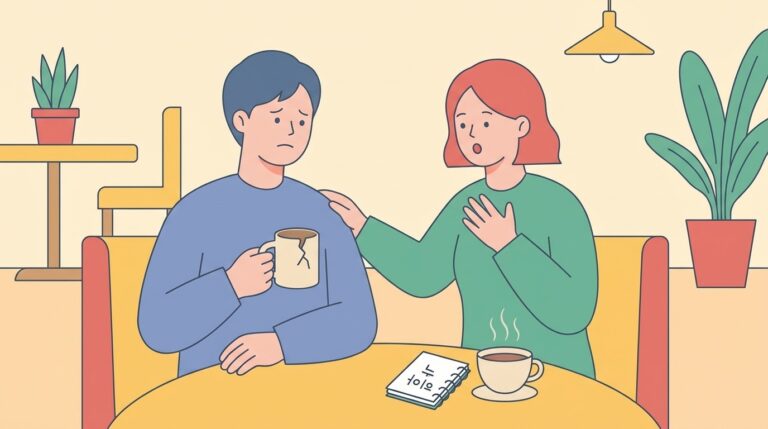
Phase 1: Empathy (Immersive Open)
Hello! I’m your Lead Editor at Daily Hangul.
Picture this: You are watching a classic K-Drama. The main character accidentally knocks over a ridiculously expensive vase belonging to the wealthy CEO. Time slows down. Crash! The CEO glares. The subtitles simply read: “I’m sorry.” But the character’s face shows pure terror, and they are bowing at a 90-degree angle, promising to work for free for the next ten years to pay it off.
Now, imagine you’re in Korea. You borrowed a friend’s tablet, a digital camera, or even rented a beautiful Hanbok. Suddenly, you drop it. It’s broken. Your heart drops to your stomach.
Saying “미안해요 (mianhaeyo, I’m sorry)” is just the beginning. In Korean culture, a sincere apology for property damage requires offering a practical solution. If you only say “I’m sorry,” Koreans might feel you aren’t taking responsibility. But don’t panic! Today, we will learn exactly what to say to navigate this terrifying situation smoothly, fix the problem, and maybe even make your friendship stronger.
(This guide is based on real panicked text messages I’ve received from my foreign students over the years!)
Phase 2: Core Expressions Deep Dive
Here are the lifesavers. Memorize these to show your sincerity.
1. 제가 실수로 망가뜨렸어요.
- Pronunciation: Jega silsuro manggatteuryeosseoyo. [Je-ga / shil-su-ro / mang-ga-tteu-ryeo-sseo-yo]
- Meaning: I accidentally broke it.
- K-Culture Moment: You’ll hear this in variety shows when a K-Pop idol accidentally breaks a stage prop. They immediately put their hands together, look at the camera director, and use this exact phrase.
- Editor’s Insight: The key word here is 실수로 (silsuro – by mistake/accident). It softens the blow by clarifying it wasn’t malicious. ‘망가뜨리다’ (to ruin/break) is the perfect verb for gadgets or objects.
- Situation Spectrum:
- Casual (Friends): ✅ (Say: 내가 실수로 망가뜨렸어)
- Semi-formal (Co-workers): ✅
- Formal (Boss/Elders): ⚠️ (Needs extra apologies attached)
- 🤔 Think About It: Why is it so important to specify “by mistake” in Korean? In high-context cultures, motives matter just as much as actions. Explaining why helps maintain the harmony of the relationship.
2. 수리비는 제가 다 낼게요.
- Pronunciation: Suribineun jega da naelgeyo. [Su-ri-bi-neun / je-ga / da / nael-gge-yo]
- Meaning: I will pay all the repair costs.
- K-Culture Moment: The “Chaebol” drama trope! When the female lead scratches the rich guy’s sports car, she bravely shouts this phrase (even if she has no money in her bank account!).
- Editor’s Insight: This phrase is the ultimate trust-restorer. 수리비 (suribi) means repair fee. Offering to pay all of it (다) shows you are fully taking responsibility.
- Situation Spectrum:
- Casual (Friends): ✅
- Semi-formal (Co-workers): ✅
- Formal (Boss/Elders): ✅
- 🤔 Think About It: Notice the polite ending ~ㄹ게요 (~lgeyo). It translates to “I will,” but it carries the nuance of “I promise to do this for you.” Does your language have a specific grammatical form just for making promises?
3. 똑같은 걸로 새로 사 드릴게요.
- Pronunciation: Ttokgateun geollo saero sa deurilgeyo. [Ttok-ga-teun / geol-lo / sae-ro / sa / deu-ril-gge-yo]
- Meaning: I will buy you a new identical one.
- K-Culture Moment: If an idol breaks another member’s favorite item, the fan-favorite punishment is making them buy a brand new one on camera.
- Editor’s Insight: If the item is completely destroyed (like a shattered mug or a ripped shirt), use this. 사 드릴게요 (sa deurilgeyo) is the humble way of saying “I will buy it for you.”
- Situation Spectrum:
- Casual (Friends): ✅ (Say: 새로 사 줄게)
- Semi-formal (Co-workers): ✅
- Formal (Boss/Elders): ✅
Phase 3: Textbook vs. Real Korean
Let’s see how native speakers actually talk when disaster strikes.
[Explaining What Happened]
* 📖 Textbook: 제가 당신의 물건을 파손했습니다. (I have damaged your item.)
* 🗣️ Real Korean: 아, 어떡하죠… 제가 이거 떨어뜨려서 고장 났어요. (Ah, what should I do… I dropped this and it broke.)
* 💡 Why the difference?: Using “당신” (you) and “파손” (damage) sounds like a police report. Real Koreans use “어떡하죠” (what should I do) to show genuine distress and empathy.
[Making Amends]
* 📖 Textbook: 변상하겠습니다. (I will compensate.)
* 🗣️ Real Korean: 진짜 너무 죄송해요. 제가 꼭 물어낼게요! (I’m really so sorry. I’ll definitely pay you back/replace it!)
* 💡 Why the difference?: “물어내다” is a native Korean word used daily for replacing/paying for damaged goods, whereas “변상하다” is a formal Sino-Korean word used in legal or business contracts.
Bottom Note for B1 Learners: You don’t need to use legal terms. Showing emotional distress (어떡해요) combined with a concrete offer to pay (물어낼게요 or 수리비 낼게요) is the perfect combination.
Phase 4: Cultural Context — K-Culture Deep Dive
4-1. Non-Verbal Apologies (The Art of Nunchi)
When you break something, your 눈치 (Nunchi – social awareness) needs to be at 100%.
– Eye Contact: Do not stare intensely into their eyes. In Western cultures, eye contact shows honesty. In Korea, slightly lowering your eyes while apologizing shows humility and regret.
– Body Language: Do not cross your arms. Bow your head slightly. If handing back the broken item, always use two hands.
4-2. The K-Drama Trope vs. Reality
We’ve all seen it: The protagonist breaks an antique porcelain vase. The rich heir smirks and says, “You owe me 100 million won. Work as my personal assistant!”
– The Reality Check: In real life, there are no romantic contracts for broken items! If you break a friend’s item, they might actually say “에이, 괜찮아” (Hey, it’s okay) to save face. Do not just say “Okay, thanks!” Korean culture involves a polite push-and-pull. Even if they say it’s fine, you must insist on paying for it at least twice. This shows your true character.
Phase 5: Real-Life Roleplay Scenario
Setting: Saturday afternoon, a highly aesthetic, minimalist cafe in Yeonnam-dong. You are with Minji, your Korean language exchange partner. You borrowed her expensive digital camera to take pictures of your latte. It slipped. Clack. The lens is cracked.
Characters:
– YOU: B1 Korean learner. Panicking internally.
– Minji (25): Friendly, a bit protective of her camera.
(Dialogue)
Minji: 사진 예쁘게 나왔어? 한 번 보자!
(Sajin yeppeuge nawasseo? Han beon boja!)
[Did the pictures come out pretty? Let me see!]
(🎭 Stage Direction: Minji smiles and reaches her hand out for the camera)
YOU: 민지 씨… 어떡하죠? 제가 진짜 큰 실수 했어요.
(Minji ssi… eotteokhajo? Jega jinjja keun silsu haesseoyo.)
[Minji… what should I do? I made a really big mistake.]
Minji: 응? 왜 그래? 얼굴이 너무 하얘졌는데?
(Eung? Wae geurae? Eolguri neomu hayaejyeonneunde?)
[Huh? What’s wrong? Your face went completely white?]
YOU: 제가 카메라를 떨어뜨렸어요. 렌즈가 깨진 것 같아요…
(Jega kamerareul tteoreotteuryeosseoyo. Renjeuga kkaejin geot gatayo…)
[I dropped the camera. I think the lens is broken…]
Minji: 헐… 진짜?
(Heol… jinjja?)
[OMG… really?]
(🎭 Stage Direction: Minji looks at the crack. There is an awkward, heavy silence)
🔀 Your Turn! How should you respond?
– A) 미안해요! 그런데 카메라가 너무 무거웠어요. (Sorry! But the camera was too heavy.)
– B) 아… 진짜 미안해요. 수리비는 제가 다 낼게요. (Ah… I’m really sorry. I will pay all the repair costs.)
– C) 대박! 완전 부서졌네요. (Daebak! It’s completely broken.)✅ Best Choice: B — Why: It provides a sincere apology and immediately offers a concrete solution (paying for repairs).
⚠️ Choice A Analysis: Making excuses (the camera was heavy) is considered extremely rude in Korea. Take responsibility first.
🚫 Choice C Analysis: Saying “Daebak” (Wow/Awesome/Crazy) in a negative situation sounds completely insensitive.
YOU: (Choosing B) 아… 진짜 미안해요. 수리비는 제가 다 낼게요.
(A… jinjja mianhaeyo. Suribineun jega da naelgeyo.)
[Ah… I’m really sorry. I will pay all the repair costs.]
Minji: 아… 너무 걱정하지 마. 서비스 센터 가면 고칠 수 있을 거야.
(A… neomu geokjeonghaji ma. Seobiseu senteo gamyeon gochil su isseul geoya.)
[Ah… don’t worry too much. We can fix it if we go to the service center.]
YOU: 내일 당장 같이 서비스 센터 가요. 진짜 미안해요.
(Naeil dangjang gachi seobiseu senteo gayo. Jinjja mianhaeyo.)
[Let’s go to the service center together right away tomorrow. I’m really sorry.]
Minji: 알았어. 다친 데는 없지? 괜찮아.
(Arasseo. Dachin deneun eopji? Gwaenchana.)
[Got it. You didn’t get hurt anywhere, right? It’s fine.]
YOU: 네… 오늘 커피랑 케이크는 제가 다 살게요!
(Ne… oneul keopirang keikeuneun jega da salgeyo!)
[Yes… I’ll buy all the coffee and cake today!]
Phase 6: 10-Second Shadowing Drill
Practice these lines with the correct emotion and rhythm!
- 😢 어떡하죠… / 제가 / 실수로 / 망가뜨렸어요.
(eotteokhajo… / jega / silsuro / manggatteuryeosseoyo) - 🥺 진짜 / 죄송해요. / 수리비는 / 제가 다 / 낼게요!
(jinjja / joesonghaeyo. / suribineun / jega da / naelgeyo!) - 😤 똑같은 걸로 / 새로 / 사 드릴게요!
(ttokgateun geollo / saero / sa deurilgeyo!)
Phase 7: K-Culture Mini Dictionary
| 한국어 | Romanization | English | Cultural Context |
|---|---|---|---|
| 눈치 | nunchi | Social sense/tact | The crucial ability to read the room. If someone’s item breaks, your nunchi should tell you to apologize heavily. |
| 수리비 | suribi | Repair fee | Highly practical word. Even if you have travel insurance, offering this directly to the person is polite. |
| 물어내다 | mureonaeda | To compensate/replace | A common spoken verb used when you have to financially make up for destroying something. |
| 멘붕 | menbung | Mental Breakdown | Slang for that exact feeling when the item slips out of your hands. (멘탈 붕괴) |
Phase 8: Traveler Survival Kit 🧳
Breaking things while traveling is stressful. Rented Hanboks, pocket Wi-Fi (Eggs), or hotel items are common victims.
🆘 Survival Phrases for Travelers
– 🇰🇷 “이거 혹시 수리비가 얼마예요?” (igeo hoksi suribiga eolmayeyo? – How much is the repair fee for this?)
– 🇰🇷 “와이파이 도시락을 잃어버렸어요/고장 냈어요.” (waipai dosirageul ileobeoryeosseoyo/gojang naesseoyo. – I lost/broke the pocket Wi-Fi.)
– 🇰🇷 “제 보험으로 처리할 수 있을까요?” (je boheomeuro cheorihal su isseulkkayo? – Can I process this through my insurance?)
– 📍 Where to use: Hanbok rental shops, Airport Wi-Fi booths, Hotel front desks.📌 Editor’s Travel Note
– Deposits (보증금): Many rental places in Korea hold your ID or a small deposit. If you break an item, they will deduct from it.
– Honesty is the best policy: Do not try to hide a broken hotel item. Koreans appreciate straightforward honesty. If you tell the front desk immediately, they often waive the fee for minor things like a broken mug!
Phase 9: Critical Thinking Corner — “A Step Deeper”
🧠 Think Deeper: Language & Harmony (Kibun)
In Western cultures, an apology is primarily an admission of fault. However, in Korea, apologizing is deeply connected to maintaining 기분 (Kibun)—the emotional state or balance of the relationship. When you offer to pay for a repair (수리비 낼게요), you aren’t just engaging in a financial transaction; you are actively working to restore the relational harmony that was disrupted by your mistake. The focus shifts from “I am guilty” to “I value our relationship enough to fix this.”
💬 Your Turn: How are apologies handled in your country? Is offering money immediately considered polite or offensive? Share in the comments!
Phase 10: FAQ & Avoiding Misunderstandings
Q: Can I just give them cash on the spot?
A: No! Handing over raw cash immediately can feel a bit transactional and cold between friends. It’s better to say “I will pay for the repair” or “Let me transfer the money to you (계좌이체 해줄게요)” once the cost is determined.
Q: If I break a store item, can I use these phrases?
A: Yes! If you break a glass in a shop, immediately tell the staff: “죄송합니다. 제가 깰게요” (Wait, no! “깰게요” means I will break it!). Tell them: “죄송합니다. 제가 실수로 깼어요. 물어낼게요.” (Sorry, I accidentally broke it. I will pay for it.)
❌ Common Mistake #1: Saying “괜찮아요” (It’s okay) to yourself.
foreign students often say “아이고, 미안해요. 괜찮아요.” (Oh, sorry. It’s okay). You cannot declare the situation “okay”! Only the owner of the item can say “괜찮아요”!
Phase 11: Summary & Action Items
One-Liner Summary: When you break something in Korea, apologize sincerely and immediately offer a solution like paying for repairs (수리비 낼게요) to save the relationship!
Action Mission 3 Steps:
– 🥉 Bronze (Solo): Look at an expensive item in your room and say “똑같은 걸로 새로 사 드릴게요” out loud.
– 🥈 Silver (Online): Write a comment below sharing a story of a time you broke something, using the word 멘붕 (menbung)!
– 🥇 Gold (Real Life): If you ever make a small mistake with a Korean friend, use the phrase “제가 실수로 그랬어요” to calmly explain.
🎬 K-Culture Mission:
Next time you watch a K-Drama, pay attention to apologies. When someone makes a big mistake, notice if they bow, avert their eyes, or offer to pay it back. Spot the cultural nuances!
Phase 12: Quiz — Interactive Challenge
1. Situational Judgment: You borrowed a friend’s textbook and accidentally spilled coffee on it. What is the most culturally appropriate thing to say?
– A) “책에 커피를 쏟았어. 미안!” (I spilled coffee on the book. Sorry!)
– B) “진짜 미안해. 똑같은 걸로 새로 사 줄게.” (I’m really sorry. I will buy you a new identical one.)
– C) “미안. 내일 말려줄게.” (Sorry. I’ll dry it tomorrow.)
👉 Click here for the answer
Answer: B. A is too casual for destroying property. C is unhelpful. B shows sincere responsibility.
2. True or False – K-Culture Edition:
If you break an item and the Korean owner says “괜찮아요 (It’s okay),” you should just say “고마워요!” and forget about it.
👉 Click here for the answer
Answer: False. They are likely saying it out of politeness to save your face. You should insist at least one more time on paying for the damage or treating them to a nice meal to show your sincerity.
Frequently Asked Questions (FAQ)
Q: What does "제가 실수로 망가뜨렸어요." mean in Korean and how do you pronounce it?
A: In Korean, "제가 실수로 망가뜨렸어요." is pronounced [Jega silsuro manggatteuryeosseoyo. [Je-ga / shil-su-ro / mang-ga-tteu-ryeo-sseo-yo] and means: I accidentally broke it.
Q: What does "수리비는 제가 다 낼게요." mean in Korean and how do you pronounce it?
A: In Korean, "수리비는 제가 다 낼게요." is pronounced [Suribineun jega da naelgeyo. [Su-ri-bi-neun / je-ga / da / nael-gge-yo] and means: I will pay all the repair costs.
Q: What does "똑같은 걸로 새로 사 드릴게요." mean in Korean and how do you pronounce it?
A: In Korean, "똑같은 걸로 새로 사 드릴게요." is pronounced [Ttokgateun geollo saero sa deurilgeyo. [Ttok-ga-teun / geol-lo / sae-ro / sa / deu-ril-gge-yo] and means: I will buy you a new identical one.







