

Phase 1: Empathy (Immersion)
Hello there! I’m your Daily Hangul Editor.
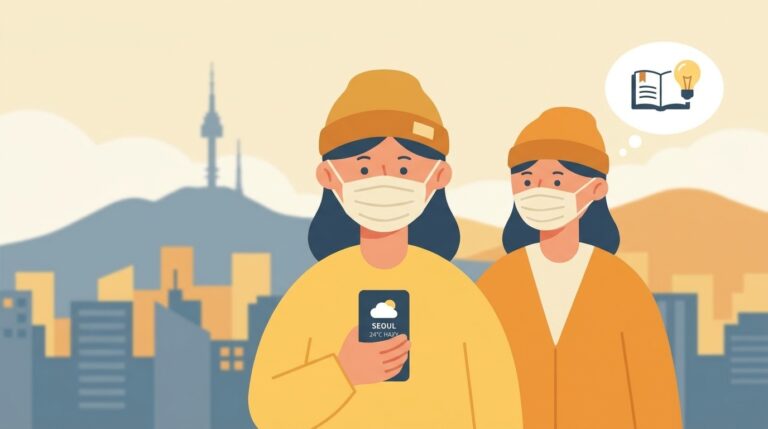
Imagine stepping out of your hotel in Myeongdong on a seemingly pleasant spring morning. You look up toward Namsan Mountain to find the iconic N Seoul Tower, but… it’s gone. Swallowed by a thick, grey haze. You might think, “Oh, it’s so foggy today! It feels like a movie.”
But then you notice something else. Every single Korean around you has suddenly equipped a face mask. No, it’s not a sudden medical emergency, and no, it’s not just K-pop airport fashion. Welcome to Korea’s infamous Mise-meonji (fine dust) season.
If you simply say, “Wow, the fog is thick today,” your Korean friends might give you a sympathetic smile. Knowing how to talk about the air quality isn’t just about the weather—it’s an essential part of Korean small talk, survival, and even deciding what to eat for dinner.
This guide is crafted from real moments my students faced when they couldn’t figure out why their Korean colleagues kept offering them masks or dragging them to pork belly restaurants on hazy days. Let’s dive in!
Phase 2: Core Expressions Deep Dive
1. 오늘 미세먼지 장난 아니에요.
- Pronunciation: oneul mise-meonji jangnan anieyo. [jang-nan / ah-nee-eh-yo]
- Meaning: (Literal) Today’s fine dust is not a joke. / (Real Nuance) The fine dust is incredibly bad today.
- K-Culture Moment: You walk into the office, coughing slightly. Your coworker is vigorously shaking their coat before hanging it up, looking at their phone’s weather app with a frown. This is the ultimate ice-breaker during spring in Korea.
- Editor’s Insight: The phrase
장난 아니다(not a joke) is a brilliant B2-level expression. It’s used to exaggerate how extreme something is—whether it’s the weather, how delicious a meal is, or how handsome a K-drama lead looks.- Situation Spectrum:
- Friends (Casual): ✅ (장난 아니야)
- Coworkers (Semi-formal): ✅ (장난 아니에요)
- Boss/Elders (Formal): ⚠️ (Better to say: 오늘 미세먼지가 참 심하네요)
- 🤔 Think About It: Why do Koreans love using negative phrasing like “not a joke” to express something intensely positive or negative? Does your language have a similar dramatic flair?
2. 마스크 꼭 쓰고 다니세요.
- Pronunciation: maseukeu kkok sseugo daniseyo. [ss-goo / dah-nee-seh-yo]
(Tip: For the ‘으’ in sseugo, make the disgusted ‘eugh’ sound when you step on chewing gum!)- Meaning: (Literal) Please wear a mask and go around. / (Real Nuance) Make sure you keep your mask on when you’re out and about.
- K-Culture Moment: This is the text message you get from your Korean friend, your manager, or even your landlord when the sky turns grey. It’s the Korean equivalent of “Drive safe” or “Stay warm.”
- Editor’s Insight: Notice the
고 다니다grammar? It doesn’t just mean “wear a mask once.” It implies carrying it with you and keeping it on as part of your routine while you move around the city. It shows deep care.- Situation Spectrum:
- Friends (Casual): ✅ (꼭 쓰고 다녀)
- Coworkers (Semi-formal): ✅ (꼭 쓰고 다니세요)
- Boss/Elders (Formal): ✅ (마스크 꼭 챙기세요 – a bit softer)
- 🤔 Think About It: In many Western cultures, telling another adult what to wear might feel overstepping. Why is it considered a heartwarming gesture of affection (Jeong/정) in Korea?
3. 목이 칼칼하네요.
- Pronunciation: mogi kalkalhaneyo. [mo-gee / kal-kal-ha-neh-yo]
- Meaning: (Literal/Real Nuance) My throat feels scratchy/dusty.
- K-Culture Moment: It’s 5 PM. Your team is deciding on a dinner menu. Someone clears their throat and drops this sentence. Everyone instantly knows what’s coming next: Samgyeopsal (Pork Belly).
- Editor’s Insight:
칼칼하다is a beautifully specific onomatopoeic/mimetic word. It describes that dry, slightly irritated feeling in your throat when you’ve inhaled dust, or the feeling when you crave something spicy and refreshing.- Situation Spectrum:
- Friends (Casual): ✅
- Coworkers (Semi-formal): ✅
- Boss/Elders (Formal): ✅
- 🤔 Think About It: Korean is incredibly rich in sensory vocabulary (like scratchy, spicy, refreshing). How does describing physical sensations help build empathy in a conversation?
Phase 3: Textbook vs. Real Korean
[Describing the Bad Air]
* 📖 Textbook Korean: 대기 오염이 심합니다. (The air pollution is severe.)
* 🗣️ Real Korean: 공기 완전 안 좋아요. / 미세먼지 대박이에요. (The air is totally bad. / The fine dust is crazy.)
* 💡 Why the difference?: Textbooks teach news-anchor vocabulary. In real life, Koreans use words like 완전 (totally) or 대박 (jackpot/crazy) to add emotional weight and conversational flow.
[Telling Someone to Wear a Mask]
* 📖 Textbook Korean: 마스크를 착용하십시오. (Please wear a face mask.)
* 🗣️ Real Korean: 마스크 꼭 쓰세요! (Make sure to wear a mask!)
* 💡 Why the difference?: 착용하다 (to don/equip) is Sino-Korean and sounds like an automated subway announcement. 쓰다 is the native, everyday verb for putting things on your head/face.
Bottom Note: At the B2 level, try to naturally sprinkle in adverbs like
참(really),완전(totally), or진짜(genuinely) to sound less robotic and more like a local.
Phase 4: Cultural Context — K-Culture Deep Dive
4-1. Non-Verbal Cues
When a Korean colleague mentions the bad air, they will almost always pull out their smartphone and show you an app with an angry red or black face. This is the universal “look at this disaster” gesture. Nod deeply, furrow your brows, and say, “Ah… jinjja-yo?” (Oh… really?).
4-2. The K-Food Connection: The Pork Belly Myth
If you watch K-Dramas, you’ve probably seen characters gathering at a noisy Pocha (tent bar) or BBQ restaurant. But did you know that eating Samgyeopsal (Pork Belly) is a national tradition on high fine-dust days?
There is a long-standing Korean myth that the sizzling, greasy fat from the pork belly coats your throat and “washes down” the fine dust from your respiratory system straight into your stomach.
Critical Viewpoint: Scientifically? Complete nonsense. Doctors go on TV every spring to debunk this. Culturally? It is the absolute best excuse to gather your friends, grab a bottle of Soju, and eat delicious BBQ on a gloomy Tuesday. Food in Korea is rarely just about calories; it’s the ultimate social glue.
Phase 5: Real-Life Roleplay Scenario
Setting: Friday, 6:00 PM. The lobby of your office building in Gangnam. You look out the glass doors, and the sky is an apocalyptic shade of yellow-grey. You are standing with Min-ji, a friendly colleague who loves showing you the ropes of Korean corporate life.
Characters:
– YOU: An expat professional, adjusting to life in Seoul, craving a good Friday dinner.
– Min-ji (29): Your coworker. Friendly, a bit of a foodie, always looks out for you.
Dialogue:
Min-ji: 밖이 완전 뿌옇네요. 오늘 미세먼지 장난 아니에요. 😷
(bak-i wanjeon ppuyeonneyo. oneul mise-meonji jangnan anieyo.)
[It’s completely hazy outside. The fine dust is no joke today.]
YOU: 맞아요. 아까 뉴스 보니까 외출하지 말라고 하더라고요.
(majayo. akka nyuseu bonikka oechulhaji mallago hadeoragoyo.)
[You’re right. I saw the news earlier, and they said not to go outside.]
(Notice the B2 grammar -라고 하더라고요 to quote the news!)
Min-ji: 그러니까요. OO씨, 마스크는 챙겼어요?
(geureonikka-yo. OO-ssi, maseukeu-neun chaenggyeosseoyo?)
[Tell me about it. Did you pack a mask, OO?]
YOU: 네, 가방에 하나 있어요.
(ne, gabang-e hana isseoyo.)
[Yes, I have one in my bag.]
Min-ji: 다행이네요. 아휴, 하루 종일 사무실에 있었는데도 목이 좀 칼칼하네요.
(dahaeng-ineyo. ahyu, haru jongil samusil-e isseonneunde-do mogi jom kalkalhaneyo.)
[That’s a relief. Phew, even though I was in the office all day, my throat feels scratchy.]
(🎭 Stage Direction: Min-ji rubs her throat and looks at you with a very specific, expectant gleam in her eyes)
🔀 Your Turn! How do you respond to Min-ji?
– A) “물 많이 드세요!” (Drink a lot of water!) – Textbook perfect.
– B) “그쵸! 이럴 때는 삼겹살로 기름칠을 좀 해줘야죠!” (Right! At times like this, we need to grease our throats with some pork belly!) – Local mastery.
– C) “저도요. 미세먼지가 정말 나쁘네요.” (Me too. Fine dust is very bad.) – A bit robotic.✅ Best Choice: B — Why? Min-ji wasn’t just stating a medical symptom; she was dropping a massive cultural hint. By suggesting pork belly to “grease the throat” (기름칠하다), you show you understand Korean subtext perfectly. She will probably insist on paying for dinner out of sheer impressment.
⚠️ Choice A Analysis: It’s polite and caring, but it shuts down the potential dinner invitation!
Phase 6: 10-Second Shadowing Drill
Try this aloud! Pay attention to the pauses (/) and the emotional tags.
😤 오늘 / 미세먼지 / 장난 아니에요!
(o-neul / mi-se-meon-ji / jang-nan a-ni-e-yo!)
Speak with an exasperated sigh, shaking your head slightly.
🥺 목이 너무 칼칼해서 / 삼겹살을 / 먹어야겠어요.
(mo-gi neo-mu kal-kal-hae-seo / sam-gyeop-sa-reul / meo-geo-ya-ge-sseo-yo.)
Speak playfully, acting like eating BBQ is a tragic medical necessity.
Phase 7: K-Culture Mini Dictionary
| Korean | Romanization | English Meaning | Cultural Context |
|---|---|---|---|
| 미세먼지 | mise-meonji | Fine dust (PM 10) | The modern-day seasonal villain of Korea. |
| 초미세먼지 | cho-mise-meonji | Ultra-fine dust (PM 2.5) | The even tinier, more dangerous dust that triggers emergency alerts on your phone. |
| 황사 | hwangsa | Yellow dust | Sandstorms blowing in from the deserts in spring. The OG bad air before fine dust became a daily issue. |
| 미세미세 | mise-mise | MiseMise (App name) | The holy grail app for Koreans. It uses cute/angry demon icons to show air quality. Red/Black = stay home! |
| KF94 | kay-eff-gu-sa | KF94 Mask | The Korean standard mask. If the dust is bad, a surgical mask won’t cut it; Koreans will tell you to wear a KF94. |
Phase 8: Traveler’s Survival Kit
If you’re traveling in Korea during spring (or honestly, any season these days), knowing how to buy the right mask is essential.
🆘 Survival Phrases for the Convenience Store (편의점)
– 🇰🇷 “이거 KF94 맞아요?” (igeo kf-gu-sa majayo?)
– 🗣️ English Guide: Is this one KF94?
– 📍 Where to use: Convenience stores, pharmacies (약국).
– 💡 Pro Tip: Look for ‘대형’ (Large – fits most adult faces) or ‘소형’ (Small – for kids).📌 Editor’s Travel Note
– Useful Apps: Download MiseMise (미세미세) or check the Naver Map home screen. They show air quality by color. If the screen is glaring red or black, buy a mask immediately.
– Pharmacy vs. Convenience Store: Convenience stores have basic masks, but Pharmacies (약국 – look for the “약” sign) sell masks in bulk and have pharmacists who can recommend the right fit.
Phase 9: Critical Thinking Corner — “One Step Deeper”
Language & Community Care (정 – Jeong)
Why do Koreans constantly tell each other, “Wear a mask,” “Dress warmly,” or “Did you eat?” To a Westerner, this might feel slightly invasive or bossy. Why is my coworker acting like my mother?
In Korean culture, these directives are expressions of Jeong (정)—a deep, collective sense of attachment and care. Because Korea developed as a highly tight-knit agricultural society, looking out for the physical well-being of your community members is the highest form of politeness. Telling someone to wear a mask isn’t about giving orders; it’s a verbal hug. It’s their way of saying, “Your health matters to me.”
💬 Your Turn: In your culture, how do you express care for a coworker or friend without saying “I care about you”? Do you give them health advice, or is that considered taboo? Let us know in the comments!
Phase 10: FAQ & Mistake Prevention
Q: Can I complain about the dust to anyone?
Yes! Complaining about the weather or fine dust is the safest, most universally accepted small talk in Korea. It unites everyone, from your taxi driver to your CEO.
Q: Do I have to wear a mask?
Unless it’s a specific pandemic mandate, no. However, when the fine dust level is “Very Bad” (매우 나쁨), you will feel it in your lungs. Wearing a mask is highly recommended for your own health, and Koreans will appreciate that you are following local norms.
❌ Common Mistake #1: Saying “오늘 안개가 많아요” (There’s a lot of fog today).
✅ Do this instead: Fog is water vapor. If the sky is grey in Seoul and it hasn’t rained, it’s almost certainly dust. Use “오늘 미세먼지가 심해요” (The fine dust is severe today) to avoid looking like a clueless tourist!
Phase 11: Summary & Action Items
One-Liner Summary: Talking about Mise-meonji isn’t just a weather report; it’s a gateway to showing care, making small talk, and eating great Korean BBQ!
Action Mission 3 Steps:
– 🥉 Bronze (Solo): Look out your window and say “오늘 미세먼지 장난 아니에요” out loud, with feeling!
– 🥈 Silver (Online): Check a Korean weather app or website, and leave a comment on our blog in Korean describing today’s air quality in your city.
– 🥇 Gold (Real-Life): Next time you see a Korean friend on a cloudy day, ask them: “오늘 미세먼지 심하지 않아요? 마스크 챙겼어요?”
K-Culture Mission:
Search for a “Korean convenience store tour” on YouTube and spot where the KF94 masks are hanging. Or, better yet, treat yourself to some pork belly (Samgyeopsal) tonight—for your throat’s health, of course!
Phase 12: Quiz — Interactive Challenge
1. Situational Judgment:
You step into a taxi. The driver points to the grey sky and sighs. What is the most natural way to agree with him?
– A) 네, 저는 마스크를 착용했습니다. (Yes, I have equipped a mask.)
– B) 그러게요, 오늘 미세먼지 장난 아니네요. (I know right, the fine dust is no joke today.)
– C) 안개가 참 아름답네요. (The fog is quite beautiful.)
2. Fill in the Blank:
“목이 너무 ( ______ ) 삼겹살 먹으러 가요!”
(My throat feels scratchy, let’s go eat pork belly!)
3. True or False – K-Culture Edition:
Eating Samgyeopsal is scientifically proven by Korean doctors to remove fine dust from your lungs. (T/F)
(Answers: 1. B / 2. 칼칼해서 / 3. False, but it’s a beloved cultural excuse to eat BBQ!)
Frequently Asked Questions (FAQ)
Q: What does "오늘 미세먼지 장난 아니에요." mean in Korean and how do you pronounce it?
A: In Korean, "오늘 미세먼지 장난 아니에요." is pronounced [oneul mise-meonji jangnan anieyo. [jang-nan / ah-nee-eh-yo] and means: (Literal) Today's fine dust is not a joke. / (Real Nuance) The fine dust is incredibly bad today.
Q: What does "마스크 꼭 쓰고 다니세요." mean in Korean and how do you pronounce it?
A: In Korean, "마스크 꼭 쓰고 다니세요." is pronounced [maseukeu kkok sseugo daniseyo. [ss-goo / dah-nee-seh-yo] and means: (Literal) Please wear a mask and go around. / (Real Nuance) Make sure you keep your mask on when you're out and about.
Q: What does "목이 칼칼하네요." mean in Korean and how do you pronounce it?
A: In Korean, "목이 칼칼하네요." is pronounced [mogi kalkalhaneyo. [mo-gee / kal-kal-ha-neh-yo] and means: (Literal/Real Nuance) My throat feels scratchy/dusty.







