

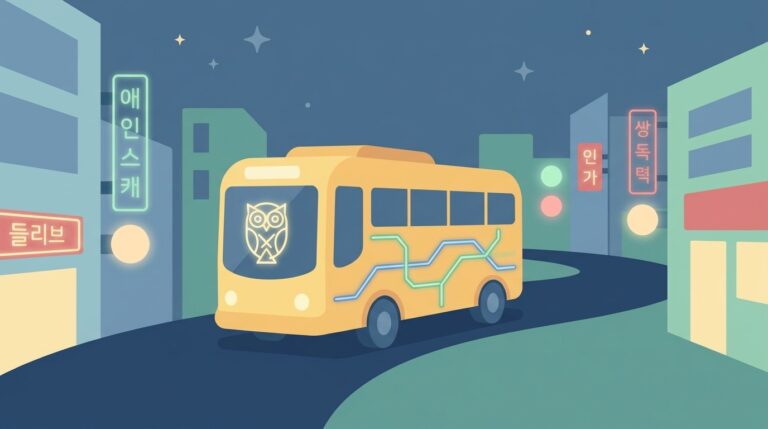
Phase 1: Empathy (The 2 AM Seoul Dilemma)
Hello! I’m your Daily Hangul Editor.
Picture this: It’s 1:30 AM in Hongdae. The neon signs of karaoke rooms (noraebang) are still blindingly bright, and the streets are packed with people. You’ve just finished a fantastic night out with your friends, but as you walk down to the subway station, the metal gates are pulled down. You open your KakaoT app to catch a taxi, and the screen just spins—no cars available, and the surge pricing (할증) is through the roof.
In a K-Drama, this is the exact moment the male lead dramatically pulls up in a sleek sports car, or the two protagonists decide to walk along the Han River until dawn. But in reality? Real Seoulites don’t panic. They pull out their map apps and look for the glowing ‘N’ on their screens.
Welcome to the magic of Korea’s ‘Owl Buses’ (올빼미 버스) or N-Buses. If you want to navigate Seoul’s legendary nightlife like an absolute insider (and save a ton of won on taxi fares), you need to master the late-night transit language. Since you’re at an advanced (C1) level, we are skipping the basic ‘Where is the bus stop?’ and diving deep into the natural, fast-paced Korean used when the clock strikes midnight.
Phase 2: Core Expressions – Deep Dive
Here are the absolute must-know expressions for surviving late-night transit in Korea.
1. 아, 막차 끊겼어요.
- Pronunciation: [a, makcha ggeun-gyeot-sseo-yo] / Sounds like: ah, mak-cha gun-gyot-so-yo (Think of the ‘ggeun’ like a very sharp, tense ‘gun’)
- Meaning: (Literal) Ah, the last car is cut off. / (Real Nuance) Ah, I missed the last train/bus.
- K-Culture Moment: You will hear this in every Korean bar around 11:30 PM. People suddenly check their watches, down their soju, and shout this phrase before sprinting out the door.
- Editor’s Insight: ‘막차’ (last vehicle) and ‘끊기다’ (to be severed/cut off) are an inseparable pair. It conveys a sense of finality. If you say this with a slight sigh, you sound 100% native.
- Situation Spectrum:
- Casual (Friends): ✅ (막차 끊겼다!)
- Semi-formal (Coworkers): ✅ (막차 끊겼네요.)
- Formal (Boss/Elders): ⚠️ (Use with caution, usually you’d excuse yourself before this happens.)
- 🤔 Think About It: Why is missing the ‘makcha’ such a massive cultural trope in Korea? How does the hard deadline of public transport shape Korean drinking culture (회식)?
2. N버스 노선 겹치는데 같이 갈래요?
- Pronunciation: [en-beoseu noseon gyeopchineunde gachi gallaeyo?]
- Meaning: (Literal) The N-Bus routes overlap, want to go together? / (Real Nuance) We’re heading the same way on the night bus, should we ride together?
- K-Culture Moment: After a company dinner (회식) or a university club meeting, people often group up by neighborhoods to ensure everyone gets home safely.
- Editor’s Insight: At the C1 level, you shouldn’t just say ‘같은 버스 타요’. Using ‘노선이 겹치다’ (routes overlap/intersect) is highly idiomatic and shows true fluency.
- Situation Spectrum:
- Casual: ✅
- Semi-formal: ✅
- Formal: 🚫 (You wouldn’t usually ask a senior executive to ride the night bus with you.)
- 🤔 Think About It: Koreans heavily value collective movement and ensuring others get home safe. Does your culture have a similar ‘shared commute’ bonding moment?
3. 지금 택시 타면 할증 붙어서 너무 비싸요.
- Pronunciation: [jigeum taeksi tamyeon haljeung buteoseo neomu bissayo]
- Meaning: (Literal) If we take a taxi now, a surcharge attaches so it’s too expensive. / (Real Nuance) Taxis have late-night surge pricing right now, it’s way too pricey.
- K-Culture Moment: Standing on the curbside of Gangnam station, furiously tapping the KakaoT app while watching the estimated fare jump by 20-40%.
- Editor’s Insight: The word ‘할증’ (late-night surcharge) is vital. By midnight, taxi fares jump significantly. Saying ‘할증 붙다’ rather than just ‘택시 비싸다’ shows you understand how the system works.
- Situation Spectrum:
- Casual: ✅
- Semi-formal: ✅
- Formal: ✅
- 🤔 Think About It: Why do you think Seoul implemented the Owl Bus system despite having a massive taxi fleet?
Phase 3: Textbook vs. Real Korean
Let’s upgrade your Korean from the textbook to the midnight streets of Seoul.
[When the last train is gone]
* 📖 Textbook: 마지막 지하철이 떠났습니다. (The final subway has departed.)
* 🗣️ Real Korean: 헐, 막차 끊김. N버스 타야겠다. (Omg, last train cut off. Gotta take the N-bus.)
* 💡 Why the difference?: Koreans use extreme shorthand (noun-ending ‘-ㅁ/음’) in text messages or quick spoken exclamations to convey urgency.
[Checking someone’s route]
* 📖 Textbook: 당신은 어느 방향으로 가십니까? (In which direction are you heading?)
* 🗣️ Real Korean: 혹시 N버스 몇 번 타세요? 방향 겹치면 같이 가요. (Which N-bus are you taking? Let’s go together if it’s the same way.)
* 💡 Why the difference?: Asking directly about bus numbers is much more practical in Seoul, where the N-buses (N13, N15, N26, etc.) are the only lifelines at 2 AM.
Bottom Note: For C1 learners, mastering these situational compound verbs (끊기다, 겹치다, 붙다) is the key to sounding like a local who has lived in Seoul for years.
Phase 4: Cultural Context — K-Culture Deep Dive
4-1. Non-Verbal Cues: The ‘Nunchi’ of Night Commutes
When riding the Owl Bus, the atmosphere is vastly different from a daytime commute. It’s quieter, people are exhausted, and sometimes a bit tipsy.
– Volume Control: Even if you’re with friends, keep your voice to a whisper. Night buses are unspoken ‘nap zones’ for tired workers.
– The App Stare: You’ll notice everyone staring at their map apps. Owl Buses have long intervals (20-40 minutes). If you miss one, it’s a disaster. Checking the live arrival time is a shared cultural anxiety.
4-2. The K-Drama Trope vs. Reality
In K-Dramas like ‘My Liberation Notes’ (나의 해방일지), the anxiety of catching the last train (makcha) or bus is a central theme for characters commuting from the outskirts of Seoul. In dramas, missing the bus often leads to a romantic, moonlit walk.
Critical View: In reality, missing the last bus in winter means freezing at a bus stop while furiously clicking the KakaoBus app to see if an N-bus is anywhere near. The ‘N-Bus’ is actually a relatively modern invention (introduced around 2013) that revolutionized Seoul’s nightlife, making it safer and cheaper for the working class and students to get home without being extorted by illegal taxi practices.
Phase 5: Roleplay Scenario — The Midnight Choice
Setting: Friday night, 1:45 AM. The busy streets of Itaewon. The pub is closing. You are standing outside with your Korean coworker, Min-su, trying to figure out how to get home across the Han River.
Characters:
– YOU: Expat living in Seoul, familiar with the city but still mastering the nightlife logistics.
– Min-su (32): Your friendly Korean coworker who just bought you the last round of drinks.
Dialogue:
Min-su: 아… 시간 보니까 지하철 막차 벌써 끊겼네요. 🚇
(a… sigan bonikka jihacheol makcha beolsseo ggeun-gyeotneyo.)
[Ah… looking at the time, the last subway is already gone.]
YOU: 헐, 진짜요? 우리 이제 어떻게 가요?
(heol, jinjjayo? uri ije eotteoke gayo?)
[Omg, really? How do we go back now?]
Min-su: 택시 부를까요? 근데 지금 할증 시간이라 엄청 비쌀 텐데… 🚕
(taeksi bureulkkayo? geunde jigeum haljeung siganira eomcheong bissal tende…)
[Should we call a taxi? But it’s surge time right now so it’ll be super expensive…]
YOU: 앱 보니까 호출도 아예 안 잡혀요.
(aep bonikka hochuldo aye an japhyeoyo.)
[Looking at the app, calls aren’t even connecting at all.]
Min-su: (Checking his phone) 어! 길 건너에서 N버스 오고 있어요. 저희 동네 쪽 가는 노선인데, 같이 뛰실래요? 🏃♂️
(eo! gil geonneo-eseo en-beoseu ogo isseoyo. jeohui dongne jjok ganeun noseoninde, gachi ttwisillaeyo?)
[Oh! The N-bus is coming across the street. It’s the route going toward our neighborhood, wanna run together?]
🔀 Your Turn! How do you respond to Min-su?
– A) “아니요, 저는 그냥 비싸도 택시 탈게요. 먼저 가세요!” (No, I’ll just take a taxi even if it’s expensive. You go first!)
– B) “대박! 방향 겹치니까 저도 같이 탈게요. 빨리 뛰어요!” (Awesome! Since our routes overlap, I’ll ride it too. Let’s run!)
– C) “마지막 버스가 떠났습니다… 유감입니다.”✅ Best Choice: B — Perfect C1-level natural Korean! Using ‘대박’ and ‘방향 겹치다’ shows you are fully immersed in the local way of speaking.
⚠️ Choice A Analysis: While grammatically correct, this can come off as slightly blunt or dismissive to a coworker trying to help you. Koreans prefer sticking together late at night.
Phase 6: 10-Second Shadowing Drill
Practice this phrase out loud. It will save you during your next Seoul night out!
😤 지금 / 막차가 끊겨서, / 우리 N버스를 / 타야 할 것 같아요.
(jigeum / makchaga ggeun-gyoseo, / uri en-beoseureul / taya hal geot gatayo.)
“The last train is cut off now, so I think we have to take the N-bus.”
(Tip: Put a slight emphasis on ‘막차’ and ‘N버스’ to make your point clear amidst the noisy streets!)
Phase 7: K-Culture Mini Dictionary
| Korean | Romanization | English | Context |
|---|---|---|---|
| 올빼미 버스 | olppaemi beoseu | Owl Bus | The official nickname for Seoul’s late-night N-buses (N stands for Night). |
| 막차 | makcha | Last car/train | The final public transport of the day. A crucial concept in Korean time management. |
| 할증 | haljeung | Surcharge | Extra fees added to taxis from 10 PM to 4 AM. |
| 막차요정 | makcha yojeong | Last train fairy | A slang term for the friend who always meticulously calculates and reminds everyone when to leave to catch the last train. |
| 환승 | hwanseung | Transfer | T-Money card transfers work on Owl buses too, saving you even more money! |
Phase 8: Traveler Survival Kit (Night Commute Edition)
Taking an Owl Bus for the first time can be intimidating. Here is your survival kit.
🆘 Survival Phrases
– 🇰🇷 “기사님, 이거 [홍대] 가요?” (gisanim, igeo [Hongdae] gayo?)
– 🗣️ Key-sa-nim, ee-go Hongdae ga-yo?
– 📍 Where to use: Asking the driver right as you board to confirm the direction.
– 💡 Pro Tip: Night buses take slightly different routes than daytime ones. Always double-check!📌 Editor’s Travel Note
– Must-have Apps: KakaoBus or Naver Map. Google Maps does NOT track live bus arrivals accurately in Korea.
– Cash vs. Card: Seoul buses are transitioning to ‘Cashless Buses’ (현금 없는 버스). You CANNOT pay with cash on many routes now. Always have a loaded T-Money card or an Apple Pay/international transit card ready.
– Boarding: You must tap your card when getting ON and getting OFF. If you don’t tap off, you get penalized on your next ride!
Phase 9: Critical Thinking — “A Step Deeper”
The Global Era & Public Infrastructure: The ‘Ppalli-Ppalli’ Night
Seoul is globally renowned as a city that never sleeps, but this wasn’t always seamlessly supported by public transit. The Owl Bus (N-Bus) system was born from big data. The city government analyzed millions of late-night mobile phone calls and taxi requests to map out exactly where people needed to go between midnight and 4 AM. This reflects a unique aspect of modern Korean society: the integration of high-tech data with hyper-responsive public services to support the intense work-hard, play-hard culture. It acknowledges that whether you are a designated driver (대리기사), an office worker finishing late, or a student drinking until dawn, the city owes you a safe, affordable way home.
💬 Your Turn: Does your home city have a late-night public transport system? How does it compare to Seoul’s Owl Buses? Share your experiences in the comments!
Phase 10: FAQ & Avoiding Common Mistakes
Q: Is it safe for foreigners to ride the Owl Bus alone at 3 AM?
Yes! Korea has CCTV on every bus, and the crime rate on public transit is incredibly low. The biggest danger is falling asleep and missing your stop.
Q: Can I eat my late-night street food (Tteokbokki) on the bus?
NO. This is a strict law in Seoul. You cannot board any bus with open/unpackaged food or drinks (like a takeout coffee cup). The driver will deny you entry.
❌ Common Mistake #1: Forgetting that ‘N’ routes are much longer.
✅ Do this: An N-bus might cover the distance of 3 normal daytime buses. Always check the ETA on Naver Map, as the ride might take an hour or more depending on traffic.❌ Common Mistake #2: Translating “I missed the bus” as “버스를 놓쳤어요” every time.
✅ Do this: While “놓쳤어요” means you physically missed a bus that just drove away, if the entire service is over for the night, you MUST use “막차가 끊겼어요”.
Phase 11: Summary & Action Items
One-Liner Summary: When the clock strikes midnight and taxis are too expensive, conquer Seoul’s nightlife by mastering the phrase “막차 끊겼으니 N버스 타자” (The last train is gone, let’s take the N-bus)!
Action Mission:
– 🥉 Bronze (Solo): Look up your favorite Seoul neighborhood on Naver Map right now and see which ‘N’ buses pass through it.
– 🥈 Silver (Online): Leave a comment using the phrase “막차 끊겼어요!” in a sentence.
– 🥇 Gold (Real Life): Next time you are out late in Korea, successfully ride an N-bus instead of taking a taxi, and text a friend “저 N버스 타고 가요!”
K-Culture Mission: Watch an episode of a slice-of-life K-Drama (like Itaewon Class or My Liberation Notes) and try to spot the moment characters rush to catch the ‘막차’ (last train/bus).
How did you get home during your last night out in Korea? Let me know below! 👇
Phase 12: Quiz — Interactive Challenge
1. Situational Judgment: It’s 1:00 AM. You and a coworker want to go home, but the taxis are showing a 30% extra fee. What is the most natural way to express this?
– A) 택시가 아주 비쌉니다.
– B) 할증 붙어서 택시 너무 비싸요. N버스 타죠.
– C) 마지막 택시가 끊겼습니다.
2. Fill in the Blank:
“아, 어떡해! 지하철 ______ 끊겼어!”
(Ah, what do I do! The subway ______ is cut off!)
– A) 첫차 (First car)
– B) 막차 (Last car)
– C) 기차 (Train)
3. True or False – K-Culture Edition:
“You can pay for the N-Bus using cash if you run out of money on your T-Money card.”
(Answers: 1: B, 2: B, 3: False – Most Seoul buses are now completely cashless!)
Frequently Asked Questions (FAQ)
Q: What does "아, 막차 끊겼어요." mean in Korean and how do you pronounce it?
A: In Korean, "아, 막차 끊겼어요." is pronounced [a, makcha ggeun-gyeot-sseo-yo] and means: (Literal) Ah, the last car is cut off. / (Real Nuance) Ah, I missed the last train/bus.
Q: What does "N버스 노선 겹치는데 같이 갈래요?" mean in Korean and how do you pronounce it?
A: In Korean, "N버스 노선 겹치는데 같이 갈래요?" is pronounced [en-beoseu noseon gyeopchineunde gachi gallaeyo?] and means: (Literal) The N-Bus routes overlap, want to go together? / (Real Nuance) We're heading the same way on the night bus, should we ride together?
Q: What does "지금 택시 타면 할증 붙어서 너무 비싸요." mean in Korean and how do you pronounce it?
A: In Korean, "지금 택시 타면 할증 붙어서 너무 비싸요." is pronounced [jigeum taeksi tamyeon haljeung buteoseo neomu bissayo] and means: (Literal) If we take a taxi now, a surcharge attaches so it's too expensive. / (Real Nuance) Taxis have late-night surge pricing right now, it's way too pricey.







