

Beyond SKY Castle: Decoding Korea’s ‘Spoon Class Theory’ and the Broken Education Ladder
Phase 1: Empathy & K-Culture Cold Open
Hello! I’m your Daily Hangul Editor, your local culture navigator and veteran Korean tutor.
Imagine this: You are watching a hit K-Drama like SKY Castle or Penthouse. The characters are screaming, throwing vases, and betraying their closest friends—all just to get their children into a top-tier university. The English subtitles might simply say, “We need better education,” but the cultural weight behind those words? It’s as heavy as a mountain.
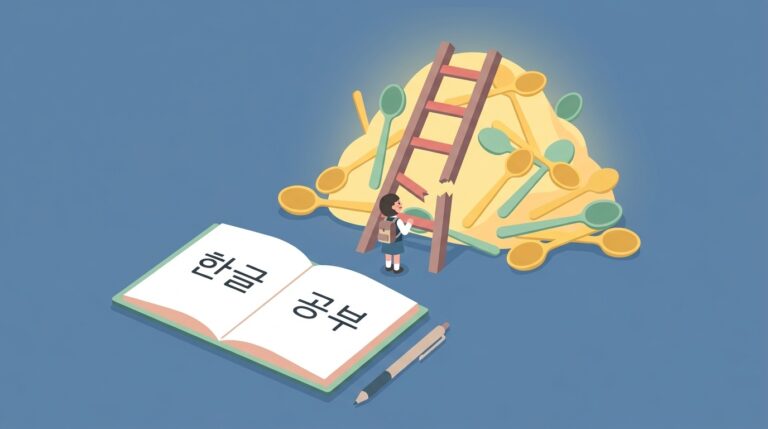
For decades in South Korea, education wasn’t just about learning; it was the ultimate, undisputed path to changing your social destiny. But recently, a chilling phrase has taken over Korean news outlets and intellectual debates: “교육 불평등” (Educational Inequality) and the despairing realization that the “계층 이동 사다리” (Social Mobility Ladder) is breaking.
At the C2 level, you are no longer just ordering coffee or asking for directions. You are engaging in deep, socio-political discussions with Korean intellectuals, colleagues, and friends. If you want to truly understand the pulse of modern Korean society and express yourself like an educated local, mastering this socio-cultural context is absolutely non-negotiable. Let’s dive deep into the reality of Korea’s educational landscape.
Phase 2: Core Expressions Deep Dive
1. 개천에서 용 난다
- Pronunciation: gaecheoneseo yong nanda [gae-cheon-eh-seo yong nan-da]
- Meaning: Literal: A dragon rises from a small stream. / Real nuance: Rags to riches; achieving great success despite coming from a poor background (usually through education).
- K-Culture Moment: In dramas, the self-made billionaire who grew up poor will proudly use this idiom. However, in modern society, millennials and Gen Z usually say, “개천에서 용 난다는 옛말이다” (A dragon rising from a stream is a thing of the past) to express frustration with the current system.
- Editor’s Insight: The word ‘개천’ (a small, humble stream) represents a low socio-economic background, while ‘용’ (dragon) symbolizes supreme success. It carries a sense of nostalgic hope that has slowly turned into modern cynicism.
- Situation Spectrum:
- Casual with friends: ✅
- Semi-formal (Debate/News): ✅
- Formal/Elders: ✅ (It’s a widely respected proverb)
- 🤔 Think About It: Why a dragon? In East Asian culture, dragons are sacred beings that control rain and weather—symbols of ultimate power. Does your language have an idiom for achieving success against all odds?
2. 계층 이동 사다리가 끊어지다
- Pronunciation: gyecheung idong sadariga kkeuneojida [gyeh-cheung ee-dong sah-dah-ri-gah kkeun-uh-jee-dah]
- Meaning: Literal: The social mobility ladder is cut off. / Real nuance: The pathway to climb the socio-economic ladder (usually via education) has been destroyed by structural inequality.
- K-Culture Moment: You will hear this phrase constantly in Korean election debates, documentaries, and newspaper editorials discussing how expensive private academies (Hagwons) have made it impossible for lower-income students to compete.
- Editor’s Insight: ‘계층’ means social class, and ‘사다리’ means ladder. To sound like a highly educated native speaker, you can advocate for “사다리 복원” (restoring the ladder), which implies leveling the playing field.
- Situation Spectrum:
- Casual with friends: ⚠️ (A bit too academic for a casual Friday night drinking session)
- Semi-formal (Work/University): ✅
- Formal/News: ✅
- 🤔 Think About It: What does it mean for a society when its citizens feel the “ladder” is gone? How does this impact the birth rate in South Korea?
3. 금수저 / 흙수저
- Pronunciation: geumsujeo / heuksujeo [geum-soo-jeo / heuk-soo-jeo]
- Meaning: Literal: Gold spoon / Dirt spoon. / Real nuance: Someone born into a wealthy family vs. someone born into poverty.
- K-Culture Moment: The “Spoon Class Theory” (수저계급론) is everywhere in K-Pop lyrics (e.g., BTS’s “Mic Drop” or “Baepsae”) and webtoons. It’s the ultimate expression of fatalism among Korean youth.
- Editor’s Insight: Unlike the English phrase “born with a silver spoon,” Koreans have created an entire hierarchy (Gold, Silver, Bronze, Dirt). Using “흙수저” (dirt spoon) is a form of self-deprecation.
- Situation Spectrum:
- Casual with friends: ✅
- Semi-formal (Coworkers): ⚠️ (Use cautiously, as it touches on personal wealth)
- Formal/Elders: 🚫 (Considered internet slang/cynical terminology)
- 🤔 Think About It: Why did “dirt” (흙) become the opposite of gold here? It represents the absolute bare minimum foundation of life, stripped of all privilege.
Phase 3: Textbook vs. Real Korean
[Describing Someone Who Succeeded Despite Poverty]
* 📖 Textbook Korean: 가난한 환경을 극복하고 성공했습니다. (They overcame a poor environment and succeeded.)
* 🗣️ Real Korean: 옛날에나 개천에서 용 났지, 요즘은 다 부모 재력싸움이에요. (Back in the day dragons rose from streams, but nowadays it’s all a battle of parents’ wealth.)
* 💡 Why the difference?: Advanced speakers don’t just state facts; they comment on the societal shift. Using proverbs critically shows C2 fluency.
[Discussing Educational Privilege]
* 📖 Textbook Korean: 부유한 집안의 학생들이 더 좋은 교육을 받습니다. (Students from wealthy families receive better education.)
* 🗣️ Real Korean: 솔직히 금수저 물고 태어난 애들을 사교육 없이 어떻게 이겨요? 사다리가 끊긴 지 오래죠. (Honestly, how can you beat kids born with a gold spoon without private education? The ladder has been broken for a long time.)
* 💡 Why the difference?: Incorporating metaphors (금수저, 사다리) creates an emotional, authentic resonance that clinical textbook phrases lack.
Bottom Note for C2 Learners: Avoid overusing internet slang like “존버” (hold on for dear life) in serious discussions about inequality. Stick to sociological metaphors like “사다리” (ladder) or “출발선이 다르다” (the starting line is different) to sound sophisticated.
Phase 4: Cultural Context — K-Culture Deep Dive
4-1. Non-Verbal Nuance in Deep Discussions
When discussing heavy topics like educational inequality in Korea, Nunchi (눈치) is crucial. Wealth is a sensitive topic. If you are discussing the “Spoon Theory,” do not pry into your Korean friend’s financial background. Maintain an empathetic tone, nod frequently, and use active listening sounds like “아, 그렇구나” (Ah, I see) or “맞아요, 참 씁쓸하죠” (Right, it’s quite bitter/sad).
4-2. The K-Drama Reality Check: “Ilta Gangsa” & The Hagwon Cartel
If you’ve watched Crash Course in Romance (일타 스캔들), you’ve seen the intense culture of “일타 강사” (Number 1 Star Tutors). These tutors are treated like K-Pop idols, earning millions.
But here is the Critical Perspective: While dramas portray this with a mix of comedy and romance, in reality, the staggering cost of “사교육” (private education) in neighborhoods like Daechidong is exactly what’s breaking the social mobility ladder. A middle-class family might spend over half their income on Hagwons, desperately trying to keep the “ladder” intact for their child. Knowing this context elevates your Korean from mere translation to profound cultural empathy.
Phase 5: Real-Life Roleplay Scenario
Setting: A Friday evening at a trendy craft beer pub in Euljiro. You are having drinks with your Korean debate club members. The topic of the new education reform policy comes up.
Characters:
– YOU: An expat working in Seoul, highly observant of social issues.
– Jiwon (30): A Korean friend who works as a high school teacher. Passionate but slightly cynical.
– Minho (32): A corporate worker who recently became a father, heavily stressed about the future.
Dialogue:
Jiwon: 이번 교육 개편안 봤어요? 사교육비 잡겠다는데, 솔직히 와닿지가 않네요. 🍺
(ibeon gyoyuk gaehpyeonan bwasseoyo? sagyoyukbi japgetdaneunde, soljikhi wadakjiga anneyo.)
[Did you see the new education reform plan? They say they’ll curb private education costs, but honestly, it doesn’t resonate with me.]
(🎭 Stage Direction: Jiwon sighs and takes a sip of her beer.)
Minho: 내 말이. 대치동 학원가 불패 신화가 하루아침에 깨지겠어? 요즘은 진짜 부모 정보력과 재력이 애들 성적이잖아.
(nae mari. daechidong hagwonga bulpae sinhwaga haruachime kkaejigesseo? yojeumeun jinjja bumo jeongboryeokgwa jaeryeogi aedeul seongjeokijana.)
[Tell me about it. Will the myth of Daechidong’s invincibility shatter overnight? Nowadays, parents’ networking and wealth equal the kids’ grades.]
Jiwon: 맞아요. 우리 어릴 때만 해도 열심히 하면 된다는 희망이 있었는데… 계층 이동 사다리가 완전히 끊어진 느낌이에요.
(majayo. uri eoril ttaeman haedo yeolsimhi hamyeon doendaneun huimangi isseonneunde… gyecheung idong sadariga wanjeonhi kkeuneojin neukkimieyo.)
[Right. Even when we were young, there was hope that hard work would pay off… It feels like the social mobility ladder is completely broken.]
🔀 Your Turn! How do you respond?
– A) “그래도 한국은 교육 시스템이 좋잖아요.” (But Korea has a good education system, right?)
– B) “맞아요. 진짜 개천에서 용 난다는 옛말이 된 것 같아 안타까워요.” (Right. It’s sad that ‘a dragon rising from a stream’ has truly become a thing of the past.)
– C) “저도 흙수저라서 그 기분 알아요!” (I’m a dirt spoon too, so I know that feeling!)✅ Best Choice: B — Why? It shows C2-level vocabulary (개천에서 용 난다) and validates their feelings with high-level empathy (안타까워요).
⚠️ Choice A Analysis: While technically true globally, this dismisses their lived experience and struggles, showing a lack of Nunchi.
⚠️ Choice C Analysis: Too casual and potentially uncomfortable for a serious socio-economic discussion.
YOU: 맞아요. 진짜 개천에서 용 난다는 옛말이 된 것 같아 안타까워요. 다시 사다리를 복원하려면 사회 구조적인 변화가 필요할 텐데요.
(majayo. jinjja gaecheoneseo yong nandaneun yenmari doen geot gata antakkawoyo. dasi sadarireul bogwonharyeomyeon sahoe gujojeogin byeonhwaga piryohal tendeyo.)
[Right. It’s sad that ‘a dragon rising from a stream’ has truly become a thing of the past. To restore the ladder, we would need structural societal changes.]
Minho: (Eyes widening in pleasant surprise at your advanced Korean) 오, 정확해요! 바로 그거예요! 🍻
(o, jeonghakaeyo! baro geugeoyeyo!)
[Oh, exactly! That’s precisely it!]
Phase 6: 10-Second Shadowing Drill
Let’s practice the intonation of a highly educated native speaker expressing societal concern.
😤 요즘은 / 개천에서 용 난다는 말이 / 옛말이 된 지 / 오~~래예요.
(yojeumeun / gaecheoneseo yong nandaneun mari / yenmari doen ji / o~~raeyeyo.)
Emotion Tag: 😤 Frustrated but analytical
Tip: Drag out the “오~~” in 오래 (a long time) to emphasize how long the system has been broken.
Phase 7: K-Culture Mini Dictionary
| 한국어 | Romanization | English | Contextual Explanation |
|---|---|---|---|
| 사교육비 | sagyoyukbi | Private Education Expenses | The financial burden of Hagwons, tutors, and online courses. A major factor in Korea’s low birth rate. |
| 일타 강사 | ilta gangsa | 1st Tier Star Tutor | The most popular and lucrative instructors in the Hagwon industry, treated like celebrities. |
| 대치동 | Daechidong | Daechi-dong | A neighborhood in Gangnam known as the epicenter of Korea’s intense private education market. |
| 수능 | Suneung | CSAT | The College Scholastic Ability Test. The single exam that determines a student’s university, often viewed as the final “ladder” of mobility. |
| 입시 코디 | ipsi kodi | Admissions Coordinator | A high-end consultant who manages a student’s entire academic portfolio (made famous by SKY Castle). |
Phase 8: Traveler Survival Kit (Education Hubs Edition)
Even as a traveler, you will witness Korea’s intense education culture. If you visit Noryangjin (famous for civil service exam students) or Daechidong, you’ll see a different side of Korea.
🆘 Survival & Observation Tips for Education Districts
– 🇰🇷 “여기 학원가라서 밤 10시에 차가 엄청 막혀요.” (yeogi hagwongaraseo bam 10sie chaga eomcheong makhyeoyo.)
– 🗣️ Meaning: Because this is the academy district, traffic is insane at 10 PM.
– 📍 Where to use: In a taxi in Gangnam/Mokdong/Nowon.
– 💡 Pro Tip: Hagwons legally must close at 10 PM in Seoul. Avoid driving through Daechidong at exactly 10:00 PM, as thousands of parents park on the streets to pick up their “studying warriors.”📌 Editor’s Travel Note
– Cupbap (컵밥): If you visit Noryangjin, try Cupbap (rice in a cup). It was invented for test-takers who needed a cheap, 5-minute meal between study sessions. It’s a literal taste of the “grind” for social mobility.
Phase 9: Critical Thinking Corner — “One Step Deeper”
🧠 Think Deeper: Media vs Reality (미디어와 현실)
K-Dramas like SKY Castle and The Penthouse paint a terrifying picture of the Korean education system—murder, sabotage, and psychological warfare. But is this reality?
While the extreme crimes are pure fiction, the underlying anxiety is 100% real. The “Educational Cartel” and the astronomical cost of private tutoring have created a society where parents feel guilty if they cannot afford a “Gold Spoon” starting line for their children. The dramas act as a cathartic mirror for a society mourning the loss of its “Social Mobility Ladder.” When we learn Korean, understanding this collective anxiety allows us to communicate with far deeper empathy rather than just memorizing vocabulary.💬 Your Turn: Does your country have a similar “ladder”? Is education still the great equalizer where you are from, or has wealth taken over? Let me know in the comments!
Phase 10: FAQ & Avoiding Misunderstandings
Q: Can I ask a Korean teenager or young adult what their Suneung (수능) score was?
– Absolutely NO. This is considered highly intrusive and rude. Suneung scores dictate university admissions, which in Korea, can dictate one’s entire social standing. It is a very sensitive topic.
Q: Is it okay to call a wealthy friend a “금수저” (Gold Spoon) to their face?
– Maybe, but be careful. Among very close friends, it can be a joke (e.g., “Wow, you bought a car? You’re such a 금수저!”). However, it can also sound like you are dismissing their hard work and attributing all their success to their parents’ money.
❌ Common Mistake #1: Saying “사다리를 걷어차다” (kicking away the ladder) to your boss when they deny your promotion.
✅ Do this instead: This phrase is a macro-level socio-economic term (often referencing Ha-Joon Chang’s book). It should be used when discussing societal policies, not personal workplace grievances!
Phase 11: Summary & Action Items
- One-Liner Summary: Understanding the “broken ladder” (끊어진 사다리) and the “Spoon Theory” (수저계급론) is the ultimate key to unlocking C2-level discussions about modern South Korean society.
-
Action Mission 3 Steps:
- 🥉 Bronze: Look in the mirror and practice the proverb: “개천에서 용 난다.”
- 🥈 Silver: Read a Korean news headline containing the word “사교육” (Private education) or “불평등” (Inequality) and translate it.
- 🥇 Gold: Next time you are with a Korean friend discussing society or the economy, casually mention, “요즘은 사다리가 끊어진 것 같아 씁쓸해요” (It’s bitter to think the ladder is broken these days).
- K-Culture Mission: Watch episode 1 of SKY Castle or Crash Course in Romance. Pay attention to how the parents talk about Hagwons (학원) and university admissions. You’ll hear the desperation to keep the “ladder” intact!
Engagement: Have you ever watched a K-Drama that made you shocked about the Korean school system? Drop the drama title below! 👇
Phase 12: Quiz — Interactive Challenge
1. Situational Judgment: You are watching a news report with your Korean professor about a new policy that makes university tuition free for low-income families. Which C2-level phrase is the most appropriate for you to say?
– A) “대박! 애들 기분 좋겠네요.” (Awesome! The kids must be happy.)
– B) “계층 이동 사다리를 복원하는 데 도움이 되겠네요.” (This will help in restoring the social mobility ladder.)
– C) “저 학교는 학원가가 아니네요.” (That school isn’t an academy street.)
2. Fill in the Blank:
“솔직히 요즘 시대에 ( ______ )에서 용 난다는 건 거짓말이죠. 다 부모의 정보력 싸움입니다.”
(Honestly, in this day and age, a dragon rising from a ( ______ ) is a lie. It’s all a battle of parents’ networking.)
3. True or False — K-Culture Edition:
In Seoul, Hagwons (private academies) are allowed to run 24/7 so students can study all night. (T/F)
👀 Click here for answers!
1. B (Perfect C2-level academic response. ‘A’ is too casual for a professor, and ‘C’ is irrelevant.)
2. 개천 (Gaecheon – small stream).
3. False. The government enforces a strict 10 PM curfew for Hagwons in Seoul to protect students’ health (and curb private education madness), though some secretly study in cafes afterward!
Frequently Asked Questions (FAQ)
Q: What does "개천에서 용 난다" mean in Korean and how do you pronounce it?
A: In Korean, "개천에서 용 난다" is pronounced [gaecheoneseo yong nanda [gae-cheon-eh-seo yong nan-da] and means: Literal: A dragon rises from a small stream. / Real nuance: Rags to riches; achieving great success despite coming from a poor background (usually through education).
Q: What does "계층 이동 사다리가 끊어지다" mean in Korean and how do you pronounce it?
A: In Korean, "계층 이동 사다리가 끊어지다" is pronounced [gyecheung idong sadariga kkeuneojida [gyeh-cheung ee-dong sah-dah-ri-gah kkeun-uh-jee-dah] and means: Literal: The social mobility ladder is cut off. / Real nuance: The pathway to climb the socio-economic ladder (usually via education) has been destroyed by structural inequality.
Q: What does "금수저 / 흙수저" mean in Korean and how do you pronounce it?
A: In Korean, "금수저 / 흙수저" is pronounced [geumsujeo / heuksujeo [geum-soo-jeo / heuk-soo-jeo] and means: Literal: Gold spoon / Dirt spoon. / Real nuance: Someone born into a wealthy family vs. someone born into poverty.







