

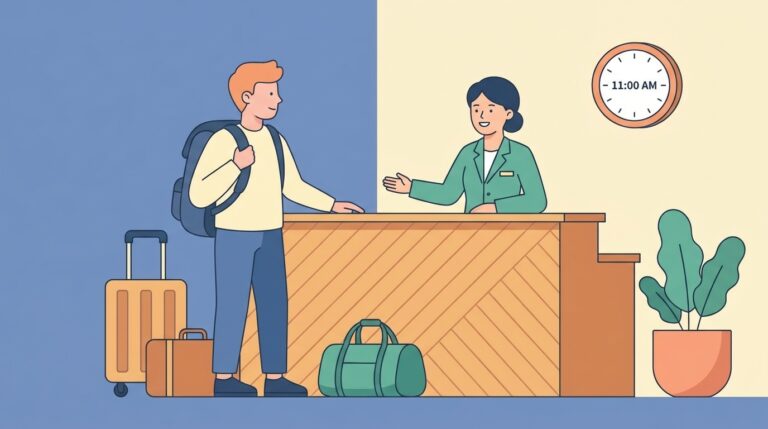
Phase 1: Empathy (Immersive Opening)
Hello! Daily Hangul Editor here.
Picture this: You’re in a beautiful hotel in Seoul. Last night, you stayed up until 2 AM eating Chimaek (fried chicken and beer) and watching the latest K-Drama on the giant hotel TV. You slowly open your eyes, stretch, and glance at your phone. It’s 10:45 AM.
Panic sets in. Wait, is checkout at 11:00 AM or 12:00 PM?!
You need to call the front desk right now. In a K-Drama, this is the moment the main character frantically throws clothes into a suitcase and sprints down the hallway. But the subtitles just say “I need to check out.” How do you actually ask for the checkout time or a little extra time in real, everyday Korean?
If you don’t know these phrases, you might end up paying late fees or awkwardly hauling your luggage around Myeongdong for five hours before your flight. But don’t worry! I’ve had countless beginner students text me in a panic from their Seoul hotel rooms. Today, I’m going to teach you the ultimate survival phrases for hotel checkouts, perfectly tailored for complete beginners (A1).
Let’s turn that panic into confidence!
Phase 2: Core Expressions Deep Dive
1. 체크아웃 몇 시예요? (What time is checkout?)
- Pronunciation: [che-keu-aut myeot si-ye-yo?]
- Tutor Tip: The ‘eu’ in che-keu sounds like the disgusted “ugh” sound you make when stepping in gum. ‘Myeot’ rhymes with “yacht” but starts with an ‘m’.
- Meaning: Literal: “Checkout what time is it?” / Real Nuance: “When do I need to be out of this room?”
- K-Culture Moment: You wake up slightly hungover from Makgeolli and need to know if you have time for a shower or if you need to run.
- Editor’s Insight: It’s direct, polite, and completely natural. Koreans use the English word “checkout” heavily in hospitality!
- Situation Spectrum:
- Casual with friends: ✅ (Just drop the ‘yo’: 체크아웃 몇 시야?)
- Hotel Front Desk (Formal/Polite): ✅
- ና2 Think About It: Why do Koreans use the English loanword “check-eu-aut” instead of a traditional Korean word? How does your native language handle modern travel terms?
2. 레이트 체크아웃 되나요? (Is late checkout possible?)
- Pronunciation: [re-i-teu che-keu-aut doe-na-yo?]
- Tutor Tip: “doe-na-yo” sounds like “dway-nah-yo”.
- Meaning: Literal: “Does late checkout work?” / Real Nuance: “Can I please sleep in a bit longer?”
- K-Culture Moment: You spent all morning trying on the K-beauty products you bought at Olive Young, and packing is taking longer than expected.
- Editor’s Insight: “되나요?” (Does it work? / Is it available?) is a magical phrase in Korea. You can put almost any noun in front of it!
- Situation Spectrum:
- Hotel Front Desk: ✅
- ና2 Think About It: Koreans love efficiency. Instead of a long, polite sentence asking for permission, they just ask “Is [Noun] possible?” Does your language prioritize politeness or efficiency?
3. 짐 맡겨도 돼요? (Can I leave my luggage here?)
- Pronunciation: [jim mat-gyeo-do dwae-yo?]
- Tutor Tip: “Jim” sounds exactly like the English name Jim. “Dwae-yo” sounds like “dway-yo”.
- Meaning: Literal: “Is it okay if I entrust my luggage?” / Real Nuance: “Can you hold my bags while I go shopping before my flight?”
- K-Culture Moment: You’ve checked out, but your flight isn’t until 8 PM. Time for one last street food run at Gwangjang Market!
- Editor’s Insight: This is the #1 most useful phrase on your last day in Korea. Almost all Korean hotels and guesthouses offer free luggage storage.
- Situation Spectrum:
- Hotel Front Desk: ✅
- ና2 Think About It: Korea is famous for its “high trust” society (people leave laptops on cafe tables!). Does this cultural trust make it easier to ask strangers to watch your belongings?
Phase 3: Textbook vs. Real Korean
[Asking about the checkout time]
* ኂ16 Textbook Korean: 퇴실 시간이 언제입니까? (Toe-sil si-gan-i eon-je-im-ni-kka?)
* ኄ63️ Real Korean: 체크아웃 몇 시예요? (Che-keu-aut myeot si-ye-yo?)
* ኁ61 Why the difference?: “퇴실” (leaving the room) is very formal and slightly old-fashioned. Modern hotels prefer Konglish (Korean-English), and the -입니까 ending sounds too much like a news anchor!
[Asking to leave your bags]
* ኂ16 Textbook Korean: 수하물을 보관해 주실 수 있습니까? (Su-ha-mul-eul bo-gwan-hae ju-sil su it-seum-ni-kka?)
* ኄ63️ Real Korean: 짐 맡겨도 돼요? (Jim mat-gyeo-do dwae-yo?)
* ኁ61 Why the difference?: “수하물” is the word you hear at airport baggage claim. “짐” (jim) is the everyday word for bags/luggage. Keep it simple!
Bottom Note: At the A1 level, don’t worry about overly complicated honorifics. Standard polite Korean (ending in “-yo”) is perfectly respectful and safe to use with all service staff.
Phase 4: Cultural Context — K-Culture Deep Dive
4-1. Non-verbal Communication at the Hotel
When handing over your room key or credit card at checkout, try to use two hands, or at least support your right elbow with your left hand. It’s a subtle sign of respect in Korea. Also, read the room (Nunchi): if the lobby is packed with a tour group checking out, keep your requests brief and efficient. Koreans appreciate Pali-Pali (hurry, hurry) culture!
4-2. K-Travel & K-Drama Connection
Have you ever noticed in K-Dramas like King the Land or Hotel Del Luna how flawless the hotel service is? Real-life Korean hospitality is very similar.
One amazing travel perk in Korea is the luggage delivery service. If you ask the front desk “짐 배송 되나요?” (Jim bae-song doe-na-yo? / Do you do luggage delivery?), many hotels can actually ship your heavy bags straight from your hotel in Seoul to Incheon Airport! You can enjoy your last day completely hands-free.
Phase 5: Real-life Roleplay Scenario
Setting: 10:55 AM. The sleek, modern lobby of a boutique hotel in Hongdae. Smooth K-R&B music is playing in the background. You are dragging a very heavy suitcase filled with Korean snacks and cosmetics.
Characters:
– YOU: A foreign traveler on your last day in Seoul.
– Jiwon (Receptionist): A friendly hotel staff member in a neat uniform.
Dialogue:
Jiwon: 안녕하세요, 체크아웃 도와드릴까요?
(Annyeonghaseyo, chekeu-aut dowa-deurilkkayo?)
[Hello, can I help you check out?]
YOU: 네, 여기 방 키요.
(Ne, yeogi bang ki-yo.)
[Yes, here is the room key.]
( ቸAD Stage Direction: You hand the key card over with two hands – great job!)
Jiwon: 미니바 사용하신 거 있으세요?
(Miniba sayong-hasin geo isseuseyo?)
[Did you use anything from the minibar?]
YOU: 아니요, 없어요.
(Aniyo, eopseoyo.)
[No, I didn’t.]
Jiwon: 네, 결제 완료되셨습니다. 이용해 주셔서 감사합니다.
(Ne, gyeolje wallyo-doesyeot-seumnida. Iyong-hae jusyeoseo gamsahamnida.)
[Yes, your payment is complete. Thank you for staying with us.]
YOU: 저기요… 짐 맡겨도 돼요?
(Jeogiyo… jim matgyeo-do dwaeyo?)
[Excuse me… can I leave my luggage here?]
Jiwon: 네, 당연하죠! 몇 시에 찾으러 오실 건가요?
(Ne, dang-yeon-hajo! Myeot si-e chajeureo osil geongayo?)
[Yes, of course! What time will you come to pick it up?]
ኂ56 Your Turn! How do you answer?
– A) “세 시요!” (Se si-yo! / Three o’clock!)
– B) “Tomorrow!”
– C) “지금요!” (Jigeum-yo! / Right now!)✅ Best Choice: A — Simply stating the time with “yo” at the end is perfect.
⚠️ Choice B & C Analysis: You usually can’t leave bags overnight (Tomorrow) after checkout unless arranged prior. And saying “Right now” (C) makes no sense since you are leaving them now to pick up later!
YOU: 세 시요. 감사합니다!
(Se si-yo. Gamsahamnida!)
[Three o’clock. Thank you!]
Jiwon: 네, 이따 뵙겠습니다. 좋은 하루 보내세요!
(Ne, itta boepget-seumnida. Joeun haru bonaeseyo!)
[Yes, see you later. Have a good day!]
Phase 6: 10-Second Shadowing Drill
Let’s practice! Speak out loud along with the emotion tags.
- ኔ0A (Desperately) 프론트죠? / 체크아웃 / 몇 시예요?
(Peuronteu-jyo? / che-keu-aut / myeot si-ye-yo?) - ኅ42 (Politely begging) 레이트 체크아웃 / 되나요?
(Re-i-teu che-keu-aut / doe-na-yo?) - ኅ12 (Brightly) 저기요, / 짐 / 맡겨도 돼요?
(Jeogiyo, / jim / matgyeo-do dwaeyo?)
Phase 7: K-Culture Mini-Dictionary
| Korean | Romanization | English | Context |
|---|---|---|---|
| 짐 | jim | Luggage/Baggage | Very useful word! Can mean bags, burdens, or packages. |
| 프론트 | peuronteu | Front Desk | Konglish. Don’t say “reception,” say “front” (peuronteu). |
| 로비 | robi | Lobby | Another essential Konglish word. |
| 호캉스 | ho-kang-seu | Staycation | Hotel + Vacance (French for vacation). A huge trend in Korea where people spend weekends just enjoying luxury hotels! |
| 눈치 | nunchi | Social awareness | The art of reading the room. Essential when judging if the front desk is too busy for small talk. |
Phase 8: Traveler’s Survival Kit
Since checking out means you are about to move to a new location, here are your top survival expressions for stepping out of the hotel!
ሙ8ሙ4 Survival Phrase #1: Calling a Taxi
– ቴ72ቴ79 “택시 좀 불러주세요.” (Taek-si jom bul-leo-ju-se-yo.)
– ኄ63️ English Guide: [Tak-shee jom bool-luh-joo-say-yo]
– ኂ05 Where to use: Hotel front desk.
– ኁ61 Pro Tip: It’s often easier to have the hotel call a cab than trying to hail one on the street with heavy bags.ሙ8ሙ4 Survival Phrase #2: Finding the Subway
– ቴ72ቴ79 “가까운 지하철역이 어디예요?” (Ga-kka-un ji-ha-cheol-yeok-i eo-di-ye-yo?)
– ኄ63️ English Guide: [Ga-kka-oon jee-ha-chul-yuck-ee uh-dee-yay-yo?]
– ኂ05 Where to use: Stepping outside the hotel.ኂ0C Editor’s Travel Note:
– Useful Apps: Kakao T (for taxis) and Naver Map (Google Maps doesn’t work well for walking directions in Korea!).
– Tipping Culture: KOREA HAS NO TIPPING CULTURE. Do not leave a tip for the room cleaners or the bellboy. They might actually run down the hall to return the money you “left behind” by mistake!
Phase 9: Critical Thinking Corner — “One Step Deeper”
Korean in the Global Era: The Power of Konglish
If you listen closely in a Korean hotel, you’ll hear words like check-eu-aut (checkout), peuronteu (front), robi (lobby), and miniba (minibar). Why don’t they use pure Korean words? In Korea, the hospitality and luxury industries heavily adopt English loanwords (Konglish) because it sounds more “modern,” “global,” and “premium” to locals. While language purists argue we should preserve traditional words like toesil (leaving a room), everyday Koreans find Konglish much more practical for global businesses.
ኁ72 Your Turn: Does your country use English words to make things sound more luxurious or modern? Share your thoughts in the comments!
Phase 10: FAQ & Avoiding Misunderstandings
Q: “Can I just leave the key card in my room when I leave?”
Maybe, but it’s not standard. In Korea, you are usually expected to bring the key card down to the peuronteu so they can ask if you used the minibar and officially process your checkout.
Q: “Can I ask the front desk staff ‘How are you?’ in English?”
Korean service staff are incredibly polite, but “How are you?” isn’t a natural greeting in Korean culture. Simply bowing your head slightly and saying “안녕하세요” (Annyeonghaseyo) is much more appreciated!
❌ Common Mistake #1: Leaving a tip on the bed.
✅ Do this instead: Just leave the room reasonably tidy. If you want to show appreciation, a simple “감사합니다” (Gamsahamnida) at the front desk is enough!❌ Common Mistake #2: Assuming late checkout is free.
✅ Do this instead: Always ask if there is an extra charge. Add “무료예요?” (Mu-ryo-ye-yo? / Is it free?) to be safe!
Phase 11: Summary & Action Items
One-Liner Summary: To survive checkout, remember the magic words: “체크아웃” (Checkout), “연장” (Extend/Late), and “짐 맡겨도 돼요?” (Can I leave my bags?).
Action Mission:
– ና51 Bronze (Solo): Say “짐 맡겨도 돼요?” out loud 3 times while packing your bag at home.
– ና52 Silver (Online): Comment below with what time you usually prefer to wake up on vacation!
– ና53 Gold (Real World): Use “체크아웃 몇 시예요?” the next time you stay at a hotel in Korea (or even to a Korean-speaking friend!).
ዀ K-Culture Mission:
Next time you watch a K-Drama featuring a hotel (like King the Land), listen carefully. Can you hear the characters using Konglish words like “Front” or “Lobby”?
Phase 12: Quiz — Interactive Challenge
1. You bought way too many K-Pop albums and want to explore Hongdae for 3 more hours before heading to the airport. What should you say to the hotel receptionist?
A) 레이트 체크아웃 되나요?
B) 짐 맡겨도 돼요?
C) 체크아웃 몇 시예요?
2. True or False: You should leave a $5 tip on your hotel pillow for the cleaning staff in Korea.
3. Fill in the blank: To ask if late checkout is possible, you say “레이트 체크아웃 _____?”
A) 있어요 (isseoyo)
B) 되나요 (doenayo)
C) 없어요 (eopseoyo)
(Answers: 1: B – You want to leave your bags (짐). / 2: False – No tipping in Korea! / 3: B – “Does it work/is it possible?”)
Frequently Asked Questions (FAQ)
Q: What does "체크아웃 몇 시예요? (What time is checkout?)" mean in Korean and how do you pronounce it?
A: In Korean, "체크아웃 몇 시예요? (What time is checkout?)" is pronounced [che-keu-aut myeot si-ye-yo?] and means: a key conversational Korean expression covered in this lesson.
Q: What does "레이트 체크아웃 되나요? (Is late checkout possible?)" mean in Korean and how do you pronounce it?
A: In Korean, "레이트 체크아웃 되나요? (Is late checkout possible?)" is pronounced [re-i-teu che-keu-aut doe-na-yo?] and means: a key conversational Korean expression covered in this lesson.
Q: What does "짐 맡겨도 돼요? (Can I leave my luggage here?)" mean in Korean and how do you pronounce it?
A: In Korean, "짐 맡겨도 돼요? (Can I leave my luggage here?)" is pronounced [jim mat-gyeo-do dwae-yo?] and means: a key conversational Korean expression covered in this lesson.







