

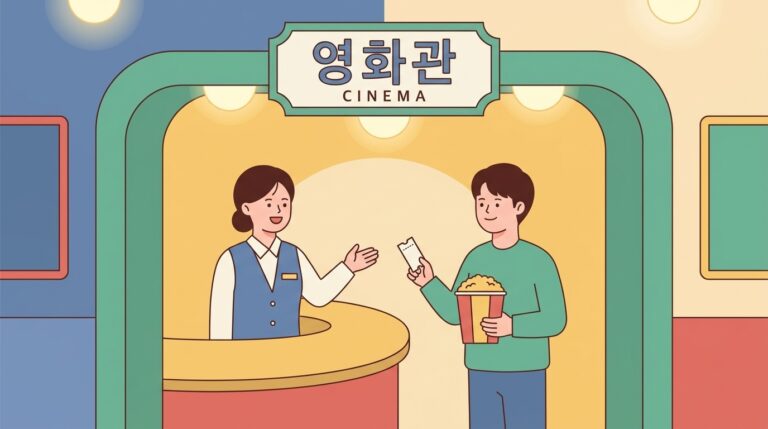
Phase 1: Empathy & K-Culture Cold Open
Hello there! I’m your Daily Hangul Editor.
Picture this: It’s the classic K-Drama date scene. The main characters are at a fancy multiplex in Seoul. They share a bucket of half-and-half (Sweet & Onion) popcorn, their hands accidentally brush, and the romantic OST starts playing. It’s magical, right? ✨
But let’s fast forward to your reality. You’re standing in a bustling Korean movie theater (like CGV, Megabox, or Lotte Cinema). The lights are dimming, the ticket checker is speaking rapidly, and you’re staring at your mobile ticket wondering, “Wait, where is Screen 5? And how do I tell that person they’re sitting in my seat without starting a fight?”
Entering a screening room (상영관) in Korea is a fast-paced mini-mission. If you don’t know the right phrases, you might end up wandering the dark aisles or nervously standing while the movie starts. Don’t worry! This guide is built from the real-life panic moments of my foreign students. By the end of this, you’ll navigate Korean cinemas like a true local.
Phase 2: Core Expressions Deep Dive
Here are the top 3 survival phrases you need from the ticket gate to your seat.
1. 몇 관이에요? (Which screen is it?)
- Pronunciation: [myeot gwan-i-e-yo?] ‘myeot’ sounds like ‘mute’ but stop abruptly before the ‘t’. ‘gwan’ sounds like the name ‘Gwen’, but with an ‘ah’ sound instead of ‘e’.
- Meaning: Literal: How many halls is it? / Real nuance: Which screen/theater number is this for?
- K-Culture Moment: You’re at the ticket check-in. Instead of looking at your phone, the staff might quickly ask, “몇 관이세요?” (Which screen are you?). Knowing this word saves you from freezing up!
- Editor’s Insight: ‘관’ (gwan) means hall or pavilion. In Korea, we don’t say “Screen 1” in English; we say “1관” (il-gwan), “2관” (i-gwan). It’s short, punchy, and essential.
- Situation Spectrum:
- Casual with friends: ✅ (몇 관이야?)
- Asking staff (Polite): ✅ (몇 관이에요?)
- Formal: 🚫 (Not necessary to be ultra-formal here)
- 🤔 Think About It: Why do Koreans use numbers for almost every location (Screen 1, Exit 2, Gate 3) instead of names? Does your country name cinema halls or number them?
2. 잠시만요, 지나갈게요. (Excuse me, passing through.)
- Pronunciation: [jam-si-man-yo, ji-na-gal-ge-yo] ‘jam’ like traffic jam, ‘si’ like she. ‘ji-na-gal-ge-yo’ flows together like a little song.
- Meaning: Literal: Wait a moment, I will pass. / Real nuance: Excuse me, I need to squeeze past you to get to my seat.
- K-Culture Moment: Korean theater seats can be tight. When you need to get to the middle seat, you say this while doing the classic “Nunchi Bow” (bending slightly and making yourself as small as possible).
- Editor’s Insight: Never just say “비키세요” (Move). That sounds like a villain in an action movie! “잠시만요” is your magical shield for any crowded space in Korea.
- Situation Spectrum:
- Casual: ✅
- Semi-formal (Strangers): ✅ (Perfect for strangers in the cinema)
- Formal: ✅
- 🤔 Think About It: “잠시만요” literally means “just a moment.” Why do Koreans ask for a “moment of time” when they actually want “physical space” to pass?
3. 제 자리인 것 같은데요. (I think this is my seat.)
- Pronunciation: [je ja-ri-in geot ga-teun-de-yo] ‘je’ (my) ‘ja-ri’ (seat). For ‘geot’, stop the ‘t’ sound sharply.
- Meaning: Literal: It seems like it is my seat. / Real nuance: You’re in my seat, please check your ticket.
- K-Culture Moment: You find Row G, Seat 12. Someone is sitting there. Instead of pointing and saying “My seat!”, a Korean will politely tilt their head, show their phone screen, and use this soft phrase.
- Editor’s Insight: This is the ultimate A2 leveling-up phrase. Adding “~인 것 같은데요” (I think it is…) softens the blow. It saves face for the other person in case they just misread their ticket in the dark.
- Situation Spectrum:
- Casual (to a friend): 🚫 (Just say “내 자리야!” – That’s mine!)
- Strangers: ✅ (Highly recommended)
- Elders: ⚠️ (Say it with a gentle tone and a slight bow)
- 🤔 Think About It: Why does Korean culture prefer “I think…” instead of “This is…”? How does protecting the other person’s pride (face-saving) play a role here?
Phase 3: Textbook vs. Real Korean
Let’s see how real life differs from your language app.
[Finding the Screen]
* 📖 Textbook Korean: 상영관이 어디에 있습니까? (Where is the screening room located?)
* 🗣️ Real Korean: 3관 어디예요? (Where is Screen 3?)
* 💡 Why the difference?: Efficiency! Cinemas are busy. People just state the number and add “어디예요?” (Where is it?).
[When Someone Blocks the Aisle]
* 📖 Textbook Korean: 길을 비켜 주시겠습니까? (Would you please clear the path?)
* 🗣️ Real Korean: 아, 잠시만요~ (Ah, excuse me~)
* 💡 Why the difference?: Action speaks louder than words. A soft “Jam-si-man-yo” paired with a slight body turn is the universal Korean signal for “I need to pass.”
Bottom Note: For A2 (Beginner) learners, you don’t need fancy grammar. Tone and body language are 50% of the communication!
Phase 4: Cultural Context — K-Culture Deep Dive
4-1. Non-Verbal Cues: The ‘Cinema Bow’
In Korea, language is only half the battle. When you say “잠시만요” (Excuse me) in a dark theater, do not stand up perfectly straight and stare the person down.
Instead, employ “Nunchi (눈치)”. Hunch your shoulders slightly, tuck your arms in, make eye contact for just a split second to acknowledge them, and gently nod your head as you pass. It’s a non-verbal way of saying, “I’m so sorry for interrupting your trailers!”
4-2. K-Food Connection: The Cinema Snack Culture
Korean movie theaters are basically high-end snack bars.
* You rarely just eat plain salty popcorn. The staple is 반반 팝콘 (Ban-ban Popcorn: Half & Half), usually Sweet (달콤한 맛) and Onion or Cheese flavor.
* If you drop your popcorn while squeezing past someone, say “앗, 죄송합니다” (Ah, sorry!).
* Critical View: Eating is communal in Korea. If you’re on a date or with friends, buying one large bucket to share is the norm. Buying two separate small popcorns might make your Korean friend wonder if you’re upset with them!
Phase 5: Real-Life Roleplay Scenario
Setting: Friday night, 7:50 PM. You are at the massive Yongsan I-Park Mall CGV. The lights are already dimming for a blockbuster movie. You are holding a large Caramel Popcorn and walking in with your Korean colleague, Minsu.
Characters:
* YOU: An expat working in Seoul, a bit nervous about finding the right seat in the dark.
* Minsu (30): Your friendly Korean coworker who bought the tickets.
Dialogue:
Minsu: 팝콘 샀고… 우리 몇 관이지? 표 좀 볼래?
(Popkon satgo… uri myeot gwan-i-ji? Pyo jom bollae?)
[Got the popcorn… which screen are we? Can you check the ticket?]
YOU: (Looking at your phone) 어… 5관이에요.
(Eo… o-gwan-i-e-yo.)
[Uh… It’s Screen 5.]
Minsu: 오케이, 5관 저쪽이다. 가자!
(O-ke-i, o-gwan jeo-jjok-i-da. Ga-ja!)
[Okay, Screen 5 is over there. Let’s go!]
(🎭 Stage Direction: You both walk into the dark theater. It’s packed. You find Row H.)
Minsu: 우리 H열이야. 들어가자.
(Uri H-yeol-i-ya. Deu-reo-ga-ja.)
[We are Row H. Let’s go in.]
YOU: 저기요, 잠시만요. 지나갈게요.
(Jeo-gi-yo, jam-si-man-yo. Ji-na-gal-ge-yo.)
[Excuse me, wait a moment. I’ll pass through.]
(🎭 Stage Direction: You squeeze past people, doing the polite hunch. You reach seats 14 and 15… but someone is sitting in 15!)
Minsu: 어? 저기 누가 앉아있는데?
(Eo? Jeo-gi nu-ga an-ja-it-neun-de?)
[Huh? Someone is sitting there?]
🔀 Your Turn! How should you address the person in your seat?
– A) “여기는 제 자리입니다! 비키세요!” (This is my seat! Move!)
– B) “저기요… 제 자리인 것 같은데요.”
– C) “뭐야? 왜 여기 있어요?” (What the? Why are you here?)✅ Best Choice: B — Reason: It’s polite, indirect, and allows the person to realize their mistake without feeling attacked.
⚠️ Choice A & C Analysis: ‘비키세요’ is incredibly rude and aggressive. Choice C is fighting words. Remember, Koreans value public harmony!
Stranger: 아! 죄송합니다. 제가 줄을 착각했네요.
(A! Joe-song-ham-ni-da. Je-ga ju-reul chak-gak-haet-ne-yo.)
[Ah! I’m sorry. I mistook the row.]
(The stranger hurries away, and you enjoy your movie!)
Phase 6: 10-Second Shadowing Drill
Let’s practice the magic “soft” claim for your seat. Read it aloud, paying attention to the pauses and the mood!
🥺 저기요, / 제 자리인 것 / 같은데요?
(jeo-gi-yo, / je ja-ri-in geot / ga-teun-de-yo?)
- Flow Guide: Start softly with ‘jeo-gi-yo’ (Excuse me). Pause slightly. Say the rest with an upward inflection at the end, as if you are asking a question, not giving an order!
Phase 7: K-Culture Mini Dictionary
| 한국어 (Korean) | Romanization | English | Context/Meaning |
|---|---|---|---|
| 상영관 | sang-yeong-gwan | Screening Room | The official word for the theater hall. |
| 예매 | ye-mae | Advance Booking | Reserving tickets online (very common in Korea). |
| 열 / 번 | yeol / beon | Row / Number | Seats are marked like “G열 15번” (Row G, No. 15). |
| 눈치 | nun-chi | Nunchi | The subtle art of reading the room (e.g., being quiet in the dark). |
| 반반 팝콘 | ban-ban popkon | Half & Half Popcorn | The ultimate cinema snack choice. |
Phase 8: Traveler’s Survival Kit
If you’re traveling in Korea and want to catch a movie (maybe a Korean film with English subtitles in specific theaters!), keep these on hand.
🆘 Survival Phrases for the Cinema
– 🇰🇷 “화장실이 어디예요?” (hwa-jang-sil-i eo-di-ye-yo?)
– 🗣️ Meaning: Where is the restroom?
– 📍 Use it: Right before entering the screen! Korean movies rarely have intermissions.
– 🇰🇷 “표 확인해 주세요.” (pyo hwa-gin-hae ju-se-yo)
– 🗣️ Meaning: Please check my ticket.
– 📍 Use it: When showing your mobile ticket to the staff at the entrance.📌 Editor’s Travel Note
– Mobile Tickets: Most Koreans don’t print tickets anymore. Just show the barcode on the CGV/Megabox app or KakaoTalk message.
– Photo Tickets: You can print a customizable “Photo Ticket” at kiosks with your favorite K-Pop idol or your own photo on the back!
– Tip Culture: Never tip the cinema staff or the concession stand workers. Tipping doesn’t exist in Korea and will cause confusion.
Phase 9: Critical Thinking — “One Step Deeper”
Language & Power: The Art of Indirectness
In many Western cultures, clear and direct communication is highly valued. If someone is in your seat, saying “Excuse me, you’re in my seat” is normal and factual. However, in Korean culture, directness can sometimes be perceived as aggression or a challenge to one’s pride (face).
This is why the phrase “제 자리인 것 같은데요” (I think this is my seat) is brilliant. By adding “I think,” you temporarily lower your “power” in the conversation. You are offering the other person a gentle exit strategy: “Ah, you are right, silly me!” instead of making them feel foolish. It reflects a society that prioritizes collective harmony and emotional comfort over cold, hard facts.
💬 Your Turn: In your home country, how direct are you when a stranger makes a mistake? Do you point it out bluntly, or do you soften the language? Share in the comments!
Phase 10: FAQ & Avoiding Mistakes
Q: Do I need to bow to the staff when showing my ticket?
A: A full 90-degree bow? No! Just a slight nod of the head and a smile while handing them your phone/ticket is the perfect Korean etiquette.
Q: Can I talk loudly during the movie previews?
A: It’s best to whisper. Koreans are very sensitive to “관크” (Gwan-keu: Theater Nuisance). Even during previews, keep your voice low.
❌ Common Mistake #1: Saying “비키세요” (Move) to get past someone.
✅ Do this instead: Say “잠시만요” (Excuse me) with a slight bowing posture. “비키세요” sounds like you’re picking a fight!❌ Common Mistake #2: Getting confused between ‘관’ (Screen number) and ‘열’ (Row).
✅ Do this instead: Check carefully! “5관” means Screen 5. “E열” means Row E. Don’t wander into Screen 3 looking for Row 5!
Phase 11: Summary & Action Items
- One-Liner Summary: To smoothly enter a Korean cinema, use “몇 관이에요?” to find your screen, “잠시만요” to navigate the aisles, and “제 자리인 것 같은데요” to politely claim your seat.
-
Action Mission:
- 🥉 Bronze (Solo): Look at your mirror, hunch slightly, and practice saying “잠시만요, 지나갈게요” 3 times.
- 🥈 Silver (Online): Find a trailer for an upcoming Korean movie on YouTube and comment: “한국 영화관에서 보고 싶어요!” (I want to watch this in a Korean cinema!)
- 🥇 Gold (Real World): Next time you are in an aisle or a crowded cafe in Korea, use “잠시만요” to squeeze past someone instead of saying “Excuse me” in English.
- K-Culture Mission: Watch a K-Drama episode tonight. Notice how characters squeeze past each other in tight spaces (like a bus or a restaurant). Do you see the “Nunchi bow”?
Phase 12: Quiz — Interactive Challenge
1. Situational Judgment: You find Row D, Seat 8 in the cinema, but a man is sitting there. What is the most culturally appropriate way to talk to him?
* A) 비키세요! 내 자리야!
* B) 저기요, 제 자리인 것 같은데요.
* C) 일어나세요. (Stand up.)
(Answer: B. A and C are too direct and rude.)
2. True or False – K-Culture Edition: In a Korean cinema, you should leave a 10% tip for the person who scoops your popcorn.
(Answer: False. There is absolutely no tipping culture in South Korea!)
3. Fill in the Blank:
You are looking at your ticket but can’t find the screen number. You ask the staff:
“저기요, 이거 몇 [ ]이에요?”
(Answer: 관 – gwan)
Great job! You’re now officially ready for movie night in Seoul! 🍿🎬
Frequently Asked Questions (FAQ)
Q: What does "몇 관이에요? (Which screen is it?)" mean in Korean and how do you pronounce it?
A: In Korean, "몇 관이에요? (Which screen is it?)" is pronounced [myeot gwan-i-e-yo?] and means: Literal: How many halls is it? / Real nuance: Which screen/theater number is this for?
Q: What does "잠시만요, 지나갈게요. (Excuse me, passing through.)" mean in Korean and how do you pronounce it?
A: In Korean, "잠시만요, 지나갈게요. (Excuse me, passing through.)" is pronounced [jam-si-man-yo, ji-na-gal-ge-yo] and means: Literal: Wait a moment, I will pass. / Real nuance: Excuse me, I need to squeeze past you to get to my seat.
Q: What does "제 자리인 것 같은데요. (I think this is my seat.)" mean in Korean and how do you pronounce it?
A: In Korean, "제 자리인 것 같은데요. (I think this is my seat.)" is pronounced [je ja-ri-in geot ga-teun-de-yo] and means: Literal: It seems like it is my seat. / Real nuance: You're in my seat, please check your ticket.







