

Phase 1: Empathy & The “K-Drama” Moment
Hello! I’m the Lead Editor of Daily Hangul.
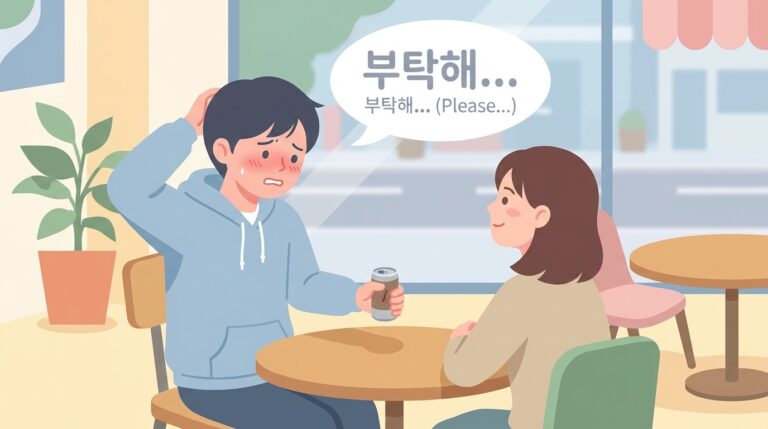
Picture this K-Drama trope: The protagonist meets a friend at a local Pojangmacha (street tent cart). They pour a glass of Soju, let out a deep sigh, scratch the back of their neck, and say… “Hey… so…”
The subtitles might simply say, “Can you lend me some money?” But if you listen closely, there are about five different filler words, apologies, and hesitations before they even get to the point.
Asking for a difficult favor—especially involving money—is incredibly daunting in any language. But in Korea, where 눈치 (Nunchi, reading the atmosphere) and maintaining harmony are essential, you can’t just bluntly say, “Give me money.” If you use the robotic textbook phrases, your Korean friends might feel completely caught off guard.
Today, we’re diving deep into the delicate art of asking for a tough favor. This guide is based on real struggles from my B1-level students who found themselves short on cash at a restaurant or needing a quick transfer for a K-Pop concert ticket. Let’s learn how to ask like a true insider!
Phase 2: Core Expressions Deep Dive
1. 진짜 미안한데, 혹시 돈 좀 빌려줄 수 있어?
- Pronunciation: jin-jja mi-an-han-de, hok-si don jom bil-lyeo-jul su is-seo? (Sounds like: jin-jja mee-an-han-deh, hoke-shee dohn jome bill-lyuh-jool soo iss-uh?)
- Meaning: Literal: “I’m really sorry but, by any chance, can you lend me a little money?” / Real Nuance: “I feel terrible asking this, but could you possibly spot me some cash?”
- K-Culture Moment: You’ll hear this when a friend suddenly realizes they forgot their wallet at a BBQ joint right when the bill arrives. The “혹시 (hok-si / by any chance)” and “좀 (jom / a little)” act as cultural shock absorbers to soften the blow of the request.
- Editor’s Insight: The focus here isn’t just on the grammar; it’s the apologetic buildup. You must start with “진짜 미안한데 (I’m really sorry, but…)” to show you know this is an uncomfortable request.
- Situation Spectrum:
- Close Friends (Casual): ✅
- Coworkers (Semi-formal): ⚠️ (Only if you’re very close, but generally frowned upon)
- Boss/Elders (Formal): 🚫 (Never ask your boss for a personal loan!)
- 🤔 Think About It: Why do Koreans use the word “좀 (a little)” even if they are asking to borrow a large amount of money? How does downplaying the request help “save face” for both people?
2. 혹시 여유 좀 있어?
- Pronunciation: hok-si yeo-yu jom is-seo? (Sounds like: hoke-shee yuh-yoo jome iss-uh?)
- Meaning: Literal: “Do you happen to have some room/spare?” / Real Nuance: “Do you have some extra cash to spare right now?”
- K-Culture Moment: This is the ultimate insider expression. Instead of saying the word “money” (돈), Koreans often use “여유” (spare capacity/room). It’s a very polite, indirect way to ask if your friend is financially comfortable enough to lend you money without making it awkward.
- Editor’s Insight: This phrase gives the listener an easy way out. If they say “아, 나도 요즘 여유가 없네 (Ah, I don’t have much to spare these days either),” no one loses face.
- Situation Spectrum:
- Close Friends (Casual): ✅
- Coworkers (Semi-formal): ⚠️
- Boss/Elders (Formal): 🚫
- 🤔 Think About It: Indirectness is a key feature of polite Korean conversation. Does your native language have a way to ask for money without actually saying the word “money”?
3. 금방 갚을게!
- Pronunciation: geum-bang ga-peul-ge! (Sounds like: geum-bang gah-pull-geh! – The ‘p’ is soft, almost like an ‘f’ and ‘p’ mixed)
- Meaning: Literal: “I will pay back soon!” / Real Nuance: “I’ll transfer it right back to you!”
- K-Culture Moment: You’re at a cafe, and the kiosk only takes Korean credit cards. Your foreign card gets rejected. Your Korean friend pays for your iced Americano, and you immediately say, “금방 갚을게! 계좌번호 알려줘! (I’ll pay you right back! Let me know your account number!)”
- Editor’s Insight: In Korea’s fast-paced Pali-pali culture, bank transfers take about 3 seconds via phone apps. Saying this shows you are responsible and won’t drag out the debt.
- Situation Spectrum:
- Close Friends (Casual): ✅
- Coworkers (Semi-formal): ✅ (Change to: 금방 갚겠습니다!)
- Boss/Elders (Formal): 🚫
Phase 3: Textbook vs. Real Korean
[Scenario 1: Asking for a favor]
* 📖 Textbook Korean: 제게 돈을 빌려주십시오. (Please lend money to me.)
* 🗣️ Real Korean: 아, 내가 지갑을 두고 와서 그런데… 혹시 만 원만 빌려줄 수 있어? (Ah, I left my wallet behind, so… could you maybe lend me 10,000 won?)
* 💡 Why the difference?: Koreans always provide the reason before making the request. Throwing a direct demand sounds rude and robotic.
[Scenario 2: Rejecting a money request gently]
* 📖 Textbook Korean: 아니요, 빌려줄 수 없습니다. (No, I cannot lend it to you.)
* 🗣️ Real Korean: 아… 어떡하지? 나도 요즘 지갑 사정이 좀 안 좋아서… (Ah… what should I do? My wallet situation isn’t great these days either…)
* 💡 Why the difference?: A flat “No” destroys the harmonious mood (Kibun). Blaming your own “poor wallet situation” is the most culturally acceptable white lie to save both of your feelings.
Bottom Note for B1 Learners: You don’t need excessive slang. Just mastering the art of starting with “미안한데… (I’m sorry but…)” and trailing off with “~그런데… (so…)” will make you sound 10x more natural.
Phase 4: Cultural Context — K-Culture Deep Dive
4-1. Non-Verbal Elements: The Art of Hesitation
When making a difficult request in Korea, body language speaks louder than words. Do not look the person dead in the eye with a confident posture.
Instead, you want to show a bit of Nunchi. Rub the back of your neck slightly, let out a small sigh (“아…”), and look slightly downward or away before you speak. This physically demonstrates that you are burdened by asking this favor.
4-2. K-Drama & The Taboo of “Bojung” (보증)
If you watch K-Dramas, you’ve definitely seen this plot: A family loses their house, gangsters put red tags on their TV, and everyone is crying. Why? Because the father did 보증 (Bojung – Financial Guarantee/Cosigning) for a friend.
In Korea, asking someone to be a guarantor for a massive loan is the ultimate taboo. It destroys friendships and families. While borrowing 50,000 won for dinner is fine, asking for huge, life-altering amounts is deeply frowned upon in reality—leave it to the K-Drama villains!
Phase 5: Real-Life Roleplay Scenario
Scenario A: The Ticketing Panic
- Setting: 7:55 PM at a loud PC Bang (Internet Cafe) in Seoul. You are trying to buy VIP tickets for your favorite K-Pop idol’s concert.
- Characters:
- YOU: A foreign student whose overseas credit card was just rejected by the Korean ticketing site. You have 5 minutes before your seat is canceled.
- Min-su (25): Your Korean friend who came to the PC Bang to help you click fast.
Dialogue:
YOU: 아, 안 돼! 오류 났어! 내 카드 결제가 안 돼!
(Ah, an dwae! oryu nasseo! nae kadeu gyeoljaega an dwae!)
[Oh no! There’s an error! My card isn’t working!]
(🎭 Stage Direction: You frantically click the mouse, panicking)
Min-su: 헐, 진짜? 5분 안에 결제해야 되는데!
(Heol, jinjja? obun ane gyeoljaehaeya doeneunde!)
[Omg, really? You have to pay within 5 minutes!]
YOU: 민수야…
(Min-su-ya…)
[Min-su…]
Min-su: 어? 왜 나를 그렇게 봐?
(Eo? Wae nareul geureoke bwa?)
[Huh? Why are you looking at me like that?]
🔀 Your Turn! How do you ask Min-su to pay for the ticket?
* A) 내 티켓값을 내주십시오. (Pay for my ticket.)
* B) 진짜 미안한데… 네 카드로 먼저 결제해 줄 수 있어? 금방 갚을게!
* C) 야, 빨리 네 돈 줘!✅ Best Choice: B — “I’m really sorry but… can you pay with your card first? I’ll pay you right back!” It has the apology, the buffer, and the promise to repay immediately.
⚠️ Choice A & C Analysis: ‘A’ sounds like a robot commanding him. ‘C’ (Hey, give me your money fast!) is incredibly rude, even in an emergency.
Min-su: 아, 깜짝이야. 알았어, 알았어! 비켜봐!
(Ah, kkamjjagiya. arasseo, arasseo! bikyeobwa!)
[Ah, you scared me. Okay, okay! Move over!]
YOU: 진짜 고마워! 내가 내일 밥 쏠게!
(Jinjja gomawo! naega naeil bap ssolge!)
[Thank you so much! I’ll treat you to food tomorrow!]
Scenario B: The Bonus K-Culture Scenario (The Cafe Save)
- Setting: A cute cafe in Yeonnam-dong. You try to pay for your cake, but your physical wallet is missing.
- YOU: 앗… 사장님, 죄송해요. 제가 지갑을 잃어버린 것 같아요. 혹시 계좌이체 될까요?
(At… sajangnim, joesonghaeyo. jega jigabeul ileobeorin geot gatayo. hoksi gyejwa-iche doelkkayo?)
[Oops… Boss (Owner), I’m sorry. I think I lost my wallet. By any chance, can I do a bank transfer?] - Cafe Owner: 네, 카운터 앞에 계좌번호 있어요~ (Yes, the account number is in front of the counter~)
(Note: Almost every small business in Korea allows direct bank transfers (계좌이체) if your card fails!)
Phase 6: 10-Second Shadowing Drill
Practice making your voice sound a little hesitant and apologetic. Follow the slashes for pauses!
😅 아, / 진짜 미안한데... / 혹시 / 여유 좀 있어?
(Ah, / jinjja mianhande… / hoksi / yeoyu jom isseo?)
🥺 내가 / 지금 지갑을 안 가져와서 그런데, / 만 원만 / 빌려줄 수 있어?
(Naega / jigeum jigabeul an gajyeowaseo geureonde, / man wonman / billyeojul su isseo?)
Phase 7: K-Culture Mini Dictionary
| Korean | Romanization | English | Context |
|---|---|---|---|
| 눈치 | nunchi | Social sense / tact | The art of reading the room. Essential when deciding if it’s the right time to ask a favor. |
| 계좌이체 | gyejwa-iche | Bank transfer | The most common way Koreans pay each other back. Fast and fee-free! |
| 쏘다 | ssoda | To treat (someone) | Literally “to shoot.” When you owe someone a favor, you “shoot” them a meal. (내가 쏠게! = I’ll treat!) |
| 더치페이 | deochi-pei | Dutch pay (Split bill) | Splitting the bill. Very common among young people to avoid money issues. |
| 보증 | bojeung | Guarantor/Cosign | NEVER ask a Korean friend for this. It’s the fastest way to end a relationship. |
Phase 8: Traveler Survival Kit
While traveling, you probably won’t ask strangers for money, but you might need to ask them for difficult favors when you are in a pinch!
🆘 Survival Phrases for Travelers
* 🇰🇷 “혹시 핸드폰 좀 빌릴 수 있을까요?” (hoksi haendeupon jom billil su isseulkkayo?)
* Meaning: “By any chance, could I borrow your phone?” (Useful if you’re lost and your phone died!)
* 🇰🇷 “너무 무거워서 그런데, 혹시 좀 도와주실 수 있나요?” (neomu mugeowoseo geureonde, hoksi jom dowajusil su innayo?)
* Meaning: “It’s too heavy so… by any chance, could you help me?” (Useful for heavy luggage on subway stairs).
* 📍 Where to use: Subway stations, streets, airports.📌 Editor’s Travel Note
* Asking Strangers: Koreans generally mind their own business, but if you look genuinely distressed and approach them politely with “죄송한데…” (I’m sorry but…), they will almost always go out of their way to help you.
* Tipping: Korea has NO tipping culture. If someone helps you, just bow slightly and say “정말 감사합니다” (Thank you so much). Trying to hand them cash might confuse or even offend them!
Phase 9: Critical Thinking Corner — “A Step Deeper”
Language & Power: The Buffer System
Have you noticed how Koreans rarely get straight to the point when asking a favor? Words like “혹시” (by any chance), “좀” (a little), and trailing sentences ending in “~는데” (so/but…) act as a linguistic buffer zone.
In Korean culture, protecting the listener’s Kibun (pride/mood) is highly respected. By adding these buffers, you are shrinking the “weight” of your request, signaling, “I respect your boundaries, and I’m not demanding this of you.” It shifts the power dynamic, making you humble and giving the other person the power to grant the favor graciously.
💬 Your Turn: Does your culture have a direct “Yes/No” approach to favors, or do you also use “buffer words”? How do you ask to borrow something in your native language? Share in the comments!
Phase 10: FAQ & Avoiding Misunderstandings
- Q: Can I ask my boss or a senior colleague to lend me money?
- A: Absolutely NOT. Mixing personal finances with professional hierarchy is highly unprofessional in Korea. If you forgot your wallet at a team lunch, a senior might naturally offer to pay for you, but you should never initiate a loan request.
- Q: My friend bought my dinner. Should I hand them cash right there?
- A: It’s better to do a bank transfer (계좌이체). Handing physical cash over a table can feel a bit transactional or awkward. Just ask for their bank account! (계좌번호 알려줘!)
❌ Common Mistake #1: Saying “돈 빌려줘!” (Lend me money!) to a friend without any lead-up.
✅ Do this instead: Buy them a canned coffee first, sigh, and start with “내가 진짜 급해서 그러는데…” (I’m in a really urgent situation, so…)
Phase 11: Summary & Action Items
- One-Liner Summary: When asking for a difficult favor in Korean, the key is the apologetic buildup (“미안한데…”) and softening the request with “혹시” and “좀”.
-
Action Mission 3 Steps:
- 🥉 Bronze (Solo): Stand in front of a mirror, rub the back of your neck, and say “진짜 미안한데… 혹시 여유 좀 있어?” with the most apologetic face possible.
- 🥈 Silver (Online): Go to a language exchange app and ask a Korean friend how they usually split bills (더치페이) with their friends.
- 🥇 Gold (Real Life): Next time you are out with a Korean friend, offer to pay them back via KakaoPay or bank transfer!
- K-Culture Mission: Watch any K-Drama episode tonight. I guarantee you will spot at least one scene where a character hesitates, stutters, and uses “혹시…” before asking for a massive favor. Spot it, and you’re officially a K-Culture insider!
Phase 12: Quiz — Interactive Challenge
1. Situational Judgment: You left your wallet at home and need 5,000 won for a taxi. What is the most natural way to ask your close friend?
* A) 5천 원만 줘. (Give me 5,000 won.)
* B) 내게 택시비를 대출해 주십시오. (Please issue a taxi loan to me.)
* C) 진짜 미안한데, 택시비 5천 원만 빌려줄 수 있어? (I’m really sorry but, could you lend me 5,000 won for the taxi?)
2. True or False — K-Culture Edition:
If a stranger helps you carry heavy luggage up the subway stairs in Seoul, you should give them a $5 tip to show appreciation.
* True / False
Answers & Explanations (Click to reveal!)
- Answer: C. Option A is too direct and demanding. Option B sounds like you are talking to a bank teller in a 19th-century novel. Option C perfectly blends apology and a specific, small request.
- Answer: False. Korea does not have a tipping culture. Giving cash to a stranger who helped you out of kindness can make them feel uncomfortable. A warm “정말 감사합니다!” (Thank you so much) is the best reward!
Frequently Asked Questions (FAQ)
Q: What does "진짜 미안한데, 혹시 돈 좀 빌려줄 수 있어?" mean in Korean and how do you pronounce it?
A: In Korean, "진짜 미안한데, 혹시 돈 좀 빌려줄 수 있어?" is pronounced [jin-jja mi-an-han-de, hok-si don jom bil-lyeo-jul su is-seo? (Sounds like: jin-jja mee-an-han-deh, hoke-shee dohn jome bill-lyuh-jool soo iss-uh?] and means: Literal: "I'm really sorry but, by any chance, can you lend me a little money?" / Real Nuance: "I feel terrible asking this, but could you possibly spot me some cash?"
Q: What does "혹시 여유 좀 있어?" mean in Korean and how do you pronounce it?
A: In Korean, "혹시 여유 좀 있어?" is pronounced [hok-si yeo-yu jom is-seo? (Sounds like: hoke-shee yuh-yoo jome iss-uh?] and means: Literal: "Do you happen to have some room/spare?" / Real Nuance: "Do you have some extra cash to spare right now?"
Q: What does "금방 갚을게!" mean in Korean and how do you pronounce it?
A: In Korean, "금방 갚을게!" is pronounced [geum-bang ga-peul-ge! (Sounds like: geum-bang gah-pull-geh! - The 'p' is soft, almost like an 'f' and 'p' mixed] and means: Literal: "I will pay back soon!" / Real Nuance: "I'll transfer it right back to you!"







