

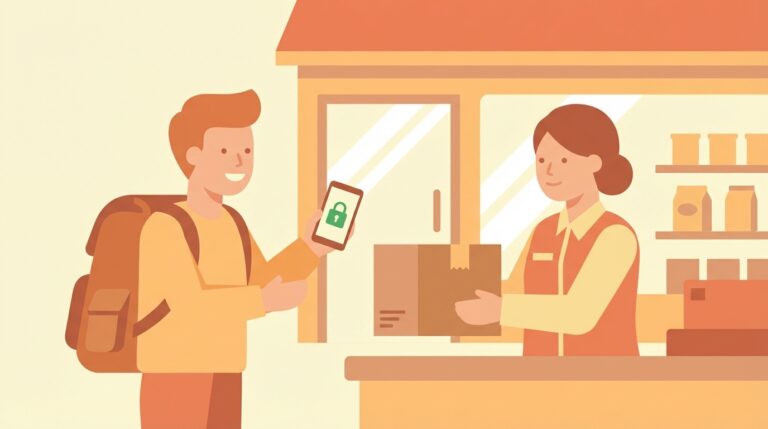
Phase 1: Empathy & Immersion (The Cold Open)
Hello! This is your Daily Hangul Editor.
Imagine this: You finally found it. You’re scrolling through X (Twitter) or a Korean second-hand trading app like Bunjang late at night, and there it is—that ultra-rare, out-of-print K-Pop photocard (포카) you’ve been hunting for months. Or maybe it’s that sold-out vintage jacket worn by your favorite K-Drama actor. Your heart races. You message the seller, ready to buy.
But then, the seller asks for a direct bank transfer (계좌이체).
Wait a minute. You’ve heard the horror stories. What if it’s a scam? You want to use the app’s “Safe Payment” (안전 결제) system, but you’re afraid of offending the seller or losing the item if you sound too aggressive.
How do you ask for a secure transaction politely, like a true Korean local, without ruining the vibe?
Today, we are diving deep into the high-stakes world of Korean second-hand trades (중고 거래), specifically focusing on Safe Payment (안전 결제) and Delivery (택배). This guide is based on real struggles from B2 learners who wanted to buy K-merch but got stuck at the payment screen. Let’s master the art of the Korean “cool deal”!
Phase 2: Core Expressions Deep Dive
1. 안전 결제 가능할까요?
- Pronunciation: [anjeon gyeolje ganeunghalkkayo?] -> an-jeon gyul-je ga-neung-hal-kka-yo? (End with a soft, rising tone like you are carefully asking a favor).
- Meaning: Is safe payment possible? (Literal) / Would you mind if we use the safe payment system? (Real Nuance)
- K-Culture Moment: Sellers in Korea often prefer direct wire transfers because “Safe Payment” systems (like KakaoPay or Bunjang’s secure pay) hold the money until the buyer confirms delivery, and they take a small fee. Asking this requires a bit of Nunchi (눈치). You don’t want to sound like you’re accusing them of being a scammer!
- Editor’s Insight: The key here is the ending
~가능할까요?(Is it possible?). It’s much softer and more polite than saying안전 결제 해주세요(Do safe payment). It shows you respect their preference but are gently negotiating. - Situation Spectrum:
- Casual trading app chat: ✅
- Polite request to a stranger: ✅
- Demanding aggressively: 🚫
- 🤔 Think About It: Why is indirectness so crucial in Korean negotiations? By asking “Is it possible?” instead of “I want,” you are saving face for both parties. Does your native language have a similar way to soften a financial request?
2. 택포인가요? (택배비 포함인가요?)
- Pronunciation: [taekpo-ingayo?] -> taek-po-in-ga-yo?
- Meaning: Is shipping included? (Literal & Real Nuance)
- K-Culture Moment: You see a great deal on Danggeun Market (Karrot). It says 15,000 KRW. But wait—who pays for the shipping? In Korean second-hand culture, abbreviating “택배비 포함” (Taek-bae-bi po-ham: Shipping fee included) to 택포 (Taek-po) is an absolute B2-level essential. If it’s not included, it’s called 착불 (Chak-bul: Pay on delivery) or 배송비 별도 (Shipping separate).
- Editor’s Insight: Using abbreviations like “택포” signals to the seller that you aren’t a newbie. You are a seasoned buyer ready for a “쿨거” (Cool deal – fast and no-nonsense transaction).
- Situation Spectrum:
- Online text/chat: ✅
- Spoken conversation with friends: ✅
- Formal business email: 🚫
- 🤔 Think About It: Koreans love shortening words (택포, 쿨거, 반택). How does this reflect the “Ppalli-ppalli” (Hurry-hurry) culture of Korea’s digital space?
3. 송장 번호 부탁드려요.
- Pronunciation: [songjang beono butakdeuryeoyo] -> song-jang bun-ho boo-tak-deu-ryeo-yo
- Meaning: Please give me the tracking number. (Literal) / Please send me the tracking number when you ship it. (Real Nuance)
- K-Culture Moment: The transaction is done. Now, the waiting game begins. In Korea, delivery is incredibly fast (often next-day), but ONLY if you have the magical 운송장 번호 (Waybill/Tracking number).
- Editor’s Insight: Never demand it by saying “번호 주세요!” Use
부탁드려요(I request / please). It keeps the transaction warm and polite. - Situation Spectrum:
- Online chat with seller: ✅
- Calling a customer service center: ✅
Phase 3: Textbook vs. Real Korean
[Asking about shipping costs]
* 📖 Textbook Korean: 물건을 택배로 보낼 때 배송비는 누가 냅니까? (Who pays the shipping fee when sending the item by parcel?)
* 🗣️ Real Korean: 이거 혹시 택포인가요? (Is this ‘taek-po’ by any chance?)
* 💡 Why the difference?: Efficiency! Online trading requires fast, bite-sized communication.
[Requesting to use a cheaper delivery option]
* 📖 Textbook Korean: 우체국 소포로 보내 주실 수 있습니까? (Can you send it via Post Office parcel?)
* 🗣️ Real Korean: 혹시 반값택배(반택) 되나요? (Is half-price delivery possible?)
* 💡 Why the difference?: “Half-price delivery” (반값택배 or 반택) using convenience stores like GS25 or CU is the absolute norm for Gen Z/Millennial trading in Korea because it’s much cheaper than regular mail.
Bottom Note: For B2 learners, throwing in a casual
혹시(by any chance) or abbreviating to택포/반택will instantly make your Korean sound incredibly natural without crossing the line into rude slang.
Phase 4: Cultural Context — K-Culture Deep Dive
4-1. The Non-Verbal Game of “Nunchi”
In online trading, your response time is your non-verbal communication. If you agree to buy something, Koreans expect you to transfer the money or initiate the Safe Payment almost immediately (within 10-15 minutes). If you disappear for an hour without saying “I’ll pay after work,” the seller will likely assume you are “ghosting” them (거파 – Geopa, breaking the deal) and move to the next buyer. Speed is a form of politeness!
4-2. K-Pop Fan Merch & The “Bunjang” Ecosystem
If you are a K-Pop fan, you will eventually use X (Twitter) or the app Bunjang (번개장터) to buy photocards, concert slogans, or lightsticks.
Because photocards are essentially pieces of paper, scammers are rampant. Fans have developed strict protocols:
* Asking for “인증” (Verification) – e.g., asking the seller to take a photo of the photocard next to a piece of paper with today’s date and their username.
* Filming an “언박싱 영상” (Unboxing video) – Buyers must film themselves opening the package the moment it arrives. If the card is damaged or missing, you have video proof to get a refund through Safe Payment.
Phase 5: Real-Life Roleplay Scenario
Setting: It’s 11:30 PM. You are lying in bed, browsing a Korean second-hand app. You finally found a limited-edition hoodie you wanted. You message the seller.
Characters:
* YOU: An expat living in Korea, eager to buy the hoodie but cautious about losing your money.
* SELLER (Jae-hyun): A quick-replying local who wants a fast, hassle-free transaction.
Dialogue:
YOU: 안녕하세요! 후드티 아직 판매 중이신가요?
(annyeonghaseyo! hudeuti ajik panmae jung-isingayo?)
[Hello! Are you still selling the hoodie?]
SELLER: 네, 아직 있습니다~ 쿨거하시면 내일 아침에 바로 보내드릴게요.
(ne, ajik itseumnida~ kulgeohasimyeon naeil achime baro bonaedeurilgeyo.)
[Yes, I still have it~ If we make a cool/fast deal, I’ll send it right away tomorrow morning.]
YOU: 아, 다행이네요! 혹시 택포 가격인가요?
(a, dahaeng-ineyo! hoksi taekpo gageogingayo?)
[Ah, what a relief! By any chance, is the price with shipping included?]
SELLER: 네, 택포 5만 원입니다. 계좌 알려드릴까요?
(ne, taekpo oman wonimnida. gyejwa allyeodeurilkkayo?)
[Yes, it’s 50,000 won shipping included. Shall I give you my bank account?]
YOU: 앗, 제가 중고 거래가 처음이라 조금 걱정돼서요. 혹시 안전 결제 가능할까요?
(at, jega junggo georaega cheoeumira jogeum geokjeongdwaeseoyo. hoksi anjeon gyeolje ganeunghalkkayo?)
[Ah, it’s my first time doing a second-hand trade so I’m a bit worried. Is safe payment possible?]
SELLER: 아… 안전 결제는 정산이 너무 늦게 돼서요. ㅠㅠ
(a… anjeon gyeoljeneun jeongsani neomu neutge dwaeseoyo. yuyu)
[Ah… Safe payment settlement takes too long. T_T]
(🎭 Stage Direction: The seller is hesitant. They aren’t necessarily a scammer; they just don’t want to wait 5 days for the app to release their money.)
🔀 Your Turn! How should you respond?
* A) “사기꾼 아니죠? 그냥 안전결제 해주세요.” (You’re not a scammer, right? Just do safe payment.)
* B) “그럼 수수료는 제가 부담할 테니 안전 결제로 부탁드려도 될까요?” (Then I will cover the fee, so could I please ask for safe payment?)
* C) “네, 알겠습니다. 계좌번호 주세요.” (Yes, understood. Give me the account number.)✅ Best Choice: B.
Reason: In Korean second-hand trades, the buyer covering the Safe Payment fee (usually 3-5%) is a very common compromise!
⚠️ Choice A Analysis: Calling someone a “사기꾼” (Scammer) or being too direct will instantly offend the seller, and they will likely block you.
YOU (Choosing B): 그럼 수수료는 제가 부담할 테니 안전 결제로 부탁드려도 될까요? 제발요~ 🥺
(geureom susuryoneun jega budamhal teni anjeon gyeoljero butakdeuryeodo doelkkayo? jebalyo~)
[Then I will cover the fee, so could I please ask for safe payment? Please~]
SELLER: 음… 네, 알겠습니다. 결제창 열어둘게요.
(eum… ne, algetseumnida. gyeoljechang yeoreodulgeyo.)
[Hmm… Yes, understood. I’ll open the payment window.]
YOU: 감사합니다! 바로 결제했습니다. 내일 택배 보내시고 송장 번호 부탁드려요!
(gamsahamnida! baro gyeoljehaetseumnida. naeil taekbae bonaesigo songjang beono butakdeuryeoyo!)
[Thank you! I paid right away. Please send the parcel tomorrow and I request the tracking number!]
SELLER: 네, 확인했습니다. 내일 GS25에서 반택으로 보내고 연락드릴게요~
(ne, hwaginhaetseumnida. naeil GS25-eseo bantaegeuro bonaego yeollakdeurilgeyo~)
[Yes, confirmed. I’ll send it via GS25 half-price delivery tomorrow and contact you~]
K-Culture Bonus Roleplay: Picking up the package
Context: You are at the GS25 convenience store to pick up your Half-price delivery (반택).
YOU: 안녕하세요, 반값택배 찾으러 왔는데요.
(annyeonghaseyo, bangaptaekbae chajeureo watneundeyo.)
[Hello, I came to pick up a half-price parcel.]
CLERK: 네, 고객님 이름이랑 QR코드 보여주시겠어요?
(ne, gogaengnim ireumirang QR-kodeu boyeojusigesseoyo?)
[Yes, could you show me your name and QR code?]
YOU: 네, 여기요!
(ne, yeogiyo!)
[Yes, here it is!]
Phase 6: 10-Second Shadowing Drill
Practice these lines out loud. Pay attention to the pauses (/) and the emotion tags!
- 🥺 조심스럽게 (Cautiously): 혹시 / 안전 결제 / 가능할까요?
(hok-si / an-jeon gyul-je / ga-neung-hal-kka-yo?) - 😎 당당하게 (Confidently): 이거 / 택포 가격 / 맞나요?
(i-geo / taek-po ga-gyeok / mat-na-yo?) - 😊 친절하게 (Kindly): 내일 꼭 / 송장 번호 / 부탁드려요~
(nae-il kkok / song-jang beon-ho / boo-tak-deu-ryeo-yo~)
Phase 7: K-Culture Mini Dictionary
Here are the absolute must-know slang and abbreviations for online trading in Korea:
| 한국어 (Korean) | Romanization | English Meaning | Cultural Context |
|---|---|---|---|
| 당근하다 | danggeun-hada | To trade on Karrot | “Danggeun Market” is so popular it became a verb. Like “Googling” but for second-hand trading! |
| 쿨거 | kul-geo | Cool deal | A fast transaction without haggling or asking too many questions. Sellers love this. |
| 거파 | geo-pa | Breaking a deal | Short for 거래 파기. Ghosting a seller or backing out last minute. Highly frowned upon! |
| 반택 | ban-taek | Half-price delivery | Short for 반값택배. Sending parcels from one convenience store to another. Slower, but super cheap! |
| 네고 | ne-go | Negotiation | Asking for a discount. Often sellers write “네고 불가” (No negotiation allowed). |
Phase 8: Traveler Survival Kit
Even if you aren’t living in Korea permanently, you can still buy cheap K-Pop albums or clothes and use Convenience Store Delivery (반값택배 / CU알뜰택배)! It doesn’t require a permanent home address, just a local phone number and the app.
🆘 Survival Phrases for Convenience Store Parcels
* 🇰🇷 “반값택배 접수할게요.” (bangaptaekbae jeopsuhalgeyo) – I’d like to register a half-price parcel.
* 🇰🇷 “반택 찾으러 왔어요.” (bantaek chajeureo wasseoyo) – I came to pick up a half-price parcel.
* 📍 Where to use: GS25 or CU convenience stores.
* 💡 Pro Tip: When a seller asks for your address for “Ban-taek”, you don’t give them your house address! You give them the name of the specific GS25 or CU branch closest to you (e.g., “GS25 홍대스타점”), along with your name and Korean phone number.
📌 Editor’s Travel Note:
* Payment for travelers: If you don’t have a Korean bank account, Safe Payment (connected to an international card via some apps) or doing an “in-person trade” (직거래 – jik-georae) and paying in cash is your best bet!
* Stranger danger: Korean public spaces are incredibly safe. Doing a “직거래” (direct trade) at a busy subway station exit is the most common and safest way to trade items without getting scammed.
Phase 9: Critical Thinking Corner — “One Step Deeper”
Trust in Digital Korea: High Trust Offline, Cautious Online
🧠 Think Deeper:
Korea is globally famous as a “High-Trust Society.” You can leave your MacBooks on a cafe table for hours, and no one will steal them. However, in the realm of online second-hand trading (like the notorious Joonggonara forums), scams are historically quite common. Why this paradox?
Offline, the physical presence and CCTV culture create strong social accountability. Online, anonymity strips away that “face” (체면 – Chaemyeon). This is exactly why “Safe Payment” systems and extreme verification methods (like unboxing videos for K-Pop merch) evolved so rapidly to rebuild that trust digitally.💬 Your Turn: How is trust handled in online transactions in your country? Do people prefer meeting in person, or do you rely entirely on platform security? Share in the comments!
Phase 10: FAQ & Avoiding Misunderstandings
- Q: Can I force a seller to use Safe Payment?
- A: No. Unlike Amazon or eBay, on Korean peer-to-peer apps, the seller has the right to refuse. If they write “안결 X” (Safe payment X) or “계좌이체만” (Bank transfer only) in their post, don’t insist. Just find another seller.
- Q: Is it okay to ask for a discount (Nego)?
- A: Maybe. Read the room! If the post says “네고 사절” (Refusing nego) or “에눌 불가” (No discounts), asking for one is rude. If not, a cute “혹시 조금 네고 가능할까요?” is acceptable.
❌ Common Mistake #1: Asking directly “사기 아니죠?” (This isn’t a scam, right?).
✅ Do this instead: Look at their profile reviews (후기). If they have good reviews, trust them. If you are anxious, politely ask for “인증 사진” (Verification photo with a timestamp).
Phase 11: Summary & Action Items
One-Liner Summary: Soften your request with “~가능할까요?”, master abbreviations like “택포”, and you’ll navigate Korean online trades like a true local!
Your Action Missions:
* 🥉 Bronze (Solo): Repeat the 3 expressions from Phase 6 out loud while pretending to text on your phone.
* 🥈 Silver (Online): Go to X (Twitter) and search for “[Your favorite idol’s name] 포카 양도”. See if you can spot the words 택포, 반택, or 인증 in the posts!
* 🥇 Gold (Real-World): Next time you buy something on Karrot (Danggeun) or Bunjang, successfully complete a transaction using the phrase “혹시 택포인가요?”
Phase 12: Interactive Quiz
Test your new B2 trading skills!
1. Situational Judgment: You want to buy a used textbook. You want the seller to send it via the cheap convenience store method. What is the most natural way to ask?
* A) 편의점으로 보내주세요. (Send it to the convenience store.)
* B) 혹시 반값택배 되나요? (Is half-price delivery possible by any chance?)
* C) 우체국 말고 GS25 사용합시다. (Let’s use GS25 instead of the post office.)
2. True or False – K-Culture Edition:
* When using “반값택배” (Ban-taek), the delivery driver will bring the package directly to your apartment door. (T/F)
3. Fill in the blank:
* Seller: “가격은 3만 원입니다.” (The price is 30,000 won.)
* You: “결제했습니다! 내일 보내시고 꼭 ______ 번호 알려주세요!” (I paid! Please send it tomorrow and let me know the ______ number!)
(Answers: 1: B – It’s polite and uses the right term. 2: False – You must go to the convenience store to pick it up yourself! 3: 송장 – tracking)
Frequently Asked Questions (FAQ)
Q: What does "안전 결제 가능할까요?" mean in Korean and how do you pronounce it?
A: In Korean, "안전 결제 가능할까요?" is pronounced [anjeon gyeolje ganeunghalkkayo?] and means: Is safe payment possible? (Literal) / Would you mind if we use the safe payment system? (Real Nuance)
Q: What does "택포인가요? (택배비 포함인가요?)" mean in Korean and how do you pronounce it?
A: In Korean, "택포인가요? (택배비 포함인가요?)" is pronounced [taekpo-ingayo?] and means: Is shipping included? (Literal & Real Nuance)
Q: What does "송장 번호 부탁드려요." mean in Korean and how do you pronounce it?
A: In Korean, "송장 번호 부탁드려요." is pronounced [songjang beono butakdeuryeoyo] and means: Please give me the tracking number. (Literal) / Please send me the tracking number when you ship it. (Real Nuance)







