

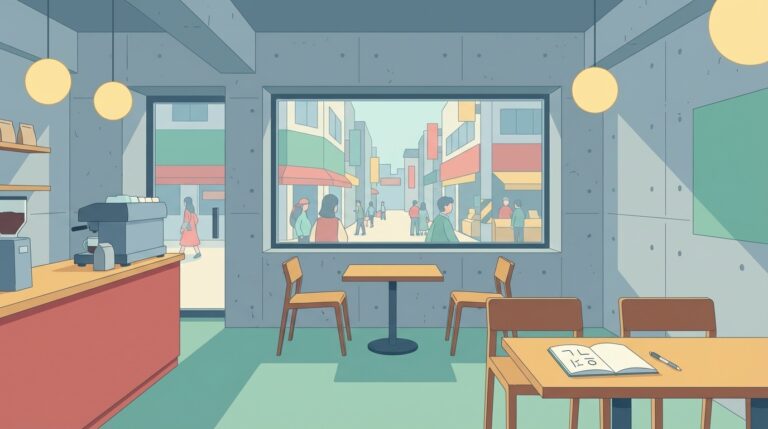
Phase 1: Welcome to the Concrete Jungle
Hello! This is your Daily Hangul Editor.
Imagine this: You’re walking through the alleys of Seongsu-dong, often dubbed the ‘Brooklyn of Seoul.’ You step into a trendy cafe that used to be an old shoe factory. The walls are exposed concrete, there are exactly three sleek, stainless steel tables, and the aesthetic is so incredibly minimal it almost hurts. Your Korean architect friend looks around, nods approvingly, and says, “와, 여기 공간 진짜 기가 막히게 뺐다.” (Wow, they really pulled out the space amazingly here.)
Pulled out? Did they physically extract something from the room?
If you’ve ever wondered how Koreans manage to fit an entire high-tech living system into a 5-pyeong (16 sqm) studio, or why every new hotspot in Seoul feels like a study in extreme minimalism, you’re in the right place. At a C2 mastery level, you already know words like 넓다 (wide) and 좁다 (narrow). Today, we’re going to talk like a true Seoulite—diving into the sophisticated, highly idiomatic language of spatial efficiency and minimalist aesthetics.
Let’s upgrade your vocabulary from “this room is small but good” to “this space maximizes utility with zero fluff.”
Phase 2: Deep Dive into Core Expressions
1. 공간을 (기가 막히게) 빼다
- Pronunciation: gong-gan-eul (gi-ga ma-ki-ge) bbaet-da.
Sound Analogy: The ‘ㅃ’ in ‘빼’ sounds like a sharp, tense ‘p’—imagine the abrupt sound you make when popping a bubble. ‘기가 막히게’ sounds like gee-gah mah-kee-geh. - Meaning:
- Literal: To pull out the space (amazingly).
- Real Nuance: To design, lay out, or utilize a given area with exceptional efficiency and cleverness.
- K-Culture Moment: You will hear this non-stop when Koreans go apartment hunting (부동산 투어) or review new cafes. In K-Dramas, when a protagonist moves into a tiny rooftop room (옥탑방) but it surprisingly fits a bed, a desk, and a kitchen, the real estate agent will proudly declare, “방이 아주 잘 빠졌어요” (The room was pulled out very well).
- Editor’s Insight: This phrase captures the essence of Seoul real estate. Because land is incredibly expensive and scarce, the ultimate compliment for an architect or designer isn’t just making something pretty; it’s maximizing every square inch.
- Situation Spectrum:
- Casual with friends: ✅
- Professional (with real estate agents/designers): ✅
- Formal (giving an academic architecture presentation): ⚠️ (Use ‘공간 활용도가 매우 높다’ instead)
- 🤔 Think About It: Why do Koreans use the verb ‘빼다’ (to subtract/pull out) for space? It implies extracting maximum value out of a constrained, rigid box. How does your language describe maximizing small spaces?
2. 군더더기 없이 (깔끔하게) 떨어지다
- Pronunciation: gun-deo-deo-gi eop-si (ggal-ggeum-ha-ge) tteol-eo-ji-da.
Sound Analogy: ‘군더더기’ rolls off the tongue like goon-duh-duh-ghee. ‘떨어지다’ starts with a sharp, tense ‘tt’ like the ‘t’ in ‘stop’. - Meaning:
- Literal: To fall cleanly without any superfluity.
- Real Nuance: To have a perfectly minimalist, sleek design with absolutely no unnecessary fluff or messy details.
- K-Culture Moment: Think of the flagship stores of luxury K-Beauty brands or the immaculate, sterile office of a K-Drama CEO. The lines are straight, the colors are monochromatic, and there is zero clutter.
- Editor’s Insight: ‘군더더기’ means superfluous additions. ‘떨어지다’ here means how a line or design finishes. When something “falls cleanly,” it satisfies the Korean aesthetic desire for neatness and modernity.
- Situation Spectrum:
- Casual with friends: ✅
- Professional (at work/design review): ✅
- Formal: ✅
- 🤔 Think About It: Minimalism is globally trendy, but in Korea, it often contrasts sharply with the extremely cluttered, fast-paced nature of the streets outside. Do you think minimalist interiors serve as psychological escapes for modern Seoulites?
3. 개방감이 좋다 / 탁 트여 있다
- Pronunciation: gae-bang-gam-i jo-ta / tak teu-yeo it-da.
Sound Analogy: ‘탁’ (tak) is an onomatopoeia for something bursting open. - Meaning:
- Literal: The sense of openness is good / It is burst wide open.
- Real Nuance: The space feels visually expansive, airy, and unconfined, usually due to high ceilings, lack of partitions, or large windows.
- K-Culture Moment: Whenever celebrities show off their luxury Han River-view apartments on reality shows like I Live Alone (나 혼자 산다), the first thing the studio panelists exclaim is, “와~ 거실 개방감 보소!” (Wow, look at the openness of that living room!)
- Editor’s Insight: Koreans hate feeling 답답하다 (stuffy/cramped). Because so many people live in dense apartment complexes (아파트), creating ‘개방감’ (a feeling of openness) through interior design is a massive selling point.
Phase 3: Textbook vs. Real Korean
Let’s bridge the gap between your C2 textbook and the streets of Seoul.
[Admiring a small but perfectly designed Studio Apartment]
* 📖 Textbook Korean: 이 방은 면적에 비해 공간 활용이 아주 효율적이네요. (This room is very efficient in its space utilization compared to its area.)
* 🗣️ Real Korean: 와, 평수 대비 진짜 알차게 잘 나왔네요. (Wow, compared to the pyeong [size], it came out really packed/efficient.)
* 💡 Why the difference?: Real estate lingo in Korea relies heavily on words like ‘알차다’ (solid/packed with substance) and ‘잘 나오다’ (came out well) rather than academic terms like ‘효율적이다’.
[Describing a Minimalist Cafe Interior]
* 📖 Textbook Korean: 이곳은 아주 미니멀한 디자인을 채택했습니다.
* 🗣️ Real Korean: 완전 여백의 미 장난 아니다. 선이 깔끔하게 떨어지네.
* 💡 Why the difference?: ‘여백의 미’ (the beauty of empty space) is a traditional Korean art concept heavily applied to modern minimalism. ‘장난 아니다’ (it’s no joke) adds that native dramatic flair.
Phase 4: Cultural Context — K-Culture Deep Dive
4-1. Non-Verbal Nuances: The Architecture of “Nunchi”
When discussing space in Korea, it’s not just about the physical walls; it’s about the social space. The concept of Nunchi (눈치, situational awareness) heavily dictates spatial efficiency. In tiny, highly efficient cafes, tables are often placed uncomfortably close together. The Nunchi here implies that you keep your voice down, keep your belongings confined to your tiny chair, and don’t overstay if there’s a line outside. The physical minimalism demands behavioral minimalism.
4-2. K-Drama Tropes: The Chaebol Mansion vs. The Gosiwon
If you watch K-Dramas, architectural space is the ultimate indicator of class. The Chaebol (재벌) heir always lives in a space where ‘개방감’ is absurdly high—think massive glass walls, echoing living rooms, and a floating staircase. It’s the pinnacle of “군더더기 없는 미니멀리즘” (fluff-free minimalism).
Conversely, the hardworking protagonist lives in a 옥탑방 (rooftop room) or 고시원 (study dorm). Here, the language shifts to extreme survival efficiency. Bed frames have built-in drawers; folding tables are a must. Yet, in Korean culture, these tiny spaces are often romanticized as cozy (아늑하다) spaces where real human connection happens, often over a shared pot of ramen.
Phase 5: Real-Life Roleplay Scenario
Setting: A Friday afternoon in Yeonnam-dong. You are hunting for a new “Officetel” (studio apartment) because your current lease is up. You are sitting in a local real estate office (부동산) with an experienced agent.
Characters:
* YOU: An expat who has lived in Seoul for 4 years. You want a modern, clean space but have a strict budget.
* Agent Kim (50s): A fast-talking, sharp-eyed real estate agent who knows every building in the neighborhood.
Dialogue:
Agent Kim: 손님, 방금 나온 매물인데, 여긴 진짜 공간을 기가 막히게 뺐어요. 한번 보실래요?
(Sonnim, banggeum naon maemurinde, yeogin jinjja gongganeul giga makige ppaesseoyo. Hanbeon bosillaeyo?)
[Customer, this is a newly listed property, and they really pulled out the space amazingly here. Want to take a look?]
YOU: 아, 그래요? 평수가 어떻게 되는데요?
(A, geuraeyo? Pyeongsuga eotteoke doeneundeyo?)
[Oh, really? What’s the square footage (pyeong)?]
Agent Kim: 실평수는 6평인데, 빌트인 가구가 벽에 싹 들어가 있어서 체감은 한 8평 돼요.
(Silpyeongsuneun yug-pyeonginde, bilteuin gaguga byeoge ssak deureoga isseoseo chegameun han pal-pyeong dwaeyo.)
[The actual size is 6 pyeong, but the built-in furniture is tucked right into the walls, so it feels like 8 pyeong.]
YOU: (Looking at the photos) 오, 디자인이 군더더기 없이 깔끔하게 떨어지네요.
(O, dijaini gundeodeogi eopsi kkalppeumhage tteoreojineyo.)
[Oh, the design falls very cleanly without any unnecessary fluff.]
Agent Kim: 그렇죠? 창문도 통창이라 개방감이 아주 좋아요. 답답한 거 싫어하시면 딱이에요.
(Geureochyo? Changmundo tongchangira gaebanggami aju joayo. dabdaphan geo sileohasimyeon ttagieyo.)
[Right? The window is floor-to-ceiling too, so the sense of openness is great. If you hate stuffiness, it’s perfect.]
🔀 Your Turn! You like the place, but you want to check the practical side. What do you say?
- A) “아름답네요. 당장 계약할게요!” (Beautiful. I’ll sign the contract right now!)
- B) “다 좋은데, 수납공간은 넉넉한가요? 관리비도 궁금해요.” (Everything is great, but is there enough storage space? I’m also curious about the maintenance fee.)
- C) “이거 너무 좁은 거 아니에요?” (Isn’t this too small?)
✅ Best Choice: B — Reason: In Korean real estate, acknowledging the aesthetic (‘다 좋은데’ – everything is good, but…) while immediately asking about practical efficiency (수납공간 – storage space) and hidden costs (관리비 – maintenance) proves you are a seasoned Seoul resident.
⚠️ Choice C Analysis: Directly calling a space “좁다” (small/cramped) after the agent praised its efficiency can sound a bit blunt. It’s better to frame it as a question about storage.
Phase 6: 10-Second Shadowing Drill
Speak like a native! Pay attention to the intonation and pauses.
😲 와, / 여기 평수 대비 / 공간을 / 진짜 기가 막히게 뺐네요!
(Wa, / yeogi pyeongsu daebi / gong-gan-eul / jin-jja gi-ga ma-ki-ge bbaet-ne-yo!)
[Tone: Highly impressed, eyes slightly widened, nodding slowly]
Phase 7: K-Culture Mini Dictionary
| 한국어 | Romanization | English | Contextual Meaning |
|---|---|---|---|
| 평수 | pyeongsu | Pyeong (Size) | The traditional Korean measurement for floor space (1 pyeong ≈ 3.3 sqm). Still universally used in real estate. |
| 빌트인 | bil-teu-in | Built-in | Essential for Korean spatial efficiency. Appliances (fridge, washing machine) hidden inside minimalist cabinetry. |
| 여백의 미 | yeo-baek-ui mi | Beauty of empty space | A traditional artistic concept now used to praise minimalist architecture and interior design. |
| 가성비 | ga-seong-bi | Cost-effectiveness | Highly relevant when discussing if a small space is worth the high Seoul rent. |
| 통창 | tong-chang | Floor-to-ceiling window | The ultimate architectural hack to give a tiny apartment or cafe ‘개방감’ (openness). |
Phase 8: Traveler’s Survival Kit (Seoul Architecture Edition)
Whether you’re visiting trendy cafes in Seongsu or actually moving to Seoul, these phrases are lifesavers when assessing spaces.
🆘 Survival Phrases for K-Spaces
* 🇰🇷 “와이파이 비밀번호랑 콘센트 자리 어디 있어요?” (wa-i-pa-i bi-mil-beon-ho-rang kon-sen-teu ja-ri eo-di is-seo-yo?)
* Translation: Where is the Wi-Fi password and an outlet?
* Context: Essential for working in aesthetically pleasing but practically confusing minimalist cafes.
* 🇰🇷 “채광은 좀 어때요?” (chae-gwang-eun jom eo-ttae-yo?)
* Translation: How is the natural light?
* Context: The #1 question to ask when an agent shows you an “efficiently” designed apartment that might be facing a brick wall.
* 🇰🇷 “여긴 테이크아웃 전용인가요?” (yeo-gin te-i-keu-a-ut jeon-yong-in-ga-yo?)
* Translation: Is this place takeout only?
* Context: Some “minimalist” cafes are so minimal they actually don’t have seats.📌 Editor’s Travel Note
* Navigation: In highly developed areas like Gangnam or Hongdae, “efficient space utilization” means many cafes and hidden gems are located underground (B1) or on the 3rd/4th floors without obvious street signs. Always look UP when using KakaoMap or Naver Map.
Phase 9: Critical Thinking — “A Step Deeper”
Media vs Reality: The Aesthetics of Necessity
When we look at modern Korean architecture, especially the hyper-minimalist cafes and “smart” studio apartments, it’s easy to praise the sophisticated ‘여백의 미’ (beauty of emptiness). However, for the MZ generation in Seoul, this minimalism is often born out of economic necessity rather than artistic choice. With housing prices skyrocketing, young professionals are forced into “micro-apartments.” The extreme space efficiency (공간을 기가 막히게 뺐다) is a brilliant architectural solution, but it also reflects the harsh reality of urban density. Media romanticizes the “minimalist lifestyle,” but for many, living without “군더더기” (fluff) simply means not having enough space to own more than the absolute essentials.
💬 Your Turn: Does your culture view “minimalism” as a luxury aesthetic or an economic necessity? How does architecture in your city reflect social realities? Share your thoughts in the comments!
Phase 10: FAQ & Avoiding Common Mistakes
Q: Can I use “공간을 기가 막히게 뺐다” to my boss or an older architect?
* A: It’s a bit too colloquial. While it shows high fluency, if you are in a formal business meeting, it’s safer to use: “공간 활용을 매우 극대화하셨네요” (You have truly maximized the space utilization).
Q: Why do Koreans say a room is “답답하다” (stuffy)? Isn’t that for breathing?
* A: In Korean, ‘답답하다’ is used for physical spaces, emotional states, and even personalities! A room without windows, a person who won’t listen, or a chest cold—they are all 답답하다. The antidote to a 답답한 space is 개방감 (openness).
❌ Common Mistake #1: Saying “이 방은 너무 작아요” (This room is too small) to an agent or host.
✅ Do This Instead: Koreans tend to soften negative space descriptions. Instead of ‘작다’, use ‘아담하네요’ (It’s petite/cozy) or ‘콤팩트하네요’ (It’s compact). It preserves Nunchi and politeness.
Phase 11: Summary & Action Items
- One-Liner Summary: To speak about Korean architecture like a local, focus on how brilliantly the space was “pulled out” (공간을 잘 뺐다) and the sleek lack of fluff (군더더기 없이 떨어지다).
Action Mission:
* 🥉 Bronze (Solo): Look around your current room and describe its space efficiency out loud in Korean.
* 🥈 Silver (Online): Find a picture of a K-Drama interior or a Seoul cafe on Instagram. Leave a comment: “공간이 군더더기 없이 깔끔하네요!”
* 🥇 Gold (Real World): Visit a newly opened cafe or space in your city. Tell your friend (or yourself) in Korean: “여긴 답답하지 않고 탁 트여서 좋네!”
* 🇰🇷 K-Culture Mission: Go on YouTube and search “원룸 랜선집들이” (Studio Apartment Online Housewarming). Listen for how many times the host mentions “수납” (storage) or “공간 활용” (space utilization)!
Phase 12: Interactive Quiz
1. Situational Judgment: You step into a cafe in Hannam-dong. It has incredibly high ceilings, massive glass windows, and only a few tables. Which phrase perfectly describes this vibe?
* A) 공간을 알차게 뺐네요.
* B) 탁 트여서 개방감이 엄청나네요.
* C) 너무 답답하네요.
2. Fill in the Blank:
“이 오피스텔은 빌트인 가구가 잘 되어 있어서, 좁은 평수인데도 공간을 진짜 기가 막히게 ( _____ ).”
* A) 더했어요
* B) 좁혔어요
* C) 뺐어요
3. True or False – K-Culture Edition:
In Seoul, “풀옵션” (Full-option) means a hotel room that comes with room service and daily cleaning. (T/F)
🚨 Click to reveal answers!
1. B – The high ceilings and windows provide a massive sense of openness (개방감).
2. C – ‘뺐어요’ (pulled out). It’s the ultimate idiom for space efficiency.
3. False – “풀옵션” (Full-option) in Korea refers to rental apartments (like officetels) that come fully furnished with major appliances like a washing machine, fridge, and A/C built right into the walls to save space!
Keep building your Korean skills, one perfectly designed sentence at a time! See you in the next Daily Hangul post.
Frequently Asked Questions (FAQ)
Q: What does "공간을 (기가 막히게) 빼다" mean in Korean and how do you pronounce it?
A: In Korean, "공간을 (기가 막히게) 빼다" is pronounced [gong-gan-eul (gi-ga ma-ki-ge] and means: Literal: To pull out the space (amazingly).
Q: What does "군더더기 없이 (깔끔하게) 떨어지다" mean in Korean and how do you pronounce it?
A: In Korean, "군더더기 없이 (깔끔하게) 떨어지다" is pronounced [gun-deo-deo-gi eop-si (ggal-ggeum-ha-ge] and means: Literal: To fall cleanly without any superfluity.
Q: What does "개방감이 좋다 / 탁 트여 있다" mean in Korean and how do you pronounce it?
A: In Korean, "개방감이 좋다 / 탁 트여 있다" is pronounced [gae-bang-gam-i jo-ta / tak teu-yeo it-da.] and means: Literal: The sense of openness is good / It is burst wide open.






