

Phase 1: Empathy (Immersive Open)
Hello! Daily Hangul Editor here.
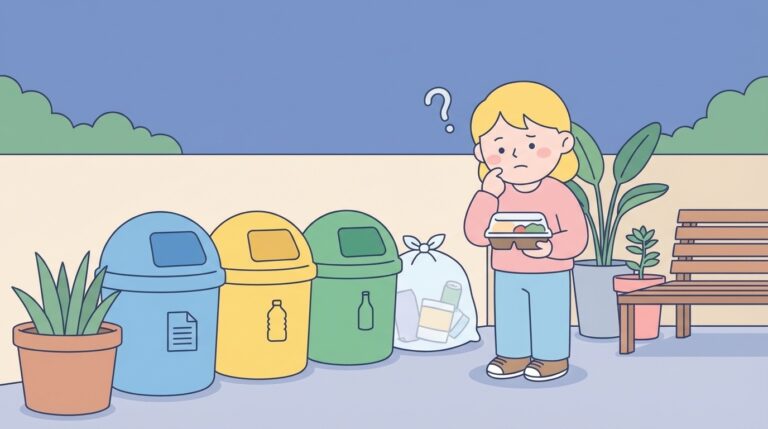
Imagine this: You’ve finally settled into your cozy Seoul apartment or your Airbnb. It feels like you’re the main character in an episode of I Live Alone (나 혼자 산다). You’ve just successfully ordered a massive feast of delivery Tteokbokki and fried chicken. You ate well, watched a K-Drama, and now it’s time to clean up. You gather all the plastic containers, chicken bones, and leftover radish, throw them into a random plastic bag, and head downstairs to the trash area.
Suddenly, the building’s security guard (경비 아저씨) intercepts you. He looks at your bag, sighs, and says a string of Korean words that sound like a gentle scolding. Your neighbors walking by give you a sympathetic—or perhaps annoyed—look.
What went wrong? You just violated one of the most sacred, unspoken rules of Korean society: 분리수거 (bunrisugeo, recycling) and garbage disposal.
If you don’t know the local housing rules for waste, you might face fines, angry neighbors, or the eternal disapproval of your building’s security guard. But don’t worry! This guide is built from the exact panic-moments my expat students have faced. Once you master this, you won’t just be surviving in Korea—you’ll be living like a true, respected local.
Phase 2: Deep Dive into Key Expressions
Let’s break down the essential vocabulary you need to survive trash day in Korea.
1. 분리수거 하러 가요.
- Pronunciation: bun-ri-su-geo ha-reo ga-yo. (The ‘r’ in ‘ri’ sounds like a soft ‘d/l’ flap, and ‘geo’ sounds like ‘guh’.)
- Meaning: Literal: I’m going to do the separated collection. / Real nuance: I’m going out to do the recycling.
- K-Culture Moment: In K-Dramas, “taking out the recycling” is the ultimate excuse characters use to sneak out of the house late at night. It’s the perfect alibi to secretly meet a lover by the apartment playground or grab a late-night beer at the convenience store!
- Editor’s Insight: 분리 (bunri) means separation, and 수거 (sugeo) means collection. In Korea, recycling isn’t just tossing things into one bin. It’s an elaborate sorting ceremony.
- Situation Spectrum:
- Casual with friends: ✅ (분리수거 하러 갈게)
- Semi-formal/Neighbors: ✅
- Formal/Elders: ✅
- 🤔 Think About It: Why is “separation” emphasized so heavily in Korea compared to countries where all recyclables go into one bin? How does population density affect this?
2. 일반 쓰레기로 버려야 돼요.
- Pronunciation: il-ban sseu-re-gi-ro beo-ryeo-ya dwae-yo.
- Meaning: Literal: You must throw it as general trash. / Real nuance: This goes in the regular garbage bag, not the recycling.
- K-Culture Moment: You’ll hear this a lot from kind neighbors or security guards when you mistakenly try to recycle a greasy pizza box or a plastic Tteokbokki container stained permanently red.
- Editor’s Insight: This phrase is a lifesaver. If you’re ever unsure if something is recyclable, ask someone, and they will likely use this phrase to correct you.
- Situation Spectrum:
- Casual: ✅
- Semi-formal: ✅
- Formal: ⚠️ (To elders, add ‘요’ and use softer tone)
- 🤔 Think About It: Does your language have a specific term to distinguish “general waste” from “recycling” and “food waste” so strictly?
3. 종량제 봉투에 담으세요.
- Pronunciation: jong-nyang-je bong-tu-e da-meu-se-yo.
- Meaning: Literal: Put it in the volume-based system bag. / Real nuance: You have to put this in the paid municipal garbage bag.
- K-Culture Moment: Buying these bags at the convenience store is a rite of passage for any expat. The cashier will ask what size you want (10L, 20L), and you must buy the specific color for your district (e.g., Gangnam-gu bags won’t work in Mapo-gu).
- Editor’s Insight: Without a 종량제 봉투 (jongnyangje bongtu), your trash will not be collected, and you could be fined. It’s the physical proof that you’ve paid your “trash tax.”
- Situation Spectrum:
- Convenience store clerks will use this with you: ✅
- Neighbors instructing you: ✅
- 🤔 Think About It: Paying for specific garbage bags makes citizens financially responsible for the amount of trash they produce. Does this exist in your home country?
Phase 3: Textbook vs. Real Korean
[Taking out the trash]
* 📖 Textbook Korean: 쓰레기를 버립니다. (I throw away the trash.)
* 🗣️ Real Korean: 쓰레기 좀 비우고 올게. (I’ll go empty the trash and be right back.)
* 💡 Why the difference?: “버리다” (to throw away) sounds a bit rigid. In daily life, Koreans use “비우다” (to empty) for bins, focusing on the action of clearing the space.
[Talking about Food Waste]
* 📖 Textbook Korean: 음식물 쓰레기를 처리해야 합니다. (I must process the food waste.)
* 🗣️ Real Korean: 오늘 음쓰 버리는 날이야. (Today is the day to throw out the um-sseu.)
* 💡 Why the difference?: “음식물 쓰레기” is long, so young Koreans and busy households abbreviate it to “음쓰 (um-sseu)” for efficiency.
Bottom Note: For B2 level, confidently throwing out words like “음쓰” or “종량제” will instantly make Koreans view you as a well-adapted resident rather than just a tourist!
Phase 4: Cultural Context — K-Culture Deep Dive
4-1. Non-Verbal Elements: Nunchi at the Trash Bins
When you are at the communal recycling area in a Korean apartment (아파트), Nunchi (눈치, the subtle art of reading the room) is critical. If you see the 경비 아저씨 (security guard) organizing boxes, it is polite to bow your head slightly and say, “수고하십니다!” (Thank you for your hard work!). If you’re struggling to flatten a cardboard box, someone might step in to help—accept it with a polite smile and a quick bow.
4-2. K-Food Connection: The “Delivery Container” Dilemma
Korea’s delivery app culture (배달의 민족, 요기요) is legendary. But it comes with a massive responsibility.
When you order Jjamppong (spicy seafood noodle soup) or Tteokbokki, they arrive in thick plastic containers.
Crucial Rule: You cannot just toss these into the plastic recycling bin! You must rinse them out with water. If the plastic is stained red and the color won’t wash out, it loses its recycling value and must go into the regular garbage bag (일반 쓰레기). This meticulous washing of delivery containers is a very common scene in Korean vlogs and reality shows.
Phase 5: Real-Life Roleplay Scenario
Setting: A chilly Tuesday evening, 8 PM. You are at the recycling area of your new officetel (studio apartment) in Seoul. You are holding a confused mix of delivery boxes, empty beer cans, and a plastic container that still has some spicy sauce in it.
Characters:
– YOU: An expat who moved in 2 weeks ago, trying to do your best.
– Mr. Kim (60s): The building’s diligent security guard. He is strict about rules but has a warm heart.
Dialogue:
Mr. Kim: 학생, 그거 그냥 버리면 안 돼! 분리수거 제대로 해야지.
(Haksaeng, geugeo geunyang beorimyeon an dwae! Bunrisugeo jedaero haeyaji.)
[Student, you can’t just throw that away! You have to recycle properly.]
(🎭 Stage Direction: Mr. Kim points at the plastic container in your hand with his sorting stick.)
YOU: 아, 죄송합니다. 제가 아직 한국 분리수거가 처음이라서요.
(A, joesonghamnida. Jega ajik hanguk bunrisugeoga cheoeumiraseoyo.)
[Ah, I’m sorry. This is my first time doing recycling in Korea.]
Mr. Kim: (Sighs but softens his tone) 박스는 테이프 다 뜯고, 캔은 저쪽에. 근데 그 플라스틱은 양념이 묻었네.
(Bakseuneun teipeu da tteutgo, kaeneun jeojjoge. Geunde geu peullaseutigeun yangnyeomi mudeonne.)
[Take all the tape off the boxes, cans go over there. But that plastic has sauce on it.]
🔀 Your Turn! How do you respond to ask what to do with the stained container?
– A) “그럼 음식물 쓰레기예요?” (Then is it food waste?)
– B) “씻어서 분리수거 할까요? 아니면 일반 쓰레기로 버릴까요?” (Should I wash it and recycle it, or throw it away as general trash?)
– C) “아저씨가 대신 버려주세요.” (Please throw it away for me, sir.)✅ Best Choice: B — Reason: It shows you understand the two possible solutions (washing vs. general trash) and are actively trying to follow the rules. Mr. Kim will be highly impressed!
⚠️ Choice A Analysis: The container is plastic, not food. Food waste (음식물 쓰레기) is strictly for things animals can eat (so no bones, no shells either!).
🚫 Choice C Analysis: Highly disrespectful. You must handle your own trash.
Mr. Kim: (Smiling) 양념 안 지워지면 일반 쓰레기, 종량제 봉투에 담아서 버려요.
(Yangnyeom an jiwojimyeon ilban sseuregi, jongnyangje bongtue damaseo beoryeoyo.)
[If the sauce doesn’t wash off, it’s general trash, put it in the volume-based bag and throw it away.]
YOU: 네, 알겠습니다. 감사합니다, 수고하세요!
(Ne, algetseumnida. Gamsahamnida, sugohaseyo!)
[Yes, I understand. Thank you, keep up the good work!]
Phase 6: 10-Second Shadowing Drill
Practice this sentence so you can confidently ask your neighbors or the building manager for help!
🥺 이거는 / 일반 쓰레기로 / 버리시면 돼요? (i-geo-neun / ilban sseu-re-gi-ro / beo-ri-si-myeon dwae-yo?)
(Tone: Slightly confused, polite, and seeking confirmation.)
Phase 7: K-Culture Mini Dictionary
| Korean | Romanization | English | Cultural Context |
|---|---|---|---|
| 분리수거 | bunrisugeo | Recycling / Waste separation | A strict daily chore. Categories often include paper, plastic, vinyl, glass, and cans. |
| 종량제 봉투 | jongnyangje bongtu | Volume-based garbage bag | Paid bags required by law for non-recyclable trash. Bought at local convenience stores. |
| 음식물 쓰레기 | eumsingmul sseuregi | Food waste | Strictly separated to be processed into animal feed or compost. Often disposed of using a T-money card on a smart bin, or specific food waste bags. |
| 눈치 | nunchi | Reading the room | Crucial when moving into a shared building. Following communal rules shows good nunchi. |
| 일반 쓰레기 | ilban sseuregi | General waste | Anything that is NOT recyclable and NOT food waste (e.g., dirty napkins, chicken bones, eggshells). |
Phase 8: Traveler Survival Kit
Even if you’re just staying at a Korean Airbnb for a week, you are legally required to separate your trash. The host will likely leave instructions, but here is what you need to survive:
🆘 Survival Expressions
– 🇰🇷 “종량제 봉투 20리터짜리 하나 주세요.” (jongnyangje bongtu isib-niteo-jjari hana juseyo.)
– 🗣️ Meaning: Please give me one 20-liter volume-based garbage bag.
– 📍 Where to use: Convenience stores (CU, GS25, 7-Eleven)
– 💡 Pro Tip: They are kept behind the counter. You have to ask the cashier for them directly!📌 Editor’s Travel Note
– Bones and Shells are NOT food waste: Eating Korean fried chicken or clams? The bones and shells go into the general waste bag, not the food waste bin. (Rule of thumb: If a pig can’t eat it, it’s not food waste!)
– District Specific: A garbage bag bought in Hongdae (Mapo-gu) cannot be used in Gangnam (Gangnam-gu). Only buy what you need for your specific neighborhood.
Phase 9: Critical Thinking — “One Step Deeper”
🧠 Think Deeper: Space, Population, and Community Rules
Korea is a mountainous country with a massive population density, especially in the Seoul metropolitan area where most people live in towering apartment complexes (아파트). Space is a luxury, meaning landfills are extremely limited. Korea’s strict 종량제 (volume-based waste fee system) and 분리수거 (recycling) rules aren’t just environmental policies—they are a survival mechanism for a crowded society. It reflects the Korean collective mindset: your individual convenience must not harm the communal living space. Following these rules is considered a basic measure of citizenship and respect for your neighbors.
💬 Your Turn: How does your country handle recycling and food waste? Is it a strict communal effort, or is it mostly left to the individual? Let me know in the comments!
Phase 10: FAQ & Avoiding Mistakes
Q: Can I use a regular plastic bag for my garbage if I double-tie it?
No. Absolutely not. If you throw away general trash in a regular shopping bag, it will not be collected, and the city officials actually open illegal bags to find receipts or mail with your name on it to fine you (fines can be up to 1,000,000 KRW)!
Q: What do I do with old clothes or broken electronics?
Do not put them in regular bags. Most buildings have a specific bin for clothes (의류수거함). For electronics, you must report them to the district office and print a paid sticker to attach to them.
❌ Common Mistake #1: Throwing chicken bones or tea bags into the food waste (음식물 쓰레기).
✅ Do this instead: Chicken bones, eggshells, onion skins, and tea bags are considered general waste (일반 쓰레기). Only put soft, digestible food scraps in the food waste bin.❌ Common Mistake #2: Recycling plastic cups with coffee still inside.
✅ Do this instead: You must pour the leftover liquid down the drain, rinse the cup, and then recycle the plastic.
Phase 11: Summary & Action Items
One-Liner Summary: In Korea, mastering 종량제 봉투 (paid garbage bags) and 분리수거 (recycling) is the ultimate proof that you respect Korean culture and community space.
Action Mission 3 Steps:
– 🥉 Bronze (Solo): Look around your room right now. Pick up three items and say out loud whether they are 일반 쓰레기 (general) or 분리수거 (recycling).
– 🥈 Silver (Online): Share a picture of a confusing piece of trash in our community forum and ask in Korean: “이거 어디에 버려요?” (Where do I throw this away?)
– 🥇 Gold (Real-world): Go to a Korean convenience store and successfully buy a 종량제 봉투 in Korean!
K-Culture Mission:
Next time you watch a modern K-Drama, look closely at the background when characters are walking outside their apartments. Try to spot the green or blue recycling nets and the food waste bins!
Phase 12: Quiz — Interactive Challenge
1. Situational Judgment: You ordered delivery Jajangmyeon (black bean noodles). The plastic bowl is completely stained black and oily, even after washing it. What do you do?
– A) Put it in the plastic recycling bin.
– B) Put it in the 종량제 봉투 (general waste bag).
– C) Put it in the food waste bin.
2. True or False — K-Culture Edition:
“I can buy a large pack of 종량제 봉투 in Seoul and use them anywhere in Korea when I travel.” (T/F)
3. Fill in the Blank:
Korean friends invite you over. They are cleaning up dinner and say: “이 닭 뼈는 일반 쓰레기니까 ______에 담아서 버려줘.”
(Since these chicken bones are general waste, put them in the ______ and throw them out.)
Click here for Answers!
1. B – If the plastic cannot be cleaned of stains/oil, it loses its recycling value and becomes general waste.
2. False – Garbage bags are specific to the city district (e.g., Mapo-gu, Gangnam-gu). They cannot cross borders!
3. 종량제 봉투 – The official volume-based garbage bag.
Frequently Asked Questions (FAQ)
Q: What does "분리수거 하러 가요." mean in Korean and how do you pronounce it?
A: In Korean, "분리수거 하러 가요." is pronounced [bun-ri-su-geo ha-reo ga-yo. (The 'r' in 'ri' sounds like a soft 'd/l' flap, and 'geo' sounds like 'guh'.] and means: Literal: I'm going to do the separated collection. / Real nuance: I'm going out to do the recycling.
Q: What does "일반 쓰레기로 버려야 돼요." mean in Korean and how do you pronounce it?
A: In Korean, "일반 쓰레기로 버려야 돼요." is pronounced [il-ban sseu-re-gi-ro beo-ryeo-ya dwae-yo.] and means: Literal: You must throw it as general trash. / Real nuance: This goes in the regular garbage bag, not the recycling.
Q: What does "종량제 봉투에 담으세요." mean in Korean and how do you pronounce it?
A: In Korean, "종량제 봉투에 담으세요." is pronounced [jong-nyang-je bong-tu-e da-meu-se-yo.] and means: Literal: Put it in the volume-based system bag. / Real nuance: You have to put this in the paid municipal garbage bag.







