

Hello there! I’m your Lead Editor at Daily Hangul.
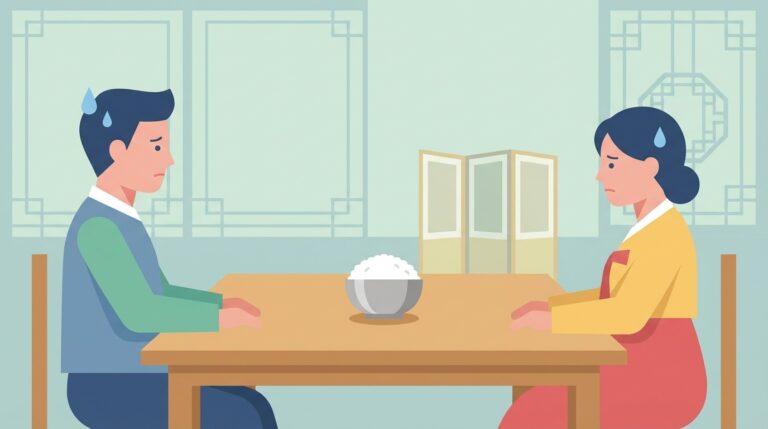
Imagine this classic K-Drama scene: The morning after a massive family blowout. The parents are furious, the kids are looking down at their laps, and the only sound in the room is the clinking of metal spoons against ceramic bowls. The main character looks like every grain of rice is made of sand. They aren’t just eating breakfast; they are eating… Nunchi.
If you’ve spent any time watching Korean dramas, working in a Korean company, or even just hanging out with Korean friends, you’ve probably felt this invisible heavy air. It’s the art of 눈치 (Nunchi)—reading the room. But what happens when you have to eat a meal while reading a very uncomfortable room?
Today, we’re diving into one of the most culturally loaded (and practically useful!) phrases in Korean: 눈칫밥을 먹다 (Eating Nunchitbap). Understanding this won’t just improve your Korean; it will give you a backstage pass into the Korean psyche.
(Note: This guide is built on real ‘aha!’ moments from my B1 students who finally understood why their Korean coworkers looked so miserable during certain team lunches!)
Phase 2: Core Expressions Deep Dive
Let’s break down the expressions you need to survive (and describe) these tense situations.
1. 눈치를 보다
- Pronunciation: nun-chi-reul bo-da (The ‘eu’ in ‘neun/nun’ sounds a bit like the disgusted sound you make when stepping in gum: eugh!)
- Meaning: Literal: To look at ‘eye-measure’. / Real Nuance: To walk on eggshells, to read the room, to be self-conscious of someone else’s mood.
- K-Culture Moment: You are at a K-Pop fan meeting, and the staff says time is up, but your favorite idol is still talking. You keep glancing at the staff—you are 눈치를 보는 중 (doing nunchi).
- Editor’s Insight: This isn’t always negative! It’s a survival skill. But it implies you aren’t completely relaxed. You are adjusting your behavior based on someone else’s vibe.
- Situation Spectrum:
- Casual (Friends): ✅ (e.g., “Why are you walking on eggshells around me?”)
- Semi-formal (Coworkers): ✅
- Formal (Boss/Elders): ⚠️ (You can do it, but telling a boss “I am reading your nunchi” can sound a bit passive-aggressive!)
- 🤔 Think About It: Why is “reading the room” such a prominent verb in Korean? How does your native language describe the act of sensing other people’s unspoken feelings?
2. 눈칫밥을 먹다
- Pronunciation: nun-chit-ba-beul meok-da
- Meaning: Literal: To eat nunchi rice. / Real Nuance: To eat an uncomfortable meal because you are highly conscious of someone else (who is usually angry, strict, or holds power over you), OR to suffer indignity while depending on someone else.
- K-Culture Moment: In a K-Drama, the poor protagonist who lives with her evil step-family eats quickly and quietly in the corner. She is eating 눈칫밥.
- Editor’s Insight: Think of it as a meal seasoned with tension. You usually use this to complain to a friend after the awful meal is over.
- Situation Spectrum:
- Casual: ✅
- Semi-formal: ⚠️ (Only with close work friends)
- Formal: 🚫 (Never say this to the person making you uncomfortable!)
- 🤔 Think About It: Rice (밥) is the core of Korean culture. Why do you think emotional distress is paired with the word for rice?
3. 체할 것 같아요
- Pronunciation: che-hal geot ga-ta-yo
- Meaning: Literal: I think I will get indigestion. / Real Nuance: This situation is so incredibly tense that my stomach is physically rejecting the food.
- K-Culture Moment: You are having lunch with your Korean boss, and they start asking about your marriage plans or why your project failed. You whisper to your coworker, “체할 것 같아…”
- Editor’s Insight: Koreans closely link emotional stress to digestion. Saying you feel like you’re going to get indigestion is the ultimate way to say, “This meal is stressing me out.”
- Situation Spectrum:
- Casual: ✅
- Semi-formal: ✅
- Formal: 🚫
Phase 3: Textbook vs. Real Korean
How do we describe an uncomfortable meal in real life compared to a textbook?
[Describing a terrible lunch with a grumpy boss]
* 📖 Textbook Korean: 오늘 점심 식사는 매우 불편했습니다. (Today’s lunch was very uncomfortable.)
* 🗣️ Real Korean: 아휴, 오늘 완전 눈칫밥 먹었잖아. (Ugh, I totally ate ‘nunchitbap’ today.)
* 💡 Why the difference?: Textbooks focus on literal adjectives (uncomfortable), but real conversational Korean uses vivid, relatable metaphors (eating tension) to build immediate empathy.
[When the atmosphere is too heavy to eat]
* 📖 Textbook Korean: 분위기가 안 좋아서 밥을 못 먹겠어요. (The atmosphere is bad, so I can’t eat.)
* 🗣️ Real Korean: 아, 분위기 진짜… 체할 것 같아. (Ah, this vibe seriously… I feel like I’m going to get indigestion.)
* 💡 Why the difference?: Expressing physical discomfort (indigestion) due to a social situation is a very common Korean communicative habit to show extreme stress.
Bottom Note: At the B1 level, dropping a well-timed “체할 것 같아” with friends will make you sound incredibly fluent and culturally tuned in!
Phase 4: Cultural Context — K-Culture Deep Dive
4-1. The Non-verbal Art of Nunchitbap
When you are eating 눈칫밥, your body language changes.
* Eye Contact: Minimal. You stare intensely at your soup.
* Speed: You might eat faster to escape the situation quickly, or very slowly because you have no appetite.
* Silence: You do not initiate conversation. You only answer with a quiet “네” (Yes) if spoken to.
4-2. The K-Drama Trope: The “Suffocating Company Dinner” (회식)
If you watch workplace K-Dramas like Misaeng (Incomplete Life), you’ll see this constantly. A team messes up a big presentation, but the boss still takes them out for a mandatory team dinner (회식). The pork belly (삼겹살) is sizzling, but no one is talking. The junior employees are frantically grilling the meat, trying not to make a sound.
Critical View: In dramas, a brave character might stand up and shout, “I can’t eat this nunchitbap anymore!” But in real life? We just chew our food quietly, drink a glass of Soju, and vent to our friends on KakaoTalk on the subway ride home.
Phase 5: Interactive Roleplay Scenario
Let’s put you in the hot seat.
- Setting: Tuesday, 12:30 PM. A crowded, noisy Kalguksu (noodle) restaurant near your office.
- Characters:
- YOU: A foreign employee who has been working in Seoul for 6 months.
- Manager Kim (45): Your boss. He just got yelled at by the CEO all morning. He is in a terrible mood but brought you out for lunch anyway.
Manager Kim: (Sighing heavily while aggressively stirring his noodles) 하아… 김 대리, 일은 할 만해?
(Haa… Gim daeri, ireun hal manhae?)
[Sigh… Assistant Manager Kim, is the work bearable?]
YOU: 네, 팀장님 덕분에 잘 배우고 있습니다.
(Ne, timjangnim deokbune jal baeugo itseumnida.)
[Yes, thanks to you, Manager, I am learning well.]
Manager Kim: (Frowning) 그래… 요즘 회사 분위기도 안 좋은데… 국수나 많이 먹어. 맛은 있네.
(Geurae… yojeum hoesa bunwigido an joeunde… guksuna mani meogeo. Maseun inne.)
[Right… the company vibe isn’t great these days either… just eat a lot of noodles. It tastes good, at least.]
🔀 Your Turn! How do you reply in this tense situation?
– A) “아니요! 팀장님 때문에 눈칫밥 먹어서 체할 것 같아요!” (No! I feel like I’ll get indigestion from eating nunchitbap because of you!)
– B) “네, 팀장님도 많이 드세요.” (Yes, please eat a lot too, Manager.)
– C) “대박! 진짜 맛있어요!” (Daebak! It’s seriously delicious!)✅ Best Choice: B — Reason: In a formal nunchi situation, it is best to be polite, brief, and turn the attention back to them eating. Keep your head down and survive!
⚠️ Choice A Analysis: NEVER say this to the person you are reading! You will probably be fired (or at least face a very awkward tomorrow).
⚠️ Choice C Analysis: Too bright and oblivious. When the boss is depressed, acting too happy means you have 눈치가 없다 (no nunchi/clueless).
Phase 6: 10-Second Shadowing Drill
Practice reading this like you are complaining to your best friend after a terrible day at work.
😔 아휴, / 오늘 회식에서 / 완~~전 / 눈칫밥 먹었어... / 진짜 / 체할 뻔했잖아.
(Ahyu, / oneul hoesigeseo / wan~~jeon / nunchitbap meogeosseo… / jinjja / chehal ppeonhaetjana.)
[Ugh, / at the team dinner today / I to~~tally / ate nunchitbap… / Seriously / I almost got indigestion.]
Phase 7: K-Culture Mini Dictionary
| Korean | Romanization | English | Context |
|---|---|---|---|
| 눈치 | nunchi | Social sensing | The core Korean ability to read the atmosphere and people’s moods. |
| 눈치가 빠르다 | nunchiga ppareuda | Quick-witted | Someone who reads the room very quickly and reacts appropriately. |
| 눈치가 없다 | nunchiga eopda | Clueless | Someone who fails to read the room and says/does the wrong thing. |
| 갑분싸 | gap-bun-ssa | Mood killer | Slang: “갑자기 분위기 싸해짐” (Suddenly the mood turns icy). Happens when someone has no nunchi. |
| 회식 | hoe-sik | Company dinner | Often a prime location for eating nunchitbap if the boss is in a bad mood. |
Phase 8: Traveler’s Survival Kit
You might think nunchitbap only happens in offices. But tourists experience it too! Imagine walking into a famous Seoul restaurant alone during the 12 PM lunch rush. You take up a 4-person table. The owner keeps glancing at you. The line outside is growing. You, my friend, are now eating 눈칫밥!
🆘 Survival Phrases for Busy Restaurants
– 🇰🇷 “혼자인데 식사 되나요?” (honjainde siksa doenayo?)
– 🗣️ Meaning: I’m alone, is it possible to eat?
– 📍 Where to use: Small restaurants during busy hours.
– 💡 Pro Tip: If you want to avoid ‘nunchitbap’ as a solo traveler, try dining slightly off-peak (like 1:30 PM) or look for places with bar seating (바 자리).📌 Editor’s Travel Note
Korea is a “빨리빨리” (Hurry Hurry) culture. In popular restaurants, people eat fast and leave immediately so others can sit. Lingering over a cup of water for 30 minutes after finishing your meal while people are waiting will definitely earn you some sharp nunchi glares from the staff!
Phase 9: Critical Thinking — “One Step Deeper”
🧠 Think Deeper: Food & Identity (음식과 정체성)
In many Western cultures, if people are angry with each other, they simply skip dinner or eat in separate rooms. But in Korea, even if a family or a team is fighting, they will often still sit down and eat together—resulting in 눈칫밥. Why? Because in Korea, eating together (식구 – meaning ‘mouths that eat together’) is the ultimate symbol of belonging and relationship (정 – Jeong). To refuse to eat together is to sever the relationship completely. Eating nunchitbap is, ironically, a sign that people are still trying to hold the relationship together, even when it’s painfully uncomfortable.💬 Your Turn: In your culture, what do you do when you are angry with someone right before a meal? Do you still eat together? Share in the comments!
Phase 10: FAQ & Avoiding Mistakes
Q: Can I tell a waiter “눈칫밥을 먹었어요” if the food is bad?
No! Nunchitbap has nothing to do with the actual taste or quality of the food. It’s 100% about the psychological atmosphere.
Q: If I’m eating at a friend’s house and their parents start arguing, is that nunchitbap?
Yes! That is the perfect textbook definition of eating nunchitbap.
❌ Common Mistake #1: Thinking Nunchitbap is a real dish you can order.
(Student: “I’d like one order of Bibimbap and one Nunchitbap please.”)
✅ How to fix: Remember, it’s an invisible, emotional meal!
Phase 11: Summary & Action Items
- One-Liner Summary: 눈칫밥을 먹다 means to eat an uncomfortable meal because you are anxiously reading the room.
-
Action Mission:
- 🥉 Bronze: Say “아, 체할 것 같아” while pressing your stomach dramatically in the mirror.
- 🥈 Silver: Leave a comment below describing a time you ate nunchitbap in your own country using English and Korean.
- 🥇 Gold: Next time you watch a K-Drama, point at the screen during a tense family dinner and shout, “They are eating nunchitbap!”
Phase 12: Interactive Quiz
1. You are at a team dinner. Your boss is furious because the team lost a major client. He is drinking Soju silently. You are carefully grilling the meat and chewing without making a sound. What are you doing?
A) 야근을 하다 (Working overtime)
B) 눈칫밥을 먹다 (Eating nunchitbap)
C) 밥을 사다 (Buying a meal)
2. True or False: You should confidently tell your boss, “팀장님 때문에 눈칫밥 먹었어요!” (I ate nunchitbap because of you!) to show off your Korean skills.
* (T/F)
3. Fill in the blank: “Ah, the vibe is so bad… my stomach hurts. _______ 것 같아.”
A) 배고플 (will be hungry)
B) 체할 (will get indigestion)
C) 맛있을 (will be delicious)
(Answers: 1. B / 2. False – It’s too direct and rude to say to the person causing the tension! / 3. B)
Frequently Asked Questions (FAQ)
Q: What does "눈치를 보다" mean in Korean and how do you pronounce it?
A: In Korean, "눈치를 보다" is pronounced [nun-chi-reul bo-da (The 'eu' in 'neun/nun' sounds a bit like the disgusted sound you make when stepping in gum: eugh!] and means: Literal: To look at 'eye-measure'. / Real Nuance: To walk on eggshells, to read the room, to be self-conscious of someone else's mood.
Q: What does "눈칫밥을 먹다" mean in Korean and how do you pronounce it?
A: In Korean, "눈칫밥을 먹다" is pronounced [nun-chit-ba-beul meok-da] and means: Literal: To eat nunchi rice. / Real Nuance: To eat an uncomfortable meal because you are highly conscious of someone else (who is usually angry, strict, or holds power over you), OR to suffer indignity while depending on someone else.
Q: What does "체할 것 같아요" mean in Korean and how do you pronounce it?
A: In Korean, "체할 것 같아요" is pronounced [che-hal geot ga-ta-yo] and means: Literal: I think I will get indigestion. / Real Nuance: This situation is so incredibly tense that my stomach is physically rejecting the food.







