

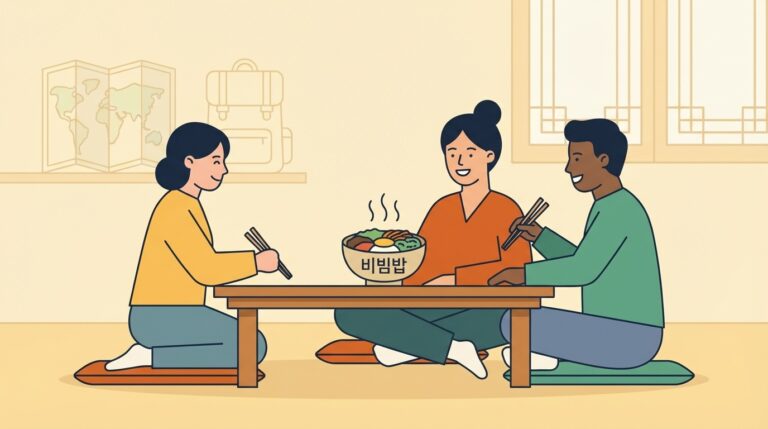
Phase 1: Empathy (Immersive Open)
Hello! This is your Daily Hangul Editor.
Picture this: You are watching a popular K-Drama or a Korean variety show. The main characters hop in a car and drive three hours from Seoul just to eat a single bowl of Bibimbap in Jeonju or Dwaeji Gukbap (pork soup) in Busan. They finally arrive, only to stand in line for another hour. You might be thinking, “Is it really worth all that trouble just for a meal?”
If you ever visit Korea, you’ll quickly realize that for Koreans, food is not just fuel—it is a passionate pursuit, a regional pride, and the ultimate travel destination in itself. But when you finally make it to that famous foodie city, your map app shows twenty different restaurants all claiming to be the “Original” (원조). How do you order like a local and find the hidden gems instead of the tourist traps?
If you only know the textbook phrase “맛있어요” (It is delicious), you are missing out on 90% of the authentic foodie experience. This guide is crafted from the real questions my students ask after wandering the streets of Jeonju, Busan, and Jeju, hungry and confused. Let’s turn you into a true Korean foodie insider!
Phase 2: Core Expressions Deep Dive
1. 여기 현지인 찐 맛집 맞아요?
- Pronunciation: yeogi hyeonjiin jjin matjip majayo? [yuh-gee hyuhn-jee-een jjin maht-jeep mah-jah-yo?]
- Meaning: (Literal) Is this a true local taste-house? / (Real nuance) Is this a spot that actual locals love, not just a tourist trap?
- K-Culture Moment: You’ve just arrived in Busan and asked a taxi driver for a good seafood place. When he points to a tiny, unpretentious alley restaurant instead of the big shiny one on the main road, you can ask your friend this to confirm you hit the jackpot.
- Editor’s Insight: “찐” (jjin) is a super common slang meaning “real” or “authentic.” Combine it with “맛집” (matjip – delicious restaurant), and you get the holy grail of Korean food hunting: The True Local Spot.
- Situation Spectrum:
- Casual with friends: ✅
- Friendly local store owners or taxi drivers: ✅
- Formal business dinner: 🚫
- 🤔 Think About It: Why do Koreans distinguish so heavily between “famous restaurants” and “local authentic restaurants”? Does your home country have a similar foodie divide?
2. 이 동네 원조가 어디예요?
- Pronunciation: i dongne wonjoga eodiyeyo? [ee dong-neh won-jo-gah uh-dee-yeh-yo?]
- Meaning: (Literal) Where is the original in this neighborhood? / (Real nuance) Which restaurant here is the true founder of this regional dish?
- K-Culture Moment: You are in Sindang-dong Tteokbokki Town. Every single sign says “Grandma’s Original.” You whisper this question to a friendly convenience store clerk to find out which grandma actually started it all.
- Editor’s Insight: “원조” (wonjo) means the originator or founder. In Korea, when one restaurant invents a hit dish, ten others open next door. Knowing how to ask for the “wonjo” earns you immediate respect as a serious foodie.
- Situation Spectrum:
- Casual: ✅
- Semi-formal: ✅
- Formal: ⚠️ (Fine to use, but might sound a bit too casual depending on tone)
- 🤔 Think About It: The obsession with the “Original” (원조) highlights a deep respect for tradition in Korean culinary culture. Why do you think preserving the exact original recipe is so valued?
3. 제일 잘나가는 걸로 주세요.
- Pronunciation: jeil jallaganeun geollo juseyo. [je-eel jahl-lah-gah-neun guhl-lo joo-seh-yo.]
- Meaning: (Literal) Please give me the one that goes out the best. / (Real nuance) I’ll have your best-selling/most popular dish.
- K-Culture Moment: You sit down at a famous Jeonju Bibimbap spot. The menu is entirely in Korean and has 15 variations of Bibimbap. Instead of panicking, you smile at the auntie (이모님) and say this like a boss.
- Editor’s Insight: “잘나가다” normally means “to be successful” or “to be popular.” When applied to a menu, it means the crowd favorite. It’s the ultimate hack when you can’t read the menu!
- Situation Spectrum:
- Casual restaurants/Diners: ✅
- Semi-formal: ✅
- High-end Fine Dining: 🚫 (They usually have a set course or expect specific orders)
- 🤔 Think About It: Asking for the most popular dish shows a collective trust in the community’s taste. Do you prefer exploring the menu yourself, or do you trust the crowd’s favorite?
Phase 3: Textbook vs. Real Korean
[Situation 1: Searching for a good restaurant]
* 📖 Textbook Korean: 유명한 식당이 어디입니까? (Where is a famous restaurant?)
* 🗣️ Real Korean: 여기 웨이팅 길어요? (Is the wait long here?) / 여기 찐 맛집이에요? (Is this a real good spot?)
* 💡 Why the difference?: In modern Korea, a long line (“웨이팅”) is the most reliable indicator of a good restaurant. Young Koreans trust lines more than tourist brochures.
[Situation 2: Expressing extreme deliciousness]
* 📖 Textbook Korean: 음식이 아주 맛있습니다. (The food is very delicious.)
* 🗣️ Real Korean: 와, 미쳤다. (Wow, this is crazy.) / 완전 인생 맛집이에요! (This is totally the best restaurant of my life!)
* 💡 Why the difference?: Korean foodie culture thrives on emotional exaggeration. Calling a place your “인생 맛집” (life’s best restaurant) is the highest compliment you can give!
Bottom Note: As a B2 learner, using words like “찐 맛집” or “인생 맛집” shows you’re culturally fluent. Just avoid “미쳤다” in front of your company’s CEO!
Phase 4: Cultural Context — K-Culture Deep Dive
4-1. Non-verbal Nunchi at Famous Regional Restaurants
When you visit a famously busy regional restaurant (like a popular Dwaeji Gukbap spot in Busan), Nunchi (눈치) is everything. If there’s a long line outside, it’s an unspoken rule to eat efficiently. It’s not a place to chat for two hours after finishing your meal. Also, keep an eye out for “셀프” (Self) signs! Often, water (물) and extra side dishes (반찬) are self-service. Waiting for a waiter to bring you water when there’s a giant “물은 셀프입니다” sign is a classic rookie mistake!
4-2. The “Nopo” (노포) Culture and Foodie Travels
In recent years, K-Culture has seen a massive boom in the love for 노포 (Nopo)—which translates to old, long-established eateries. You might have seen K-Dramas where a wealthy CEO sneaks out to eat at a slightly rundown, decades-old soup kitchen in the countryside. There is a strong romanticization of places where the walls are faded, the menu is simple, and the recipe hasn’t changed in 50 years. When Koreans travel to regions like Jeonju or Jeju, they aren’t looking for shiny new restaurants; they are hunting for the oldest, most authentic Nopo to connect with the region’s history.
Phase 5: Real-Life Roleplay Scenario
Setting: Saturday afternoon, 1:00 PM. The bustling streets of Jeonju Hanok Village. The smell of sesame oil and grilled meat is in the air. You and your Korean friend, Min-su, are on a mission to eat authentic Jeonju Bibimbap.
Characters:
– YOU: An adventurous foodie who wants the real deal, not a tourist trap.
– Min-su: (28, your Korean friend) Enthusiastic, but gets hangry easily.
Dialogue:
Min-su: 와, 사람 진짜 많다. 우리 어디로 갈까?
(Wa, saram jinjja manta. Uri eodiro galkka?)
[Wow, there are so many people. Where should we go?]
YOU: 글쎄. 전주에 왔으니까 진짜 원조집을 가보고 싶은데.
(Geulsse. Jeonjue wasseunikka jinjja wonjojibeul gabogo sipeunde.)
[Hmm. Since we’re in Jeonju, I want to go to a true original place.]
Min-su: 저기 코너에 있는 집 어때? 간판에 ’50년 전통’이라고 써 있어.
(Jeogi koneoe inneun jip eottae? Ganpane ‘osip-nyeon jeontong’irago sseo isseo.)
[How about that place on the corner? The sign says ’50 years of tradition’.]
YOU: 근데 안에 사람이 하나도 없잖아. 찐 맛집 맞아?
(Geunde ane sarami hanado eopjana. Jjin matjip maja?)
[But there’s no one inside. Is it a real authentic spot?]
Min-su: 음… 그럼 저쪽 골목은 어때? 줄이 엄청 긴데?
(Eum… Geureom jeojjok golmogeun eottae? Juri eomcheong ginde?)
[Hmm… Then how about that alley? The line is super long!]
YOU: 오, 현지인들이 가는 곳인가 보다! 가서 물어보자.
(O, hyeonjiindeuri ganeun gosinga boda! Gaseo mureoboja.)
[Oh, must be where the locals go! Let’s go ask.]
(🎭 Stage Direction: You walk up to the restaurant. There is a massive crowd waiting.)
Min-su: 사장님, 여기 지금 웨이팅 얼마나 걸려요?
(Sajangnim, yeogi jigeum weiting eolmana geollyeoyo?)
[Excuse me (Boss), how long is the wait right now?]
사장님 (Owner): 지금 앞에 스무 팀 있어요. 한 시간 반은 기다리셔야 돼요.
(Jigeum ape seumu tim isseoyo. Han sigan baneun gidarisyeoya dwaeyo.)
[There are 20 teams ahead of you right now. You’ll have to wait about an hour and a half.]
Min-su: 헉… 한 시간 반? 나 배고파 죽겠는데…
(Heok… Han sigan ban? Na baegopa jukgenneunde…)
[Gasp… An hour and a half? I’m starving to death…]
🔀 Your Turn! How do you respond?
– A) “그냥 사람 없는 곳으로 가자. 배고파.”
– B) “그래도 여기까지 왔는데 기다리자! 내가 맛있는 디저트 살게!”
– C) “저기요, 저희 외국인인데 빨리 들어가면 안 되나요?”✅ Best Choice: B — Why? In Korean foodie travel culture, waiting for the “famous spot” is part of the experience. Offering to buy dessert (a classic Korean cafe follow-up) easily smooths over your friend’s “hangry” mood.
⚠️ Choice C Analysis: Absolutely never do this! Cutting the line (새치기) or expecting foreigner privilege at a restaurant is a huge cultural faux pas in Korea’s strict “first come, first served” waiting culture.
Phase 6: 10-Second Shadowing Drill
Practice this common, confident way to order when you sit down at a bustling regional eatery!
😊 “사장님~ / 여기 / 비빔밥 두 그릇 / 주세요!”
(sa-jang-nim~ / yeo-gi / bi-bim-bap du geu-reut / ju-se-yo!)
🥺 “아, / 혹시 / 많이 맵나요? / 덜 맵게 / 가능할까요?”
(a, / hok-si / ma-ni maem-na-yo? / deol maep-ge / ga-neung-hal-kka-yo?)
Note: Use a bright, polite tone on “사장님” to get their attention over the restaurant noise! Raise your hand slightly as you say it.
Phase 7: K-Culture Mini Dictionary
| Korean | Romanization | English | Cultural Context |
|---|---|---|---|
| 찐 맛집 | jjin matjip | Authentic/True great restaurant | ‘Jjin’ means real/authentic. Used to separate hyped tourist traps from places locals actually love. |
| 웨이팅 | weiting | Waiting (in line) | A Konglish term. In Korea, “웨이팅이 있다” (There is a waiting) is synonymous with a restaurant being excellent. |
| 노포 | nopo | Old eatery | Traditional restaurants that have been operating for decades. Highly respected in foodie culture. |
| 원조 | wonjo | The Original | Every regional food street has places claiming to be the “wonjo.” Finding the real one is a fun challenge! |
| 먹방 | meokbang | Mukbang | Broadcasts of eating. Seeing a “Featured on Mukbang TV” sign can either mean it’s great or a tourist trap! |
Phase 8: Traveler’s Survival Kit
Are you planning a regional food tour to Jeju, Busan, or Jeonju? These expressions will save your life (and your stomach)!
🆘 Survival Expression #1: Finding your place in line
– 🇰🇷 “예약 기계(캐치테이블) 어디 있어요?” (yeyak gigye(kaechiteibeul) eodi isseoyo?)
– 🗣️ Pronunciation: [yeh-yak gee-gyeh uh-dee ees-uh-yo?]
– 📍 Where to use: Outside any busy restaurant.
– 💡 Pro Tip: Nowadays, Koreans don’t physically stand in line. They input their phone number into a tablet (usually CatchTable app) by the door. If you don’t have a Korean number, go inside and show this phrase to the staff!🆘 Survival Expression #2: Adjusting the spice
– 🇰🇷 “맵기 조절 되나요? 덜 맵게 해주세요.” (maepgi jojeol doenayo? deol maepge haejuseyo.)
– 🗣️ Pronunciation: [maep-gee jo-jeol dwe-nah-yo? duhl maep-geh heh-joo-seh-yo.]
– 📍 Where to use: When ordering regional stews or noodles.
– 💡 Pro Tip: Korean “mild” (신라면 맵기 – Shin Ramyun level) can still be quite spicy for foreigners! Always ask just to be safe.🆘 Survival Expression #3: The Ultimate Finale
– 🇰🇷 “여기 볶음밥 하나 추가요!” (yeogi bokkeumbap hana chugayo!)
– 🗣️ Pronunciation: [yuh-gee boh-kkeum-bahp ha-na choo-ga-yo!]
– 📍 Where to use: At BBQ, Dakgalbi, or hotpot restaurants.
– 💡 Pro Tip: In Korea, “K-Dessert” is not cake… it’s frying rice in the leftover meat/stew grease! Never skip the Bokkeumbap.
📌 Editor’s Travel Note:
– Map Apps: Do NOT rely on Google Maps for local restaurants in Korea! Use Naver Map or KakaoMap. They have actual local reviews and menus.
– Dining Solo (혼밥): Many famous regional restaurants (like BBQ or large stews) require a minimum 2-person order (2인분 이상). If you are traveling alone, ask: “1인분도 되나요?” (Can I order for one?).
Phase 9: Critical Thinking Corner — “One Step Deeper”
Food & Identity: Why Do Koreans Travel Just to Eat?
If you live in a massive country, traveling three hours just to eat a bowl of soup might sound absurd. But in Korea, regional food is deeply tied to local identity. Koreans believe that the unique climate, soil, and even the water of a specific region completely change the taste of ingredients. Therefore, eating Jeonju Bibimbap in Seoul is never considered the “real” experience. It’s not just about the recipe; it’s about consuming the culture, the atmosphere, and the history of that specific region. Sharing this authentic experience with friends or family over a weekend trip is a core pillar of modern Korean community bonding.
🧠 Think Deeper: Food is a powerful anchor for cultural identity. By insisting on traveling to the “source” of the dish, Koreans preserve regional diversity in a rapidly modernizing country.
💬 Your Turn: Would you travel 3 hours on a train just to eat one specific local dish? What is the ultimate “regional specialty” in your country?
Phase 10: FAQ & Avoiding Misunderstandings
Q: Can I ask the restaurant for more side dishes (Banchan)? Is there an extra charge?
Yes, absolutely! Unlike many Western countries, Banchan in Korea are entirely free to refill. Just politely say, “사장님, 여기 반찬 좀 더 주세요” (Please give us some more side dishes).
Q: I saw an older waiter/waitress. Should I call them ‘아줌마’ (Ajumma) or ‘아저씨’ (Ajeossi)?
Please, no! While you might hear this in older dramas, calling a server “Ajumma” can sound rude or condescending nowadays. Stick to “사장님” (Boss/Owner—used for anyone working there as a sign of respect) or “이모님” (Auntie—if it’s a casual, older establishment).
❌ Common Mistake #1: Leaving a tip because the service was excellent.
✅ Do this instead: Korea has a strict NO TIPPING culture. Leaving cash on the table will confuse the staff, and they might even chase you down the street thinking you forgot your change! A simple, warm “잘 먹었습니다!” (I ate well!) as you leave is the best tip you can give.
Phase 11: Summary & Action Items
One-Liner Summary: To master the Korean foodie tour, look beyond the “famous” signs and ask for the Jjin Matjip (찐 맛집) and the Wonjo (원조) like a true local.
Action Mission 3 Steps:
– 🥉 Bronze (Solo): Look at a menu of a Korean restaurant online and practice saying “제일 잘나가는 걸로 주세요” out loud.
– 🥈 Silver (Online): Find a YouTube Mukbang or K-Travel vlog about Jeonju or Busan. Comment in Korean: “여기가 그 유명한 찐 맛집인가요?”
– 🥇 Gold (Real Life): Next time you visit a Korean restaurant, ask the staff “여기 시그니처 메뉴가 뭐예요?” or “제일 잘나가는 메뉴 추천해 주세요!”
🎬 K-Culture Mission: Open Naver Map (or KakaoMap), search around “Jeonju Hanok Village” (전주 한옥마을), and look for the word “원조” in the restaurant names. How many can you spot?
Got a funny foodie story or a burning question about ordering in Korea? Leave a comment below! Let’s chat! 👇
Phase 12: Quiz — Interactive Challenge
Q1. You are in Busan, and you want to ask a local taxi driver for a truly authentic, local-loved pork soup restaurant. What is the most natural B2-level phrase?
1) 인터넷에서 가장 유명한 식당이 어디입니까?
2) 기사님, 현지인들이 가는 찐 맛집 추천해 주실 수 있나요?
3) 식당이 아주 맛있어요.
Q2. (True or False) If you go to a famous regional restaurant in Korea and the service is amazing, you should leave a 10% tip on the table.
Q3. Fill in the blank! You want the most popular item on the menu:
“사장님, 여기 제일 _________ 걸로 주세요!”
(Hint: ‘The one that goes out the best’)
🚨 Click here for the answers!
A1: 2) “기사님, 현지인들이 가는 찐 맛집 추천해 주실 수 있나요?” (Asking for a ‘Jjin Matjip’ shows you want the authentic local experience, not the tourist trap!)
A2: FALSE. Tipping is not part of Korean culture and will cause confusion. Just say “감사합니다, 잘 먹었습니다!”
A3: 잘나가는 (jallaganeun).
Frequently Asked Questions (FAQ)
Q: What does "여기 현지인 찐 맛집 맞아요?" mean in Korean and how do you pronounce it?
A: In Korean, "여기 현지인 찐 맛집 맞아요?" is pronounced [yeogi hyeonjiin jjin matjip majayo? [yuh-gee hyuhn-jee-een jjin maht-jeep mah-jah-yo?] and means: (Literal) Is this a true local taste-house? / (Real nuance) Is this a spot that actual locals love, not just a tourist trap?
Q: What does "이 동네 원조가 어디예요?" mean in Korean and how do you pronounce it?
A: In Korean, "이 동네 원조가 어디예요?" is pronounced [i dongne wonjoga eodiyeyo? [ee dong-neh won-jo-gah uh-dee-yeh-yo?] and means: (Literal) Where is the original in this neighborhood? / (Real nuance) Which restaurant here is the true founder of this regional dish?
Q: What does "제일 잘나가는 걸로 주세요." mean in Korean and how do you pronounce it?
A: In Korean, "제일 잘나가는 걸로 주세요." is pronounced [jeil jallaganeun geollo juseyo. [je-eel jahl-lah-gah-neun guhl-lo joo-seh-yo.] and means: (Literal) Please give me the one that goes out the best. / (Real nuance) I'll have your best-selling/most popular dish.







