

Hello! I’m the Lead Editor at Daily Hangul.
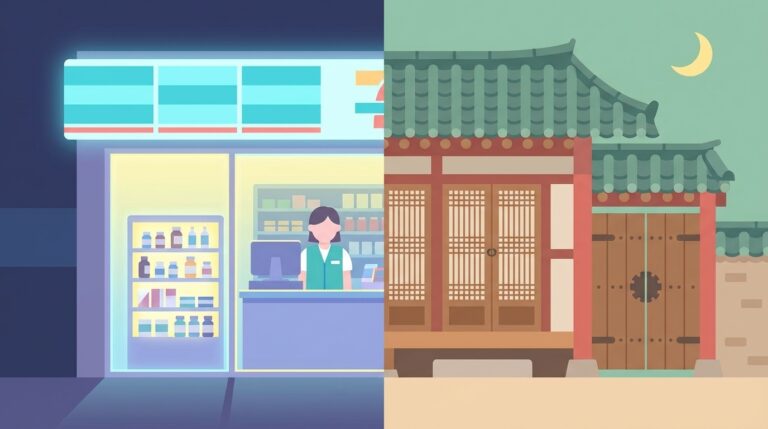
Imagine this: You’re watching a K-Drama. The female lead suddenly gets a terrible fever at 2 AM. The panicked male lead sprints through the rainy streets, bursts through the doors of a brightly lit GS25, and grabs a box of medicine. Romantic, right?
But if you’re an advanced Korean learner living in Seoul, you might watch that scene and think, “Wait, why did he only buy Tylenol? Why couldn’t he get anything stronger for that fever?”
Welcome to the intersection of K-Culture, everyday convenience, and complex societal debates. As a C2 learner, you already know how to buy a bottle of water. Today, we’re diving into a hot-button issue you’ll hear discussed over late-night Soju or in office breakrooms: The debate over expanding the sale of over-the-counter (OTC) medicines in convenience stores, and the fierce pushback from the Korean Pharmaceutical Association.
Knowing how to navigate this topic won’t just help you cure a midnight stomachache—it will prove to your Korean friends that your cultural fluency is as sharp as your vocabulary. Let’s dive in! 🏪💊
Phase 2: Core Expressions Deep Dive
To debate like a local, you need the vocabulary of a news anchor but the delivery of a friend at a cafe. Here are the core phrases.
1. 안전상비의약품 (anjeonsangbieuiyakpum)
- Pronunciation: [an-jeon-sang-bi-eui-yak-pum]
- Meaning: Safe household medicine / Over-the-counter (OTC) medicine.
- K-Culture Moment: You’ll see this exact phrase on a small, brightly lit shelf near the cash register of any CU, GS25, or 7-Eleven. It’s the official legal term for the 13 specific medicines allowed to be sold outside pharmacies.
- Editor’s Insight: This word is a mouthful! In casual conversation, most people just say “편의점 약” (pyeonuijeom yak – convenience store medicine), but if you use “상비약” (sangbiyak – household medicine), you instantly sound highly educated.
- Situation Spectrum:
- Casual with friends: ⚠️ (A bit stiff, use 편의점 약 instead)
- News/Debate (Semi-formal): ✅
- Formal written/Business: ✅
- 🤔 Think About It: Why does the Korean language use such long, descriptive Hanja (Sino-Korean) words for legal/medical terms? How does this elevate the perceived “danger” or “seriousness” of the medication?
2. 오남용 우려 (onamyong uryeo)
- Pronunciation: [o-nam-yong / u-ryeo]
- Meaning: Concerns about misuse and abuse.
- K-Culture Moment: This is the primary weapon of the Korean Pharmaceutical Association (대한약사회) in their press releases. If you read a Naver News article about this topic, this phrase will be in the headline.
- Editor’s Insight: ‘오용’ (misuse) and ‘남용’ (abuse) are often combined. When debating, using the word ‘우려’ (concern) instead of ‘걱정’ (worry) instantly bumps your Korean level from B1 to C2.
- Situation Spectrum:
- Casual with friends: ⚠️ (Sounds like you’re reading a textbook)
- Semi-formal debate: ✅
- Formal/News: ✅
- 🤔 Think About It: Does your home country prioritize the accessibility of medicine, or the control of medicine to prevent misuse? How does this reflect the government’s trust in the public?
3. 밥그릇 싸움 (bapgeureut ssaum)
- Pronunciation: [bap-geu-reut / ssa-um]
- Meaning: (Literal) Fighting over a rice bowl. (Real nuance) Turf war / Protecting one’s livelihood and vested interests.
- K-Culture Moment: Picture a group of salarymen having Hoesik (after-work drinks). They are complaining about how pharmacies close too early on weekends, and the government won’t let convenience stores sell more medicine. Someone inevitably slams their Soju glass down and mutters this phrase.
- Editor’s Insight: This is the ultimate “insider” term. The public often views the pharmacists’ opposition not just as a safety concern, but as a desire to maintain their monopoly on drug sales.
- Situation Spectrum:
- Casual with friends: ✅ (Perfect!)
- Semi-formal/Office colleagues: ✅
- Formal/To a Pharmacist: 🚫 (Highly offensive to the target!)
- 🤔 Think About It: Rice (밥) is life in Korea. What does the idiom “fighting over a rice bowl” tell you about the historical importance of job security in Korean society?
Phase 3: Textbook vs. Real Korean
Let’s see how these concepts shift from the classroom to the streets of Hongdae.
[Discussing the lack of variety in convenience store meds]
* 📖 Textbook Korean: 편의점에서 파는 약의 종류가 너무 적습니다. (There are too few types of medicine sold at convenience stores.)
* 🗣️ Real Korean: 편의점 상비약 품목 좀 팍팍 늘렸으면 좋겠는데. (I really wish they’d massively expand the list of convenience store meds.)
* 💡 Why the difference?: Using “품목 확대” (expansion of items) or “늘리다” (to increase) paired with the emphasizing sound word “팍팍” (generously/vigorously) sounds incredibly native and expressive.
[Explaining why the rules haven’t changed]
* 📖 Textbook Korean: 약사들이 반대하기 때문입니다. (Because pharmacists oppose it.)
* 🗣️ Real Korean: 약사회 반발이 장난 아니잖아요. 결국 밥그릇 싸움이죠 뭐. (The Pharmacists’ Association’s pushback is no joke. In the end, it’s just a turf war.)
* 💡 Why the difference?: Advanced speakers don’t just state facts; they state the socio-political context using idioms (밥그릇 싸움) and colloquial exaggerations (장난 아니다).
Bottom Note: For C2 learners, the goal is to mix high-level vocabulary (반발, 품목) with colloquial grammar (장난 아니잖아요, ~죠 뭐) to sound effortlessly fluent.
Phase 4: Cultural Context — K-Culture Deep Dive
4-1. Non-verbal Nuances
When discussing sensitive societal issues like strikes or union pushbacks (like the Pharmacists’ Association), Koreans employ a specific type of Nunchi (눈치). You don’t usually declare “The pharmacists are greedy!” loudly in a crowded cafe. You lean in slightly, maybe lower your voice half a decibel, and say, “솔직히… 밥그릇 싸움 아니에요?” (Honestly… isn’t it a turf war?). It’s a shared, unspoken agreement that you are criticizing a powerful group.
4-2. K-Culture Connection: The “Ppalli-Ppalli” Paradox
South Korea is the global capital of convenience. You can get a hot Americano delivered to your door in 15 minutes, and convenience stores are open 24/7/365. Yet, if you have a terrible migraine on a Sunday afternoon, you might find yourself wandering the streets looking for a “휴일지킴이약국” (Holiday open pharmacy) because the local GS25 is only legally allowed to carry one specific brand of painkiller, and they happen to be sold out.
This creates a fascinating friction. The Korean desire for absolute convenience (빨리빨리 – hurry up) directly collides with the strict regulations of medical expertise. It’s a paradox that makes Korean society so dynamic to study.
Phase 5: Real-Life Roleplay Scenario
Let’s put you in the driver’s seat.
Setting: It’s Sunday morning, 10 AM. You and your Korean coworker, Minsoo, are at a trendy brunch cafe in Seongsu-dong. You both had a bit too much Somaek (Soju + Beer) last night. You have a massive headache and an upset stomach, but the pharmacy next door is closed.
Characters:
– YOU (The Reader): An expat working in Seoul, fluent in Korean but dealing with a killer hangover.
– Minsoo (32): Your Korean coworker. Friendly, opinionated, and loves talking about current events.
Dialogue:
YOU: 아, 머리 깨질 것 같아요. 어제 너무 달렸나 봐요. 🤕
(A, meori kkaejil geot gatayo. Eoje neomu dallyeonna bwayo.)
[Ah, my head feels like it’s going to split. Guess we went too hard yesterday.]
(🎭 Stage Direction: You massage your temples while looking out the window at the closed pharmacy)
Minsoo: 내 말이. 속도 쓰려 죽겠어. 옆에 약국 문 닫았지?
(Nae mari. Sokdo sseuryeo jukgesseo. Yeope yakguk mun dadatji?)
[Tell me about it. My stomach is burning. The pharmacy next door is closed, right?]
YOU: 네, 일요일이라 그런가 봐요. 방금 편의점 갔다 왔는데, 제가 찾는 위장약은 안 팔더라고요.
(Ne, ilyoirira geureonga bwayo. Banggeum pyeonuijeom gatda wanneunde, jega channeun wijangyageun an paldeoragoyo.)
[Yeah, guess so since it’s Sunday. I just went to the convenience store, but they don’t sell the stomach medicine I’m looking for.]
Minsoo: 그치? 편의점 상비약 품목 좀 팍팍 늘려주면 좋은데. 진짜 너무 불편해.
(Geuchi? Pyeonuijeom sangbiyak pummok jom pakpak neullyeojumyeon joeunde. Jinjja neomu bulpyeonhae.)
[Right? It’d be great if they massively expanded the convenience store medicine items. It’s really so inconvenient.]
YOU: 진짜요. 타이레놀이랑 까스활명수 말고는 살 게 별로 없어요.
(Jinjja-yo. Tairenorirang kaseuhwalmyeongsu malgoneun sal ge byeollo eopseoyo.)
[Seriously. Other than Tylenol and Gas Whalmyungsu (digestive drink), there’s barely anything to buy.]
Minsoo: 정부에서는 품목 확대하려고 하는데, 약사회 반발이 장난 아니잖아. 오남용 우려된다면서.
(Jeongbueseoneun pummok hwakdaeharyeogo haneunde, yaksahoe banbari jangnan anijana. Onamyong uryeodoendamyeonseo.)
[The government is trying to expand the items, but the pharmacists’ association’s pushback is no joke. Claiming they’re concerned about misuse.]
🔀 Your Turn! How do you respond to show your C2 fluency?
– A) “약사들이 나빠요!” (The pharmacists are bad!)
– B) “오남용 우려도 이해는 가지만, 솔직히 밥그릇 싸움 같기도 해요.”
– C) “저는 병원에 갈게요.”✅ Best Choice: B — “I understand the concern about misuse, but honestly, it feels like a turf war too.” This perfectly balances empathy (understanding the safety issue) with sharp societal observation using the idiom “밥그릇 싸움”.
⚠️ Choice A Analysis: Too simple, sounds like a child’s complaint. Not suitable for C2.
⚠️ Choice C Analysis: Grammatically perfect, but kills the conversation completely.
Minsoo: (Slapping the table) 내 말이 그 말이야! 솔직히 주말에 아프면 어떡하라고?
(Nae mari geu mariya! Soljikhi jumare apeumyeon eotteokharago?)
[That’s exactly what I’m saying! Honestly, what are we supposed to do if we get sick on the weekend?]
(🎭 Stage Direction: Minsoo sips his iced americano aggressively)
YOU: 맞아요. 접근성이냐, 전문성이냐… 참 어려운 문제긴 하네요. 일단 아이스 아메리카노로 해장이나 하죠.
(Majayo. Jeopgeunseonginya, jeonmunseonginya… cham eoryeoun munjegin haneyo. Ildan aiseu amerikano-ro haejangina hajyo.)
[You’re right. Accessibility vs. Expertise… It really is a difficult problem. For now, let’s just cure our hangover with iced americanos.]
💡 Bonus K-Culture Scenario: At the Convenience Store Counter
(You finally find Tylenol at a GS25, but you want to buy 3 boxes for your family. You place them on the counter.)
Part-timer: 손님, 상비약은 규정상 한 번에 한 통씩만 구매 가능하세요.
[Customer, by regulation, household medicines can only be purchased one box at a time.]
YOU: 아, 오남용 방지법 때문이죠? 몰랐네요. 한 통만 계산해 주세요.
[Ah, because of the drug misuse prevention law, right? I didn’t know. Just ring up one box, please.]
Pro-tip: Yes, it is literally illegal for the cashier to scan more than one box of the same medicine in a single transaction in Korea!
Phase 6: 10-Second Shadowing Drill
Practice your flow, intonation, and attitude! Repeat this until you sound like a disgruntled Seoulite on a Sunday morning.
😤 솔직히 / 편의점 약 / 품목 좀 / 늘려야 되는 거 아니에요?
(soljikhi / pyeonuijeom yak / pummok jom / neullyeoya doeneun geo anieyo?)
[Honestly, shouldn’t they expand the list of convenience store medicines?]
🤔 오남용 걱정도 / 이해는 가는데, / 결국 / 밥그릇 싸움 / 같기도 하고요.
(onamyong geokjeongdo / ihaeneun ganeunde, / gyeolguk / bapgeureut ssaum / gatgido hagoyo.)
[I understand the worry about misuse, but ultimately, it kind of feels like a turf war.]
Phase 7: K-Culture Mini Dictionary
Here are some keywords to boost your K-Society vocabulary.
| Korean | Romanization | English | Context |
|---|---|---|---|
| 안전상비의약품 | anjeonsangbieuiyakpum | Safe OTC medicine | The 13 items legally sold in convenience stores (painkillers, cold meds, digestives, patches). |
| 휴일지킴이약국 | hyuiljikimiyakguk | Holiday open pharmacy | Pharmacies designated to stay open on weekends and national holidays. |
| 해장 | haejang | Hangover cure | The cultural practice of relieving hangovers, often with spicy soup or, among younger generations, iced coffee. |
| 밥그릇 싸움 | bapgeureut ssaum | Turf war / Vested interests | Used when professional groups (like doctors, taxi drivers, or pharmacists) strike or protest to protect their monopolies. |
Phase 8: Traveler’s Survival Kit
Even if you aren’t debating politics, getting sick in Korea is a reality. Here is your ultimate survival kit for navigating late-night sickness.
🆘 Survival Phrases for Late-Night Sickness
– 🇰🇷 “두통약 / 소화제 / 감기약 있어요?” (dutongyak / sohwaje / gamgiyak isseoyo?)
– 🗣️ Meaning: Do you have headache pills / digestives / cold medicine?
– 📍 Where to use: Convenience stores.
– 💡 Pro Tip: Don’t ask the convenience store worker for medical advice (e.g., “What should I take for a fever?”). Legally, they are not allowed to recommend medicine. You must pick it yourself.📌 Editor’s Travel Note
– Finding an open pharmacy: Use the 카카오맵 (KakaoMap) app and search “심야약국” (Late-night pharmacy) or “휴일지킴이약국”.
– Purchase Limits: As mentioned, you can only buy ONE box of a specific medication per transaction at a convenience store to prevent misuse.
– Prescriptions: You CANNOT buy antibiotics (항생제) over the counter anywhere in Korea. You must see a doctor and get a prescription (처방전).
Phase 9: Critical Thinking Corner — “One Step Deeper”
🧠 Think Deeper: Language & Power (Expertise vs. Convenience)
The debate over convenience store medicine in Korea is a fascinating study of Language & Power. Notice the terminology used by the opposing sides. The Pharmacists’ Association uses heavy, authoritative Sino-Korean words: 오남용 (Misuse), 부작용 (Side effects), 국민 건강권 (Citizens’ right to health). These words project expertise and gatekeep the authority of medicine.
On the other hand, the general public and convenience store lobbyists use words related to modern consumerism: 편의성 (Convenience), 접근성 (Accessibility), 소비자 선택권 (Consumer’s right to choose). In Korea, where speed and efficiency (Ppalli-ppalli) are almost religious values, the resistance of traditional “expert” groups against consumer convenience is one of the most defining social conflicts of the 21st century.
💬 Your Turn: In your home country, how is the balance between medical safety and consumer convenience handled? Can you buy painkillers at a gas station? Share in the comments!
Phase 10: FAQ & Common Mistakes
Q: If I’m talking to an older Korean person, can I say “그거 밥그릇 싸움 아니에요?”
A: Be careful (Maybe). If the older person is your close friend or a friendly coworker, yes. But if they are a pharmacist, a doctor, or someone with conservative views on professional authority, it can sound aggressive or disrespectful. Stick to “전문성과 편의성 사이의 갈등 같네요” (It seems like a conflict between expertise and convenience) for a safer, formal approach.
Q: Can I use a delivery app (Baemin/Yogiyo) to order medicine?
A: No. In South Korea, delivering medicine is currently illegal for the same reasons pharmacists oppose convenience store expansions: safety and the prevention of drug misuse.
❌ Common Mistake: Trying to buy multiple boxes of Tylenol at a GS25 to stock up before a flight.
✅ Do this instead: Go to a real pharmacy (약국) during the day. Pharmacists can sell you multiple boxes, and the prices at pharmacies are actually slightly cheaper than at convenience stores!
Phase 11: Summary & Action Items
- One-Liner Summary: The battle over convenience store medicine in Korea is a perfect example of the clash between consumer convenience (접근성) and professional gatekeeping (밥그릇 싸움).
-
Action Mission 3 Steps:
- 🥉 Bronze (Solo): Read the 10-second shadowing drill aloud three times, focusing on the exasperated sigh before “솔직히” (Honestly).
- 🥈 Silver (Online): Go to Naver News, search “안전상비의약품”, and read the top headlines. Try to spot the words 오남용 or 반발.
- 🥇 Gold (Real-world): Next time you are at a Korean convenience store, locate the medicine shelf. Take note of the exact items they sell—and impress your Korean friend by bringing up the expansion debate.
- K-Culture Mission: Watch a K-Drama hospital or slice-of-life show (like Hospital Playlist). Notice how much respect and authority is given to medical professionals. Contrast that with how Koreans treat service workers. It explains why the Pharmacists’ Association holds so much power!
Phase 12: Quiz — Interactive Challenge
1. Situational Judgment: You are having dinner with your Korean boss. They mention that they had a hard time finding headache pills on a Sunday. Which response shows you are a C2 Korean master with great Nunchi?
– A) 약사들이 돈 욕심이 많아서 그래요!
– B) 아, 편의점 상비약 품목이 적어서 고생하셨겠네요. 약사회 반대가 여전한가 봐요.
– C) 타이레놀은 하루에 8알 이상 먹으면 안 됩니다.
Answer: B. It’s empathetic to your boss, perfectly uses the C2 vocabulary (상비약 품목, 약사회 반대), and remains politely observational.
2. True or False – K-Culture Edition: “You can use the Baemin app to order Tylenol from a convenience store at 3 AM in Korea.”
Answer: False. Delivery of medicine is illegal in Korea.
3. Fill in the blank:
“솔직히 이건 국민 건강을 위해서라기보다, 약사들의 ( _____ ) 싸움 같아요.”
Answer: 밥그릇 (Rice bowl/Turf war).
Frequently Asked Questions (FAQ)
Q: What does "안전상비의약품 (anjeonsangbieuiyakpum)" mean in Korean and how do you pronounce it?
A: In Korean, "안전상비의약품 (anjeonsangbieuiyakpum)" is pronounced [an-jeon-sang-bi-eui-yak-pum] and means: Safe household medicine / Over-the-counter (OTC) medicine.
Q: What does "오남용 우려 (onamyong uryeo)" mean in Korean and how do you pronounce it?
A: In Korean, "오남용 우려 (onamyong uryeo)" is pronounced [o-nam-yong / u-ryeo] and means: Concerns about misuse and abuse.
Q: What does "밥그릇 싸움 (bapgeureut ssaum)" mean in Korean and how do you pronounce it?
A: In Korean, "밥그릇 싸움 (bapgeureut ssaum)" is pronounced [bap-geu-reut / ssa-um] and means: (Literal) Fighting over a rice bowl. (Real nuance) Turf war / Protecting one's livelihood and vested interests.







