

Phase 1: Empathy (The K-Culture Cold Open)
Hello! It’s your Daily Hangul Editor.
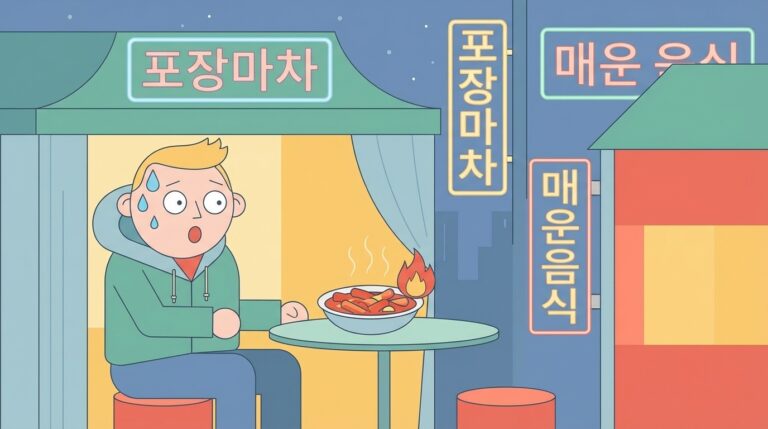
Picture this K-Drama scene: The main character is sitting alone at a pojangmacha (street food tent) on a rainy night. They just watched the love of their life walk away. They take a shot of soju, sigh deeply, and look up at the rain. The English subtitle simply says: “I regret it.”
But if you listen closely, they didn’t say the dictionary word for regret (후회하다). They muttered a specific, melancholic phrase that perfectly captures the agonizing feeling of “What if…?”
When you live or travel in Korea, you’ll face plenty of these moments. Maybe you ordered the Level 5 spicy Buldak because you felt brave, or maybe you hesitated for one second too long during a K-Pop concert ticketing war and got waitlisted.
In textbooks, they teach you “I regret” (저는 후회합니다). But trust me, as someone who has taught Korean for years, if you say that at a restaurant, you’ll sound like a robot giving a formal apology! Today, we’re going to learn how to express your past experiences and biggest regrets like a true local.
Phase 2: Core Expressions Deep Dive
1. ~할 걸 그랬어요 (I should have done…)
- Pronunciation: [~hal kkeol geu-rae-sseo-yo] / Think of the ‘hal’ in Halloween, a slight gulping ‘kkeol’, and ‘gu-rae-so-yo’.
- Meaning: Literal = “I guess I should have done that.” / Real = “I really should have… (and I’m sad I didn’t).”
- K-Culture Moment: You are standing outside a K-Pop concert venue, listening to the muffled music because you didn’t buy tickets. You look at your friend and sigh, “아, 그냥 티켓 살 걸 그랬어요…” (Ah, I should have just bought the tickets…)
- Editor’s Insight: This phrase is the ultimate “wistful” expression. The trailing “그랬어요” softens the blow. You aren’t furiously angry; you are just genuinely bummed out about a missed opportunity.
- Situation Spectrum:
- 친구 사이 (Casual): ✅ (Just say “~할 걸!”)
- 직장 동료 (Semi-formal): ⚠️ (Use full “~할 걸 그랬어요”)
- 직장 상사·어른 (Formal): 🚫 (Sounds a bit like complaining/whining)
- 🤔 Think About It: Why do Koreans use a guessing/assuming grammar form (~ㄹ 걸) to express regret? Does framing it as a “guess” about the past soften the harsh reality of the mistake?
2. ~지 말 걸 그랬어요 (I shouldn’t have done…)
- Pronunciation: [~ji mal kkeol geu-rae-sseo-yo]
- Meaning: Literal = “I should have stopped doing that.” / Real = “I really shouldn’t have done that.”
- K-Culture Moment: You decided to show off your Maep-bu-sim (Spicy Pride) and ordered the spiciest Tteokbokki. Five minutes later, you are sweating through your shirt, gulping down milk. “이거 시키지 말 걸 그랬어요…” (I shouldn’t have ordered this…)
- Editor’s Insight: Perfect for moments of instant, usually physical or emotional, regret. It’s often preceded by a sharp inhale of breath or a long sigh.
- Situation Spectrum:
- 친구 사이 (Casual): ✅ (~지 말 걸!)
- 직장 동료 (Semi-formal): ⚠️
- 직장 상사·어른 (Formal): 🚫
- 🤔 Think About It: In your culture, do people openly admit their small, silly mistakes to friends, or do they try to hide them to save face?
Phase 3: Textbook vs. Real Korean
Let’s look at how “Real Korean” changes based on the situation.
[Situation 1: Ordering Food That Is Way Too Spicy]
* 📖 Textbook Korean: 저는 매운 음식을 주문한 것을 후회합니다. (I regret ordering spicy food.)
* 🗣️ Real Korean: 아… 매운 거 시키지 말 걸! (Ah… shouldn’t have ordered the spicy one!)
* 💡 Why it’s different: “후회하다” (to regret) is a heavy, formal Sino-Korean word. Using “~말 걸” makes it a relatable, everyday frustration rather than a lifelong sin.
[Situation 2: Missing the Last Subway]
* 📖 Textbook Korean: 일찍 출발하지 않아서 아쉽습니다. (It is a pity that I did not depart early.)
* 🗣️ Real Korean: 아, 그냥 택시 탈 걸 그랬나? / 일찍 나올 걸! (Ah, should I have just taken a taxi? / Should’ve left earlier!)
* 💡 Why it’s different: Koreans hate wasting time (the famous Pali-Pali culture). Dropping the formal ending and trailing off captures the panic of trying to figure out a Plan B.
Bottom Note: At the B1 level, stop using “후회해요” for small daily mistakes! Swap it out for “~할 걸 그랬어요” and watch your Korean friends’ eyes light up in surprise at your fluency.
Phase 4: Cultural Context — K-Culture Deep Dive
4-1. Non-Verbal Cues (The Art of the Sigh)
When expressing regret in Korea, language is only half the battle. You need the body language. Koreans often pair “~할 걸 그랬어요” with a deep, vocalized sigh (하아…) or lightly scratching the back of their neck. It shows vulnerability. In Korean Nunchi culture, showing this slight vulnerability (like admitting you ordered the wrong food) actually makes people like you more. It breaks the ice!
4-2. The “Spicy Pride” & Food Regrets
In Korea, food is deeply tied to emotions and regrets. There is even a slang word called 맵부심 (Maep-bu-sim: Pride in one’s ability to eat spicy food). Many foreigners fall into the trap of trying to impress their Korean friends by ordering Level 5 heat.
When the fire hits your tongue, saying “이거 시키지 말 걸 그랬어요…” with a desperate laugh is a fantastic survival tactic. It instantly turns an awkward moment into a funny memory. The restaurant owner (이모님) might even laugh and bring you complimentary steamed egg (계란찜) to cool your mouth!
Phase 5: Real-Life Roleplay Scenario
Let’s step into a real situation. You are the main character now.
Setting: Saturday night, 8 PM in Hongdae. You are at a famous Jokbal (Pig’s trotters) restaurant with your Korean friend.
Characters:
– YOU: A B1 Korean learner, loves K-Food but slightly overestimates your spice tolerance.
– Minho: (28, your Korean friend, born and raised in Seoul, loves spicy food).
Minho: 여기 불족발이 진짜 유명해. 맵기 제일 매운맛으로 시킬까? 🔥
(Yeogi buljokbari jinjja yumyeonghae. Maepgi jeil maeunmaseuro sikilkka?)
[This place is really famous for spicy Jokbal. Should we order the spiciest level?]
YOU: 네! 저 매운 거 완전 잘 먹어요. 문제없어요.
(Ne! Jeo maeun geo wanjeon jal meogeoyo. Munjeeopseoyo.)
[Yes! I am totally good at eating spicy food. No problem.]
(🎭 Stage Direction: The red, intimidating food arrives. You take one confident bite. Your soul immediately leaves your body. Your eyes water.)
Minho: 어? 너 괜찮아? 땀 엄청 나는데… 물 줄까?
(Eo? Neo gwaenchana? Ttam eomcheong naneunde… mul julkka?)
[Uh? Are you okay? You’re sweating a lot… should I give you water?]
🔀 Your Turn! How do you answer?
– A) 네, 저는 이 선택을 매우 후회합니다. (Yes, I deeply regret this choice.)
– B) 아… 1단계로 시킬 걸 그랬어요…
– C) 이거 진짜 맛없어요! (This tastes really bad!)
✅ Best Choice: B — “Ah… I should have ordered level 1…” It’s natural, cute, and admits your mistake perfectly.
⚠️ Choice A Analysis: You sound like an AI from a sci-fi movie apologizing for a system error.
⚠️ Choice C Analysis: Be careful! It’s not bad (맛없다), it’s spicy (맵다). Saying it tastes bad might offend the chef!
Bonus K-Culture Scenario: The Midnight “Ibul-kik” 🛏️
(You are tossing and turning in bed at 2 AM, remembering you waved at someone who wasn’t waving at you.)
YOU: 아악! 미쳤어! 내가 왜 그랬지? (Aak! Micheosseo! Naega wae geuraetji? – Ah! I’m crazy! Why did I do that?)
YOU: 그냥 가만히 있을 걸… (Geunyang gamanhi isseul kkeol… – I should have just stayed still…)
(🎭 You kick your blankets in frustration — this is the famous Korean “이불킥”!)
Phase 6: 10-Second Shadowing Drill
Let’s practice the intonation. Slur the words slightly like a tired K-Drama lead!
😢 아… / 안 매운 거 / 시킬 걸 그랬어요…
(A… / an mae-un geo / sikil kkeol geuraesseoyo…)
[Ah… / non-spicy thing / I should have ordered…]
Tip: Drop your pitch at the end to sound truly regretful.
Phase 7: K-Culture Mini Dictionary
| 한국어 (Korean) | Romanization | English Meaning | Context |
|---|---|---|---|
| 이불킥 | ibul-kik | Blanket kick | Kicking your blankets at night because you remembered an embarrassing past action. |
| 맵부심 | maep-bu-sim | Spicy pride | Having excessive pride in how much spicy food you can handle. Usually ends in regret! |
| 티켓팅 | tiket-ting | Ticketing | The fierce online battle to buy K-Pop concert tickets. Often followed by “~할 걸 그랬어요”. |
| 눈치 | nunchi | Social sense | Reading the room. Knowing when to admit a mistake playfully to ease tension. |
Phase 8: Traveler’s Survival Kit
Did you make a mistake while traveling in Seoul? Here is your survival kit for expressing regret on the go.
🆘 Survival Expressions for Travel Regrets
– 🚕 “택시 탈 걸 그랬어요.” (Taeksi tal kkeol geuraesseoyo.)
Meaning: I should have taken a taxi. (Use this when you trusted Google Maps but ended up climbing a massive hill in Itaewon).
– 🧥 “겉옷 챙길 걸 그랬어요.” (Geodot chaenggil kkeol geuraesseoyo.)
Meaning: I should have brought an outer layer. (Use this when the Korean autumn wind suddenly hits you).
– 🛍️ “거기서 살 걸 그랬어요.” (Geogiseo sal kkeol geuraesseoyo.)
Meaning: I should have bought it there. (When you see the same K-Beauty product is now sold out everywhere else).
📌 Editor’s Travel Note
– Map Apps: Never trust Google Maps walking directions in Korea; it doesn’t show the steep hills accurately! Use Naver Map or KakaoMap, or you’ll be saying “택시 탈 걸…” all day.
– Weather: Korea has crazy daily temperature gaps in Spring and Fall. Layers are your best friend.
Phase 9: Critical Thinking Corner — A Step Deeper
Media vs Reality: The Romanticization of Regret
🧠 Think Deeper:
In K-Dramas, expressing regret is almost always an aesthetic, romanticized moment. The camera pans around the handsome actor holding an umbrella, crying in the rain, whispering, “I should have held onto her…”
However, in modern Korean society, regret (후회) is often much more practical and tied to fierce competition. You will hear young Koreans saying “I should have studied that major,” “I should have bought Samsung stocks back then,” or “I should have learned English earlier.” The grammar is the same, but the weight of the regret reflects a highly competitive society where one missed timing can feel like a huge setback.💬 Your Turn: How is “regret” portrayed in your culture’s media versus real life? Is it romanticized, or is it mostly about practical mistakes? Share in the comments!
Phase 10: FAQ & Avoiding Misunderstandings
Q: Can I use “~할 걸 그랬어요” to my boss at work if I made a mistake?
A: No! While it’s polite in form (ending in 요), the nuance is personal regret or whining. If you missed a deadline, do NOT say “일찍 할 걸 그랬어요.” It sounds unprofessional. Instead, use a forward-looking apology: “죄송합니다. 다음부터는 주의하겠습니다.” (I am sorry. I will be careful from now on.)
Q: Can I use this phrase when writing a fan letter to a K-Pop idol?
A: Yes! Idols love it when fans use conversational Korean. You can write: “콘서트 못 가서 너무 아쉬워요. 무조건 갈 걸 그랬어요 ㅠㅠ” (I’m so sad I couldn’t go to the concert. I definitely should have gone.)
❌ Common Mistake Alert:
Translating “I regret” directly to “저는 후회해요” in casual conversations. Unless you are confessing a dark secret or making a dramatic movie speech, stick to “~할 걸 그랬어요”!
Phase 11: Summary & Action Items
One-Liner Summary: Ditch the robotic “저는 후회합니다” and use “~할 걸 그랬어요” to express your past regrets and “what-ifs” naturally like a native Korean!
🎯 Action Missions:
– 🥉 Bronze (Solo): Stand in front of your mirror and practice the 10-second shadowing drill with a sad, dramatic sigh.
– 🥈 Silver (Online): Go to your favorite Korean learning forum or Twitter, and post about a recent funny regret using “~지 말 걸 그랬어요” (e.g., I shouldn’t have stayed up until 3 AM watching Netflix).
– 🥇 Gold (Real World): Next time you are at a Korean restaurant and accidentally order too much food, point to your stomach and jokingly say to the waiter, “조금만 시킬 걸 그랬어요!” (I should have ordered just a little!).
🎬 K-Culture Mission: Watch one episode of any K-Drama today. I guarantee you will hear “~할 걸” at least once, usually when a character is pacing back and forth in their room, kicking their blankets!
Phase 12: Interactive Challenge — Quiz Time!
1. Situational Judgment: You went to Jeju Island in July, but you didn’t pack sunscreen. Now you look like a tomato. What should you say?
– A) 저는 선크림을 원합니다.
– B) 선크림 바를 걸 그랬어요.
– C) 선크림 바르지 말 걸 그랬어요.
2. Fill in the Blank: You missed the bus right in front of your eyes.
“아… 조금 더 일찍 뛰어나올 ( ______ ).”
3. True or False – K-Culture Edition: Koreans will judge you harshly if you admit you ordered something too spicy by saying “시키지 말 걸 그랬어요.”
– True / False
(Answers: 1: B (I should have applied sunscreen), 2: 걸 그랬어요, 3: False – They actually love it when foreigners show vulnerability and try to joke about the spicy food!)
Frequently Asked Questions (FAQ)
Q: What does "~할 걸 그랬어요 (I should have done...)" mean in Korean and how do you pronounce it?
A: In Korean, "~할 걸 그랬어요 (I should have done...)" is pronounced [~hal kkeol geu-rae-sseo-yo] and means: Literal = "I guess I should have done that." / Real = "I really should have... (and I'm sad I didn't)."
Q: What does "~지 말 걸 그랬어요 (I shouldn't have done...)" mean in Korean and how do you pronounce it?
A: In Korean, "~지 말 걸 그랬어요 (I shouldn't have done...)" is pronounced [~ji mal kkeol geu-rae-sseo-yo] and means: Literal = "I should have stopped doing that." / Real = "I really shouldn't have done that."







