

Hello! I’m the Lead Editor at Daily Hangul.
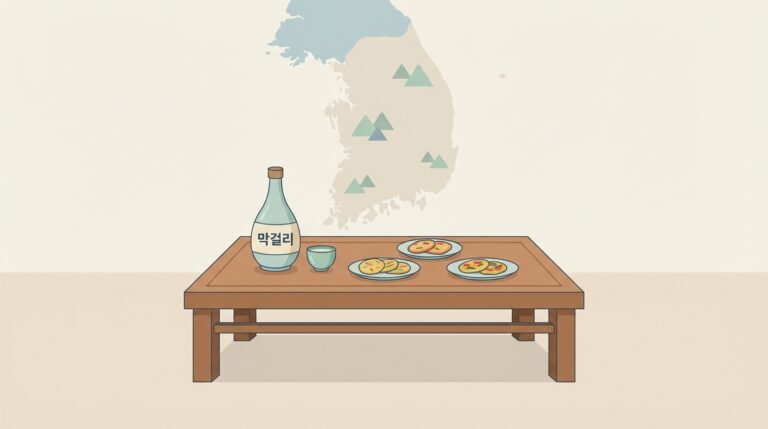
Imagine this: You’re watching a beautifully shot K-Drama. The main characters aren’t in a neon-lit Seoul club; instead, they are sitting on a wooden porch at a rural brewery, the sound of crickets in the background, sharing a beautifully frosted bottle of regional Makgeolli and a plate of local delicacies. They talk about the ‘deep flavor’ and how the food ‘pairs perfectly’ with the drink.
As an advanced Korean learner (C2), you already know how to order Soju and Samgyeopsal. But what happens when you travel to Andong, Jeonju, or Jeju, and you want to truly experience Korean Food Tourism (음식 관광)? The real magic happens when you can discuss terroir, flavor profiles, and the perfect marriage between local specialties (지역 특산물) and traditional liquor (전통주).
Today, we are going to dive deep into the sophisticated language of Korean gastronomy. This guide is built from the real experiences of our advanced students who wanted to sound less like tourists and more like seasoned local foodies. Let’s get started!
Phase 2: Deep Dive into Core Expressions
If you want to impress a brewery owner or a chef at a traditional Korean dining (한식 파인다이닝) restaurant, these are the expressions you need.
1. “이 지역 특산물로 만든 안주 추천해 주시겠어요?”
- Pronunciation: [I jiyeok teuksanmul-lo mandeun anju chucheonhae jusigesseoyo?] + [ee jee-yeok teuk-san-mool-lo man-deun ahn-joo choo-cheon-hae joo-shee-ge-sseo-yo?]
- Meaning: Could you recommend an anju (side dish/bar food) made with local specialties?
- K-Culture Moment: You walk into a hip traditional pub in Yeonnam-dong or a historic tavern in Jeonju. Instead of just asking “What’s delicious?”, you ask this. The chef’s eyes will light up. You are speaking their language—the language of terroir and regional pride.
- Editor’s Insight: Teuksanmul (특산물) refers to local specialties (like Jeju Black Pork or Boseong Green Tea). Anju (안주) is a culturally significant word; it’s food specifically meant to be consumed with alcohol. By combining these, you show profound respect for their culinary roots.
- Situation Spectrum:
- Casual with friends: ✅ (Though you’d say “여기 특산물 안주 뭐 있어?”)
- Ordering at a restaurant (Formal/Polite): ✅
- Formal business dinner: ✅
- 🤔 Think About It: Why does Korean have a specific word (anju) for food eaten with alcohol, rather than just calling it “food”? What does this say about the Korean philosophy of drinking?
2. “이 막걸리는 바디감이 묵직하고 산미가 적당하네요.”
- Pronunciation: [I makgeollineun badigami mukjikago sanmiga jeokdanghaneyo.] + [ee mak-geol-lee-neun bah-dee-gam-ee mook-jee-ka-go san-mee-ga jeok-dang-ha-ne-yo.]
- Meaning: This Makgeolli has a heavy body and just the right amount of acidity.
- K-Culture Moment: Tasting traditional liquor isn’t just taking a shot. In modern K-Culture, MZ generation Koreans love visiting local breweries (양조장). Swirling a premium, additive-free Makgeolli and noting its sanmi (acidity) or mukjikham (heaviness) makes you sound like a true connoisseur.
- Editor’s Insight: Notice the use of ~네요 (~neyo) at the end. It expresses a spontaneous realization or mild surprise upon tasting. It’s much more natural than saying “It is heavy.”
- Situation Spectrum:
- Talking to the brewer/sommelier: ✅
- Tasting with fellow foodies: ✅
- Chugging soju at a noisy BBQ joint: 🚫 (Too pretentious for this setting!)
- 🤔 Think About It: How does the adoption of wine-tasting terminology (바디감 – body) into traditional Korean liquor tasting reflect the globalization of Korea’s culinary scene?
3. “이 음식과 곁들이기 좋은 전통주 페어링을 부탁드립니다.”
- Pronunciation: [I eumsikgwa gyeotdeurigi joeun jeontongju pe-eo-ring-eul butakdeurimnida.] + [ee eum-shik-gwa gyeot-deu-ree-gee jo-eun jeon-tong-joo pe-eo-ring-eul boo-tak-deu-reem-nee-da.]
- Meaning: I’d like to request a traditional liquor pairing that goes well with this dish.
- K-Culture Moment: Fine dining in Seoul often features a “Traditional Liquor Pairing” course instead of wine. Using the verb 곁들이기 (to accompany/garnish/pair with) elevates your Korean instantly.
- Editor’s Insight: While Koreans often use the native concept of Gunghap (궁합 – marital compatibility, often used for food pairings), in high-end culinary scenes, the English loanword 페어링 (pairing) mixed with traditional terms is highly prevalent.
- Situation Spectrum:
- High-end restaurants / Breweries: ✅
- Casual street food stalls: 🚫
- 🤔 Think About It: Food “compatibility” (궁합 – Gunghap) implies that ingredients have distinct energies that either clash or harmonize. Does your culture view food pairings as scientific, or spiritual?
Phase 3: Textbook vs. Real Korean
At the C2 level, you need to bridge the gap between formal textbook phrases and the sophisticated, yet natural ways native speakers talk about gastronomy.
[Scenario 1: Asking for a Food & Drink Match]
* 📖 Textbook Korean: 이 음식과 어울리는 술은 무엇입니까? (What alcohol goes well with this food?)
* 🗣️ Real Korean: 이거랑 궁합 좋은 술로 하나 추천해 주실래요? (Could you recommend a drink that has good ‘gunghap/chemistry’ with this?)
* 💡 Why the difference?: Using Gunghap (궁합) adds a deep cultural layer. It shows you understand that Korean food and drink are meant to be soulmates, not just things consumed together.
[Scenario 2: Describing a Clean Finish]
* 📖 Textbook Korean: 이 술은 끝에 맛이 아주 좋습니다. (The taste at the end of this alcohol is very good.)
* 🗣️ Real Korean: 와, 이거 끝맛이 엄청 깔끔하네요. 목넘김도 좋고요. (Wow, the aftertaste is so clean. It goes down really smooth too.)
* 💡 Why the difference?: Mok-neom-gim (목넘김 – the sensation of swallowing) and Kkeut-mat (끝맛 – aftertaste) are the absolute standard vocabulary for Korean drinkers evaluating quality liquor.
Phase 4: Cultural Context — K-Culture Deep Dive
4-1. Non-verbal Etiquette in Liquor Tasting
When participating in a traditional liquor tasting (시음 – si-eum), the etiquette of pouring and receiving remains crucial, even in modern settings.
– Always hold your tasting cup with two hands (or place one hand lightly under your wrist/forearm) when the brewer pours for you.
– Nunchi (눈치) Check: If the brewer is explaining the origin of the regional rice used, wait until they finish speaking and make eye contact before you take your first sip.
4-2. The MZ Generation’s “Brewery Tour” Trend (양조장 투어)
In recent years, the K-Travel landscape has shifted. While older generations associated Makgeolli with cheap post-hike drinks, the MZ generation treats it like craft beer.
– K-Travel Link: Exploring regional breweries (e.g., visiting Yesan Market or artisanal breweries in Chungju) is a huge trend. You’ll hear words like 프리미엄 막걸리 (Premium Makgeolli) and 지역 상생 (Coexisting with the local region).
– Critical View: Notice how tourist spots often market these regional liquors with very trendy, Instagram-friendly packaging, creating a fascinating juxtaposition between ancient fermentation techniques and hyper-modern marketing.
Phase 5: Real-Life Roleplay Scenario
Setting: It’s Saturday afternoon in Andong, a city famous for its rich culinary heritage. You are visiting a 100-year-old traditional Soju distillery. The scent of fermenting wheat and rice fills the air. The owner, a passionate artisan in his 50s, is offering a private tasting session.
Characters:
– YOU: An advanced Korean learner, a culinary enthusiast traveling through Korea.
– Master Lee (55): The master brewer. Deeply proud of his regional roots.
Dialogue:
Master Lee: 여기까지 오시느라 고생하셨습니다. 이게 우리 안동 쌀로 빚은 45도짜리 소주입니다. 향 한 번 맡아보시죠. 🍶
(Yeogikkaji osineura gosaenghasyeotseumnida. Ige uri Andong ssallo bijeun sasibodo-jjari soju-imnida. Hyang han beon matabosijyo.)
[Translation: You’ve come a long way. This is our 45-degree Soju brewed with Andong rice. Please, take a smell of the aroma.]
YOU: 아, 정말 감사합니다. (잔을 두 손으로 받으며 향을 맡는다) 와, 향이 정말 깊네요. 인공적인 냄새가 전혀 안 나요.
(Ah, jeongmal gamsahamnida. Wa, hyangi jeongmal gimneyo. Ingongjeogin naemsaega jeonhyeo an nayo.)
[Translation: Ah, thank you so much. Wow, the aroma is so deep. There’s no artificial smell at all.]
Master Lee: (Smiling proudly) 그렇죠? 일반 희석식 소주랑은 차원이 다릅니다. 한 모금 넘겨보세요.
(Geureotjyo? Ilban huiseoksik sojurang-eun chawoni dareumnida. Han mogeum neomgyeoboseyo.)
[Translation: Right? It’s on a completely different level from regular diluted soju. Try taking a sip.]
YOU: (Tasting it) 으음… 도수가 높은데도 목넘김이 엄청 부드럽네요. 끝맛도 깔끔하고요!
(Euum… dosuga nopeundedo mongneomgimi eomcheong budeureomneyo. Kkeunmatdo kkalkkeumhagoyo!)
[Translation: Mmm… Even though the ABV is high, it goes down so smoothly. And the aftertaste is incredibly clean!]
Master Lee: 술맛을 제대로 아시네요! 우리 소주는 안주 없이 마셔도 좋지만, 지역 특산물이랑 먹으면 기가 막힙니다.
(Sulmaseul jedaero asineyo! Uri sojuneun anju eopsi masyeodo jotjiman, jiyeok teuksanmurirang meogeumyeon giga makimnida.)
[Translation: You really know your liquor! Our soju is good on its own, but it’s breathtaking when eaten with regional specialties.]
🔀 Your Turn! How do you respond?
– A) “그럼 이 소주랑 어울리는 맛있는 안주 좀 주세요.”
– B) “맞아요. 이 지역 특산물 중에 어떤 안주랑 페어링하면 제일 좋을까요? 추천 부탁드립니다.”
– C) “아, 저는 배불러서 술만 마실게요.”✅ Best Choice: B — Reason: At C2 level, choice B elevates the conversation. Using terms like “지역 특산물” (regional specialties) and “페어링” (pairing) matches the artisan’s passion and respect for the craft.
⚠️ Choice A Analysis: It’s grammatically flawless but lacks the sophisticated vocabulary of a true culinary enthusiast.
Phase 6: 10-Second Shadowing Drill
Master the intonation to sound like a K-Food connoisseur! Follow the slashes for pauses and emphasize the bolded syllables.
😲 와, / 도수가 높은데도 / 목넘김이 / 엄청~ 부드럽네요!
(wa, / dosuga nopeundedo / mongneomgimi / eomcheong~ budeureomneyo!)
[Emotion: Utterly impressed. Raise your pitch slightly on ‘엄청’.]
😊 이 지역 특산물로 만든 안주 중에 / 궁합이 좋은 걸로 / 추천해 주시겠어요?
(i jiyeok teuksanmullo mandeun anju jung-e / gunghabi joeun geollo / chucheonhae jusigesseoyo?)
[Emotion: Polite, curious, and respectful. Soften the end of the question.]
Phase 7: K-Culture Mini Dictionary (Gastronomy Edition)
| 한국어 | Romanization | English | Cultural Context |
|---|---|---|---|
| 안주 | anju | Food paired with alcohol | In Korea, drinking without eating is rare. Anju is a dedicated culinary category. |
| 반주 | banju | Alcohol consumed with a meal | Having 1-2 glasses of liquor (usually Soju or Makgeolli) during a regular meal to enhance the dining experience. |
| 궁합 | gunghap | Compatibility / Pairing | Originally a fortune-telling concept for marriage, widely used to describe the perfect synergy between food and drink (e.g., Jeon & Makgeolli). |
| 목넘김 | mongneomgim | “Throat-feel” (Smoothness) | The physical sensation of the liquid going down the throat; crucial for evaluating Korean alcohol. |
| 특산물 | teuksanmul | Regional Specialty | Crucial to food tourism. Every region in Korea fiercely protects and promotes its local produce. |
Phase 8: Traveler’s Survival Kit
If your food tourism takes you out of Seoul and into the vibrant traditional markets of the provinces, you need these phrases.
🆘 Survival Phrases for Regional Food Tourism
– 🇰🇷 “이거 혹시 시음/시식해 볼 수 있나요?” (igeo hoksi sieum/sisikae bol su innayo?)
– 🗣️ Meaning: Is it possible to taste test (drink/food) this?
– 📍 Where to use: Traditional markets (e.g., Gwangjang Market, regional 5-day markets), breweries, food expos.
– 💡 Pro Tip: Look for signs saying “시식 코너” (Tasting Corner). Koreans are incredibly generous with samples, especially for regional specialties!📌 Editor’s Travel Note: Going Local
– Apps: KakaoMap is far superior to Google Maps in rural Korea for finding local “hidden gem” restaurants (노포 – Nopo).
– Etiquette: In deeply traditional restaurants outside of major cities, you might still need to sit cross-legged on the floor (좌식). Be prepared to take off your shoes!
– Buying Specialties: If you buy traditional liquor or heavy specialties to take home, ask “택배 되나요?” (Can this be delivered?). Most regional vendors will happily courier it to your Seoul hotel for a few bucks!
Phase 9: Critical Thinking Corner — “A Step Deeper”
Food and Identity (음식과 정체성): The Terroir of Korea
🧠 Think Deeper:
Historically, Korea is a mountainous country, meaning movement between regions was extremely difficult before modern times. This geographical isolation birthed fiercely distinct regional cuisines and fermentation techniques (the true Korean terroir). Today, as Korea globalizes, there is a massive domestic push to preserve these “local flavors” (지역의 맛) through food tourism. When you ask a local for their Teuksanmul, you aren’t just ordering food; you are acknowledging their historical survival, their unique climate, and their regional pride. It is the ultimate form of cultural respect.💬 Your Turn: Does your country have a strong culture of “regional specialties”? How do locals feel when tourists make an effort to try their specific local foods rather than just the national dishes? Let me know in the comments!
Phase 10: FAQ & Avoiding Misunderstandings
- Q: Can I pour my own drink when tasting traditional liquor?
- A: Generally, Korea operates on Cheomjan (첨잔 – filling a half-empty glass, though mostly for beer) and pouring for others. Pouring your own drink is called Jajo (자조) and is traditionally a faux pas. However, at a modern tasting session (like a flight of Makgeolli), it is completely acceptable to pour for yourself. Just read the room!
- Q: Are all Korean traditional liquors called Soju or Makgeolli?
- A: No! This is a common C2-level realization. There are Cheongju (clear rice wine), Yakju (medicinal liquor), Gwasilju (fruit wines like Bokbunja), and distilled vs. diluted Soju. Using the correct category name instantly marks you as an expert.
❌ Common Mistake: Drinking premium, aged regional liquor in one shot while shouting “Geonbae!”
✅ Do This Instead: Treat premium traditional liquor (전통주) like fine wine. Sip it slowly, comment on the Mok-neom-gim (목넘김), and appreciate the pairing with the local food.
Phase 11: Summary & Action Items
One-Liner Summary: To truly experience Korean food tourism, elevate your vocabulary from “delicious” to discussing pairing (궁합/페어링), texture (목넘김), and regional pride (특산물).
Action Mission:
– 🥉 Bronze (Solo): Read the Shadowing Drill out loud 3 times, focusing on sounding incredibly impressed with the flavor.
– 🥈 Silver (Online): Find an Instagram post or YouTube video about a Korean traditional brewery. Leave a comment in Korean: “여기 특산물 안주랑 전통주 페어링이 너무 기대되네요!”
– 🥇 Gold (Real World): Visit a traditional liquor bar (전통주점) in your area or in Korea. Ask the staff: “이 지역 특산물 안주와 궁합이 좋은 술 추천해 주시겠어요?”
K-Culture Mission: Watch an episode of a Korean food travel show (like Paik’s Spirit or Korean Cold Noodle Rhapsody). Every time they talk about a regional specialty being paired with alcohol, listen closely to the descriptive words they use!
Phase 12: Interactive Challenge (Quiz)
1. Situational Judgment: You are at a famous Jeju Island restaurant. You want a local liquor that perfectly complements your Jeju Black Pork. What is the most sophisticated way to ask?
– A) 흑돼지랑 맛있는 술 주세요.
– B) 흑돼지와 곁들이기 좋은 제주 로컬 술 페어링을 부탁드립니다.
– C) 소주 한 병 주세요.
2. Fill in the Blank:
“Wow, this rice wine goes down so smoothly!”
👉 “와, 이 전통주 ___이/가 엄청 부드럽네요!”
3. True or False – K-Culture Edition:
“When visiting a traditional market to buy local specialties, you are usually not allowed to taste the food before buying.” (T/F)
🚨 Click here for the Answers!
1. B – It uses the concepts of “곁들이다” (to pair/accompany) and “로컬/페어링” which are highly natural for foodies.
2. 목넘김 (Mongneomgim) – The sensation of swallowing.
3. False – “시식” (tasting) is a huge part of Korean market culture! Always ask “시식해 볼 수 있나요?” (Can I taste this?).
Frequently Asked Questions (FAQ)
Q: What does ""이 지역 특산물로 만든 안주 추천해 주시겠어요?"" mean in Korean and how do you pronounce it?
A: In Korean, ""이 지역 특산물로 만든 안주 추천해 주시겠어요?"" is pronounced [I jiyeok teuksanmul-lo mandeun anju chucheonhae jusigesseoyo?] and means: Could you recommend an anju (side dish/bar food) made with local specialties?
Q: What does ""이 막걸리는 바디감이 묵직하고 산미가 적당하네요."" mean in Korean and how do you pronounce it?
A: In Korean, ""이 막걸리는 바디감이 묵직하고 산미가 적당하네요."" is pronounced [I makgeollineun badigami mukjikago sanmiga jeokdanghaneyo.] and means: This Makgeolli has a heavy body and just the right amount of acidity.
Q: What does ""이 음식과 곁들이기 좋은 전통주 페어링을 부탁드립니다."" mean in Korean and how do you pronounce it?
A: In Korean, ""이 음식과 곁들이기 좋은 전통주 페어링을 부탁드립니다."" is pronounced [I eumsikgwa gyeotdeurigi joeun jeontongju pe-eo-ring-eul butakdeurimnida.] and means: I'd like to request a traditional liquor pairing that goes well with this dish.







