

Phase 1: Empathy (Immersive Open)
Hello! I’m the Lead Editor at Daily Hangul.
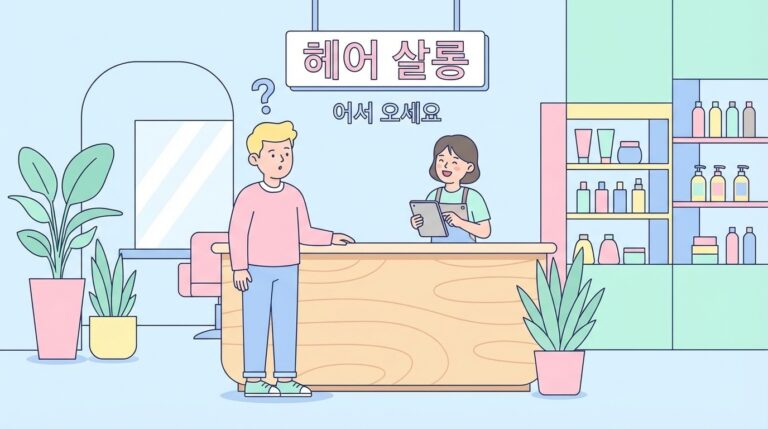
Imagine this: You are exploring the trendy streets of Seongsu-dong or Hongdae. You spot a beautifully lit, minimalist hair salon—the exact kind you see in K-Dramas where the protagonist gets a stunning makeover. You gather your courage, walk in, and… the staff looks incredibly busy. Hair dryers are buzzing, K-Pop is playing softly in the background, and you don’t have an appointment.
You want that trendy K-Pop ‘layered cut’, but you have a cafe-hopping schedule to maintain. You need to know: “How long do I have to wait?”
If you don’t know how to ask this, you might end up sitting awkwardly on a velvet sofa for two hours, or worse, you might walk out of a salon that actually had an opening in just 10 minutes!
Don’t worry. This guide is built from the real, slightly sweaty, and awkward experiences of my beginner students in Seoul. Today, we are going to learn how to ask about wait times like a true local.
Phase 2: Core Expressions Deep Dive
Here are the absolute must-know phrases when you walk into a Korean salon (or any place with a waiting line!).
1. 얼마나 기다려야 해요?
- Pronunciation: eol-ma-na gi-da-ryeo-ya hae-yo?
- Sound-alike guide: ‘eol-ma-na’ sounds like “all my nah”. ‘gi-da’ sounds like “gee-dah”.
- Meaning: How long do I have to wait? (Literal: How much must I wait?)
- K-Culture Moment: You will use this everywhere in Korea! Whether you are at a famous hair salon in Gangnam or waiting outside a Michelin-starred BBQ restaurant.
- Editor’s Insight: This phrase is incredibly practical. To make it sound even more polite and soft, add “혹시” (hok-si / by any chance) at the beginning: “Hok-si… eolmana gidaryeoya haeyo?”
- Situation Spectrum:
- Casual with friends: ⚠️ (Use “얼마나 기다려야 돼?” instead)
- Staff/Clerks (Semi-formal): ✅ (Perfect!)
- Boss/Elders (Formal): 🚫 (Too direct)
- 🤔 Think About It: Koreans are famous for their “Pali-Pali” (hurry hurry) culture. Why do you think asking about the exact wait time is so important in a fast-paced society like Seoul?
2. 예약하셨어요?
- Pronunciation: ye-yak-ha-syeo-sseo-yo?
- Sound-alike guide: ‘ye-yak’ sounds like “yay-yak”.
- Meaning: Did you make a reservation/appointment?
- K-Culture Moment: The moment you open the door of any decent salon, the receptionist will warmly greet you and immediately ask this question.
- Editor’s Insight: You don’t need to say this, but you must understand it. If you hear “ye-yak” (reservation), they are asking if you booked ahead.
- Situation Spectrum:
- You will hear this from staff (Semi-formal): ✅
- 🤔 Think About It: Korea has rapidly shifted to a “100% reservation culture” via apps like Naver Map. Does your country still prefer walk-ins for haircuts, or is it mostly app-based now?
3. 조금만 기다려 주세요.
- Pronunciation: jo-geum-man gi-da-ryeo ju-se-yo.
- Sound-alike guide: ‘jo-geum’ means a little. ‘ju-se-yo’ means please give/do.
- Meaning: Please wait a little bit.
- K-Culture Moment: The stylist smiles, hands you an iced Americano, and says this.
- Editor’s Insight: Beware the Korean “jogeum” (a little). Depending on the salon’s busyness, “a little” could mean 5 minutes, or it could mean 30 minutes!
Phase 3: Textbook vs. Real Korean
Let’s look at how language changes from the textbook to the actual streets of Seoul.
[Asking the Wait Time]
* 📖 Textbook Korean: 대기 시간이 어떻게 됩니까? (dae-gi si-gan-i eo-tteo-ke doem-ni-kka?)
* 🗣️ Real Korean: 얼마나 걸려요? (eol-ma-na geol-lyeo-yo? / How long will it take?)
* 💡 Why the difference?: The textbook version sounds like a news anchor or a corporate email. Real Koreans use “얼마나 걸려요?” because it is shorter, softer, and more conversational.
[Saying You Will Wait]
* 📖 Textbook Korean: 네, 기다리겠습니다. (ne, gi-da-ri-get-seum-ni-da.)
* 🗣️ Real Korean: 네, 기다릴게요. (ne, gi-da-ril-ge-yo.)
* 💡 Why the difference?: The “-ge-yo” ending sounds much friendlier and more personal than the stiff, military-like “-seum-ni-da.”
Bottom Note: As an A1 (Super Beginner) learner, stick to the “-yo” (요) endings. They are the golden key to sounding polite but natural in 99% of daily situations!
Phase 4: Cultural Context — K-Culture Deep Dive
4-1. Non-Verbal Cues: The Art of Nunchi
When you ask “How long do I have to wait?” in a Korean salon, pay attention to the staff’s body language. If they suck in their breath slightly (a soft “Tss” sound) and look at their schedule tablet with a worried face, your Nunchi (social sense/reading the room) should tell you the wait is going to be very long.
Also, if you decide to wait, you don’t need to stand awkwardly. The staff will usually guide you to a comfortable waiting area and ask: “음료 준비해 드릴까요?” (Would you like a drink?). It’s totally normal to enjoy a free iced Americano or orange juice while waiting!
4-2. K-Culture Connection: The Pali-Pali Paradox
K-Beauty & Wait Times: Koreans love Pali-Pali (doing things fast). Food delivery takes 20 minutes, and internet speed is lightning fast. However, there is a paradox when it comes to K-Beauty. Koreans are willing to wait hours or book months in advance for a specific, famous hair stylist (often called a ‘Designer’ in Korea). So, if a trendy salon tells you the wait is 2 hours, it’s not bad service—it’s a sign that the designer is incredibly popular!
Phase 5: Real-Life Roleplay Scenario
Setting: A bright, aesthetic hair salon in Hongdae. It’s 2 PM on a Saturday. NewJeans is playing on the speakers. The salon is bustling with people getting perms.
Characters:
– YOU: A tourist wanting to try a Korean hairstyle. You don’t have an appointment.
– Min-ji: The friendly salon receptionist holding a tablet.
Dialogue:
Min-ji: 안녕하세요! 예약하셨어요? 😊
(an-nyeong-ha-se-yo! ye-yak-ha-syeo-sseo-yo?)
[Hello! Did you make a reservation?]
YOU: 아니요, 안 했어요. 혹시… 얼마나 기다려야 해요?
(a-ni-yo, an hae-sseo-yo. hok-si… eol-ma-na gi-da-ryeo-ya hae-yo?)
[No, I didn’t. By any chance… how long do I have to wait?]
Min-ji: (Checking her tablet) 음… 한 시간 정도 기다리셔야 해요. 괜찮으세요?
(eum… han si-gan jeong-do gi-da-ri-syeo-ya hae-yo. gwaen-cha-neu-se-yo?)
[Hmm… You have to wait about one hour. Is that okay?]
🔀 Your Turn! How will you respond?
– A) “아, 너무 길어요. 갈게요.” (Ah, too long. I will go.)
– B) “네, 괜찮아요. 기다릴게요.” (Yes, it’s okay. I will wait.)
– C) “빨리 해주세요!” (Do it fast!)✅ Best Choice: B! If you have the time, B is polite and natural. If you want to leave because it’s too long, A is a bit blunt. Instead, try saying: “아, 그럼 다음에 올게요.” (Ah, then I will come next time.)
⚠️ Choice C Analysis: Never say “Do it fast!” (빨리 해주세요) to service workers in Korea. It is considered very rude!
Bonus Scenario: Waiting for Food!
Did you know you can use this exact same phrase at a famous restaurant?
– YOU: 얼마나 기다려야 해요? (How long do I have to wait?)
– Staff: 앞에 5팀 있습니다. (There are 5 teams in front of you.)
Phase 6: 10-Second Shadowing Drill
Let’s practice! Follow the intonation (/) and emotion tags.
😊 (Politely and gently)
혹시 / 얼마나 / 기다려야 / 해요?
(hok-si / eol-ma-na / gi-da-ryeo-ya / hae-yo?)
🙂 (With a warm smile)
네, / 여기서 / 기다릴게요.
(ne, / yeo-gi-seo / gi-da-ril-ge-yo.)
[Yes, I will wait here.]
Phase 7: K-Culture Mini Dictionary
| Korean | Romanization | English | Context |
|---|---|---|---|
| 미용실 | mi-yong-sil | Hair salon | The general word for a hair salon. |
| 디자이너 | di-ja-i-neo | Designer / Stylist | In Korea, hair stylists are respectfully called ‘Designers’. |
| 예약 | ye-yak | Reservation | Crucial for beauty, dining, and travel in modern Korea. |
| 눈치 | nun-chi | Nunchi | The Korean social art of reading the atmosphere. |
| 앞머리 | ap-meo-ri | Bangs/Fringe | A very popular K-beauty hairstyle feature! |
Phase 8: Traveler’s Survival Kit
Whether you are at a salon, a busy restaurant, or a theme park, waiting is part of the travel experience. Here are your top survival phrases!
🆘 Survival Phrases: The Waiting Game
– 🇰🇷 “얼마나 걸려요?” (eol-ma-na geol-lyeo-yo?)
– 🗣️ Meaning: How long will it take? (Great for asking how long the actual haircut or taxi ride will take).
– 🇰🇷 “다음에 올게요.” (da-eum-e ol-ge-yo.)
– 🗣️ Meaning: I will come next time. (The polite way to escape a 2-hour wait!).📌 Editor’s Travel Note
– Useful Apps: Most trendy hair salons in Korea use Naver Map for bookings. Walk-ins are getting rare in hot spots like Seongsu or Yeonnam-dong.
– Tipping: There is absolutely NO tipping culture in Korean hair salons! You just pay the exact price listed at the desk. Tipping will just confuse the staff.
Phase 9: Critical Thinking Corner — “One Step Deeper”
Media vs. Reality: The K-Drama Makeover
In K-Dramas, the main character is feeling down, walks directly into a luxurious, empty salon, and immediately gets a life-changing haircut from the head stylist. In reality? That exact salon requires a Naver reservation at least two weeks in advance, and the “head stylist” charges an extra premium!
While media portrays Korea as extremely spontaneous and fast, modern Korean society is highly scheduled and systematic, especially when it comes to popular places. The clash between the traditional Pali-pali (fast) mindset and the new reservation-only system is an interesting shift in Korean culture.
💬 Your Turn: Does your country rely heavily on apps for booking simple things like a haircut, or do people still prefer to just walk in? Share in the comments!
Phase 10: FAQ & Avoiding Misunderstandings
Q: Can I use “얼마나 기다려야 해요?” at a restaurant too?
Yes! It is 100% universal. Use it at restaurants, cafes, amusement parks, or pop-up stores.
Q: Can I just point and ask “How long?” (얼마나? / eol-ma-na?)
No. Dropping the “해요” (hae-yo) makes it informal (Banmal). Speaking informally to service staff is considered very rude in Korea. Always use the full phrase with “요” at the end.
❌ Common Mistake #1: Expecting no wait time without an app reservation.
✅ Do this instead: Always ask politely. If the wait is too long, say “다음에 올게요” (I’ll come next time) with a smile.
Phase 11: Summary & Action Items
One-Liner Summary: To ask about wait times anywhere in Korea, smoothly say: “혹시… 얼마나 기다려야 해요?”
Action Mission 3 Steps:
– 🥉 Bronze (Solo): Stand in front of your mirror and practice the phrase out loud 3 times until it flows naturally.
– 🥈 Silver (Online): Find a Korean cafe or salon on Instagram. In your head, imagine commenting the phrase!
– 🥇 Gold (Real Life): Next time you visit a Korean restaurant or store (even in your home country), ask the staff this phrase when it looks busy!
K-Culture Mission:
Open Naver Map (or Google Maps) and look at the streets of ‘Seongsu-dong’. Find a hair salon (미용실) on the map, imagine walking in, and say the phrase out loud!
Phase 12: Quiz — Interactive Challenge
1. Situational Judgment:
You walk into a busy Korean hair salon. The staff looks at you and says, “예약하셨어요?” (ye-yak-ha-syeo-sseo-yo?). What are they asking?
A) Do you want coffee?
B) Did you make a reservation?
C) How long will you wait?
2. Fill in the Blank:
You want to ask the wait time politely.
“혹시… 얼마나 _________ 해요?”
A) 먹어야 (eat)
B) 자야 (sleep)
C) 기다려야 (wait)
3. True or False – K-Culture Edition:
“If the salon staff did a great job on your haircut, you should leave a 15% tip at the counter.”
(T / F)
(Answers: 1. B, 2. C, 3. False – No tipping in Korea!)
Frequently Asked Questions (FAQ)
Q: What does "얼마나 기다려야 해요?" mean in Korean and how do you pronounce it?
A: In Korean, "얼마나 기다려야 해요?" is pronounced [eol-ma-na gi-da-ryeo-ya hae-yo?] and means: a key conversational Korean expression covered in this lesson.
Q: What does "예약하셨어요?" mean in Korean and how do you pronounce it?
A: In Korean, "예약하셨어요?" is pronounced [ye-yak-ha-syeo-sseo-yo?] and means: a key conversational Korean expression covered in this lesson.
Q: What does "조금만 기다려 주세요." mean in Korean and how do you pronounce it?
A: In Korean, "조금만 기다려 주세요." is pronounced [jo-geum-man gi-da-ryeo ju-se-yo.] and means: a key conversational Korean expression covered in this lesson.







