

Phase 1: Empathy (The Real K-Tech Scene)
Hello! Daily Hangul Editor here.
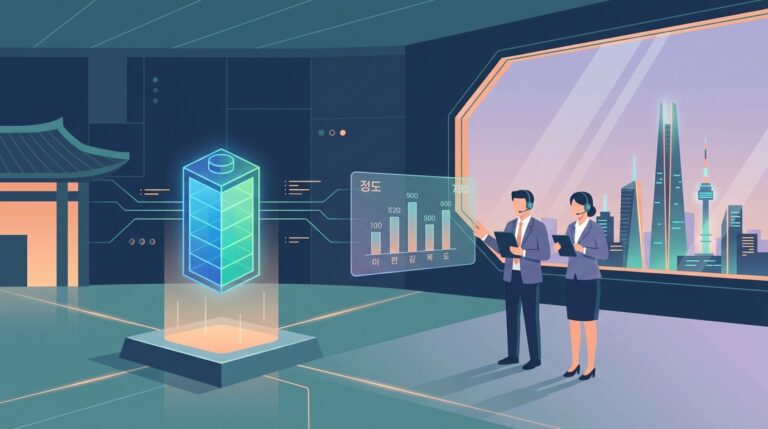
Picture this: You are watching a high-stakes K-Drama like Start-Up or Reborn Rich. The CEO stands in front of a sleek holographic screen, passionately presenting a new technology. The subtitles simply read, “We have a great technology and we will beat the competition.” But if you listen closely to the Korean audio, the words they use are far more intense, strategic, and poetic.
As a C1 learner, you already know basic words like 경쟁 (competition) or 이기다 (to win). But if you step into a boardroom in Seoul or attend a dinner with Korean engineers discussing the cutthroat global EV battery race (LG, SK, Samsung—the “K-Battery” titans), textbook Korean won’t cut it. You need the insider corporate jargon.
Today, we are going beyond the textbook. We will learn the exact “survival” vocabulary Korean professionals use when talking about tech dominance, why they sound like they are preparing for war, and how you can use these expressions to instantly earn the respect of any Korean industry insider.
Phase 2: Core Expressions Deep Dive
1. 초격차를 벌리다
- Pronunciation: cho-gyeo-kcha-reul beol-li-da [Sound-alike: cho (like ‘choke’) – gyuck – cha (like ‘cha-cha’) – reul / bull – lee – da]
- Meaning: Literal: To widen a super-gap. / Real nuance: To create an insurmountable technological or market lead that competitors cannot possibly catch up to.
- K-Culture Moment: This term was famously popularized by Samsung executives to describe their semiconductor strategy and is now the ultimate buzzword in the K-Battery industry. Imagine a tense strategy meeting where a director slams their hand on the table: “We can’t just be slightly better. We need a super-gap!”
- Editor’s Insight: This isn’t just about winning; it’s about absolute dominance. It carries a sense of pride and urgency.
- Situation Spectrum:
- Casual with friends: 🚫 (Too dramatic, unless used sarcastically, like “I’m creating a super-gap in my gaming skills.”)
- Semi-formal with colleagues: ✅
- Formal business meetings/Presentations: ✅
- 🤔 Think About It: Why does Korean corporate culture love terms with “초” (Super/Ultra)? How does this reflect the “Palli-palli” (hurry up) and hyper-competitive nature of modern South Korea?
2. 주도권을 쥐다
- Pronunciation: ju-do-gwo-neul jwi-da [Sound-alike: joo – dough – gwon – eul / jwee (like ‘jeep’ with a ‘w’) – da]
- Meaning: Literal: To grasp the right of leadership. / Real nuance: To take the initiative, to be in the driver’s seat of the market.
- K-Culture Moment: In K-Dramas, this is the exact phrase a cunning vice-president uses when planning a hostile takeover or launching a disruptive tech product.
- Editor’s Insight: The verb 쥐다 (to grasp tightly in one’s fist) adds a visceral, physical feeling of seizing power, unlike the softer 가지다 (to have).
- Situation Spectrum:
- Casual with friends: ⚠️ (A bit stiff, but okay for debating sports or games)
- Semi-formal with colleagues: ✅
- Formal business meetings/Presentations: ✅
- 🤔 Think About It: Does your native language use physical metaphors (like “grasping” or “holding”) to describe market leadership?
3. 수율을 잡다
- Pronunciation: su-yu-reul jap-da [Sound-alike: soo – yool – eul / jahp – da]
- Meaning: Literal: To catch the yield rate. / Real nuance: To stabilize the manufacturing process so that the percentage of non-defective products is high and profitable.
- K-Culture Moment: This is pure engineer talk. In the EV battery world, having great tech means nothing if you can’t mass-produce it perfectly. When engineers finally achieve this after months of all-nighters, they celebrate over unlimited Samgyeopsal (pork belly).
- Editor’s Insight: To say you “caught” (잡다) the yield rate implies that the yield rate was like a wild animal running away from you. It highlights the struggle of manufacturing.
- Situation Spectrum:
- Casual with friends: 🚫 (They won’t know what you’re talking about unless they are engineers)
- Semi-formal with colleagues: ✅
- Formal business meetings: ✅
Phase 3: Textbook vs. Real Korean
[Describing Tech Superiority]
* 📖 Textbook Korean: 우리 회사의 배터리 기술이 가장 좋습니다. (Our company’s battery tech is the best.)
* 🗣️ Real Korean: 이번 전고체 배터리로 초격차를 벌릴 계획입니다. (We plan to widen the super-gap with this solid-state battery.)
* 💡 Why the difference?: The textbook phrase sounds like a simple advertisement. “초격차” shows aggressive strategic vision, essential in high-stakes corporate PR.
[Explaining Production Success]
* 📖 Textbook Korean: 생산이 안정되었습니다. (Production has stabilized.)
* 🗣️ Real Korean: 드디어 공장 수율을 확실히 잡았습니다. (We finally secured the factory’s yield rate for sure.)
* 💡 Why the difference?: Using industry-specific jargon like “수율” (yield rate) combined with the active verb “잡다” proves you are an insider who understands the actual pain points of manufacturing.
Phase 4: Cultural Context — K-Culture Deep Dive
4-1. Non-verbal Communication: The Corporate “Nunchi”
When discussing competitors in a Korean meeting, it’s all about Nunchi (reading the room). If a competitor releases a new battery with a longer driving range, you don’t casually say, “Oh, that’s cool.” You must match the room’s gravity. A slight nod, a serious expression, and saying “우리도 주도권을 뺏기면 안 됩니다” (We cannot lose the initiative either) while making firm eye contact with the team leader is key.
4-2. The K-Drama Boardroom Trope
If you’ve watched any K-Drama involving Chaebols (family-owned conglomerates), you know the classic “crisis” scene. The protagonist is facing a hostile board of directors. The screen shows a plunging graph. Then, with a dramatic musical swell, they click the presenter remote. A new graph shoots up. “This new battery technology…” they announce smoothly, “…will widen the super-gap.” The room gasps. In reality, while Korean presentations are highly professional, they do heavily rely on these strong, visionary buzzwords to build consensus and inspire teams.
Phase 5: Real-Life Roleplay Scenario
Setting: Friday night, 8 PM. A bustling Galbi (Korean BBQ) restaurant in Gangnam. The air is thick with the smell of roasting meat and the clinking of Soju glasses. You are an expat tech analyst, invited to a Hoesik (company dinner) with the advanced battery research team.
Characters:
– YOU: A smart, adaptable expat professional navigating Korean corporate culture.
– Min-su (35): The passionate lead engineer. He’s had two glasses of Soju and is getting fired up about work.
Dialogue:
Min-su: (Pouring you a drink) 아, 이번에 경쟁사 발표 봤어요? 걔네 주행 거리 장난 아니던데.
(Ah, ibeone gyeongjaengsa balpyo bwasseoyo? Gyaene juhaeng geori jangnan anideonde.)
[Ah, did you see the competitor’s announcement this time? Their driving range is no joke.]
YOU: 네, 봤습니다. 시장 반응이 꽤 뜨겁더라고요.
(Ne, bwatseumnida. Sijang baneungi kkoae tteugeopdeoragoyo.)
[Yes, I saw it. The market reaction is quite hot.]
Min-su: (Sighs, flipping the meat) 하아… 솔직히 긴장되네요. 이러다 우리가 밀리는 거 아닌가 몰라.
(Haa… soljikhi ginjangdoeneyo. Ireoda uriga millineun geo aninga molla.)
[Sigh… Honestly, I’m nervous. I don’t know if we’ll fall behind at this rate.]
🔀 Your Turn! How should you respond to motivate Min-su?
– A) 걱정 마세요. 우리가 이길 겁니다. (Textbook, a bit dry)
– B) 에이, 선배님! 우리 전고체 기술로 초격차를 벌리면 되죠! 제가 응원합니다! (Perfect mix of insider tech jargon and friendly encouragement)
– C) 회식에서는 일 얘기 하지 맙시다! (A bit too direct, might ruin his mood)✅ Best Choice: B — Why? You validate his concern but pivot to a highly motivating, strategic buzzword (초격차). Calling him ‘선배님’ (Senior) even if you’re not strictly in the same hierarchy builds immense camaraderie at a Hoesik.
Min-su: (Laughs loudly) 캬~ 역시! 맞아요, 수율만 확실히 잡으면 우리가 무조건 주도권 쥡니다! 자, 짠 할까요?
(Kya~ yeoksi! Majayo, suyulman hwaksilhi jabeumyeon uriga mujogeon judogwon jwimnida! Ja, jjan halkkayo?)
[Haha~ As expected! That’s right, if we just secure the yield rate, we will unconditionally take the lead! Shall we cheers?]
(🎭 Stage Direction: Min-su raises his Soju glass with a renewed fire in his eyes.)
Phase 6: 10-Second Shadowing Drill
Practice this sentence to sound like a visionary Korean tech CEO:
😤 이번 프로젝트로 / 시장의 판도를 바꾸고 / 기술 초격차를 / 벌려야 합니다!
(ibeon peurojekteuro / sijangui pandoreul bakkugo / gisul chogyeokchareul / beollyeoya hamnida!)
[With this project, we must change the landscape of the market and widen the technological super-gap!]
Tip: Deliver the word 초격차 with absolute confidence and a slight pause right before it for dramatic effect.
Phase 7: K-Culture Mini Dictionary
| 한국어 | Romanization | English | Cultural Context |
|---|---|---|---|
| 회식 | hoesik | Company dinner | More than just eating; it’s where real corporate bonding, secret-sharing, and team alignment happen. |
| 눈치 | nunchi | Social intelligence | The art of reading the room. Crucial when navigating office politics during high-stakes tech races. |
| 전고체 | jeongoche | Solid-state | The “Holy Grail” of EV batteries. If you drop this word in a tech conversation, Koreans will know you read the news. |
| 주행 거리 | juhaeng geori | Driving range | Literally “driving distance.” The most critical spec for EVs in Korea’s mountainous terrain. |
| 파란 번호판 | paran beonhopan | Blue license plate | In Korea, all eco-friendly vehicles (EVs and Hydrogen) are legally required to have blue license plates. |
Phase 8: Traveler’s Survival Kit
Even if you aren’t an engineer, the EV boom is incredibly visible in Korea. If you travel to Jeju Island (the EV capital of Korea) or rent an “Ioniq” taxi in Seoul, you need these phrases!
🆘 Survival Phrase #1: Finding a Charger
– 🇰🇷 “근처에 전기차 충전소 있나요?” (geuncheoe jeongicha chungjeonso innayo?)
– 🗣️ Pronunciation: geun-cheo-e / jeon-gi-cha / chung-jeon-so / in-na-yo?
– 📍 Where to use: Rental car centers, gas stations, asking locals on Jeju Island.
– 💡 Pro Tip: Download apps like ‘EV Infra’ or just use Naver Maps and search “충전소” (Charging Station).🆘 Survival Phrase #2: Checking the Charge Type
– 🇰🇷 “이거 급속 충전 되나요?” (igeo geupsok chungjeon doenayo?)
– 🗣️ Pronunciation: i-geo / geup-sok / chung-jeon / doe-na-yo?
– 📍 Where to use: At highway rest stops (휴게소) where time is of the essence.
– 💡 Pro Tip: 급속 (Fast charging) is expensive but quick. 완속 (Slow charging) is usually found at hotels for overnight charging.📌 Editor’s Travel Note
Look around Seoul streets! EV taxis have blue license plates and often “EV” painted on the side. They are incredibly quiet, so be careful when walking in narrow alleys where the “Nunchi” of pedestrians and cars is a daily dance.
Phase 9: Critical Thinking — “One Step Deeper”
Language & Power: The “War” Metaphors of Korean Business
🧠 Think Deeper:
South Korea transformed from a war-torn nation to a high-tech powerhouse in just a few decades. Because of this hyper-compressed economic growth, Korean business language is heavily infused with militaristic and survivalist metaphors. Terms like 초격차 (Super-gap), 생존 (Survival), and 시장 장악 (Market domination) aren’t just buzzwords; they reflect a deeply ingrained national psyche that “if we stop innovating, we will perish.” The tech race isn’t seen as friendly competition; it is viewed as an existential battle.💬 Your Turn: Does your country’s business culture use aggressive, war-like terminology to describe technological competition, or is it framed differently? Share in the comments!
Phase 10: FAQ & Avoiding Misunderstandings
Q: Can I use “초격차를 벌리다” when I am playing a casual video game with my friends?
A: Only if you are being highly sarcastic and dramatic! It’s a heavy corporate term. If you beat your friend in Mario Kart, just say “내가 압도적으로 이겼어” (I won overwhelmingly).
Q: What’s the difference between “배터리 수명” and “주행 거리”?
A: This is a common mix-up! 배터리 수명 (Battery lifespan) refers to how many years the battery will last before it degrades. 주행 거리 (Driving range) is how far the car can go on a single charge.
❌ Common Mistake: Saying “내 차는 배터리 시간이 길어요” (My car has a long battery time) – this is literal translation from English.
✅ Do This Instead: Say “내 차는 주행 거리가 길어요” (My car has a long driving range).
Phase 11: Summary & Action Items
One-Liner Summary: To speak like a Korean tech insider, drop the dictionary words and use aggressive, strategic terms like 초격차 (Super-gap) and 수율 (Yield rate).
Action Mission 3 Steps:
– 🥉 Bronze: Stand in front of a mirror and deliver the Phase 6 shadowing sentence with CEO-level confidence.
– 🥈 Silver: Write a comment below using the word “주도권” in a sentence about your own career or studies.
– 🥇 Gold: Find a Korean news article about “LG에너지솔루션” or “삼성SDI” and spot the words “초격차” or “수율” in the text!
🔋 K-Culture Mission:
The next time you watch a modern K-Drama set in Seoul, count how many blue license plates (EVs) you see in the street scenes. It’s a fun way to notice how fast mobility is changing in Korea!
Phase 12: Quiz — Interactive Challenge
1. Situational Judgment:
You are giving a presentation to Korean investors about your new battery recycling tech. You want to assure them that you will completely leave competitors in the dust. What is the most impactful phrase?
– A) 우리 기술이 1등입니다.
– B) 확실하게 기술 초격차를 벌리겠습니다.
– C) 배터리 수명을 잡겠습니다.
2. Fill in the Blank:
“이번에 공장 시스템을 개선해서 드디어 ___을(를) 확실히 잡았습니다.”
(Hint: Stabilizing the percentage of good products in manufacturing)
3. True or False – K-Culture Edition:
In South Korea, all electric vehicles (EVs) are legally required to have a blue license plate. (T/F)
(Answers: 1. B / 2. 수율 / 3. True)
Frequently Asked Questions (FAQ)
Q: What does "초격차를 벌리다" mean in Korean and how do you pronounce it?
A: In Korean, "초격차를 벌리다" is pronounced [cho-gyeo-kcha-reul beol-li-da [Sound-alike: cho (like 'choke'] and means: Literal: To widen a super-gap. / Real nuance: To create an insurmountable technological or market lead that competitors cannot possibly catch up to.
Q: What does "주도권을 쥐다" mean in Korean and how do you pronounce it?
A: In Korean, "주도권을 쥐다" is pronounced [ju-do-gwo-neul jwi-da [Sound-alike: joo - dough - gwon - eul / jwee (like 'jeep' with a 'w'] and means: Literal: To grasp the right of leadership. / Real nuance: To take the initiative, to be in the driver's seat of the market.
Q: What does "수율을 잡다" mean in Korean and how do you pronounce it?
A: In Korean, "수율을 잡다" is pronounced [su-yu-reul jap-da [Sound-alike: soo - yool - eul / jahp - da] and means: Literal: To catch the yield rate. / Real nuance: To stabilize the manufacturing process so that the percentage of non-defective products is high and profitable.







