

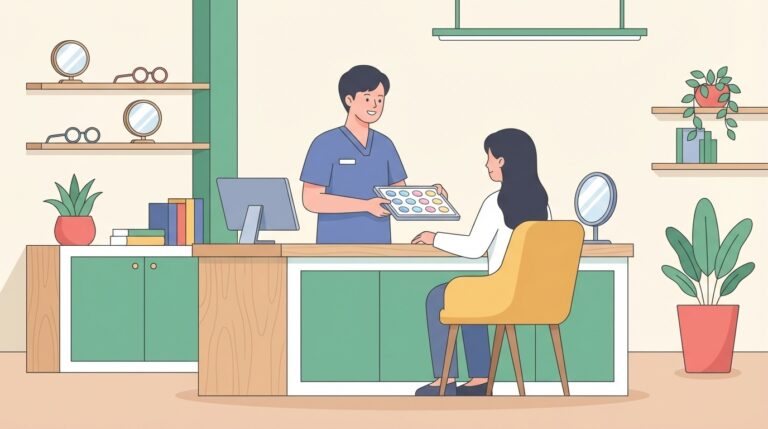
Phase 1: Empathy & Immersion (The Cold Open)
Hello! I am the senior editor of Daily Hangul.
Have you ever watched a K-Pop music video and wondered, “How do their eyes look so mesmerizing?” The secret is often color contact lenses! Or maybe you’re traveling in Korea, enjoying a hot bowl of Ramyun, and suddenly your only pair of contact lenses rips. Panic sets in. You think, “Do I need to find an eye doctor? Do I need a prescription from my home country?”
Relax! You are in South Korea, the land of Pali-pali (hurry, hurry) and ultimate convenience. Korean opticians (안경점, an-gyeong-jeom) are like magic shops. You can walk in without a doctor’s note, get a free eye exam in 5 minutes, and walk out with your lenses immediately.
But how do you ask for them when you only know how to say “Hello” and “Thank you”? Today, we are going to learn the easiest, most powerful phrase to get exactly what you need at a Korean optician. Let’s dive in!
Phase 2: Deep Dive into Core Expressions
1. 렌즈 주세요 (I’d like some lenses, please)
- Pronunciation: ren-jeu ju-se-yo [ren-jeu joo-seh-yo]
- Meaning: Literal: Lenses give me. / Real nuance: I would like to buy contact lenses.
- K-Culture Moment: You walk into a brightly lit store with hundreds of glasses frames. A friendly staff member approaches you. You simply say this phrase, and they will immediately lead you to the contact lens section.
- Editor’s Insight: In Korean, we use the word “렌즈” (lens) directly from English (Konglish!). And “주세요” (give me) is the magical magic wand for shopping. You don’t need a complicated sentence like “I would like to purchase…”
- Situation Spectrum:
- Casual to friends: 🚫 (You wouldn’t ask a friend to give you their lenses!)
- To a shop staff (Formal enough): ✅
- 🤔 Think About It: Why do Koreans say “Give me” instead of “I want to buy”? In Korean service culture, the transaction is seen as the staff providing or “giving” a service to the honored customer.
2. 컬러 렌즈 있어요? (Do you have color lenses?)
- Pronunciation: keol-leo ren-jeu i-sseo-yo? [cull-luh ren-jeu ee-ssoh-yo?]
- Meaning: Literal: Color lens exist? / Real nuance: Do you sell color contact lenses?
- K-Culture Moment: If you want to recreate the look of NewJeans or IVE’s Wonyoung, this is your go-to phrase. Color lenses are a massive part of K-Beauty!
- Editor’s Insight: “있어요?” (is there / do you have) is your best friend when looking for specific items in any store in Korea. Raise your intonation at the end to make it a question.
- Situation Spectrum:
- Shop staff (Formal enough): ✅
- 🤔 Think About It: Have you noticed how many English words are used in Korean beauty and fashion? “Color” and “Lens” are both adopted into everyday Korean.
Phase 3: Textbook vs. Real Korean
[Situation: Asking to buy contact lenses]
* 📖 Textbook Korean: 콘택트렌즈를 사고 싶습니다. (kon-taek-teu-ren-jeu-reul sa-go sip-seum-ni-da) – I want to buy contact lenses. (Very stiff and long!)
* 🗣️ Real Korean: 렌즈 주세요. (ren-jeu ju-se-yo) – Lenses, please.
* 💡 Why the difference?: Koreans value efficiency in conversations, especially in shops. Dropping the object markers and using the Konglish abbreviation “렌즈” gets straight to the point.
Phase 4: Cultural Context — K-Culture Deep Dive
4-1. Non-Verbal Cues
When you say “렌즈 주세요” (Lenses please), you can gently point to your own eyes. If you don’t know your prescription power, simply point to your glasses or your eyes and look a bit helpless—the optician will immediately understand and guide you to the eye testing machine!
4-2. The Speed of K-Travel
If you lose a contact lens while traveling in Europe or North America, it can ruin your day because you often need a prescription from a clinic. In Korea, opticians (안경점) have a machine called an auto-refractor. They will check your eyes for free within 3 minutes and hand you a box of lenses. This is a perfect example of Korea’s famous 빨리빨리 (Pali-pali / Hurry-hurry) culture applied to healthcare and retail!
Phase 5: Real-Life Roleplay Scenario
Setting: A bright, modern optician in the busy streets of Hongdae. There is a whole wall dedicated to colorful contact lenses.
Characters:
– YOU: A traveler who wants to try K-Pop style color lenses for the first time.
– Optician (안경사): A friendly professional wearing a neat uniform.
Dialogue:
Optician: 어서 오세요! 찾으시는 거 있으세요? 😊
(eo-seo o-se-yo! cha-jeu-si-neun geo i-sseu-se-yo?)
[Welcome! Are you looking for anything?]
YOU: 안녕하세요. 렌즈 주세요.
(an-nyeong-ha-se-yo. ren-jeu ju-se-yo.)
[Hello. Lenses, please.]
Optician: 네, 투명 렌즈요?
(ne, tu-myeong ren-jeu-yo?)
[Yes, clear lenses?]
YOU: 아뇨, 컬러 렌즈 있어요?
(a-nyo, keol-leo ren-jeu i-sseo-yo?)
[No, do you have color lenses?]
Optician: 네, 이쪽으로 오세요. 도수 아세요?
(ne, i-jjog-eu-ro o-se-yo. do-su a-se-yo?)
[Yes, come this way. Do you know your prescription?]
🔀 Your Turn! How do you answer if you don’t know your prescription?
– A) 도수 몰라요. (do-su mol-la-yo) – I don’t know the prescription.
– B) 안경 주세요. (an-gyeong ju-se-yo) – Give me glasses.
– C) 싫어요. (sil-heo-yo) – I hate it/No.✅ Best Choice: A. By saying “몰라요” (I don’t know), the optician will happily say “시력 검사 해드릴게요” (I’ll test your eyes for you).
⚠️ Choice B & C Analysis: B means you want to buy glasses instead. C is a very blunt rejection and will confuse the staff!
Phase 6: 10-Second Shadowing Drill
Read out loud and practice the rhythm!
😊 밝게 (Brightly): 저기요, / 렌즈 / 주세요!
(jeo-gi-yo, / ren-jeu / ju-se-yo!)
🥺 약간 곤란하게 (Slightly troubled): 도수는 / 잘 / 몰라요.
(do-su-neun / jal / mol-la-yo.)
Phase 7: K-Culture Mini Dictionary
| Korean | Romanization | English | Context |
|---|---|---|---|
| 안경점 | an-gyeong-jeom | Optician / Glasses store | They are everywhere in Korea. Look for the sign with glasses! |
| 렌즈 | ren-jeu | Lenses (Contacts) | Used for both clear and colored contacts. |
| 도수 | do-su | Prescription power | The strength of your lenses (e.g., -2.50). |
| 투명 | tu-myeong | Clear / Transparent | Regular contacts without color. |
| 빨리빨리 | pal-li-pal-li | Hurry, hurry! | The core philosophy of Korean speed and efficiency. |
Phase 8: Traveler’s Survival Kit
🆘 Survival Phrases for the Optician
– 🇰🇷 “이거 얼마예요?” (i-geo eol-ma-ye-yo?)
– 🗣️ Guide: [ee-guh uhl-ma-yeh-yo?]
– 📍 Meaning: How much is this?
- 🇰🇷 “카드로 할게요.” (ka-deu-ro hal-ge-yo.)
- 🗣️ Guide: [ka-deu-ro hal-geh-yo.]
- 📍 Meaning: I will pay by card.
📌 Editor’s Travel Note
– Card vs. Cash: Opticians in Korea 100% accept foreign credit cards (Visa/Mastercard).
– Tax Free: Many big opticians in tourist areas (like Myeongdong or Hongdae) offer Tax-Free shopping. Bring your passport!
– Try it on?: You cannot try on contact lenses for hygiene reasons, but stores have artificial eye models to show you how color lenses will look.
Phase 9: Critical Thinking Corner — “One Step Deeper”
Global Era of Korean (Konglish Power)
If you look closely at the words we learned today—Lens, Color, Card—you’ll notice they sound very familiar. As Korea modernized rapidly, it adopted many English words, creating “Konglish.” For an A1 beginner, this is fantastic news! It means you already know a lot of Korean vocabulary. While some language purists worry about losing traditional Korean words, this blend makes Korea incredibly accessible and global-friendly for travelers.
💬 Your Turn: Does your native language borrow words from English or other languages for modern items? Share in the comments!
Phase 10: FAQ & Avoiding Misunderstandings
Q: Is it rude to just say “렌즈 주세요” to the staff? Should I be more polite?
A: It is perfectly fine! The “~요” ending makes it polite. In a retail setting, being direct but polite is exactly what staff expect.
Q: Do I need to make an appointment to see the eye doctor first?
A: No! That’s the beauty of Korea. Opticians (안경사) are licensed to test your vision for glasses and contacts right there in the shop, usually for free.
❌ Common Mistake #1: Trying to translate “I am looking for…” literally.
✅ Do this instead: Just say the noun + 주세요 (ju-se-yo). Simple is best in Korean shops!
Phase 11: Summary & Action Items
- One-Liner Summary: Walk into any Korean optician and confidently say “렌즈 주세요” (Lenses please) to unlock the fastest service in the world.
-
Action Mission 3 Steps:
- 🥉 Bronze (Solo): Say “렌즈 주세요” out loud 3 times right now.
- 🥈 Silver (Online): Look up a Korean optician brand online (like Davich or O-Lens) and imagine walking in.
- 🥇 Gold (Real Life): When you are in Korea, actually go into a shop and buy a pair of lenses using only Korean!
- K-Culture Mission: Look up your favorite K-Pop idol’s photos. Try to guess if they are wearing clear lenses or color lenses!
Phase 12: Quiz — Interactive Challenge
1. You are at an optician in Seoul and want to buy contacts. What is the most natural thing to say?
A) 렌즈 사고 싶어요. (I want to buy lenses)
B) 렌즈 주세요. (Lenses please)
C) 안경 주세요. (Glasses please)
2. True or False: You must bring an official doctor’s prescription from your home country to buy contact lenses in Korea.
3. Fill in the blank:
You want color contacts. You ask: “_______ 렌즈 있어요?”
(Answers: 1. B – It’s the most natural, 2. False – They will test your eyes for free, 3. 컬러)
Frequently Asked Questions (FAQ)
Q: What does "렌즈 주세요 (I'd like some lenses, please)" mean in Korean and how do you pronounce it?
A: In Korean, "렌즈 주세요 (I'd like some lenses, please)" is pronounced [ren-jeu ju-se-yo [ren-jeu joo-seh-yo] and means: Literal: Lenses give me. / Real nuance: I would like to buy contact lenses.
Q: What does "컬러 렌즈 있어요? (Do you have color lenses?)" mean in Korean and how do you pronounce it?
A: In Korean, "컬러 렌즈 있어요? (Do you have color lenses?)" is pronounced [keol-leo ren-jeu i-sseo-yo? [cull-luh ren-jeu ee-ssoh-yo?] and means: Literal: Color lens exist? / Real nuance: Do you sell color contact lenses?







