

Phase 1: Empathy & K-Culture Cold Open
Hello! I’m your Daily Hangul Editor. Imagine this: You’re watching a K-Drama, and after a soul-crushing day at work, the main character drags themselves home. They sit on their bed, open a pastel-colored book, and silently read a highlighted sentence. Suddenly, tears roll down their face. Or maybe you’ve noticed your favorite K-Pop idol like BTS’s RM recommending a book with a surprisingly quirky title like “I Want to Die but I Want to Eat Tteokbokki”.
Have you ever wondered what exactly is written in those pages?
In Korea, the “healing essay” (힐링 에세이) is a massive literary genre. They aren’t just books; they are warm hugs in paper form. But here’s the catch—when you translate these comforting phrases into English literally, they often sound awkward or overly dramatic. If you only know the textbook phrase “Don’t be sad” (슬퍼하지 마세요), you’re missing out on the deep, empathetic nuances of authentic Korean comfort.
Today, based on questions from my intermediate (B2) students who want to sound more empathetic, we’re going to explore the beautiful, nuanced language of Korean bestselling essays. Let’s learn how to comfort a friend like a true insider!
Phase 2: Deep Dive into Core Expressions
1. 애쓰지 않아도 괜찮아요 (It’s okay not to push yourself so hard)
- Pronunciation: aesseuji anado gwaenchannayo [Eh-sseu-jee ahn-ah-do gwen-chan-ah-yo]
- Meaning: (Literal) It is okay even if you don’t make an effort. / (Real Nuance) You don’t have to push yourself to the breaking point. You are enough as you are.
- K-Culture Moment: This is the ultimate “healing essay” vibe. Imagine a friend who is burned out from working overtime every day. You hand them a cup of warm tea and say this. It instantly melts the pressure away.
- Editor’s Insight: The verb ‘애쓰다’ means ‘to try hard’ or ‘to exert oneself’, often with a sense of struggling. Korean society highly values hard work, so telling someone they don’t have to struggle is a profound form of comfort.
- Situation Spectrum:
- Friends (Casual): ✅ (애쓰지 않아도 괜찮아)
- Coworkers (Semi-formal): ✅
- Boss/Elders (Formal): ⚠️ (Use carefully; they might think you’re telling them to stop working!)
- 🤔 Think About It: Why do you think a phrase giving ‘permission to stop trying’ became a national bestseller theme in South Korea? How does your culture address burnout?
2. 오늘도 수고했어요 (You worked hard again today)
- Pronunciation: oneuldo sugohaesseoyo [Oh-neul-do soo-go-hess-uh-yo]
- Meaning: (Literal) You suffered/toiled today too. / (Real Nuance) You did a great job today. I acknowledge your hard work.
- K-Culture Moment: If you’re on Weverse or watching a V-Live, you will see fans flooding the comments with “수고했어요!” after a concert. It’s the standard, beautiful way to acknowledge someone’s effort at the end of the day.
- Editor’s Insight: Westerners often say “Have a good rest!” but Koreans focus on acknowledging the effort that preceded the rest. Note: Never use this exact phrase to a boss or an elder (it implies you are evaluating their work).
- Situation Spectrum:
- Friends (Casual): ✅ (오늘도 수고했어)
- Coworkers (Semi-formal): ✅
- Boss/Elders (Formal): 🚫 (Use 고생하셨습니다 instead!)
- 🤔 Think About It: In English, “you suffered” sounds negative. In Korean, acknowledging that someone went through hardship is a sign of deep empathy. Can you think of similar cultural differences?
3. 토닥토닥 (Pat pat)
- Pronunciation: todaktodak [Toh-dak-toh-dak]
- Meaning: (Literal) The sound of lightly patting. / (Real Nuance) “There, there.” / Sending a virtual hug.
- K-Culture Moment: You’ll see this everywhere in Korean literature subtitles, webtoons, and KakaoTalk messages. It’s an onomatopoeia (의성어) used to comfort someone digitally when you can’t be there to physically pat their back.
- Editor’s Insight: You don’t usually say this out loud in a serious conversation. It’s mostly used in texting, social media comments, or written letters (like a fan letter to an idol!).
- Situation Spectrum:
- Friends (Casual): ✅
- Coworkers (Semi-formal): ⚠️ (Only if you are close)
- Boss/Elders (Formal): 🚫
- 🤔 Think About It: Korean has an incredibly rich vocabulary of mimetic and onomatopoeic words. How does using “sound words” change the emotional tone of a text message?
Phase 3: Textbook vs. Real Korean
Let’s upgrade your B2 vocabulary from stiff textbook phrases to empathetic real-life expressions.
[Comforting a friend who failed an exam/interview]
* 📖 Textbook Korean: 슬퍼하지 마세요. (Don’t be sad.)
* 🗣️ Real Korean: 많이 힘들었지? (It was really hard on you, wasn’t it?)
* 💡 Why the difference?: Telling someone not to be sad invalidates their feelings. Asking “It was hard, right?” (using the ~지 ending for seeking agreement) shows you are stepping into their shoes.
[When a friend is crying or stressed]
* 📖 Textbook Korean: 괜찮아질 거예요. (It will get better.)
* 🗣️ Real Korean: 밥은 먹었어? 우리 맛있는 거 먹으러 가자. (Did you eat? Let’s go eat something delicious.)
* 💡 Why the difference?: In Korea, food is affection. Asking if they’ve eaten and offering to feed them is a culturally ingrained way of showing you care, deeply tied to the historical importance of sharing meals.
[Encouraging someone who is overwhelmed]
* 📖 Textbook Korean: 힘내세요! (Cheer up! / Gain strength!)
* 🗣️ Real Korean: 무리하지 마. (Don’t overdo it.)
* 💡 Why the difference?: “힘내” (Cheer up) can sometimes feel like toxic positivity when someone is already at 0%. “무리하지 마” gives them permission to rest, perfectly aligning with the essay culture we’re exploring.
Phase 4: Cultural Context — K-Culture Deep Dive
4-1. The Non-Verbal “Nunchi” of Comfort
When comforting someone in Korea, Nunchi (눈치 – the ability to read the room) is crucial. Unlike some Western cultures where offering immediate advice or solutions is seen as helpful, Korean comfort often relies on listening and offering shared silence. When you say “많이 힘들었지?”, you don’t stare them down awaiting an answer. You look at them softly, maybe pour them a glass of water (or Soju!), and let them take their time.
4-2. The “Healing Essay” Phenomenon and K-Food
You might notice a quirky trend: many bestselling Korean comfort essays feature food in the title. The most famous example is “I Want to Die but I Want to Eat Tteokbokki” (죽고 싶지만 떡볶이는 먹고 싶어). Why?
In K-Culture, food is the ultimate anchor to life. No matter how depressed or burned out you are, the spicy, sweet, chewy comfort of Tteokbokki (떡볶이) is a reminder of the small joys of living. In K-Dramas, when a character is heartbroken, their friend doesn’t just sit and talk; they drag them to a Pocha (포장마차) for Udon and Soju. The language of comfort in Korea is intrinsically linked to the language of sharing a meal.
Phase 5: Real-Life Roleplay Scenario
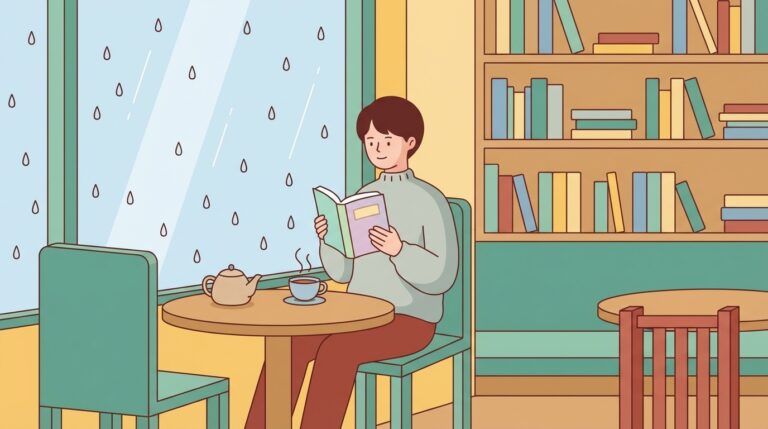
Setting: A rainy Friday evening at a cozy independent bookstore-cafe in Seochon (서촌). You are looking at the essay section. Your Korean friend, Ji-eun, who practically lives at this cafe, is with you.
Characters:
– YOU: An expat who has been working a lot of overtime lately and feeling a bit of burnout.
– 지은 (Ji-eun): 28, your close Korean friend. Very empathetic and a huge bookworm.
(The Dialogue)
지은: 요즘 회사 일 때문에 많이 바쁘다며? 얼굴이 반쪽이 됐어. 🥺
(yojeum hoesa il ttaemune mani bappeudamyeo? eolguri banjjogi dwaesseo.)
[Translation: I heard you’ve been really busy with work lately? You’ve lost so much weight (lit: Your face became half).]
(🎭 Stage Direction: Ji-eun looks at you with concern and hands you a warm cup of Yuja tea.)
YOU: 응, 매일 야근이야. 진짜 번아웃 온 것 같아.
(eung, maeil yageuniya. jinjja beonaut on geot gata.)
[Translation: Yeah, I’m working overtime every day. I feel like I’m really getting burned out.]
지은: 많이 힘들었지? 오늘도 수고했어. 토닥토닥.
(mani himdeureotji? oneuldo sugohaesseo. todaktodak.)
[Translation: It’s been really hard, hasn’t it? You worked hard today too. Pat pat.]
YOU: 고마워. 이 문장 들으니까 좀 위로가 되네.
(gomawo. i munjang deureunikka jom wiroga doene.)
[Translation: Thanks. Hearing that sentence brings me some comfort.]
지은: 이 책 한번 읽어볼래? 내가 힘들 때 읽었던 에세이인데, 되게 좋아.
(i chaek hanbeon ilgeobollae? naega himdeul ttae ilgeotdeon eseiinde, doege joa.)
[Translation: Do you want to read this book? It’s an essay I read when I was struggling, and it’s really good.]
(🎭 Stage Direction: Ji-eun hands you a book with a cute illustration on the cover.)
YOU: ‘애쓰지 않아도 괜찮아’… 제목이 참 따뜻하다.
(‘aesseuji anado gwaenchana’… jemogi cham ttatteutada.)
[Translation: ‘It’s okay not to push yourself’… The title is really warm.]
지은: 맞아. 너무 완벽하려고 애쓰지 마. 충분히 잘하고 있으니까.
(maja. neomu wanbyeokaryeogo aesseuji ma. chungbunhi jalhago isseunikka.)
[Translation: Exactly. Don’t try so hard to be perfect. You’re already doing well enough.]
🔀 Your Turn! How do you reply to Ji-eun?
– A) “아니야, 나는 더 열심히 해야 해!” (No, I need to work harder!)
– B) “고마워. 지은아, 우리 떡볶이 먹으러 갈까?” (Thanks. Ji-eun, should we go eat Tteokbokki?)
– C) “너도 수고해!” (You work hard too!)✅ Best Choice: B — Reason: In Korea, reciprocating emotional comfort with a suggestion to eat comfort food (like Tteokbokki) is the ultimate way to say “Your words cheered me up, let’s bond.”
⚠️ Choice C Analysis: Saying “수고해” to a friend out of nowhere sounds like you are abruptly ending the conversation and telling them to go back to work!
Phase 6: 10-Second Shadowing Drill
Read these out loud! Pay attention to the slashes for pauses and match the emotional tags.
- 🥺 Empathetic & Soft:
많이 / 힘들었지? / 오늘도 / 수고했어.
(mani / himdeureotji? / oneuldo / sugohaesseo.) -
😌 Warm & Reassuring:
너무 완벽하려고 / 애쓰지 않아도 / 괜찮아요.
(neomu wanbyeokaryeogo / aesseuji anado / gwaenchannayo.) -
😊 Friendly & Cheering up:
우리 / 맛있는 거 / 먹으러 가자!
(uri / masinneun geo / meogeureo gaja!)
Phase 7: K-Culture Mini Dictionary
| Korean | Romanization | English | Cultural Context |
|---|---|---|---|
| 힐링 | hilling | Healing | Konglish term used for anything that cures mental exhaustion (cafes, trips, books). |
| 위로 | wiro | Comfort / Consolation | The act of providing emotional support. |
| 번아웃 | beonaut | Burnout | Frequently used among Korean office workers due to high-stress environments. |
| 소확행 | sohwakhaeng | Small but certain happiness | A trending lifestyle keyword. e.g., Drinking a cold beer after work, or reading a good essay. |
| 공감 | gonggam | Empathy / Relating | “공감돼요” (I relate to this) is the highest praise for a Korean essay. |
Phase 8: Traveler’s Survival Kit (Bookstore Edition)
Since these beautiful essays are often purchased at places like Kyobo Bookstore or aesthetic indie bookshops in Seoul, here is what you need to know to navigate a Korean bookstore!
🆘 Survival Phrases for the Bookstore
– 🇰🇷 “에세이 코너가 어디예요?” (esei koneoga eodiyeyo?)
– 🗣️ Meaning: Where is the essay section?
– 🇰🇷 “이 책 재고 있나요?” (i chaek jaego innayo?)
– 🗣️ Meaning: Do you have this book in stock? (Show them a screenshot on your phone!)
– 🇰🇷 “선물 포장 되나요?” (seonmul pojang doenayo?)
– 🗣️ Meaning: Can you gift-wrap this?📌 Editor’s Travel Note
– Useful Bookshops: Kyobo Bookstore (Gwanghwamun branch is legendary), Starfield Library (COEX), or indie spots in Yeonnam-dong.
– Pro Tip: In major bookstores, there are “Book Search Computers” (도서 검색대) where you can type the title and print a tiny receipt showing the exact shelf location! No need to ask staff if you’re shy.
Phase 9: Critical Thinking — “A Step Deeper”
Language & Society: The Shadow of “Ppalli-Ppalli”
Why does a simple phrase like “It’s okay not to push yourself” bring Koreans to tears? To understand this, you must understand Korea’s highly competitive, fast-paced society. From a young age, Koreans face intense academic pressure, followed by rigorous corporate competition. The culture of Ppalli-Ppalli (hurry, hurry) and perfectionism leaves little room for failure.
Therefore, bestselling essays in Korea serve as a societal counterbalance. They are a quiet rebellion against the pressure to be perfect. When you learn these phrases, you aren’t just learning vocabulary; you are learning how Koreans mentally survive and heal each other in a demanding world.
💬 Your Turn: Does your country have a specific genre of books or media that people turn to when they are burned out? Share it in the comments!
Phase 10: FAQ & Avoiding Misunderstandings
Q: Can I write “수고했어요” in a fan letter to my favorite idol?
Yes, absolutely! Fans use “오늘도 수고했어요” all the time on platforms like Weverse or bubble. It shows that you appreciate the hard work they put into their performances.
Q: If I’m talking to my boss who looks tired, can I say “애쓰지 않아도 괜찮아요”?
NO! 🚫 Please don’t! If you say this to a superior, it sounds like you are evaluating their work or telling them they are incompetent. To a boss, simply say “따뜻한 차 한잔 드세요” (Please have a cup of warm tea) or use “고생 많으셨습니다” (You worked very hard) at the end of the day.
❌ Common Mistake #1: Saying “힘내세요!” (Cheer up!) to someone who is grieving or deeply depressed.
✅ Do this instead: Say “제가 옆에 있을게요” (I’ll be by your side) or simply “많이 힘들었죠?” (It was hard, right?). Let them feel their emotions.
Phase 11: Summary & Action Items
One-Liner Summary: True comfort in Korean isn’t about telling someone to stop being sad; it’s about acknowledging their hard work (수고했어요) and validating their struggles (애쓰지 않아도 괜찮아요).
🎯 Action Missions:
– 🥉 Bronze: Stand in front of a mirror and say “(Your name), 오늘도 수고했어! 토닥토닥” to yourself right now.
– 🥈 Silver: Leave a comment on your favorite K-Pop idol’s social media or a Korean friend’s Instagram saying: “오늘 하루도 수고했어요! 😊”
– 🥇 Gold: Next time a Korean friend or language partner says they are tired, use “많이 힘들었지?” instead of “Why?”
🌸 K-Culture Mission: Go to a site like Kyobo Books (교보문고) or Yes24 online, search for the ‘에세이’ (Essay) bestseller section, and try to translate the titles of the top 3 books. You’ll be amazed at how poetic they are!
Phase 12: Interactive Quiz
1. Situational Judgment: Your close Korean friend texts you: “I failed the job interview again… I’m so exhausted.” Which is the MOST empathetic response?
– A) 슬퍼하지 마! 다음엔 잘할 거야. (Don’t be sad! You’ll do better next time.)
– B) 많이 힘들었지? 우리 이따가 맛있는 거 먹자. (It was hard, right? Let’s eat something delicious later.)
– C) 수고하세요! (Work hard!)
2. Fill in the Blank:
“너무 완벽하려고 _______ 않아도 괜찮아요.”
(Hint: You don’t have to push yourself / try so hard)
3. True or False – Culture Edition:
In Korea, offering someone food (like Tteokbokki or a warm meal) is considered a legitimate way to comfort someone who is sad. (T/F)
(Answers: 1. B, 2. 애쓰지, 3. True!)
Frequently Asked Questions (FAQ)
Q: What does "애쓰지 않아도 괜찮아요 (It's okay not to push yourself so hard)" mean in Korean and how do you pronounce it?
A: In Korean, "애쓰지 않아도 괜찮아요 (It's okay not to push yourself so hard)" is pronounced [aesseuji anado gwaenchannayo [Eh-sseu-jee ahn-ah-do gwen-chan-ah-yo] and means: (Literal) It is okay even if you don't make an effort. / (Real Nuance) You don't have to push yourself to the breaking point. You are enough as you are.
Q: What does "오늘도 수고했어요 (You worked hard again today)" mean in Korean and how do you pronounce it?
A: In Korean, "오늘도 수고했어요 (You worked hard again today)" is pronounced [oneuldo sugohaesseoyo [Oh-neul-do soo-go-hess-uh-yo] and means: (Literal) You suffered/toiled today too. / (Real Nuance) You did a great job today. I acknowledge your hard work.
Q: What does "토닥토닥 (Pat pat)" mean in Korean and how do you pronounce it?
A: In Korean, "토닥토닥 (Pat pat)" is pronounced [todaktodak [Toh-dak-toh-dak] and means: (Literal) The sound of lightly patting. / (Real Nuance) "There, there." / Sending a virtual hug.







