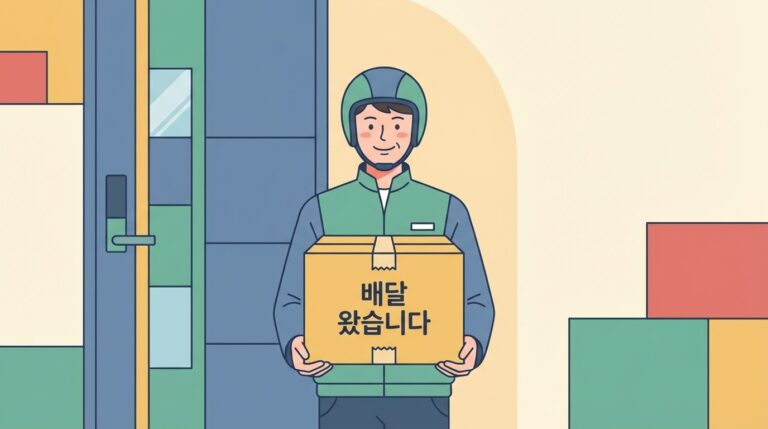
Phase 1: Empathy (The K-Culture Cold Open)
Hello! I am the Senior Editor of Daily Hangul.
Picture this: You finally navigated a Korean online shopping site. You successfully ordered that K-Pop album or the viral K-Beauty toner everyone is raving about. You are waiting excitedly. Suddenly, your phone rings. It’s an unknown 010 number. Or worse, you get a text entirely in Korean that starts with “[CJ대한통운] 택배 기사입니다…”
Panic sets in. What do they want? Do I need to be home? What if they take my package away?
If you’ve ever stared at your phone, terrified to answer because you didn’t know what to say to the Korean delivery driver (Taekbae Gisanim), you are not alone! I’ve had so many students tell me they just let it ring and hope for the best.
But here is the good news: Korean delivery culture is all about speed and convenience (Bali-bali culture!). You don’t need a long conversation. Knowing just a few simple phrases will make you look like a total local—and ensure your precious K-goods arrive safely. Let’s dive in!
Phase 2: Core Phrases Deep Dive
Here are the 3 most important phrases you need when the delivery driver contacts you.
1. 문 앞에 두고 가주세요.
- Pronunciation: [Mun ap-e / du-go / ga-ju-se-yo.] (The ‘mun ap-e’ sounds like moon ah-peh)
- Meaning: Literal: “Please leave it in front of the door and go.” / Real nuance: “Please leave it at the door.”
- K-Culture Moment: You know those K-Drama scenes where the main character opens their apartment door, and there is a mountain of boxes waiting for them? This phrase makes that happen. In Korea, package theft is incredibly rare, so leaving things at the door is the default!
- Editor’s Insight: You don’t need to overthink it. This is the ultimate “safe” phrase. You can say it on the phone or copy-paste it into a text message.
- Situation Spectrum:
- Casual (Friends): 🚫 (Too formal for friends)
- Service Workers/Drivers (Polite): ✅
- Highly Formal (Bosses): ⚠️ (Not used in office settings)
- 🤔 Think About It: Korea is a high-trust society. Packages, laptops in cafes, and wallets are rarely stolen. How does this compare to delivery culture in your home country?
2. 경비실에 맡겨주세요.
- Pronunciation: [Gyeong-bi-sil-e / mat-gyeo-ju-se-yo.] (‘Gyeong-bi-sil’ sounds like gyung-bee-sheel)
- Meaning: “Please leave it at the security office.”
- K-Culture Moment: If you live in an officetel or an apartment in Korea, the Gyeongbi-ajeossi (security guard) is the guardian of the building. Sometimes drivers prefer leaving packages there if you aren’t home.
- Editor’s Insight: If you don’t want a box sitting in the hallway (maybe it’s a birthday gift for your roommate!), this is your go-to phrase.
- Situation Spectrum:
- Casual (Friends): 🚫
- Service Workers/Drivers (Polite): ✅
3. 공동현관 비밀번호는 ___입니다.
- Pronunciation: [Gong-dong-hyeon-gwan / bi-mil-beon-ho-neun / ___ / im-ni-da.]
- Meaning: “The main entrance password is ___.”
- K-Culture Moment: This is the #1 reason drivers text you! Modern Korean buildings have a locked sliding glass door at the ground floor (gong-dong-hyeon-gwan). If the driver can’t get in, they will ask for the password.
- Editor’s Insight: Just put your 4-digit code in the blank. For example, “비밀번호는 1234입니다” (The password is 1234).
- Situation Spectrum:
- Texting the Driver: ✅
Phase 3: Textbook vs. Real Korean
How do real Koreans text their delivery drivers? It’s much shorter than what the textbooks teach!
[Replying to “Where should I leave the package?”]
* 📖 Textbook: “제 소포를 집 문 앞에 놓아 주십시오.” (Please place my parcel in front of my house door.)
* 🗣️ Real Korean: “문 앞이요! 감사합니다 :)” (At the door! Thank you :))
* 💡 Why the difference?: Drivers are busy! They appreciate short, clear answers. Adding “이요” (iyo) to a noun makes it polite but quick.
[Telling them the building password]
* 📖 Textbook: “저희 건물 공동현관 비밀번호는 일 이 삼 사 입니다.” (Our building’s main entrance password is one two three four.)
* 🗣️ Real Korean: “공동현관 1234+종소리 버튼입니다~” (Main entrance is 1234 + the bell button~)
* 💡 Why the difference?: Koreans love using the tilde (~) in texts to sound friendly and less aggressive. Also, giving the exact button sequence (like pressing the bell icon last) is super helpful!
Phase 4: Cultural Context — K-Culture Deep Dive
4-1. The Non-Verbal “Nunchi” of Deliveries
When you get a call from a delivery driver, don’t say “Hello, how are you?” Korean delivery is a fast-paced game. They have hundreds of boxes to deliver. The ultimate Nunchi (social tact) here is speed. Keep your answers brief, polite, and to the point.
4-2. The Magic of “Taekbae” (택배)
If you watch K-Dramas, you might notice people rarely go to big supermarkets to buy toilet paper or water. They order it on their phones. Why? Because of Korea’s legendary logistics network. Services like Coupang’s “Rocket Delivery” mean if you order something at 11:50 PM, it will be at your door by 7:00 AM the next morning.
Critical View: While this is incredibly convenient for consumers, it relies heavily on the intense labor of the Taekbae Gisanim. This is why Koreans always try to be polite and add “수고하세요” (Keep up the good work / Thank you for your effort) at the end of a call or text with a driver.
Phase 5: Real-Life Roleplay Scenario
Setting: It’s 2:00 PM on a Tuesday. You are sitting in a trendy cafe in Seongsu-dong, enjoying an iced Americano. Suddenly, your phone rings. It’s the delivery driver dropping off your new sneakers.
Characters:
* YOU: An expat living in Korea. Your Korean is at an A2 level, but you are ready!
* Taekbae Gisanim: The delivery driver. Speaks fast, very busy.
Dialogue:
Gisanim: 여보세요, 택배입니다. 집에 계신가요? 📦
(Yeoboseyo, taekbae-imnida. Jibe gyesin-gayo?)
[Hello, this is the delivery. Are you at home?]
YOU: 아, 아니요. 지금 집에 없어요.
(A, aniyo. Jigeum jibe eopseoyo.)
[Ah, no. I’m not home right now.]
Gisanim: 그럼 물건 어디에 둘까요?
(Geureom mulgeon eodie dulkkayo?)
[Then where should I leave the package?]
🔀 Your Turn! How should you respond?
* A) “누구세요?” (Who are you?)
* B) “문 앞에 두고 가주세요.”
* C) “내일 오세요.” (Come tomorrow.)✅ Best Choice: B — “Please leave it at the door.”
⚠️ Why not C?: Drivers have strict routes. Asking them to come back tomorrow messes up their schedule and isn’t a common practice in Korea.
(You chose B)
YOU: 문 앞에 두고 가주세요. 감사합니다!
(Mun ap-e dugo gajuseyo. Gamsahamnida!)
[Please leave it at the door. Thank you!]
Gisanim: 네, 알겠습니다. 공동현관 비밀번호 문자로 남겨주세요.
(Ne, algetseumnida. Gongdonghyeongwan bimilbeonho munjaro namgyeojuseyo.)
[Yes, understood. Please leave the main entrance password via text message.]
YOU: 네, 문자로 보낼게요. 수고하세요!
(Ne, munjaro bonaelgeyo. Sugohaseyo!)
[Yes, I’ll send it by text. Keep up the good work!]
Phase 6: 10-Second Shadowing Drill
Let’s practice the flow of the sentence. Follow the pauses (/) and the emotion tags!
- 😊 Polite & Clear:
문 앞에 / 두고 / 가주세요~
(Mun ap-e / du-go / ga-ju-se-yo~) - 🙏 Grateful Ending:
감사합니다. / 수고하세요!
(Gam-sa-ham-ni-da. / Su-go-ha-se-yo!)
Phase 7: K-Culture Mini Dictionary
| Korean | Romanization | English | Context |
|---|---|---|---|
| 택배 | taekbae | Delivery / Parcel | The general term for package delivery services in Korea. |
| 기사님 | gisa-nim | Driver (Respectful) | Added to “택배” (Taekbae Gisanim) to respectfully address the driver. |
| 경비실 | gyeongbisil | Security Office | Often located at the entrance of apartment complexes. |
| 착불 | chakbul | Pay on Delivery | You pay the shipping fee directly to the driver when it arrives. (Rare nowadays, but good to know!) |
| 부재중 | bujaejung | Missed call / Not home | You’ll see this on missed call logs or delivery slips. |
Phase 8: Traveler Survival Kit
Wait, I’m just a tourist! Do I need to know about Taekbae?
Actually, YES! Many tourists use delivery services to send heavy luggage from their hotel to Incheon Airport, or they order K-Pop albums to be delivered directly to their hotel.
🆘 Survival Phrases for Travelers
* 🇰🇷 “프론트에 맡겨주세요.” (Peuronteu-e matgyeo-juseyo.)
* 🗣️ Pronunciation: [Peu-ron-teu-e / mat-gyeo-ju-se-yo]
* 📍 Where to use: Getting packages delivered to your hotel.
* 💡 Pro Tip: ALWAYS ask your hotel front desk for permission before ordering something to the hotel. Some hotels don’t accept guest packages.📌 Editor’s Travel Note
* If a driver calls and you don’t speak Korean well, you can hand the phone to the hotel receptionist and say: “택배 전화예요. (Taekbae jeonhwa-yeyo – It’s a delivery call).”
Phase 9: Critical Thinking — “One Step Deeper”
Language & Power: The Magic of “-Nim” (님)
Why do we call the delivery driver Gisanim (기사님) instead of just Gisa (기사)? In Korean, adding the suffix “-nim” is a way to bestow respect and acknowledge someone’s professional role. Historically, Korean society was highly hierarchical, but modern Korean language uses honorifics to create a respectful distance and show appreciation for service workers. Calling someone “Taekbae-ajeossi” (delivery middle-aged man) used to be common, but today, “Taekbae-gisanim” is the standard because it respects their profession.
🧠 Think Deeper:
The Korean language builds respect into its very grammar. By adding “-nim” and using formal verbs, you aren’t just communicating a fact; you are confirming a social contract of mutual respect.💬 Your Turn: Does your language have a specific respectful title for service workers like delivery drivers or taxi drivers? Share it in the comments!
Phase 10: FAQ & Common Mistakes
Q: Should I call the driver back if I missed their call?
Mostly, no. Check your text messages first. Drivers almost always send an automated text if you don’t answer. You can simply reply to that text.
Q: Can I use Banmal (casual speech) if the driver sounds young?
Absolutely not! You have a customer-service provider relationship. You must always use formal language (존댓말 – Jondaetmal), ending your sentences with “~요” or “~습니다”.
❌ Common Mistake #1: Saying “너” (You) to the driver.
✅ Do this instead: Never use the word “You” in Korean to a stranger. Just drop the subject entirely. Instead of saying “Can you leave it at the door?”, just say “Leave it at the door, please” (문 앞에 두고 가주세요).
Phase 11: Summary & Action Items
One-Liner Summary: When the Korean delivery driver contacts you, don’t panic—just politely tell them where to leave the package!
Your Action Missions for Today:
* 🥉 Bronze (Solo): Stand in front of your door and say “문 앞에 두고 가주세요” out loud 3 times.
* 🥈 Silver (Online): Change your delivery preference on a Korean app (like Coupang or Baemin) to “문 앞에 두고 가주세요” so you don’t have to talk next time!
* 🥇 Gold (Real Life): The next time you order something in Korea, reply to the driver’s text with “문 앞이요! 감사합니다 :)”
K-Culture Mission:
Next time you watch a K-Drama, look closely at the doors in apartment hallways. You will almost certainly see standard cardboard Taekbae boxes sitting quietly, waiting for their owners!
Engagement: What is the strangest or most interesting thing you’ve ever ordered online in Korea? Let me know below!
Phase 12: Interactive Quiz Challenge
Test your new Taekbae skills!
1. Situational Judgment:
You receive a text: “[CJ대한통운] 부재중으로 연락드립니다. 물건 어디에 둘까요?” (You weren’t home. Where should I put the package?) What is the most natural A2-level text reply?
* A) 저는 학교에 있습니다. (I am at school.)
* B) 문 앞이요! 감사합니다.
* C) 기사님, 내일 오세요.
2. True or False – K-Culture Edition:
In Korea, it is common to give the delivery driver a tip when they drop off your package. (T/F)
(Answers below)
.
.
.
Answers:
* 1. B (Telling them you are at school doesn’t answer their question of where to put the box. Asking them to come tomorrow is a hassle! B is perfect.)
* 2. False! Korea is a strictly no-tipping culture. Delivering the package is part of the service. A warm “수고하세요!” (Keep up the good work) is the best tip you can give!
Frequently Asked Questions (FAQ)
Q: What does "문 앞에 두고 가주세요." mean in Korean and how do you pronounce it?
A: In Korean, "문 앞에 두고 가주세요." is pronounced [Mun ap-e / du-go / ga-ju-se-yo.] and means: Literal: "Please leave it in front of the door and go." / Real nuance: "Please leave it at the door."
Q: What does "경비실에 맡겨주세요." mean in Korean and how do you pronounce it?
A: In Korean, "경비실에 맡겨주세요." is pronounced [Gyeong-bi-sil-e / mat-gyeo-ju-se-yo.] and means: "Please leave it at the security office."
Q: What does "공동현관 비밀번호는 ___입니다." mean in Korean and how do you pronounce it?
A: In Korean, "공동현관 비밀번호는 ___입니다." is pronounced [Gong-dong-hyeon-gwan / bi-mil-beon-ho-neun / ___ / im-ni-da.] and means: "The main entrance password is ___."