

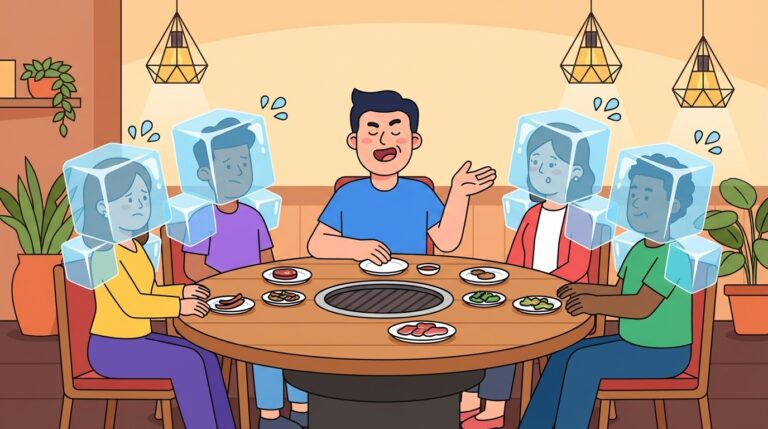
Phase 1: Empathy & The “Cold Open”
Hello there! This is your Lead Editor from Daily Hangul.
Picture this: You are watching your favorite Korean variety show like Running Man or Knowing Bros. The cast is laughing, the energy is high, and then… someone cracks a terrible joke. Suddenly, literal CGI ice blocks freeze the screen, a cartoon crow flies by making a loud caw-caw sound, and the background music completely stops. The subtitle on the screen flashes: 갑분싸.
Maybe you’ve experienced this in real life, too. You are at a lively Korean BBQ dinner, and you say something you thought was funny, but everyone suddenly looks down at their phones, and you can only hear the sound of the pork belly sizzling.
If you don’t know the phrase we are learning today, you might just sit there sweating. But if you do, you can use it to playfully save the day! Today, we are diving into one of the most widely used slang terms in modern Korean: 갑분싸 (Gap-bun-ssa). This guide is based on real moments my intermediate (B1) students have faced, so trust me, you’ll want to add this to your survival kit!
Phase 2: Core Expressions Deep Dive
1. 갑분싸 (Gap-bun-ssa)
- Pronunciation: [gap-bun-ssa]
- Sound analogy: ‘Gap’ sounds like the English word gap. ‘Bun’ sounds like bunny. ‘Ssa’ sounds like the sharp hissing sound a snake makes, or the first part of ‘sour’.
- Meaning:
- Literal: Suddenly (갑자기) + Mood (분위기) + Gets chilled/awkward (싸해짐).
- Real nuance: A sudden vibe killer, awkward silence, or crickets.
- K-Culture Moment: You are at a company Hoesik (회식 – staff dinner). Your boss makes an awful dad joke (아재개그). Nobody wants to laugh, but nobody wants to be rude either. The air gets incredibly heavy. That frozen moment? That is the definition of 갑분싸.
- Editor’s Insight: This word is all about the ‘feeling’ of the room dropping 10 degrees. You use it to call out the awkwardness, which ironically, often breaks the ice and makes people laugh!
- Situation Spectrum:
- 친구 사이 (Casual with friends): ✅ Perfect to tease them.
- 직장 동료 (Semi-formal with close coworkers): ⚠️ Okay, but keep it playful.
- 직장 상사·어른 (Formal with boss/elders): 🚫 Never direct this at an elder!
- 🤔 Think About It: Why does Korean have a specific abbreviated word just for an “awkward mood”? Does your native culture place this much emphasis on the collective “vibe” of a room?
2. 눈치 챙겨 (Nun-chi chaeng-gyeo)
- Pronunciation: [nun-chi chaeng-gyeo]
- Sound analogy: ‘Nun’ like noon, ‘chi’ like cheese. ‘Chaeng’ rhymes with hang, ‘gyeo’ sounds like the ‘gyu’ in regular but with an ‘eo’ (aw) sound.
- Meaning:
- Literal: Pack/take care of your nunchi.
- Real nuance: Read the room! / Get a clue!
- K-Culture Moment: A friend is complaining about being single in front of a couple who just had a fight. You nudge your friend under the table and whisper, “눈치 챙겨!”
- Editor’s Insight: Nunchi is the Korean superpower of social awareness. When someone lacks it, you tell them to “pack” it, as if they left their common sense at home.
- Situation Spectrum:
- 친구 사이 (Casual): ✅
- 직장 동료 (Semi-formal): 🚫 Too aggressive for work.
- 직장 상사·어른 (Formal): 🚫 Absolutely not.
- 🤔 Think About It: Is “reading the room” considered a polite skill or a stressful obligation in your culture?
Phase 3: Textbook vs. Real Korean
[Situation 1: When your friend tells a terrible, unfunny joke]
* 📖 Textbook Korean: 분위기가 갑자기 어색해졌어요. (The atmosphere suddenly became awkward.)
* 🗣️ Real Korean: 아, 완전 갑분싸. (Ah, total gapbunssa.)
* 💡 Why the difference?: Gen Z and Millennials created 3-syllable abbreviations (줄임말) for efficiency in internet chatting. Typing out “The mood became awkward” is too slow for the fast-paced Korean internet (Ppalli-ppalli culture)!
[Situation 2: When someone is being completely oblivious]
* 📖 Textbook Korean: 상황을 잘 파악하세요. (Please grasp the situation well.)
* 🗣️ Real Korean: 야, 눈치 좀 챙겨! (Hey, pack some nunchi!)
* 💡 Why the difference?: In Korean culture, abstract social skills like nunchi are treated like tangible objects. You can “have” it, “lack” it, or “pack” it.
Bottom Note: For B1 learners, using “갑분싸” with friends makes you sound incredibly fluent. Just remember not to use it when you are the one who made a serious mistake—it’s meant to be a humorous observation of the atmosphere!
Phase 4: Cultural Context — K-Culture Deep Dive
4-1. Non-Verbal Elements
When a 갑분싸 moment happens, Koreans don’t just use the word—they use their eyes. We call this 눈치 보기 (reading the nunchi).
If you cause a gapbunssa, do not maintain aggressive eye contact. Look down slightly, maybe awkwardly sip your water, or let out a small, embarrassed laugh (“아하하…”). Acknowledging your own awkwardness is the best way to melt the ice.
4-2. K-Culture Connection: The World of K-Variety Shows
You cannot talk about 갑분싸 without talking about K-Variety shows (예능 – yeneung).
In dramas, characters might say perfectly scripted lines. But in reality shows like Running Man, celebrities are constantly trying to be funny. When a comedian’s joke falls flat, the editors turn it into a masterpiece. They will literally put an ice-block CG effect on the screen, mute the audio, and play a crow sound effect (까악- 까악-).
Critical Viewpoint: Why do editors do this? By officially labeling the moment as “awkward,” the editors save the comedian from actual embarrassment. The “failure” of the joke becomes the joke itself. It’s a brilliant cultural mechanism to protect the group’s harmony!
Phase 5: Real-Life Roleplay Scenario
Setting: Friday night, 7 PM. A bustling Korean BBQ restaurant near Gangnam Station. The air is thick with the smell of roasting meat. You are at a team Hoesik (dinner) with your Korean coworkers.
Characters:
– YOU: An expat who has been working in Seoul for 6 months. You want to bond with the team.
– Min-su (32): Your friendly, slightly goofy coworker who helps you out.
– Bujang-nim (50s): The Team Manager. A nice guy, but notorious for his terrible dad jokes.
Dialogue:
Bujang-nim: 여러분, 세상에서 가장 뜨거운 바다는 어딘지 알아요? 열바다예요! 껄껄껄! 🌊🔥
(Yeoreobun, sesang-eseo gajang tteugeoun badaneun eodinji arayo? Yeol-bada-yeyo! Kkeol-kkeol-kkeol!)
(Everyone, do you know what the hottest ocean in the world is? The ‘Ten-Ocean’ [Pun on ‘Yeol-bada’ which sounds like getting angry]! Hahaha!)
(🎭 Stage Direction: Min-su freezes with a piece of lettuce halfway to his mouth. The whole table goes dead silent.)
Min-su: (Whispering to you) 와… 진짜 너무 재미없다.
(Wa… jinjja neomu jaemieopda.)
(Wow… that is really not funny.)
Bujang-nim: 흠흠, 왜 다들 조용해요? 내 농담이 별로예요?
(Heum-heum, wae dadeul joyong-haeyo? Nae nongdami byeollo-yeyo?)
(Ahem, why is everyone so quiet? Was my joke not good?)
🔀 YOUR TURN! How do you respond to the Boss?
– A) “아하하… 네, 부장님. 완전 갑분싸네요!” (Hahaha… Yes, Boss. Total gapbunssa!)
– B) “아닙니다! 부장님 농담 너무 재밌습니다!” (Not at all! Your joke is so funny!)
– C) (To Min-su softly) “민수 씨, 이게 진짜 갑분싸군요.” (Min-su, this is true gapbunssa.)✅ Best Choice: C (or B).
– Reasoning: In a formal work setting, saying “갑분싸” directly to the boss (Choice A) is a huge faux pas. It can actually insult him. Choice B is the classic, polite “social survival” lie. Choice C is great because you are acknowledging the cultural moment privately with your peer without offending the boss!
Phase 6: 10-Second Shadowing Drill
Practice making the phrase sound natural. Follow the pauses (/) and emotions!
- 😤 Playfully annoyed at a friend:
야, / 너 때문에 / 갑분싸 됐잖아!
(Ya, / neo ttaemune / gapbunssa dwaetjana!)
Hey, because of you, the mood got killed! -
🥺 Embarrassed after your own bad joke:
어... / 헐, / 갑분싸 죄송합니다...
(Eo… / heol, / gapbunssa joesonghamnida…)
Uh… wow, sorry for making it awkward…
Phase 7: K-Culture Mini Dictionary
| 한국어 | Romanization | English | Context / Meaning |
|---|---|---|---|
| 눈치 | nunchi | Social awareness | The crucial ability to read the room and anticipate others’ feelings. |
| 회식 | hoesik | Company dinner | A core part of Korean corporate culture, usually involving food and drinks. |
| 아재개그 | ajae-gaegeu | Dad joke | Unfunny puns usually made by older men (ajusshi). The leading cause of gapbunssa! |
| 낄끼빠빠 | kkil-kki-ppa-ppa | Know when to join/leave | An abbreviation meaning “join when you should join, leave when you should leave.” |
Phase 8: Traveler Survival Kit
Even if you aren’t at a company dinner, as a traveler, you might accidentally cause a “갑분싸” moment by making a cultural mistake (like walking into a traditional restaurant with your muddy shoes on!). Here is how to survive:
🆘 Survival Phrases: The “I Made a Mistake” Kit
– 🇰🇷 “제가 잘 몰라서요. 죄송합니다.” (jega jal mollaseoyo. joesonghamnida.)
– 🗣️ Meaning: I didn’t know well. I’m sorry.
– 📍 When to use: When you accidentally break a Korean etiquette rule and the room goes quiet.
- 🇰🇷 “신발 벗어야 돼요?” (sinbal beoseoya dwaeyo?)
- 🗣️ Meaning: Do I need to take off my shoes?
- 📍 When to use: Before stepping onto a raised wooden floor in a restaurant.
📌 Editor’s Travel Note
Koreans are generally very forgiving of foreigners’ mistakes! If you accidentally cause a gapbunssa, don’t panic. A polite smile, a slight bow, and “Joesonghamnida” will instantly warm the atmosphere back up.
Phase 9: Critical Thinking Corner — “One Step Deeper”
🧠 Think Deeper: Language & Power
Why are there so many words in Korean for “reading the room” (눈치, 갑분싸, 낄끼빠빠)? Korean society has historically been highly collective, valuing group harmony (분위기) over individual expression. A “vibe killer” isn’t just mildly annoying; they are momentarily threatening the social harmony of the group. Therefore, the ability to read the unspoken hierarchy and mood is a vital survival skill. The fact that young people created the playful slang gapbunssa shows a modern, humorous way of dealing with this heavy social pressure.
💬 Your Turn: In your culture, if someone ruins the mood of a group, how do people react? Do they call it out, or pretend it didn’t happen? Let us know in the comments!
Phase 10: FAQ & Common Mistakes
Q: Can I use 갑분싸 on a date?
Yes! If your date says something cheesy or tells a bad joke, playfully saying “아, 갑분싸~” while laughing is a great flirting technique. Just make sure you are smiling!
Q: Can I write 갑분싸 in a fan letter to my favorite K-Pop idol?
Absolutely. Idols use this slang all the time on V-Live or Weverse. You could say, “오빠 아재개그 갑분싸 ㅋㅋ” (Oppa’s dad joke = gapbunssa haha).
❌ Common Mistake #1:
Using 갑분싸 when you made a serious mistake at work.
✅ Do this instead: 갑분싸 is for light, humorous awkwardness. If you missed a major deadline and your boss is angry, the room is quiet, but that is NOT gapbunssa. That is an emergency. Say “죄송합니다” (I am sorry) instead!
Phase 11: Summary & Action Items
One-Liner Summary: “갑분싸 (Gap-bun-ssa)” is your go-to slang for calling out a sudden, awkward drop in the mood, usually caused by a bad joke or lack of nunchi!
Your Action Missions:
– 🥉 Bronze (Solo): Stand in front of a mirror, make an awkward face, and say “헐… 갑분싸” 3 times.
– 🥈 Silver (Online): Go to a K-Pop or K-Drama YouTube video that features an awkward moment and comment “갑분싸 ㅋㅋㅋ”.
– 🥇 Gold (Real Life): Next time your language exchange partner tells a bad joke, use it in real life!
🎬 K-Culture Mission: Watch an episode of Running Man or Knowing Bros this week. See if you can spot the moment the editors add the “freezing/crow” sound effect!
Phase 12: Quiz — Interactive Challenge
1. Situational Judgment: You are introducing yourself to your new university club in Seoul. You accidentally stumble over your words and make a strange noise. The room goes quiet. What is the most natural, charming way to recover?
– A) “저기요, 눈치 챙기세요!”
– B) “앗, 제 발음 때문에 갑분싸 됐네요. 하하!”
– C) “상황을 잘 파악하세요.”
(Spoiler: B is perfect. It shows you have great Korean nunchi and humor! A is aggressive, C sounds like a robot.)
2. Fill in the Blank:
Your friend keeps singing loudly on the subway. People are staring.
“야… 제발
[ ] 좀 챙겨!”
(Answer: 눈치 – nunchi)
3. True or False – K-Culture Edition:
If you say “갑분싸” to your company’s CEO during a formal presentation, they will be impressed by your slang skills.
(Answer: FALSE! Only use it with friends or close peers.)
Did you survive the awkwardness? Keep practicing, and soon you’ll be navigating Korean social situations like a true local! See you in the next lesson of Daily Hangul! 😊
Frequently Asked Questions (FAQ)
Q: What does "갑분싸 (Gap-bun-ssa)" mean in Korean and how do you pronounce it?
A: In Korean, "갑분싸 (Gap-bun-ssa)" is pronounced [gap-bun-ssa] and means: a key conversational Korean expression covered in this lesson.
Q: What does "눈치 챙겨 (Nun-chi chaeng-gyeo)" mean in Korean and how do you pronounce it?
A: In Korean, "눈치 챙겨 (Nun-chi chaeng-gyeo)" is pronounced [nun-chi chaeng-gyeo] and means: a key conversational Korean expression covered in this lesson.







