

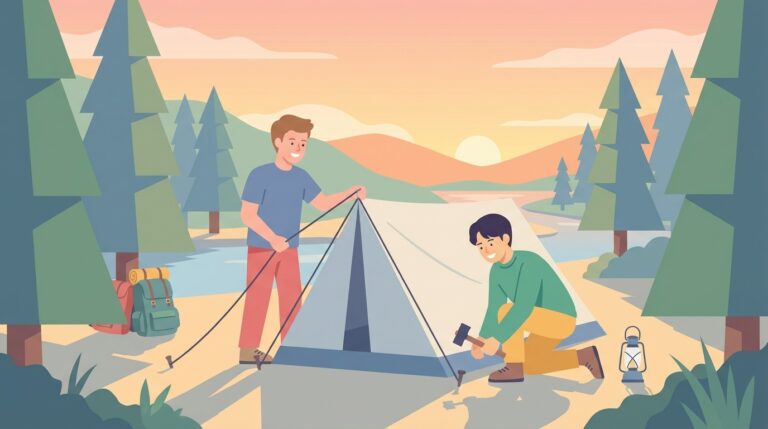
⛺ Pitching a Tent in Korea? Essential Phrases to Save Your Camping Trip!
Phase 1: Welcome to the Wild (Korean Style!)
Hello! I’m your lead editor and friendly tutor from Daily Hangul.
Picture this: You are watching a K-Variety show like In the Soop or Camping Club. The stars arrive at a beautiful campsite with a stunning lake view. But before the fun begins, they have to face the ultimate boss: Pitching the tent (텐트 치기).
Suddenly, the wind blows, the tent fabric is flying everywhere, and your Korean friend is yelling something at you while pointing at a pole. Your dictionary app says it means “pull,” but they are making a pushing motion? Panic sets in!
Camping (캠핑) and Car-camping (차박 – chabak) are massive trends in Korea. If you ever join a Korean friend for a weekend getaway to Gapyeong or the Han River, you will be asked to help with the tent. Knowing a few key phrases won’t just save the tent from collapsing; it will make you look like a total camping pro (an “Insider” or Inssa).
Note: This guide is based on real SOS questions from our A2 beginner students who found themselves tangled in tent strings!
Phase 2: Core Expressions for Tent Survival
Let’s learn the 3 most crucial phrases you need when holding a tent pole for dear life.
1. 여기 좀 잡아주세요. (Please hold this here.)
- Pronunciation: [yeogi jom jabajuseyo] -> Sounds like: “Yuh-gee johm / jaw-bah-joo-seh-yo”
- Meaning: Literal: “Please catch this here a little.” / Real nuance: “Could you hold this spot for a second?”
- K-Culture Moment: This is the most frequently used phrase when building anything in Korea. In K-Dramas, this is usually the moment when two characters’ hands accidentally touch while holding the tent pole, and romantic music starts playing!
- Editor’s Insight: The word “좀 (jom)” literally means “a little,” but we use it to soften requests. Without “좀,” it sounds like a strict military command!
- Situation Spectrum:
- Friends (Casual): ✅ (Say: 여기 좀 잡아줘 – yeogi jom jabajwo)
- Coworkers (Semi-formal): ✅ (Use the full phrase)
- Boss/Elders (Formal): ⚠️ (Better to say: 선배님, 여기 한 번만 잡아주시겠어요?)
- 🤔 Think About It: Why do Koreans add “주세요 (please give/do for me)” to verbs? It shows that the action is a favor to the speaker, reflecting a culture that highly values mutual help and politeness.
2. 이쪽으로 당겨주세요. (Please pull it this way.)
- Pronunciation: [ijjogeuro dang-gyeojuseyo] -> Sounds like: “Ee-jjog-eu-ro / dang-gyeo-joo-seh-yo”
- Meaning: Literal & Real nuance: “Please pull it toward this direction.”
- K-Culture Moment: When setting up the rainfly, the tent needs to be tight (팽팽하게). Your friend will point to themselves and say this.
- Editor’s Insight: “당기다” means to pull. (You will also see “당기세요” on doors in Korean cafes!). If they want you to push, they will say “밀어주세요” (mireojuseyo).
- Situation Spectrum:
- Friends (Casual): ✅ (이쪽으로 당겨봐 – ijjogeuro dang-gyeobwa)
- Coworkers (Semi-formal): ✅
- Boss/Elders (Formal): ⚠️
- 🤔 Think About It: In many languages, you just say “Pull!” But in Korean, specifying the direction (이쪽 – this side) is very common to avoid confusion.
3. 망치 있어요? (Do you have a hammer?)
- Pronunciation: [mangchi isseoyo?] -> Sounds like: “Mahng-chee / ee-sseo-yo?”
- Meaning: “Do you have a hammer?” or “Is there a hammer?”
- K-Culture Moment: You’ve built the frame, but now you need to secure the tent to the ground with pegs (팩). You look around… where’s the hammer? You can ask the neighboring campsite this question! Koreans are very generous campers and will often lend you tools.
- Editor’s Insight: “[Noun] 있어요?” is the ultimate A2 survival grammar. Just put the item you need in front of it!
- Situation Spectrum:
- Friends (Casual): ✅ (망치 있어? – mangchi isseo?)
- Strangers/Neighbors: ✅ (Excuse me, 저기요… 망치 있어요?)
Phase 3: Textbook vs. Real Korean
[Situation 1: Suggesting to build the tent]
* 📖 Textbook: 텐트를 설치합시다. (Let’s install the tent.)
* 🗣️ Real Korean: 텐트 칠까요? (Shall we pitch the tent?)
* 💡 Why different?: “설치하다” (install) sounds like you are installing a computer program or a refrigerator. In everyday Korean, we use the verb “치다” (to hit/pitch) for tents and curtains.
[Situation 2: When the tent is finally done]
* 📖 Textbook: 텐트 설치가 완료되었습니다. (The tent installation is complete.)
* 🗣️ Real Korean: 우와, 다 쳤다! (Wow, we’re all done!)
* 💡 Why different?: Koreans love using “다” (all/everything) to express completion. It gives a great sense of accomplishment!
[Situation 3: Thanking your friend for the hard work]
* 📖 Textbook: 도와주셔서 감사합니다. (Thank you for helping.)
* 🗣️ Real Korean: 아휴, 고생하셨어요! (Phew, you worked hard!)
* 💡 Why different?: “고생하셨어요” is the magic phrase in Korea. It acknowledges the physical effort and sweat that went into the task. It’s much warmer than just “thank you.”
Phase 4: Cultural Context — K-Culture Deep Dive
4-1. Non-Verbal Communication: The ‘Two-Hand’ Rule
When pitching a tent, you are constantly passing tools—poles, pegs, and hammers. If you are camping with someone older than you (or a boss/colleague), always pass the tools using two hands, or support your right forearm with your left hand as you hand it over. It’s a small gesture, but it screams, “I understand Korean respect!”
Also, use your Nunchi (눈치)! If your friend is holding a heavy pole and looking around frantically, don’t wait for them to ask. Hand them a peg or the hammer immediately. Good Nunchi makes you the best camping buddy.
4-2. The “Chabak (차박)” Phenomenon
If you watch recent K-Dramas or travel vlogs, you’ll see people backing their SUVs up to the ocean, opening the trunk, and attaching a small tent to the car. This is 차박 (Chabak – Car Camping). It’s incredibly popular among young Koreans because it requires less equipment than traditional camping. You don’t have to build a massive 10-person tent; you just need your car, a mattress, and of course, a portable stove for Ramyeon!
Phase 5: Real-Life Roleplay Scenario
Setting: Saturday afternoon, 4 PM. A picturesque campsite in Gapyeong, surrounded by pine trees. The sun is getting warm. You and your Korean friend, Minho, are standing in front of a giant pile of tent fabrics and poles.
Characters:
– YOU: An exchange student who has never pitched a tent in your life.
– Minho (25): Your energetic Korean friend who claims he was an expert in the army.
Dialogue:
Minho: 자, 이제 텐트 칠까요? 🏕️
(ja, ije tenteu chilkkayo?)
[Well, shall we pitch the tent now?]
(🎭 Minho hands you a long, folding pole.)
YOU: 좋아요! 근데… 이거 어떻게 해요?
(joayo! geunde… igeo eotteoke haeyo?)
[Sounds good! But… how do I do this?]
Minho: 제가 먼저 할게요. OO씨, 여기 좀 잡아주세요.
(jega meonjeo halgeyo. OO-ssi, yeogi jom jabajuseyo.)
[I’ll do it first. OO, please hold this here.]
YOU: 이렇게요?
(ireokeyo?)
[Like this?]
(🎭 You hold the pole, but it’s wobbly.)
Minho: 네! 그리고 이쪽으로 당겨주세요.
(ne! geurigo ijjogeuro dang-gyeojuseyo.)
[Yes! And please pull it this way.]
YOU: 으읏… 당겼어요!
(ee-eut… dang-gyeosseoyo!)
[Ugh… I pulled it!]
Minho: 완벽해요! 혹시 그 옆에 망치 있어요?
(wanbyeokaeyo! hoksi geu yeope mangchi isseoyo?)
[Perfect! By any chance, is there a hammer next to you?]
🔀 YOUR TURN! How do you reply?
– A) “아니요, 없어요. (No, I don’t have it.)” -> A bit blunt, but honest.
– B) “네, 여기 있어요! 두 손으로 드릴게요! (Yes, here it is! I’ll give it with two hands!)” -> Funny and shows off your cultural knowledge!
– C) “망치? 그게 뭐예요? (Hammer? What is that?)” -> Wait, didn’t you just study Phase 2?!✅ Best Choice: B — Minho will definitely laugh and appreciate your sense of humor about Korean etiquette!
Minho: 고마워요! 팩 박을게요. 쾅쾅쾅!
(gomawoyo! paek bageulgeyo. kwang-kwang-kwang!)
[Thanks! I’ll hammer the pegs. Bang bang bang!]
YOU: 우와, 다 했어요?
(uwa, da haesseoyo?)
[Wow, are we all done?]
Minho: 네, 다 쳤다! 고생하셨어요. 이제 삼겹살 먹을까요?
(ne, da chyeotda! gosaenghasyeosseoyo. ije samgyeopsal meogeulkkayo?)
[Yes, we finished pitching it! You worked hard. Shall we eat pork belly now?]
Phase 6: 10-Second Shadowing Drill
Let’s practice the most important phrase. Pay attention to the pauses (/) and the emotion tags!
🥺 애절하게 (Desperately – because the tent is falling!)
여기 좀 / 꽉! / 잡아주세요.
(yeogi jom / kkwak! / jabajuseyo)
“Please / tightly! / hold this here.”
Pro-tip: Adding “꽉 (kkwak – tightly)” makes you sound incredibly fluent!
Phase 7: K-Culture Mini Dictionary
| Korean | Romanization | English | Cultural Context |
|---|---|---|---|
| 눈치 | nunchi | Social intuition | The art of sensing what needs to be done (e.g., passing a tool before being asked). |
| 차박 | chabak | Car camping | Sleeping in your car. A huge modern K-travel trend. |
| 불멍 | bulmeong | Zong out at the fire | “불 (fire) + 멍 때리다 (to zone out)”. Staring blankly at the campfire to relieve stress. |
| 매점 | maejeom | Campsite store | The little convenience store at the campsite where you buy snacks, firewood, and ramyeon. |
Phase 8: Traveler Survival Kit
If you go camping in Korea, you will likely need to visit the campsite’s office or the 매점 (Maejeom – camp store). Here are your top survival phrases!
🆘 Survival Phrases for the Campsite
– 🇰🇷 “장작 있어요?” (jangjak isseoyo?)
– 🗣️ Meaning: Do you have firewood? (Essential for Bulmeong!)
– 🇰🇷 “쓰레기 봉투 어디서 사요?” (sseuregi bongtu eodiseo sayo?)
– 🗣️ Meaning: Where do I buy garbage bags? (Korea has strict trash sorting rules!)
– 🇰🇷 “온수 나와요?” (onsu nawayo?)
– 🗣️ Meaning: Is there hot water? (Crucial question for the shower room!)📌 Editor’s Travel Note: Can I camp at the Han River?
You might see people in tents along the Han River in Seoul. But beware! You cannot pitch a tent to sleep overnight. Only small, open pop-up tents are allowed during the day in designated zones, and they must be taken down by a specific time (usually 7 PM or 8 PM). If you violate this, you can get a heavy fine! For real camping, go to designated “캠핑장 (Camping Jang)” outside the city.
Phase 9: Critical Thinking — “One Step Deeper”
Food & Identity: Why Do Koreans Camp?
In many Western cultures, camping is about connecting with nature, hiking, and survival. But in Korea? It’s often entirely about the FOOD. Koreans will spend 2 hours pitching an elaborate, mansion-like tent, just so they can sit outside and grill Samgyeopsal (pork belly) and boil spicy Ramyeon together. The tent is merely the “dining room” for communal eating. This reflects the deep-rooted Korean belief that eating together (식구 – family/those who share meals) is the ultimate way to build strong relationships.
🧠 Think Deeper: Is camping in your home country more about “nature” or “food”? How does your culture view outdoor cooking?
💬 Your Turn: Let us know in the comments! What is the “must-eat” camping food in your country?
Phase 10: FAQ & Mistake Prevention
Q: Can I just say “잡아! (Jaba!)” to my friend?
Yes, if you are very close friends of the same age. But if you just met them, or they are older, stick to “잡아주세요 (jabajuseyo).”
Q: What if I don’t know the name of the tool?
Just point at it and say “이거 좀 주세요 (igeo jom juseyo – please give me this).” “이거” (this) is your best friend in A2!
❌ Common Mistake:
Pointing at your Korean friend’s face and saying “당신, 당겨요! (You, pull!)”
✅ How to fix it:
Never use “당신 (You)” in spoken Korean unless you are picking a fight! Instead, use their name or title: “민호 씨, 당겨주세요 (Minho, please pull).”
Phase 11: Summary & Action Items
💡 One-Liner Summary: To survive pitching a tent in Korea, remember to ask them to hold it (여기 좀 잡아주세요), pull it (당겨주세요), and use your Nunchi!
🚀 Your Action Missions:
– 🥉 Bronze (Solo): Stand up right now, grab a broom or an imaginary pole, and practice saying “여기 좀 잡아주세요” out loud 3 times!
– 🥈 Silver (Online): Go to a K-Culture community or our comment section and write: “I am ready to eat Samgyeopsal in my tent!”
– 🥇 Gold (Real Life): Next time you are doing a physical task (carrying a table, opening a door) with a Korean friend, try using “여기로 당겨주세요!”
⛺ K-Culture Mission:
Search for “BTS In the Soop camping” or “Going Seventeen camping” on YouTube and try to catch the moment they struggle with their tents. See if you can hear the word “잡아 (hold)” or “텐트 (tent)”!
Phase 12: Quiz — Interactive Challenge
1. Situational Judgment:
You are helping your older Korean coworker set up a glamping site. A pole is falling. What is the most polite and natural thing to say?
– A) 당겨!
– B) 선배님, 여기 좀 잡아주세요!
– C) 당신, 이거 하세요.
2. True or False – K-Culture Edition:
– T / F : You can pitch a large tent and sleep overnight anywhere along the Han River in Seoul.
3. Fill in the Blank:
You need a hammer to secure the tent.
“저기요… 혹시 ______ 있어요?”
(Scroll down for answers!)
…
…
…
Answers: 1. B (A is too casual, C uses the forbidden word ‘당신’). 2. False (Only pop-up tents in designated areas during the day). 3. 망치 (mangchi – hammer).
Ready to hit the campsite? Let us know your camping stories in the comments below!
Frequently Asked Questions (FAQ)
Q: What does "여기 좀 잡아주세요. (Please hold this here.)" mean in Korean and how do you pronounce it?
A: In Korean, "여기 좀 잡아주세요. (Please hold this here.)" is pronounced [yeogi jom jabajuseyo] and means: Literal: "Please catch this here a little." / Real nuance: "Could you hold this spot for a second?"
Q: What does "이쪽으로 당겨주세요. (Please pull it this way.)" mean in Korean and how do you pronounce it?
A: In Korean, "이쪽으로 당겨주세요. (Please pull it this way.)" is pronounced [ijjogeuro dang-gyeojuseyo] and means: Literal & Real nuance: "Please pull it toward this direction."
Q: What does "망치 있어요? (Do you have a hammer?)" mean in Korean and how do you pronounce it?
A: In Korean, "망치 있어요? (Do you have a hammer?)" is pronounced [mangchi isseoyo?] and means: "Do you have a hammer?" or "Is there a hammer?"







