

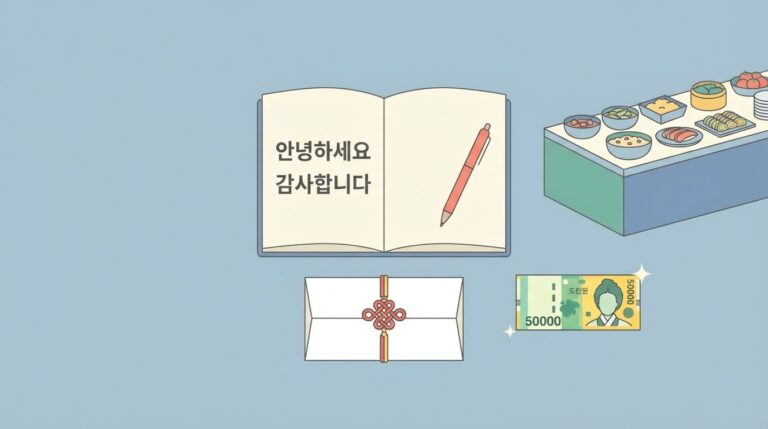
Phase 1: Empathy & K-Culture Cold Open
Hello! This is your Chief Editor at Daily Hangul.
Picture this: You’re watching your favorite office K-Drama. Two coworkers are huddled in the office pantry, whispering intensely. They aren’t gossiping about an office romance. Instead, one asks, “So… how much are you putting in the envelope for Mr. Kim’s wedding?”
Then, one day, it happens to you. You get a text message with a beautiful link—a 모바일 청첩장 (mobile wedding invitation) from a Korean friend or colleague. You’re thrilled to be invited! But then, a cold sweat breaks out. “Wait, I have to give cash? How much? Do I need a special envelope? What if I give too little and offend them?”
If you’ve ever felt this exact panic, you are not alone. In Korea, the wedding gift isn’t a blender from a registry; it’s 축의금 (Chuguigeum, congratulatory money). And deciding the exact amount is an intricate dance of Nunchi (reading the room), relationship depth, and even… the cost of the wedding buffet.
Today, we are going to demystify the unwritten rules of Korean wedding cash. Let’s make sure you walk into that wedding hall looking like a true local!
Phase 2: Core Expressions Deep Dive
Let’s look at the survival vocabulary you need when the wedding bells ring.
1. 축의금
- Pronunciation: [chu-gwi-geum] -> ‘chu’ sounds like a sneeze, ‘gwi’ sounds like ‘gwee’, ‘geum’ sounds like ‘gum’ but with an ‘uh’ sound.
- Meaning: (Literal) Congratulation intention money / (Real Nuance) Wedding cash gift; the ultimate test of your relationship.
- K-Culture Moment: You’ll see a long desk at the entrance of the wedding hall (예식장). One side says ‘Groom’ (신랑) and the other ‘Bride’ (신부). This is where you hand over your Chuguigeum envelope and receive a meal ticket in return.
- Editor’s Insight: This isn’t just money. It’s a social currency. It shows you care, and it’s a social contract that they will do the same for you in the future.
- Situation Spectrum:
- Casual friends: ✅
- Coworkers: ✅
- Boss/Elders: ✅ (Everyone uses this word!)
- 🤔 Think About It: Why do Koreans prefer cash over physical gifts for weddings? Does your culture prefer cash or a gift registry?
2. 오만 원 / 십만 원
- Pronunciation: [o-man-won / sim-man-won]
- Meaning: 50,000 KRW / 100,000 KRW
- K-Culture Moment: These are the two “golden tiers” of Korean wedding money. You give 50,000 won if you are not very close or if you are not attending the wedding. You give 100,000 won if you are attending and eating the food, or if you are fairly close to them.
- Editor’s Insight: Why 5 and 10? In Korea, odd numbers (3, 5, 7) are considered lucky. 10 is an exception because it feels “complete.” Never give 40,000 won (the number 4, ‘사’, sounds like the Chinese character for death).
- Situation Spectrum:
- Standard Colleague: ✅ (Usually 50k if not going, 100k if going)
- Best Friend: 🚫 (100k is too little for a best friend! Usually 200k+)
3. 밥값은 해야지
- Pronunciation: [bap-gap-seun hae-ya-ji]
- Meaning: (Literal) I should do the meal price / (Real Nuance) I need to give enough to at least cover the cost of my meal.
- K-Culture Moment: Korean wedding buffets are lavish and expensive (often 50,000 to 80,000 won per person). If you give 50,000 won but bring your partner and eat two meals… you’ve practically cost the couple money!
- Editor’s Insight: This expression shows the highly practical and considerate nature of Korean social etiquette. You don’t want to be a burden on the newlyweds.
- Situation Spectrum:
- Talking to yourself or a close friend: ✅
- Telling the bride/groom this directly: 🚫 (It ruins the romantic vibe!)
Phase 3: Textbook vs. Real Korean
How do Koreans actually talk about giving wedding money? Let’s compare.
[Situation 1: Asking a coworker how much they plan to give]
* 📖 Textbook: “축의금은 얼마를 낼 예정이신가요?” (How much congratulatory money do you plan to submit?)
* 🗣️ Real Korean: “이번에 축의금 얼마 할 거예요?” (How much are you going to do this time?)
* 💡 Why the difference?: Koreans use the verb 하다 (to do) instead of 내다 (to submit/pay) to make it sound less transactional and more natural.
[Situation 2: Telling them you can’t go, but will send money]
* 📖 Textbook: “결혼식에 참석하지 못하지만, 축의금은 보내겠습니다.” (I cannot attend the wedding, but I will send money.)
* 🗣️ Real Korean: “나 그날 못 가. 축의금만 보낼게, 미안해!” (I can’t go that day. I’ll just send the money, sorry!)
* 💡 Why the difference?: With friends, “축의금만 보낼게” (I’ll just send the cash gift) is the standard, practical way to apologize for your absence while showing your support.
Bottom Note: For B2 learners, mastering “얼마 할 거예요?” (How much will you do?) is a game-changer. It sounds incredibly native and polite enough for colleagues!
Phase 4: Cultural Context — K-Culture Deep Dive
4-1. The Non-Verbal “Nunchi” of the White Envelope
- Crisp Bills: Always try to use new, crisp bills (새 돈) for your Chuguigeum. It shows sincerity and preparation.
- Writing Your Name: You must write your name on the back, bottom-left corner vertically. If it’s a coworker, write your company name next to it (e.g., Daily Hangul, John Smith). There will be hundreds of envelopes, and they need to know who you are to keep their social ledger accurate!
- The Two Hands Rule: When handing the envelope to the desk staff, use two hands and give a slight bow.
4-2. The “Food Ticket” (식권 – Sik-gwon)
K-Food culture dictates that sharing a meal is the ultimate bonding experience. After you hand in your envelope, the staff will ask, “식사 하시고 가시나요?” (Are you staying for the meal?).
If you say yes, they will hand you a 식권 (Meal Ticket).
* Critical View: The wedding hall is essentially a massive, highly efficient dining operation. The ticket system ensures that only paying guests eat. While it might seem overly pragmatic or unromantic to foreigners, to Koreans, providing a lavish meal is the couple’s way of repaying the guests’ financial blessing.
Phase 5: Real-Life Roleplay Scenario
Setting: Friday afternoon in the office breakroom. You are drinking a mix-coffee with your Korean coworker, Min-su. Next week is your manager’s wedding.
Characters:
* YOU: Foreign professional working in Seoul, navigating office politics.
* Min-su (30s): Your friendly coworker who knows all the unwritten office rules.
Dialogue:
Min-su: 다음 주 팀장님 결혼식 가실 거죠?
(da-eum ju tim-jang-nim gyeol-hon-sik ga-sil geo-jyo?)
[Translation: You’re going to the manager’s wedding next week, right?]
YOU: 네, 가려고요. 한국 결혼식은 처음이라 좀 떨리네요.
(ne, ga-ryeo-go-yo. han-guk gyeol-hon-si-geun cheo-eu-mi-ra jom tteol-li-ne-yo.)
[Translation: Yes, I plan to. It’s my first Korean wedding, so I’m a bit nervous.]
Min-su: 하하, 별거 없어요. 가서 밥 맛있게 먹고 오면 돼요. 뷔페 진짜 맛있대요!
(haha, byeol-geo eop-seo-yo. ga-seo bap ma-sit-ge meok-go o-myeon dwae-yo. bwe-pe jin-jja ma-sit-dae-yo!)
[Translation: Haha, it’s nothing special. Just go and enjoy the food. I heard the buffet is really good!]
YOU: 다행이네요. 아, 근데 궁금한 게 하나 있는데요…
(da-haeng-i-ne-yo. a, geun-de gung-geum-han ge ha-na in-neun-de-yo…)
[Translation: That’s a relief. Oh, but I have one thing I’m curious about…]
🔀 Your Turn! How do you ask Min-su about the money?
* A) “팀장님에게 돈을 얼마 줄 거예요?” (How much money will you give the manager?)
* B) “민수 씨는 축의금 얼마 하실 거예요?” (How much Chuguigeum are you going to do?)
* C) “축의금 오만 원이면 충분해요?” (Is 50,000 won enough for Chuguigeum?)✅ Best Choice: B — It is natural, polite, and uses the correct phrasing “얼마 하실 거예요?” to gauge the office standard.
⚠️ Choice A & C Analysis: “돈을 주다” (giving money) sounds too blunt, like paying a bill. Choice C shows your cards too early; asking if 50k is enough for a manager’s wedding when you are attending might make you look slightly cheap (managers usually get 100k!).
(Assuming you chose B)
Min-su: 음… 직접 가고 팀장님이기도 하니까, 저는 10만 원 하려고요.
(eum… jik-jeop ga-go tim-jang-ni-mi-gi-do ha-ni-kka, jeo-neun sim-man-won ha-ryeo-go-yo.)
[Translation: Hmm… Since I’m attending in person and it’s our manager, I’m going to do 100,000 won.]
YOU: 아, 그렇군요! 저도 10만 원 해야겠어요. 알려주셔서 감사합니다.
(a, geu-reo-kun-yo! jeo-do sim-man-won hae-ya-ge-sseo-yo. al-lyeo-ju-syeo-seo gam-sa-ham-ni-da.)
[Translation: Ah, I see! I should do 100,000 won too. Thanks for letting me know.]
Phase 6: 10-Second Shadowing Drill
Practice this sentence to sound incredibly natural when asking for advice!
🤔 민수 씨는 / 이번 결혼식 / 축의금 / 얼마 하실 거예요?
(min-su ssi-neun / i-beon gyeol-hon-sik / chu-gwi-geum / eol-ma ha-sil geo-ye-yo?)
Emotion Tag: Ask this slightly quietly, leaning in, with an inquisitive tone. It’s a bit of an “office secret” conversation!
Phase 7: K-Culture Mini Dictionary
| 한국어 (Korean) | Romanization | English | Context |
|---|---|---|---|
| 청첩장 | cheong-cheop-jang | Wedding Invitation | Usually sent via KakaoTalk as a ‘Mobile’ link nowadays. |
| 예식장 | ye-sik-jang | Wedding Hall | Large, dedicated buildings just for weddings, often in Gangnam. |
| 식권 | sik-gwon | Meal Ticket | The golden ticket you get in exchange for your envelope. |
| 품앗이 | pu-ma-si | Communal sharing/Reciprocity | The traditional Korean concept of helping each other with labor/money. |
| 눈치 | nun-chi | Reading the room | Knowing exactly how much cash to give based on the situation. |
Phase 8: Traveler & Expat Survival Kit
You’re dressed up, you’re at the subway station, but you forgot cash!
🆘 Survival Phrases for the Wedding Day
* 🇰🇷 “근처에 ATM(현금인출기) 어디 있어요?” (geun-cheo-e ei-ti-em [hyeon-geum-in-chul-gi] eo-di i-sseo-yo?)
* 🗣️ Meaning: Where is the nearest ATM?
* 📍 Where to use: Convenience stores, subway stations.
* 💡 Pro Tip: Almost all Korean wedding halls have an ATM on the first floor because so many people forget to bring cash until the last minute! Be prepared for a long line at that specific ATM.📌 Editor’s Travel Note
* Envelopes: Forgot your white envelope? Don’t panic. Every wedding hall has stacks of blank white envelopes and pens right next to the ATM or the reception desk.
* App: Use KakaoMap to search “현금인출기” near your location if the hall’s ATM is broken.
Phase 9: Critical Thinking Corner — “A Step Deeper”
Social Ties and Reciprocity (품앗이 Culture)
To an outsider, handing over an envelope of cash right before entering a wedding might feel transactional, almost like buying a ticket to an event. But let’s look deeper. This stems from the traditional Korean agrarian culture called 품앗이 (Pumasi)—communal sharing of labor and resources.
Weddings are incredibly expensive. By bringing cash, the community collectively lessens the financial burden on the new couple’s family. It’s an unspoken promise: “I support your milestone today, and when it’s my turn, you will be there for me.” It is not cold cash; it is warm solidarity recorded in an intricate social ledger.
🧠 Think Deeper:
Does this system seem more practical to you than a wedding registry? How are financial burdens of major life events shared in your culture?💬 Your Turn: “Tell us in the comments: What is the standard wedding gift in your home country?”
Phase 10: FAQ & Common Mistakes
Q: “Can I give 40,000 won or 60,000 won?”
No! Always stick to 3, 5, 7, 10 (in units of 10,000 won). The number 4 is considered very unlucky in Korea. 60,000 won just breaks the unspoken rule of odd numbers. Stick to 50k or 100k to be safe!
Q: “What if I bring my boyfriend/girlfriend to the wedding?”
If you bring a +1, you are taking two meal tickets. Since meals cost around 50k+ per person, you should give at least 100,000 won, ideally 150,000 won, to ensure you aren’t costing the couple money!
❌ Common Mistake #1: Handing the money directly to the bride or groom.
✅ Do this instead: They are too busy! Give it to the family members sitting at the long reception desk (축의대) outside the hall.❌ Common Mistake #2: Writing your name on the front of the envelope.
✅ Do this instead: Write it vertically on the back, bottom-left side.
Phase 11: Summary & Action Items
- One-Liner Summary: Decide your Chuguigeum (wedding cash) based on your closeness and attendance: 50,000 won for basic acquaintances, 100,000 won if you’re attending and eating!
Action Mission 3 Steps:
* 🥉 Bronze (Solo): Say “얼마 하실 거예요?” 3 times out loud, practicing a natural, inquisitive tone.
* 🥈 Silver (Online): Write down your English name in Korean vertically, just like you would on an envelope!
* 🥇 Gold (Real World): The next time you are invited to a Korean event, confidently prepare your white envelope with crisp bills!
K-Culture Mission:
Go to YouTube and search “한국 결혼식 뷔페” (Korean wedding buffet). Look at the food—now you understand why the “meal cost” dictates the cash gift!
Phase 12: Interactive Quiz
1. Situational Judgment: Your Korean language exchange partner (whom you meet once a month for coffee) is getting married. You cannot attend the wedding because you have to work. How much Chuguigeum should you transfer to them?
* A) 0 won (I’m not going, so I don’t pay!)
* B) 50,000 won
* C) 100,000 won
* D) 40,000 won
Answer: B. Since you are casual friends and not attending, 50,000 won is the perfect amount to show congratulations without being over the top.
2. True or False — K-Culture Edition:
“It is considered polite to hand your cash envelope directly to the bride while she is in the bridal waiting room (신부대기실).”
* Answer: False! The bride doesn’t have pockets in her dress! You take a photo with her in the waiting room, but you give the money to the reception desk outside.
3. Fill in the Blank:
“I should give enough money to at least cover my meal!”
= “( ____ ) 값은 해야지!”
Answer: 밥 (Bap – Meal/Rice)
Frequently Asked Questions (FAQ)
Q: What does "축의금" mean in Korean and how do you pronounce it?
A: In Korean, "축의금" is pronounced [chu-gwi-geum] and means: (Literal) Congratulation intention money / (Real Nuance) Wedding cash gift; the ultimate test of your relationship.
Q: What does "오만 원 / 십만 원" mean in Korean and how do you pronounce it?
A: In Korean, "오만 원 / 십만 원" is pronounced [o-man-won / sim-man-won] and means: 50,000 KRW / 100,000 KRW
Q: What does "밥값은 해야지" mean in Korean and how do you pronounce it?
A: In Korean, "밥값은 해야지" is pronounced [bap-gap-seun hae-ya-ji] and means: (Literal) I should do the meal price / (Real Nuance) I need to give enough to at least cover the cost of my meal.







