

Phase 1: Empathy & The K-Culture Cold Open
Hello! This is your Daily Hangul Editor.
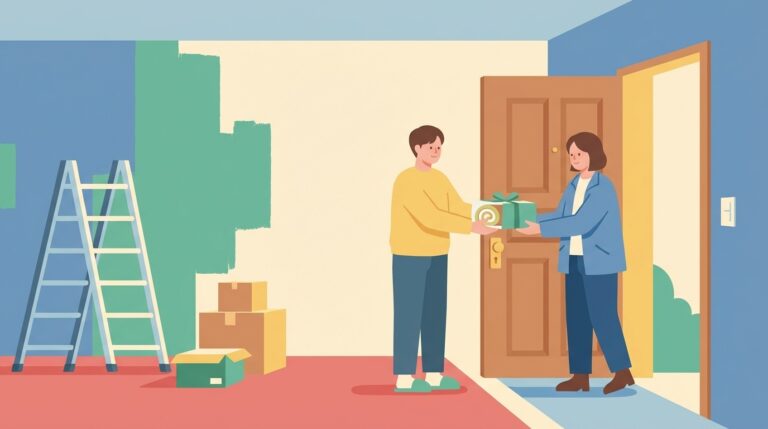
Imagine this classic K-Drama scene: The main character finally saves enough money to move into a cozy rooftop room (옥탑방) or a slightly older villa. They decide to fix it up. Cue the aesthetic montage of painting walls in overalls, drinking iced Americanos, and wiping sweat off their brow. But suddenly, there’s an angry knock on the door. It’s the downstairs neighbor, furious about the hammering noise! What follows is a frantic bowing session and the handing over of a boxed roll cake.
Have you ever wondered what they are actually saying during those tense moments? Or perhaps, you are an expat living in Korea, and one morning you wake up to the sound of apocalyptic drilling from the floor above. You walk out to the elevator and see an A4 paper taped to the mirror, full of polite Korean words you can’t quite decipher.
Whether you’re planning to revamp your own Korean apartment, or you just want to survive your neighbor’s 3-week remodeling project without losing your mind, understanding the vocabulary and the culture of Korean construction (공사) is crucial.
This guide is crafted from the real tears and sweat of expats who learned the hard way that in Korea, remodeling isn’t just about paint colors—it’s about community Nunchi (눈치). Let’s dive in!
Phase 2: Core Expressions Deep Dive
Here are the top expressions you absolutely need when dealing with interior remodeling (인테리어 리모델링 공사) in Korea.
1. 인테리어 공사 들어가요 (We’re starting interior construction)
- Pronunciation: [inte-ri-eo gong-sa deu-reo-ga-yo] (The ‘eu’ in deu sounds like the disgusted sound you make when stepping in gum.)
- Meaning: (Literal) Interior construction is entering. / (Real Nuance) We are starting our remodeling project.
- K-Culture Moment: You’ll hear this from contractors, landlords, or neighbors. In Korea, we don’t just ‘start’ a project; the project ‘enters’ (들어가다) the schedule. It gives a sense of an officially launched operation.
- Editor’s Insight: This phrase feels very professional but casual enough for daily life. When you tell your neighbor this, it’s an advanced warning.
- Situation Spectrum:
- To neighbors/friends (Casual): ✅
- To landlord/building manager (Semi-formal): ✅
- Official written notice (Formal): ⚠️ (Better to use: 실내 공사를 진행할 예정입니다)
- 🤔 Think About It: Why does Korean use the verb “to enter” (들어가다) for starting a project, a movie filming, or even a medical surgery? Does your native language use spatial metaphors for time and events?
2. 도배랑 장판만 새로 할 거예요 (I’m just going to redo the wallpaper and flooring)
- Pronunciation: [do-bae-rang jang-pan-man sae-ro hal geo-ye-yo]
- Meaning: I’m just getting new wallpaper and floor covers.
- K-Culture Moment: If you watch Korean home makeover shows, you’ll realize 90% of budget remodeling in Korea is just Dobae (wallpaper) and Jangpan (linoleum/vinyl flooring). Because Korean apartments have underfloor heating (Ondol), flooring is a huge deal.
- Editor’s Insight: Adding ‘만’ (only) minimizes the scale of the project to the listener. It’s a way of saying, “Don’t worry, it won’t be a huge, noisy, structural mess.”
- Situation Spectrum:
- To contractors (Casual): ✅
- To landlord (Semi-formal): ✅
- To the boss at work (Formal): 🚫 (Irrelevant context)
- 🤔 Think About It: In many Western countries, painting walls is the standard. In Korea, it’s almost always wallpaper. Why do you think wallpaper became the undisputed king of Korean interiors?
3. 공사 기간 동안 양해 부탁드립니다 (Please be understanding during the construction period)
- Pronunciation: [gong-sa gi-gan dong-an yang-hae bu-tak-deu-rim-ni-da]
- Meaning: (Literal) During the construction period, I beg for your understanding. / (Real Nuance) Please forgive the noise and mess while we renovate.
- K-Culture Moment: This is the holy grail of Korean apartment etiquette. It is the exact phrase printed on the notices taped inside apartment elevators before a unit gets renovated.
- Editor’s Insight: “양해” (understanding/forbearance) is a magic word in Korea. You aren’t just saying “sorry”; you are formally asking for their patience. It’s polite, humble, and legally necessary in apartment complexes.
- Situation Spectrum:
- To close friends (Casual): 🚫 (Too stiff)
- Elevator notice (Semi-formal/Formal): ✅
- Official broadcast (Formal): ✅
- 🤔 Think About It: Korean society places heavy emphasis on community harmony over individual rights. How does the concept of “asking for understanding in advance” reflect the high-density living situation in cities like Seoul?
Phase 3: Textbook vs. Real Korean
Let’s see how the textbook phrases compare to what you’ll actually hear in a Korean hardware store or apartment building.
[Situation 1: Describing the scale of the renovation]
* 📖 Textbook Korean: 집 전체를 수리할 계획입니다. (I plan to repair the whole house.)
* 🗣️ Real Korean: 이번에 올수리 들어가요. (We are going into ‘All-repair’ this time.)
* 💡 Why the difference?: “올수리” (All + Repair) is a Konglish term born in the real estate market. It’s faster, punchier, and immediately tells the real estate agent or contractor that you’re gutting the entire place.
[Situation 2: Warning someone about noise]
* 📖 Textbook Korean: 소음이 많이 발생할 것입니다. (A lot of noise will occur.)
* 🗣️ Real Korean: 며칠 좀 시끄러울 거예요, 죄송해요. (It’s going to be a bit loud for a few days, sorry.)
* 💡 Why the difference?: Spoken Korean prefers adjectives (시끄럽다 – to be loud) over formal noun-verb combos (소음이 발생하다 – noise occurs) to sound more empathetic and human.
Bottom Note: For B2 level learners, knowing terms like ‘올수리’ (All-suri) or ‘도배’ (Dobae) instantly elevates your Korean from “student” to “local resident.” Use them confidently!
Phase 4: Cultural Context — K-Culture Deep Dive
4-1. Non-Verbal Elements: The Art of the ‘Apology Gift’
When you apologize for upcoming construction noise in Korea, words are only half the battle. The other half is the “뇌물” (bribe)—jokingly speaking, of course!
If you are remodeling, you must visit the neighbors directly below, above, and next to you.
* The Posture: Slightly bow your head. Don’t stare them aggressively in the eyes; maintain a soft, apologetic gaze.
* The Hands: ALWAYS hand over the gift with two hands.
* The Gift: A roll cake (롤케익), a box of vitamins (비타500), or standardized city garbage bags (종량제 봉투 – highly practical and universally loved!).
4-2. K-Culture Connections: The Apartment Republic
Korean architecture isn’t just about traditional Hanok homes; modern Korea is an “Apartment Republic” (아파트 공화국). Over 50% of Koreans live in high-rise apartments. Because the exterior and structural layouts are standardized, Koreans express their individuality through Interior Remodeling.
However, this high-density living creates a massive social issue: 층간소음 (Inter-floor noise). In K-Dramas, you’ll often see neighbors fighting over footsteps or loud TVs. Construction amplifies this by 100x. Therefore, getting signatures of consent (동의서) from your neighbors before starting an ‘All-suri’ is not just good manners—it’s usually a strict rule enforced by the apartment management office (관리사무소)!
Phase 5: Interactive Roleplay Scenario
Setting: Saturday morning, 10:00 AM. You just bought an older apartment in Mapo-gu, Seoul. You are doing an ‘All-suri’ starting Monday. You stand nervously in front of Unit 502 (the apartment directly below yours), holding a beautifully boxed roll cake.
Characters:
* YOU: An expat trying their best to follow Korean apartment etiquette.
* Mr. Kim (50s): Your downstairs neighbor. He looks a bit grumpy because you woke him up, but he’s fundamentally a reasonable guy.
Dialogue:
Mr. Kim: (Opens the door slightly) 누구시죠?
[Nu-gu-si-jyo?]
(Who is it?)
YOU: 안녕하세요, 602호 새로 이사 온 사람입니다.
[An-nyeong-ha-se-yo, yug-baek-i-ho sae-ro i-sa on sa-ram-im-ni-da.]
(Hello, I’m the person who newly moved into 602.)
Mr. Kim: 아, 네. 그런데 무슨 일로…?
[A, ne. Geu-reon-de mu-seun il-lo…?]
(Ah, yes. But what brings you here…?)
YOU: 다름이 아니라, 저희가 월요일부터 인테리어 공사 들어가서요.
[Da-reu-mi a-ni-ra, jeo-hui-ga wo-ryo-il-bu-teo in-te-ri-eo gong-sa deu-reo-ga-seo-yo.]
(It’s nothing else but, we are starting interior construction from Monday.)
Mr. Kim: (Sighs slightly) 아… 공사요? 얼마나 걸리는데요?
[A… gong-sa-yo? Eol-ma-na geol-li-neun-de-yo?]
(Ah… construction? How long will it take?)
YOU: 한 2주 정도 걸릴 것 같습니다. 시끄럽게 해서 정말 죄송합니다.
[Han i-ju jeong-do geol-ril geot gat-seum-ni-da. Si-kkeu-reop-ge hae-seo jeong-mal joe-song-ham-ni-da.]
(It will take about 2 weeks. I’m really sorry for making noise.)
Mr. Kim: 뭐, 어쩔 수 없죠. 주말에는 안 하시는 거죠?
[Mwo, eo-jjeol su eop-jyo. Ju-ma-re-neun an ha-si-neun geo-jyo?]
(Well, it can’t be helped. You aren’t doing it on weekends, right?)
YOU: 네, 당연하죠! 주말엔 절대 안 합니다.
[Ne, dang-yeon-ha-jyo! Ju-ma-ren jeol-dae an ham-ni-da.]
(Yes, of course! We absolutely won’t do it on weekends.)
(🎭 Stage Direction: You lift the roll cake to hand it over)
🔀 Your Turn! How should you offer the gift?
* A) “이거 뇌물이에요!” (This is a bribe!)
* B) “약소하지만, 이거 좀 드시면서 양해 부탁드립니다.” (It’s not much, but please enjoy this and I ask for your understanding.)
* C) “케이크 샀어요. 맛있게 드세요!” (I bought a cake. Eat it deliciously!)✅ Best Choice: B — This hits the perfect balance of Korean humility. “약소하지만” (It’s small/not much) is a classic humble phrase, paired perfectly with “양해 부탁드립니다.”
⚠️ Choice A Analysis: Calling it a ‘bribe’ is a joke best saved for close friends. To an older neighbor you just met, it might come off as too cheeky or inappropriate.
Mr. Kim: 아이고, 뭘 이런 걸 다… 알겠습니다. 신경 써서 해주세요.
[Ai-go, mwol i-reon geol da… Al-get-seum-ni-da. Sin-gyeong sseo-seo hae-ju-se-yo.]
(Oh my, you didn’t have to… I understand. Please pay attention [to the noise].)
YOU: 네, 최대한 빨리 끝내겠습니다. 감사합니다!
[Ne, choe-dae-han ppal-li kkeut-nae-get-seum-ni-da. Gam-sa-ham-ni-da!]
(Yes, I will finish it as quickly as possible. Thank you!)
Phase 6: 10-Second Shadowing Drill
Practice this sentence to perfect your polite, apologetic tone. Remember to pause where the slashes are!
🥺 이번 주부터 / 인테리어 공사 들어가서요. / 시끄럽게 해서 / 정~~~말 죄송합니다.
(i-beon ju-bu-teo / in-te-ri-eo gong-sa deu-reo-ga-seo-yo. / si-kkeu-reop-ge hae-seo / jeong~~~mal joe-song-ham-ni-da.)
Tip: Drag out the “정~~~말” slightly with a sorrowful tone. It shows genuine empathy for their eardrums!
Phase 7: K-Culture Mini Dictionary
Here are some essential remodeling and building vocabulary for your life in Korea.
| 한국어 | Romanization | English | Context/Meaning |
|---|---|---|---|
| 올수리 | ol-su-ri | Complete renovation | A Konglish term meaning gutting the house and remodeling everything. |
| 도배 | do-bae | Wallpapering | Korean homes use thick, high-quality wallpaper instead of paint. |
| 장판 | jang-pan | Floor covering | Synthetic flooring that can handle the heat from the Ondol (floor heating). |
| 층간소음 | cheung-gan-so-eum | Inter-floor noise | A major social issue in Korea; noise traveling between apartment floors. |
| 샷시 | syat-si | Sashes (Windows) | Another Konglish word. Upgrading your “샷시” is crucial for Korean winters. |
| 관리사무소 | gwal-li-sa-mu-so | Management Office | The absolute authority in an apartment complex. You must report renovations here! |
Phase 8: Traveler & Expat Survival Kit
If you are visiting Korea and staying in an Airbnb or hotel, or if you just moved in, construction noise can ruin your day. Here are survival phrases you can use with your host or building security.
🆘 Survival Phrases #1
* 🇰🇷 “공사 언제 끝나요? 너무 시끄러워요.” (gong-sa eon-je kkeut-na-yo? neo-mu si-kkeu-reo-wo-yo.)
* 🗣️ Meaning: When does the construction end? It’s too loud.
* 📍 Where to use: To the hotel front desk or your Airbnb host.
* 💡 Pro Tip: If you complain politely to a hotel desk, they might offer you a room change or free breakfast!📌 Editor’s Travel/Living Note
* Working Hours: In Korea, interior construction is strictly prohibited on weekends and usually restricted to 9:00 AM – 5:00 PM on weekdays. If someone is using a drill at 8 PM, you have every right to call the security guard (경비 아저씨)!
* Elevator Etiquette: If you see a piece of paper taped inside the elevator with dates on it, it’s a construction notice (공사 안내문). Take a quick photo with Papago to check if it’s your floor!
Phase 9: Critical Thinking Corner — “One Step Deeper”
🧠 Think Deeper: Space & Identity
Why is Dobae (wallpaper) so heavily emphasized in Korean remodeling? Korea’s rapid modernization led to the mass construction of identical apartment blocks. With strict laws preventing structural changes to the concrete walls, the interior “skin”—the wallpaper and flooring—became the only way for Koreans to express their personal identity and aesthetics in a standardized space. Remodeling in Korea isn’t just repair; it’s a claiming of ownership over one’s personal space within a uniform concrete jungle.
💬 Your Turn: In your home country, what is the first thing people usually change when they move into a new house? Let us know in the comments!
Phase 10: FAQ & Avoiding Mistakes
- Q: Do I really need to give gifts to my neighbors before remodeling?
- A: Yes, highly recommended! While the management office will post a formal notice, personally visiting the units immediately surrounding yours (up, down, left, right) with a small $10-$15 gift prevents 99% of noise complaints.
- Q: Can I do the remodeling myself (DIY)?
- A: Partially. Painting or small changes are fine. But for anything involving flooring, drilling, or balcony expansions, Koreans almost always hire professionals (업체) because of the underfloor heating pipes and strict apartment regulations.
❌ Common Mistake #1: Starting construction without getting your neighbors’ signatures (동의서).
✅ Do this instead: Go to the 관리사무소 (Management Office) first. They will tell you exactly how many signatures you need from your building block before you can swing a hammer!
Phase 11: Summary & Action Items
- One-Liner Summary: Surviving Korean remodeling is 20% choosing the right wallpaper, and 80% successfully asking for your neighbors’ “양해” (understanding).
-
Action Mission 3 Steps:
- 🥉 Bronze (Solo): Stand in front of a mirror, bow slightly, and practice saying “시끄럽게 해서 정말 죄송합니다” with a remorseful face.
- 🥈 Silver (Online): Go to a Korean property app (like Zigbang 직방) and look at apartment listings. Try to spot the word “올수리” in the descriptions!
- 🥇 Gold (Real World): If you hear construction noise in your building, check the elevator notice. Find the word “양해”!
- K-Culture Mission:
Watch an episode of a Korean home makeover show (like Where is My Home / 구해줘! 홈즈) and listen carefully for the words 도배, 장판, and 샷시.
Phase 12: Quiz — Interactive Challenge
1. Situational Judgment: You are talking to a contractor to redo everything in your newly purchased 20-year-old apartment. What is the most natural “Real Korean” phrase to use?
* A) 집 전체를 수리할 계획입니다.
* B) 올수리 할 거예요.
* C) 도배만 할 거예요.
(Answer: B. ‘A’ is too textbook, and ‘C’ means you’re only doing wallpaper.)
2. Fill in the Blank:
“공사 기간 동안 ______ 부탁드립니다.” (Please be understanding during the construction period.)
(Answer: 양해 – yang-hae)
3. True or False – K-Culture Edition:
If you want to renovate your Korean apartment, you can just start on a Saturday morning as long as you own the house. (T/F)
(Answer: False! Weekend construction is heavily restricted or banned in almost all Korean apartment complexes, and you need permission from the management office first.)
Frequently Asked Questions (FAQ)
Q: What does "인테리어 공사 들어가요 (We're starting interior construction)" mean in Korean and how do you pronounce it?
A: In Korean, "인테리어 공사 들어가요 (We're starting interior construction)" is pronounced [inte-ri-eo gong-sa deu-reo-ga-yo] and means: (Literal) Interior construction is entering. / (Real Nuance) We are starting our remodeling project.
Q: What does "도배랑 장판만 새로 할 거예요 (I'm just going to redo the wallpaper and flooring)" mean in Korean and how do you pronounce it?
A: In Korean, "도배랑 장판만 새로 할 거예요 (I'm just going to redo the wallpaper and flooring)" is pronounced [do-bae-rang jang-pan-man sae-ro hal geo-ye-yo] and means: I'm just getting new wallpaper and floor covers.
Q: What does "공사 기간 동안 양해 부탁드립니다 (Please be understanding during the construction period)" mean in Korean and how do you pronounce it?
A: In Korean, "공사 기간 동안 양해 부탁드립니다 (Please be understanding during the construction period)" is pronounced [gong-sa gi-gan dong-an yang-hae bu-tak-deu-rim-ni-da] and means: (Literal) During the construction period, I beg for your understanding. / (Real Nuance) Please forgive the noise and mess while we renovate.







