

Phase 1: Empathy & K-Culture Cold Open
Hello! I’m the Lead Editor of Daily Hangul, your veteran tutor and local culture navigator.
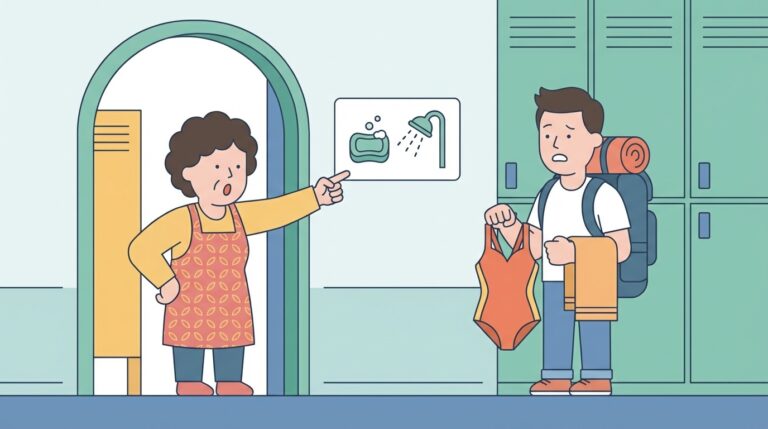
Imagine this: You’ve just arrived at a community swimming pool in Seoul. You’re wearing your favorite swimsuit, ready to dive in and get some laps done. But just as you step out of the locker room, an Ahjumma (middle-aged lady) taps you on the shoulder. She points at your perfectly dry hair and your swimsuit, clicking her tongue. Next thing you know, you’re being herded back into the shower room, utterly confused.
If you’ve watched K-Dramas, you might picture infinity pools at luxury hotels where couples sip cocktails in designer swimwear. But the reality of Korean public and municipal swimming pools is intensely different. Here, communal hygiene is a serious, non-negotiable business.
For advanced learners (C1) navigating daily life in Korea, knowing how to order food is great, but understanding the unspoken (and loudly spoken) rules of the shower room will save you from public scoldings and help you truly blend in like a local. Let’s dive deep into the fascinating, strict world of Korean swimming pool etiquette!
Phase 2: Core Expressions Deep Dive
Let’s look at the absolute must-know expressions that rule the Korean swimming pool ecosystem.
1. 입수 전 비누 샤워는 필수입니다.
- Pronunciation: ip-su jeon bi-nu sya-weo-neun pil-su-im-ni-da. [Ip-soo jeon bee-noo sha-wuh-nun peel-soo-im-nee-da]
- Meaning: (Literal) A soap shower is mandatory before entering the water. (Real nuance) Don’t you dare step into this pool if you haven’t aggressively scrubbed yourself with soap first.
- K-Culture Moment: You will see this written on huge red banners in every public pool locker room. If you just rinse with water, regular members of the early morning swim class will literally call you out.
- Editor’s Insight: In many Western countries, a quick rinse under the shower is enough. In Korea, you must do a full soap wash—hair and body—before putting your swimsuit on. Putting your swimsuit on at home and wearing it under your clothes is considered a massive faux pas.
- Situation Spectrum:
- Casual with friends: 🚫 (Too formal/announcement style)
- Public Signs/Staff: ✅
- Confrontational Ahjumma: ⚠️ (She will use a blunter version: “비누칠 하고 들어가요!”)
- 🤔 Think About It: Why does Korean culture emphasize “비누 샤워” (soap shower) so much before swimming? Does this reflect a broader cultural attitude toward shared public spaces (like public bathhouses, Jjimjilbangs)?
2. 수모 안 쓰시면 입장 불가하세요.
- Pronunciation: su-mo an sseu-si-myeon ip-jang bul-ga-ha-se-yo. [Soo-mo ahn ssu-shee-myun ip-jahng bool-gah-hah-seh-yo]
- Meaning: (Literal) If you don’t wear a swim cap, entry is impossible. (Real nuance) No swim cap, no swim. Period.
- K-Culture Moment: Even in many upscale hotel pools in Korea, unless it’s a designated “photo zone” or outdoor infinity pool, a swimming cap is strictly enforced to prevent hair from clogging the filters.
- Editor’s Insight: Notice the abbreviation! Koreans rarely say the full word “수영모자” (swimming hat). It’s always “수모” (Su-mo). Also, note the service industry honorific “불가하세요” (It is impossible [for you]).
- Situation Spectrum:
- Casual: 🚫
- Staff to Customer: ✅
- Formal/Announcements: ✅
- 🤔 Think About It: “입장 불가하세요” is grammatically incorrect (applying honorifics to an object/situation rather than the person), yet it’s widely used in Korean service culture. How does extreme politeness shape modern Korean grammar?
3. 샤워기 자리 맡아두지 마세요.
- Pronunciation: sya-weo-gi ja-ri ma-ta-du-ji ma-se-yo. [Sha-wuh-gee jah-ree mah-tah-doo-jee mah-seh-yo]
- Meaning: (Literal) Please do not reserve a shower head spot. (Real nuance) Don’t leave your shampoo basket here to claim the shower while you go into the pool or sauna.
- K-Culture Moment: At busy times, people sometimes leave their 목욕 바구니 (bath basket) under a shower head to “claim” it for when they finish swimming. This causes intense drama and silent wars in the locker room.
- Editor’s Insight: The verb “자리(를) 맡다” (to save a seat/spot) is a crucial C1 vocabulary word. You use it in cafes, libraries, and yes, shower rooms.
- Situation Spectrum:
- Annoyed regulars to each other: ⚠️ (Usually passive-aggressively)
- Staff signs: ✅
- Formal: ✅
- 🤔 Think About It: In cafes, leaving a laptop or phone to “save a spot” (자리 맡기) is perfectly acceptable and safe in Korea. Why is doing the same thing with a shampoo basket in a shower room considered rude?
Phase 3: Textbook vs. Real Korean
Let’s compare what you studied with what you’ll actually hear echoing against the wet tiles.
[Situation 1: Being scolded for a dry swimsuit]
* 📖 Textbook Korean: 수영장에 들어가기 전에 샤워를 하십시오. (Please take a shower before entering the swimming pool.)
* 🗣️ Real Korean: 아가씨(학생), 씻고 들어가야지! 수영복 집에서 입고 왔어? (Miss/Student, you need to wash before going in! Did you wear your swimsuit from home?)
* 💡 Why the difference?: Regulars at community pools often take on a self-appointed “guardian” role, using casual or semi-casual language (반말/해요체) to enforce community rules on newcomers.
[Situation 2: Telling someone they forgot their swim cap]
* 📖 Textbook Korean: 수영모자를 쓰지 않으면 안 됩니다. (You must wear a swimming hat.)
* 🗣️ Real Korean: 앗, 회원님! 수모 챙기셨어요? 쌩얼에 수모 필수예요~ (Ah, Member! Did you bring your swim cap? A bare face and swim cap are mandatory~)
* 💡 Why the difference?: Staff will often use a softer, upward intonation and words like “회원님” (Member) to lessen the blow of a strict rule, adding modern slang like “쌩얼” (bare, unmade-up face) since makeup is banned in the pool.
Phase 4: Cultural Context — K-Culture Deep Dive
4-1. Non-verbal Nunchi in the Shower Room
Korean shower etiquette requires intense Nunchi (눈치 – the subtle art of reading the room).
– The Splashing Rule: When you shower, you must be acutely aware of not splashing water on the person next to you. If you do, a quick bow of the head is necessary.
– The Naked Bow: If you bump into a senior member of your swim class or an acquaintance in the locker room, yes, you still bow (인사) completely naked.
4-2. The “Mok-yok-tang” (Public Bathhouse) Heritage
The strictness of Korean swimming pools directly stems from traditional Korean bathhouse culture. In a bathhouse, soaking in the communal tub before scrubbing yourself is the ultimate taboo. This exact mindset transfers to the swimming pool. The pool is seen as a giant communal tub. Therefore, bringing outside sweat, dirt, or even makeup into the pool feels like a personal violation to Koreans.
Phase 5: Real-Life Roleplay Scenario
Setting: 6:00 AM on a Tuesday. The aggressively fluorescent-lit locker room of the Mapo-gu Community Sports Center. The air is thick with steam and the smell of cucumber soap. You are about to walk out to the pool area.
Characters:
– YOU: An advanced Korean learner who just bought a one-month pass. You rinsed with water at home and wore your swimsuit under your clothes to save time.
– Ahjumma (지연, 55): The unofficial “president” of the 6 AM Aqua Aerobics class. She misses nothing.
Dialogue:
지연: (Blocking your path) 학생, 잠깐만. 지금 이대로 수영장 들어가려고? 🤨
hak-saeng, jam-kkan-man. ji-geum i-dae-ro su-yeong-jang deu-reo-ga-ryeo-go?
[Student, wait a minute. Are you going into the pool like this right now?]
YOU: 네? 아, 네. 수영 수업 늦어서요.
ne? a, ne. su-yeong su-eop neu-jeo-seo-yo.
[Excuse me? Ah, yes. I’m late for swim class.]
지연: 어머, 몸도 안 씻고 수영복 먼저 입었네? 안 돼, 안 돼. 비누칠 싹 하고 다시 입고 나와야지.
eo-meo, mom-do an ssit-go su-yeong-bok meon-jeo i-beot-ne? an dwae, an dwae. bi-nu-chil ssak ha-go da-si ip-go na-wa-ya-ji.
[Oh my, you put your swimsuit on before washing your body? No, no. You have to scrub with soap and put it on again.]
🔀 Your Turn! How do you respond?
– A) “아, 저 집에서 씻고 왔어요!” (Ah, I washed at home!)
– B) “네? 수영장에 염소 소독 다 되어 있잖아요.” (What? The pool is treated with chlorine anyway.)
– C) “아, 몰랐어요. 죄송합니다. 얼른 씻고 올게요!” (Ah, I didn’t know. I’m sorry. I’ll go wash quickly!)✅ Best Choice: C.
⚠️ Choice A & B Analysis: Saying “I washed at home” (A) is the #1 trigger phrase that will make Korean pool regulars furious. It implies your house water is somehow an exception to the communal rule. Arguing about chlorine (B) will likely result in a 20-minute lecture, making you miss your class entirely.
YOU: 아, 제가 한국 수영장 문화는 처음이라서 몰랐어요. 죄송합니다. 얼른 비누로 씻고 올게요!
a, je-ga han-guk su-yeong-jang mun-hwa-neun cheo-eu-mi-ra-seo mol-las-seo-yo. joe-song-ham-ni-da. eol-leun bi-nu-ro ssit-go ol-ge-yo!
[Ah, it’s my first time experiencing Korean swimming pool culture, so I didn’t know. I’m sorry. I’ll go wash with soap quickly!]
지연: (Expression softening instantly) 아~ 외국인이구나? 아이구, 모를 수 있지! 저기 구석 자리에 따뜻한 물 잘 나오니까 거기서 씻어요. 샴푸 없으면 내 거 빌려줄까?
a~ oe-gu-gi-ni-gu-na? a-i-gu, mo-reul su it-ji! jeo-gi gu-seok ja-ri-e tta-tteu-tan mul jal na-o-ni-kka geo-gi-seo ssi-seo-yo. syam-pu eop-seu-myeon nae geo bil-lyeo-jul-kka?
[Ah~ you’re a foreigner? Oh my, of course you wouldn’t know! The hot water works well in the corner spot over there, so wash there. If you don’t have shampoo, should I lend you mine?]
(🎭 Stage Direction: Nunchi acquired! You have just won the favor of the locker room boss.)
Phase 6: 10-Second Shadowing Drill
Time to practice your fluid intonation. Pay attention to the pauses!
🥺 아, / 제가 한국 수영장 문화는 / 처음이라서 / 몰랐어요.
(Ah, / je-ga han-guk su-yeong-jang mun-hwa-neun / cheo-eu-mi-ra-seo / mol-las-seo-yo.)😊 다음부터는 / 꼭 / 비누 샤워하고 / 들어갈게요!
(Da-eum-bu-teo-neun / kkok / bi-nu sya-weo-ha-go / deu-reo-gal-ge-yo!)
Phase 7: K-Culture Mini-Dictionary
| Korean | Romanization | English | Cultural Context |
|---|---|---|---|
| 수모 | su-mo | Swim cap | Short for 수영모자. Absolutely mandatory in almost all Korean pools. |
| 텃세 | teot-se | Territorial behavior | The cliquish behavior of regulars at public facilities. Very common in morning swim/aerobics classes. |
| 목욕 바구니 | mo-gyok ba-gu-ni | Bath basket | The plastic mesh basket Koreans use to carry their shampoo, body wash, and loofah. |
| 래시가드 | rae-si-ga-deu | Rash guard | Highly popular in Korea. Many prefer covering up over wearing bikinis/speedos for modesty and sun protection. |
| 쌩얼 | ssaeng-eol | Bare face | Slang for a face with zero makeup. It is incredibly frowned upon to enter a pool with makeup on. |
Phase 8: Traveler Survival Kit
If you’re visiting a hotel pool or a water park like Caribbean Bay, these phrases are lifesavers.
🆘 Survival Phrases
– 🇰🇷 “수건 대여 가능한가요?” (su-geon dae-yeo ga-neung-han-ga-yo?)
– Can I rent a towel? (In community pools, you often must bring your own!)
– 🇰🇷 “여기 수모 필수인가요? 캡모자도 되나요?”
– Is a swim cap mandatory here? Is a baseball cap okay? (Many outdoor water parks allow baseball caps instead of tight swim caps).📌 Editor’s Travel Note
– Tattoos: While attitudes are changing, large tattoos can still make some older Koreans uncomfortable in public pools. At luxury hotels, you might be asked to wear a rash guard to cover them.
– Bikinis vs. Rash Guards: In K-Dramas, everyone wears bikinis. In real Korean water parks, 80% of people wear long-sleeved rash guards, even in the dead of summer!
Phase 9: Critical Thinking Corner — “A Step Deeper”
🧠 Media vs. Reality: The K-Drama Pool vs. The Real Pool
If you watch Hotel Del Luna or True Beauty, swimming pools are aesthetic playgrounds. Characters dive into the water with full makeup, styled hair, and designer outfits. However, this creates a stark contrast with the reality of Korean public life, which is built on highly dense, shared communal spaces. In a country where thousands of people share a single municipal facility daily, hyper-hygiene becomes a mechanism for social harmony. The strict Ahjummas aren’t just being mean; they are acting as the cultural immune system, ensuring the shared water remains pure for the collective.
💬 Your Turn: Have you ever experienced a “culture shock” regarding public hygiene or shared spaces in another country? Share it in the comments!
Phase 10: FAQ & Avoiding Misunderstandings
Q: “If the staff tells me to wear a swim cap, can I argue that I don’t want to get my hair wet?”
– No. This will cause immense frustration. In Korea, the rules of the facility supersede personal preference. Just smile, say “알겠습니다” (I understand), and put it on.
Q: “Can I wear my swimsuit from home and just jump in?”
– Absolutely No. As discussed, you must shower naked with soap at the facility before putting on your swimsuit.
❌ Common Mistake #1: Entering the pool area with completely dry hair. The lifeguards and regulars use “dry hair” as a visual radar to spot people who skipped the shower. Always wet your hair (after washing it) before putting on your swim cap!
Phase 11: Summary & Action Items
One-Liner Summary: In Korea, a soap shower and a swim cap aren’t just suggestions—they are your golden ticket to surviving and respecting the communal pool culture!
Action Mission 3 Steps:
– 🥉 Bronze: Read the word “수모” and “비누 샤워” out loud 3 times right now.
– 🥈 Silver: In your language journal, write down what you would say if an Ahjumma scolded you for not showering first.
– 🥇 Gold: Next time you visit a pool in Korea, confidently take your soap shower and proudly wear your Su-mo!
K-Culture Mission:
Go on YouTube and search “수영장 텃세” (Swimming pool territorial behavior). You will find hilarious sketch comedies by Korean comedians acting out the exact Ahjumma locker room dynamics we learned today!
Phase 12: Quiz — Interactive Challenge
1. Situational Judgment: You arrive at the locker room. You are running 5 minutes late for your aqua aerobics class. What is the culturally correct action?
– A) Quickly put on your swimsuit over your dry body and run to the pool.
– B) Skip the class. It’s too late.
– C) Accept that you will be 10 minutes late, take a full soap shower, put on your swimsuit, and then enter the pool.
2. Fill in the Blank:
“수영장 들어갈 때는 무조건 머리에 ( ______ ) 를 써야 해요!”
3. True or False:
In Korean community pools, it is perfectly acceptable to reserve a shower head by leaving your shampoo basket there while you go swim.
(Answers: 1. C – Hygiene trumps punctuality in this context! / 2. 수모 / 3. False – This is called 자리 맡기 and is a huge locker room taboo!)
Frequently Asked Questions (FAQ)
Q: What does "입수 전 비누 샤워는 필수입니다." mean in Korean and how do you pronounce it?
A: In Korean, "입수 전 비누 샤워는 필수입니다." is pronounced [ip-su jeon bi-nu sya-weo-neun pil-su-im-ni-da. [Ip-soo jeon bee-noo sha-wuh-nun peel-soo-im-nee-da] and means: (Literal) A soap shower is mandatory before entering the water. (Real nuance) Don't you dare step into this pool if you haven't aggressively scrubbed yourself with soap first.
Q: What does "수모 안 쓰시면 입장 불가하세요." mean in Korean and how do you pronounce it?
A: In Korean, "수모 안 쓰시면 입장 불가하세요." is pronounced [su-mo an sseu-si-myeon ip-jang bul-ga-ha-se-yo. [Soo-mo ahn ssu-shee-myun ip-jahng bool-gah-hah-seh-yo] and means: (Literal) If you don't wear a swim cap, entry is impossible. (Real nuance) No swim cap, no swim. Period.
Q: What does "샤워기 자리 맡아두지 마세요." mean in Korean and how do you pronounce it?
A: In Korean, "샤워기 자리 맡아두지 마세요." is pronounced [sya-weo-gi ja-ri ma-ta-du-ji ma-se-yo. [Sha-wuh-gee jah-ree mah-tah-doo-jee mah-seh-yo] and means: (Literal) Please do not reserve a shower head spot. (Real nuance) Don't leave your shampoo basket here to claim the shower while you go into the pool or sauna.






