

Phase 1: Empathy & K-Culture Cold Open
Hello! I’m the Head Editor of Daily Hangul.
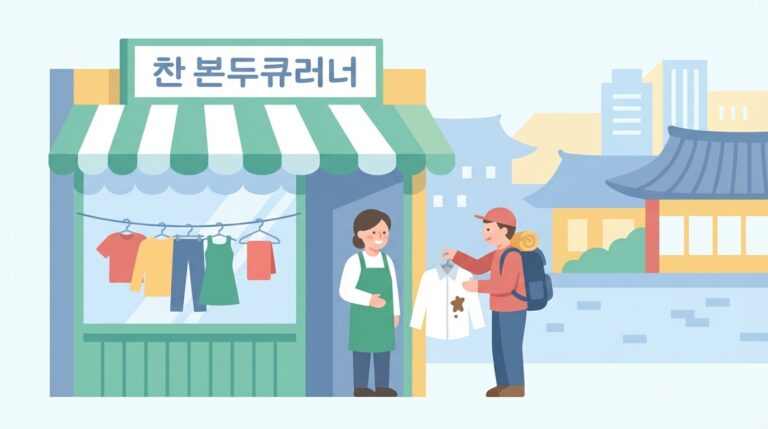
Picture this: You are watching your favorite K-Drama. The hardworking female lead is eating bright red tteokbokki at a street tent (Pojangmacha). Suddenly, disaster strikes! A huge red drop falls right onto her crisp white blouse. The very next scene? She’s standing in a cozy, steam-filled neighborhood shop with clothes hung all the way to the ceiling, desperately negotiating with a kind-looking owner to get the stain out before her big job interview.
Welcome to the Korean 세탁소 (Setakso – Dry Cleaner).
Whether you’ve spilled spicy ramen broth on your favorite shirt or just need your winter coat freshened up after a long flight, visiting a Korean dry cleaner is a rite of passage. But if you’re a complete beginner (A1), standing in front of the Sajangnim (owner) with a stained shirt can feel terrifying.
Don’t worry! I’ve been there, and I know exactly what you need. Today, we’re going to learn the simple, magical phrases that will save your clothes—and make you sound like a true local.
Phase 2: Core Expressions Deep Dive
Let’s look at the survival phrases you need. Good news: One of them uses an English word!
1. 이거 드라이 클리닝해 주세요.
- Pronunciation: ee-geo deu-ra-ee keul-ri-ning-hae joo-se-yo.
- Sound-alike guide:
- ee-geo sounds like “eagle” without the ‘l’.
- deu uses the ‘eu’ sound—imagine the disgusted sound you make when stepping in gum.
- Meaning: Please dry clean this. (Literal: This dry cleaning do please.)
- K-Culture Moment: You’ll hear “Konglish” (Korean-English) everywhere in Korea. “Dry cleaning” is one of them! You just add “hae juseyo” (please do it) at the end.
- Editor’s Insight: If “드라이 클리닝” is too long, locals just shorten it to “드라이” (deu-ra-ee). “이거 드라이해 주세요” works perfectly!
- Situation Spectrum:
- Friends (Casual): 🚫 (Too formal for friends)
- Service Staff (Formal/Polite): ✅ (Perfect for the dry cleaner)
- 🤔 Think About It: “주세요 (juseyo)” literally means “please give.” Why do Koreans use “give” when asking for a service? It reflects a culture of viewing help and services as favors given from one person to another.
2. 여기에 얼룩이 있어요.
- Pronunciation: yeo-gi-e eol-lu-gi i-sseo-yo.
- Sound-alike guide: eol-luk sounds a bit like “all look” (Imagine saying “All look at this stain!”).
- Meaning: There is a stain here.
- K-Culture Moment: Korean food is delicious but highly stain-prone (kimchi jjigae, tteokbokki, jajangmyeon). Pointing out the exact spot saves the owner a lot of time.
- Editor’s Insight: You don’t even need to say the whole sentence. Just point to the stain and say, “여기요! (yeo-gi-yo! – Here!)” with a sad face. They will understand immediately.
- Situation Spectrum:
- Friends (Casual): ⚠️ (Friends use a casual form: eolluk isseo)
- Service Staff (Formal/Polite): ✅
- 🤔 Think About It: Non-verbal communication is huge in Korea. Pointing with your whole hand rather than a single index finger is considered more polite!
3. 언제 돼요?
- Pronunciation: eon-je dwae-yo?
- Sound-alike guide: eon-je sounds like “on Jay” and dwae-yo rhymes with “way-yo”.
- Meaning: When will it be done? (Literal: When does it become?)
- K-Culture Moment: Korea is the land of Ppalli-ppalli (Hurry, hurry!). Things get done incredibly fast. If you drop it off in the morning, sometimes you can ask for it by the evening!
- Editor’s Insight: This is the ultimate A1 magic phrase. You can use it anywhere! At a restaurant waiting for food? “언제 돼요?” Waiting for a repair? “언제 돼요?”
- Situation Spectrum:
- Friends (Casual): ⚠️ (Drop the ‘yo’ for friends: eonje dwae?)
- Service Staff (Formal/Polite): ✅
Phase 3: Textbook vs. Real Korean
Textbooks often teach you complete, complex sentences. But in a busy Korean shop, short and sweet is the way to go!
[Dropping off the clothes]
* 📖 Textbook Korean: 이 옷을 드라이 클리닝 맡기고 싶습니다. (I would like to entrust these clothes for dry cleaning.)
* 🗣️ Real Korean: 이거 드라이해 주세요. (Please dry this.)
* 💡 Why the difference?: Efficiency! In daily transactions, Koreans drop unnecessary subjects and objects. “This (이거)” and the verb are all you need.
[Asking for the price]
* 📖 Textbook Korean: 비용이 얼마입니까? (What is the cost?)
* 🗣️ Real Korean: 얼마예요? (How much is it?)
* 💡 Why the difference?: “얼마예요 (eolmayeyo)” is the undisputed king of shopping phrases. It’s universally polite and natural.
Bottom Note: For A1 complete beginners, focus on “이거 (This) + [Action] + 주세요 (Please).” It will save your life in Korea!
Phase 4: Cultural Context — K-Culture Deep Dive
4-1. Non-Verbal Nunchi (눈치) at the Setakso
When you hand over your clothes, always use two hands, or at least support your right arm with your left hand. It’s a sign of respect, especially since most dry cleaner owners are older (often called Sajangnim – Boss, or Ahjussi/Ajumma – Uncle/Auntie, though Sajangnim is the safest and most polite). Also, don’t forget the slight bow when you enter and say “안녕하세요 (Hello)!”
4-2. The K-Drama Neighborhood Hub
If you watch family K-Dramas like Reply 1988 or modern rom-coms, you’ll notice the neighborhood setakso is never just a place to wash clothes. It’s the local information center! The owner knows who is going on a blind date (because they brought in a fancy suit) and who cried last night (because of the tissues left in the pockets). Visiting a local dry cleaner gives you a real taste of Jeong (정 – Korean warm-heartedness and connection), far away from the cold, automated machines.
Phase 5: Real-Life Roleplay Scenario
Setting: A Tuesday morning. You are in a small, cozy dry cleaner in Seoul. The smell of hot steam and fresh laundry fills the air. You are holding your favorite white shirt, which unfortunately met some spicy Tteokbokki sauce last night.
Characters:
– YOU: A traveler whose Korean is at the A1 level but trying your best.
– Sajangnim (사장님): The 60-something owner. He looks serious but has a very warm heart.
Dialogue:
YOU: 안녕하세요! (an-nyeong-ha-se-yo!)
[Hello!]
Sajangnim: 네, 어서 오세요. (ne, eo-seo o-se-yo.)
[Yes, welcome.]
(🎭 Stage Direction: Sajangnim adjusts his glasses and looks at your shirt.)
YOU: 이거… 드라이 클리닝해 주세요. (i-geo… deu-ra-ee keul-ri-ning-hae joo-se-yo.)
[Please dry clean this.]
Sajangnim: 아, 하얀 셔츠네. 어디 볼까요? (ah, ha-yan syeo-cheu-ne. eo-di bol-kka-yo?)
[Ah, a white shirt. Let’s see?]
YOU: 여기에 얼룩이 있어요. 떡볶이… (yeo-gi-e eol-lu-gi i-sseo-yo. tteok-bok-ki…)
[There is a stain here. Tteokbokki…]
Sajangnim: 아이고, 떡볶이 국물! 알겠어요. 지워 줄게요. 언제 필요해요? (a-i-go, tteok-bok-ki gung-mul! al-ge-sseo-yo. ji-wo jul-ge-yo. eon-je pi-ryo-hae-yo?)
[Oh my, tteokbokki broth! Understood. I’ll remove it for you. When do you need it?]
🔀 Your Turn! How do you answer?
– A) “빨리빨리 주세요!” (ppalli-ppalli juseyo! – Give it to me fast-fast!)
– B) “언제 돼요?” (eon-je dwae-yo? – When will it be done?)
– C) “몰라요.” (mol-la-yo. – I don’t know.)✅ Best Choice: B. It politely asks the owner for the timeline.
⚠️ Choice A Analysis: While Koreans love ppalli-ppalli, commanding an older person to do it “fast-fast” can sound rude and demanding. Always let them set the pace or politely ask “내일 돼요? (Can it be done tomorrow?).”
YOU: 언제 돼요? (eon-je dwae-yo?)
[When will it be done?]
Sajangnim: 목요일 오후에 오세요. (mo-gyo-il o-hu-e o-se-yo.)
[Come on Thursday afternoon.]
YOU: 네, 감사합니다! (ne, gam-sa-ham-ni-da!)
[Yes, thank you!]
Phase 6: 10-Second Shadowing Drill
Let’s practice the flow! Follow the slashes for pauses and match the emotion.
🥺 (Pointing at the stain with a sad face)
여/기에 / 얼/룩이 / 있/어/요.
(yeo-gi-e / eol-lu-gi / i-sseo-yo.)
😊 (Politely asking with a smile)
이/거 / 드라이 클리닝 / 해 주/세/요!
(i-geo / deu-ra-ee keul-ri-ning / hae joo-se-yo!)
Phase 7: K-Culture Mini Dictionary
| Korean | Romanization | English | Context |
|---|---|---|---|
| 세탁소 | se-tak-so | Dry cleaner / Laundromat | The local neighborhood dry cleaning shop. |
| 사장님 | sa-jang-nim | Boss / Owner | A polite title used for the owner of any shop or restaurant. |
| 얼룩 | eol-luk | Stain | What you get when you eat Korean noodles too fast! |
| 영수증 | yeong-su-jeung | Receipt | You will often need this paper ticket to pick up your clothes. |
Phase 8: Traveler’s Survival Kit
Are you traveling in Korea and need clean clothes? Here is your survival card!
🆘 Survival Phrases TOP 3
– 🇰🇷 “이거 얼마예요?” (i-geo eol-ma-ye-yo?) – How much is this?
– 🇰🇷 “카드 돼요?” (ka-deu dwae-yo?) – Do you take cards?
– 🇰🇷 “영수증 주세요.” (yeong-su-jeung joo-se-yo) – Please give me the receipt.📌 Editor’s Travel Note
– Finding a place: Open Naver Map or KakaoMap and type “세탁소”. Look for the tiny mom-and-pop shops in residential alleys!
– Coin Laundry vs. Setakso: If you just need regular washing, search for “코인 세탁소” (Coin Laundromat). But for suits, coats, or stains, go to a traditional “세탁소”.
– Payment: Korea is a cashless society, but very small, older neighborhood dry cleaners might prefer cash (현금 – hyeon-geum) or a bank transfer. It’s always good to have a 10,000 won bill just in case!
Phase 9: Critical Thinking Corner — “One Step Deeper”
Media vs. Reality: The K-Drama Chaebol vs. Your Neighborhood Shop
In K-Dramas, wealthy characters often have their clothes picked up by pristine, high-end valet services. But for 99% of Koreans, reality is the small, slightly cluttered, steam-filled shop on the corner of the street. These local setaksos are run by skilled artisans who have been doing this for decades. They might not have fancy iPad registers, but they can get a kimchi stain out of a white silk blouse better than anyone else in the world.
🧠 Think Deeper: K-Dramas often sell a highly polished version of Korea, but the true charm of living here lies in these humble, everyday interactions.
💬 Your Turn: Do you use a local dry cleaner in your home country, or do you mostly wash things at home? Let us know in the comments!
Phase 10: FAQ & Avoiding Misunderstandings
Q: Can I just ask them to wash normal clothes, not dry clean?
Yes! Just say “이거 세탁해 주세요” (i-geo se-tak-hae joo-se-yo – Please wash this).
Q: Do I tip the dry cleaner for a good job?
No! There is absolutely no tipping culture in Korea. If you want to show immense gratitude, bringing them a small yogurt drink (요구르트) or a canned coffee from the convenience store is the ultimate “Korean” way to say thank you.
❌ Common Mistake #1: Forgetting to check your pockets!
✅ How to fix it: Always double-check pockets before handing clothes over. If you forget, the Sajangnim might scold you (affectionately, like a parent!).
Phase 11: Summary & Action Items
- One-Liner Summary: Use “이거 드라이해 주세요” to drop off clothes, and “언제 돼요?” to find out when they’ll be ready.
-
Action Mission 3 Stages:
- 🥉 Bronze (Solo): Stand in front of your closet, hold up a shirt, and practice saying “여기에 얼룩이 있어요!” out loud.
- 🥈 Silver (Online): Write a comment below: What is the food that always stains your clothes? (e.g., “For me, it’s pizza! 여기에 얼룩이 있어요!”)
- 🥇 Gold (Real Life): Next time you pass by a Korean dry cleaner, try reading the sign “세탁(Setak)” and say hello to the Sajangnim in your head!
- K-Culture Mission:
Watch an episode of a slice-of-life K-Drama (like Reply 1988 or Hometown Cha-Cha-Cha). Try to spot the neighborhood dry cleaner. Notice how it looks completely different from the fancy shops in Seoul!
Phase 12: Quiz — Interactive Challenge
Test your new survival skills!
1. Situational Judgment: You spilled coffee on your jacket and want to point out the stain to the dry cleaner. What is the most natural thing to say?
– A) 언제 돼요? (eon-je dwae-yo?)
– B) 여기에 얼룩이 있어요. (yeo-gi-e eol-lu-gi i-sseo-yo.)
– C) 안녕! (an-nyeong!)
2. Fill in the Blank:
You want them to dry clean your pants.
“이거 _________ 해 주세요.”
– A) 빨리빨리 (ppalli-ppalli)
– B) 드라이 클리닝 (deuraee keullining)
– C) 영수증 (yeongsujeung)
3. True or False – K-Culture Edition:
If the dry cleaner does an amazing job removing a stain, you should give them a 15% tip. (T/F)
👀 Click here for Answers!
- B – This means “There is a stain here.” (A means “When will it be done?” and C is a casual “Hello/Bye” which is too informal!)
- B – “드라이 클리닝해 주세요” (Please dry clean this).
- False – Korea does not have a tipping culture! If you want to say thanks, a polite “정말 감사합니다!” (Thank you very much) or a small canned coffee is perfect.
Frequently Asked Questions (FAQ)
Q: What does "이거 드라이 클리닝해 주세요." mean in Korean and how do you pronounce it?
A: In Korean, "이거 드라이 클리닝해 주세요." is pronounced [ee-geo deu-ra-ee keul-ri-ning-hae joo-se-yo.] and means: a key conversational Korean expression covered in this lesson.
Q: What does "여기에 얼룩이 있어요." mean in Korean and how do you pronounce it?
A: In Korean, "여기에 얼룩이 있어요." is pronounced [yeo-gi-e eol-lu-gi i-sseo-yo.] and means: There is a stain here.
Q: What does "언제 돼요?" mean in Korean and how do you pronounce it?
A: In Korean, "언제 돼요?" is pronounced [eon-je dwae-yo?] and means: When will it be done? (Literal: When does it become?)






