

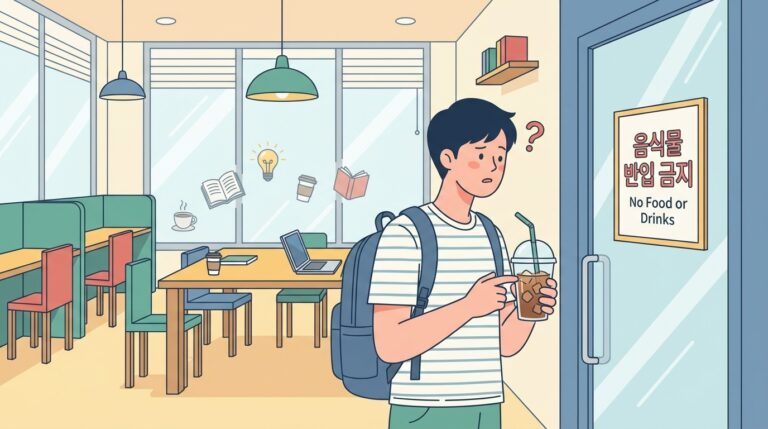
Phase 1: Empathy (Cold Open)
Hello! I’m your Daily Hangul Editor.
Imagine this: You are watching a K-Drama. The main character is pulling an all-nighter for the bar exam or a big university test. The library is dead silent—so quiet you could hear a pin drop. Now, imagine walking into that exact room and cracking open a noisy bag of potato chips or slurping an iced drink. Suddenly, thirty pairs of eyes shoot you the ultimate Korean laser glare.
In Korea, studying is serious business. Public libraries, university reading rooms, and the ever-popular Study Cafes (스터디카페) have strict rules about what you can and cannot consume. If you don’t want to become the villain of everyone’s study session, you need to know how to ask: “Can I eat this here?”
Don’t worry! I’ve seen many of my students awkwardly chug a whole hot coffee at the entrance because they didn’t know how to ask. Today, we’ll learn exactly what to say to navigate Korean library and cafe rules like a true local.
Phase 2: Core Expressions Deep Dive
Let’s look at the survival phrases you need before stepping into the quiet zone.
1. 여기 음식 먹어도 돼요?
- Pronunciation: Yeogi eumsik meogeodo dwaeyo? (Sound alike: ‘dwae’ sounds like the ‘dwe’ in ‘dwell’)
- Meaning: Can I eat food here? (Literal: Here food, even if I eat, is it okay?)
- K-Culture Moment: You’ll use this not just in libraries, but in PC Bangs (internet cafes), board game cafes, or even when visiting a friend’s pristine new apartment.
- Editor’s Insight: The magic grammar here is ~아/어도 돼요? (Is it okay if I…?). It’s polite, soft, and shows you are asking for permission rather than just stating what you want to do.
- Situation Spectrum:
- Friends (Casual): ✅ (Drop the ‘요’ -> 먹어도 돼?)
- Staff/Strangers (Semi-formal): ✅ (Perfect!)
- Official settings (Formal): ⚠️ (Better to use ‘먹어도 됩니까?’)
- 🤔 Think About It: Why does Korean use “Even if I do [X], is it okay?” to ask for permission? How does this reflect the culture of prioritizing the community’s comfort over individual desires?
2. 음료수 가지고 들어가도 돼요?
- Pronunciation: Eumnyosuneun gajigo deureogado dwaeyo?
- Meaning: Can I bring a drink inside?
- K-Culture Moment: Ah-Ah (Iced Americano) is the lifeblood of Korean students. But taking it into the “Focus Zone”? That depends on the cafe’s rules. This phrase is your golden ticket to finding out.
- Editor’s Insight: 가지고 들어가다 means “to take (something) and go inside.” You are literally describing the physical action to the staff.
- Situation Spectrum:
- Friends (Casual): ✅
- Staff/Strangers (Semi-formal): ✅
- Official settings (Formal): ⚠️
- 🤔 Think About It: Notice how specific Korean verbs are! Instead of just “bring,” you say “take and go in.” Does your native language combine actions like this?
3. 음식물 반입 금지
- Pronunciation: Eumsingmul banip geumji
- Meaning: No food or drinks allowed. (Literal: Food and beverage / bringing in / prohibited)
- K-Culture Moment: You won’t usually say this, but you will read it. It’s written on the glass doors of libraries, buses, and retail stores all over Seoul.
- Editor’s Insight: These are Hanja (Sino-Korean) words. Formal signs in Korea love using Hanja to sound official and strict. When you see 금지 (Geumji – Prohibited), stop right there!
- Situation Spectrum:
- Written signs / Announcements: ✅
- Spoken in daily conversation: 🚫 (Too robotic!)
Phase 3: Textbook vs. Real Korean
[Asking if you can take your coffee inside]
* 📖 Textbook Korean: 음료수를 반입할 수 있습니까? (Are you able to bring in beverages?)
* 🗣️ Real Korean: 커피 들고 가도 돼요? (Can I carry my coffee in?)
* 💡 Why the difference?: Textbooks use formal Hanja words (반입). In real life, “들고 가다” (to hold and go) is much more natural and friendly for everyday items.
[When the staff tells you ‘No’]
* 📖 Textbook Korean: 음식물을 섭취하시면 안 됩니다. (You must not consume food items.)
* 🗣️ Real Korean: 여기서 드시면 안 돼요. (You shouldn’t eat here.)
* 💡 Why the difference?: Staff members are usually young part-timers. They will use polite, conversational Korean (드시면 안 돼요) rather than sounding like a police officer.
Bottom Note: At an
A2 (Beginner)level, stick to ~아/어도 돼요? to ask for permission. It’s safe, natural, and works everywhere!
Phase 4: Cultural Context — K-Culture Deep Dive
4-1. Non-verbal Nunchi
When asking these questions, especially in a quiet place, lower your voice. Point to your drink or food so the staff knows exactly what you’re talking about. In Korea, Nunchi (눈치)—the ability to read the room—is crucial. If everyone is studying in complete silence, even a crinkly candy wrapper can ruin the vibe. Read the room before you eat!
4-2. The “Study Cafe” Phenomenon
In K-Dramas, you might see students studying in old, dark reading rooms. Today, Korea is obsessed with Study Cafes (스터디카페). They look like premium tech startups with coffee machines, plants, and ergonomic chairs.
But here is the catch: They usually have a Lounge (휴게실) where you can eat ramen and chat quietly, and a Focus Zone (집중형 공간) where even mouse clicks might get you a dirty look. Knowing how to ask what is allowed in which room is essential survival knowledge for any student in Korea.
Phase 5: Real-Life Roleplay Scenario
Setting: Saturday afternoon. A sleek, modern Study Cafe near Hongik University (Hongdae). You just bought a 2-hour pass from the kiosk outside. You are holding a half-eaten sandwich and a large Iced Americano.
Characters:
– YOU: A foreign exchange student trying to finish your homework.
– Staff (Jimin): 22-year-old part-timer, polite but has to enforce the rules.
Dialogue:
YOU: 안녕하세요! 저기요… (Hello! Excuse me…)
(Romanization) Annyeonghaseyo! Jeogiyo…
(English) [Hello! Excuse me…]
Jimin: 네, 안녕하세요! 결제하셨어요? 😊
(Romanization) Ne, annyeonghaseyo! Gyeoljehasyeosseoyo?
(English) [Yes, hello! Did you pay?]
(🎭 Stage Direction: Jimin smiles warmly from behind the counter)
YOU: 네. 근데, 이거 커피 들고 들어가도 돼요?
(Romanization) Ne. Geunde, igeo keopi deulgo deureogado dwaeyo?
(English) [Yes. But, can I take this coffee inside?]
Jimin: 아, 네. 뚜껑이 있어서 괜찮아요.
(Romanization) Ah, ne. Ttukkyeongi isseoseo gwaenchanayo.
(English) [Ah, yes. It has a lid, so it’s fine.]
YOU: 그럼 이 샌드위치는요? 먹어도 돼요?
(Romanization) Geureom i saendeuwichineunyo? Meogeodo dwaeyo?
(English) [Then what about this sandwich? Can I eat it?]
(🎭 Stage Direction: You lift the sandwich wrapped in crinkly plastic)
Jimin: 앗, 죄송하지만 안에는 음식물 반입 금지예요.
(Romanization) At, joesonghajiman aneneun eumsingmul banip geumjiyeyo.
(English) [Ah, I’m sorry, but bringing food inside is prohibited.]
🔀 Your Turn! How do you reply?
– A) “아, 그럼 가방에 넣을게요.” (Ah, then I’ll put it in my bag.)
– B) “왜요? 배고픈데…” (Why? I’m hungry…)
– C) “아… 그럼 샌드위치는 어디서 먹어도 돼요?”✅ Best Choice: C (Ah… then where can I eat the sandwich?) — This is the smart move! Most study cafes have a designated lounge area. Asking where it’s okay to eat solves your problem without breaking the rules.
⚠️ Choice A Analysis: Good, but you’ll stay hungry!
⚠️ Choice B Analysis: Too whiny. Rules are rules in Korea, and the part-timer can’t change them for you.
YOU (Choosing C): 아… 그럼 샌드위치는 어디서 먹어도 돼요?
(Romanization) Ah… geureom saendeuwichineun eodiseo meogeodo dwaeyo?
(English) [Ah… then where can I eat the sandwich?]
Jimin: 저기 문 옆에 휴게실이 있어요. 거기서 드시면 돼요!
(Romanization) Jeogi mun yeope hyugesiri isseoyo. Geogiseo deusimyeon dwaeyo!
(English) [There is a lounge next to the door over there. You can eat it there!]
YOU: 아, 감사합니다!
(Romanization) Ah, gamsahamnida!
(English) [Ah, thank you!]
Phase 6: 10-Second Shadowing Drill
Let’s practice the most important phrase. Pay attention to the pauses and the rising intonation at the end!
😊 저기요, / 커피 들고 / 들어가도 돼요? ⤴️
(jeogiyo, / keopi deulgo / deureogado dwaeyo?)
Editor’s tip: Say “dwaeyo?” with a bright, curious tone. If you say it too flat, it might sound like you are challenging the staff!
Phase 7: K-Culture Mini Dictionary
| Korean | Romanization | English | Context |
|---|---|---|---|
| 스터디카페 | seuteodikape | Study Cafe | Modern, aesthetic spaces where people pay by the hour to study. |
| 휴게실 | hyugesil | Lounge / Rest Area | The only place you can eat food or talk on the phone in a study cafe. |
| 눈치 | nunchi | Social awareness | Reading the room. e.g., Not opening a loud snack in a silent room. |
| 아아 | a-a | Iced Americano | The abbreviation for ‘Iced Americano’. The fuel of Korean society. |
| 뚜껑 | ttukkeong | Lid / Cap | Drinks without lids are usually rejected at libraries and on buses! |
Phase 8: Traveler Survival Kit
Are you just visiting Korea? Here are the survival phrases you need when navigating cafes, libraries, or even buses!
🆘 Survival Phrase #1: Asking about trash
– 🇰🇷 “이거 버려주실 수 있나요?” (igeo beoryeojusil su innayo?)
– 🗣️ Meaning: Can you throw this away for me?
– 📍 Where to use: Convenience stores, cafes.
– 💡 Pro Tip: Korea has strict recycling rules (분리수거). If you can’t find a bin, ask the staff politely instead of leaving your trash on the table!🆘 Survival Phrase #2: Finding the Wi-Fi
– 🇰🇷 “와이파이 비밀번호 뭐예요?” (waipai bimilbeonho mwoyeyo?)
– 🗣️ Meaning: What is the Wi-Fi password?
– 📍 Where to use: Everywhere.📌 Editor’s Travel Note
– Buses: You cannot board a Seoul city bus with a takeout cup that doesn’t have a secure, sealed lid. If you have an iced coffee with a straw sticking out, the driver will ask you to throw it away or get off! “음식물 반입 금지” applies here too.
Phase 9: Critical Thinking Corner — “One Step Deeper”
🧠 Think Deeper: Media vs Reality (The Silent Reality)
In K-Dramas, libraries are romantic. The male lead leans over, whispers sweetly, and shares a strawberry milk with the female lead.In reality? Korean libraries and reading rooms are battlegrounds for the future. People are studying for life-changing exams (Suneung, civil service, bar exams). If you whisper flirtatiously or slurp your milk, you might literally get a passive-aggressive “Post-it note” slammed on your desk reading: “Please breathe quieter” (숨소리 좀 줄여주세요). This hyper-strict environment reflects Korea’s intense, highly competitive educational society where “focus” is a shared, sacred resource.
💬 Your Turn: Does your country have strict rules in libraries, or is it more relaxed? Share in the comments!
Phase 10: FAQ & Avoiding Mistakes
Q: Can I bring water into a library?
Yes! Almost all libraries and study cafes allow water, especially if it’s in a closed bottle or a tumbler. The issue is usually with smelly food or sticky, spillable drinks.
Q: What if I have gum or a quiet candy?
Technically, “food” includes candy. However, if it’s small, doesn’t smell, and you open the wrapper quietly, Koreans will generally turn a blind eye (눈감아주다). Just use your nunchi!
❌ Common Mistake: Trying to argue with a “음식물 반입 금지” sign.
✅ Do this instead: In some cultures, rules are more like “guidelines.” In Korea, public rules are strictly followed by the collective. If the sign says no food, finish your snack outside before entering.
Phase 11: Summary & Action Items
One-Liner Summary: Before bringing your snack or drink inside, always ask: “여기 먹어도 돼요?” (Can I eat here?)
Action Mission 3 Steps:
– 🥉 Bronze (Solo): Look in the mirror and say “커피 들고 들어가도 돼요?” 3 times with a friendly smile.
– 🥈 Silver (Online): Find a picture of a Korean Study Cafe on Instagram, and comment: “여기 커피 마셔도 돼요?”
– 🥇 Gold (Real Life): Next time you enter a cafe or store in Korea with a drink, use this phrase to check with the staff!
K-Culture Mission:
Go to YouTube and search “Korean Study Cafe Tour” (스터디카페 브이로그). Look closely at the signs on the doors—can you spot the word 금지 (Prohibited)?
Did you know about the strict bus rules in Korea? Let me know in the comments if you’ve ever had a funny culture shock moment with food rules! 👇
Phase 12: Interactive Challenge Quiz
1. You are holding a hamburger. You want to study in the local library. What should you do?
– A) Hide it in your bag and eat it in the quiet zone.
– B) Ask the staff: “여기 음식 먹어도 돼요?”
– C) Give the hamburger to the librarian as a bribe.
(Answer: B! But spoiler alert, they will say no. Better to ask where the 휴게실/Lounge is!)
2. Fill in the blank: To ask for permission, the grammar pattern is “~아/어도 ________?”
(Answer: 돼요)
3. True or False: You can take an open, half-finished iced Americano onto a Seoul city bus.
(Answer: FALSE. Seoul buses strictly enforce a no-spillable-drinks policy! Finish it at the bus stop.)
Frequently Asked Questions (FAQ)
Q: What does "여기 음식 먹어도 돼요?" mean in Korean and how do you pronounce it?
A: In Korean, "여기 음식 먹어도 돼요?" is pronounced [Yeogi eumsik meogeodo dwaeyo? (Sound alike: 'dwae' sounds like the 'dwe' in 'dwell'] and means: Can I eat food here? (Literal: Here food, even if I eat, is it okay?)
Q: What does "음료수 가지고 들어가도 돼요?" mean in Korean and how do you pronounce it?
A: In Korean, "음료수 가지고 들어가도 돼요?" is pronounced [Eumnyosuneun gajigo deureogado dwaeyo?] and means: Can I bring a drink inside?
Q: What does "음식물 반입 금지" mean in Korean and how do you pronounce it?
A: In Korean, "음식물 반입 금지" is pronounced [Eumsingmul banip geumji] and means: No food or drinks allowed. (Literal: Food and beverage / bringing in / prohibited)







