

Phase 1: Empathy & Immersion (Opening)
Hello! I’m your Daily Hangul Editor.
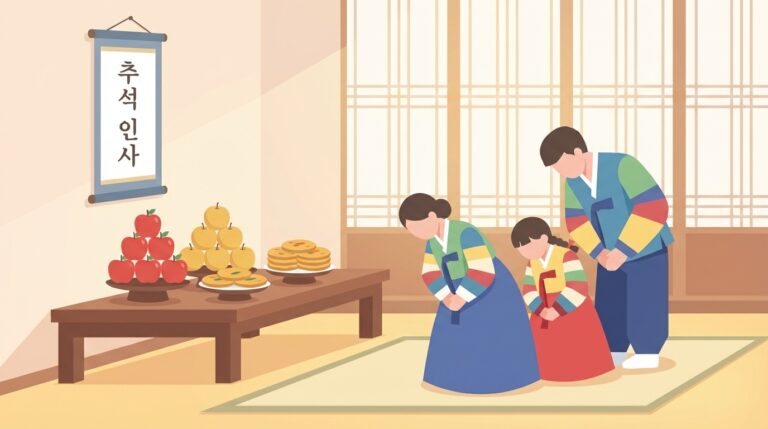
Picture this: You’re watching a K-Drama. It’s a holiday episode. Suddenly, the entire family—dressed in beautiful traditional clothes (Hanbok)—gathers in the living room. There is a magnificent table filled with perfectly stacked apples, pears, and savory pancakes. Then, everyone drops to their knees and bows deeply to the floor.
Are they apologizing for a huge mistake? Not at all! They are paying respects to their ancestors and elders for Seollal (Korean Lunar New Year).
For a beginner (A1) Korean learner, traditional holidays can feel like a totally different world. If you don’t know what’s going on, you might just stand there awkwardly while everyone else is on the floor! But don’t worry. This guide is based on real questions from my past students who survived their first Korean family holiday. Let’s dive into the heart of Seollal and learn how to greet the Korean way!
Phase 2: Deep Dive into Key Expressions
Let’s look at the top 3 expressions you need to know about Seollal greetings.
1. 새해 복 많이 받으세요
- Pronunciation: [Sae-hae bok man-i ba-deu-se-yo] / Sounds like: Say-hay bok mahn-ee bah-deu-say-yo
- Meaning: (Literal) Please receive a lot of New Year’s luck. / (Real Nuance) Happy New Year!
- K-Culture Moment: You say this right before or right after you do the deep bow (Jeol) to living elders (grandparents, parents). It’s the ultimate magic phrase that opens up wallets (for New Year’s cash!).
- Editor’s Insight: This phrase is long, but it’s like a warm hug in words. It’s not just “Happy New Year”—you are actively wishing them good fortune.
- Situation Spectrum:
- Friends (Casual): ✅ (Often shortened to “새해 복 많이 받아!”)
- Co-workers (Semi-formal): ✅
- Elders/Bosses (Formal): ✅
- 🤔 Think About It: Why does Korean focus on “receiving luck (복)” instead of just saying “happy”? How do you wish a good year in your home country?
2. 차례 지내요
- Pronunciation: [Cha-rye ji-nae-yo] / Sounds like: Cha-rye (like ‘rye’ bread) jee-nay-yo
- Meaning: We hold a memorial service for ancestors.
- K-Culture Moment: If you text your Korean friend on Seollal morning and they reply, “I can’t talk right now, 차례 지내요,” it means they are currently standing in front of the ancestral table, bowing and serving traditional liquor.
- Editor’s Insight: ‘차례(Charye)’ is the specific morning ritual for ancestors. You don’t actually speak to the ancestors during this; the respect is shown through actions and silence.
- Situation Spectrum:
- Friends (Casual): ✅
- Co-workers (Semi-formal): ✅
- Elders/Bosses (Formal): 🚫 (You wouldn’t usually declare this to a boss unless asked).
- 🤔 Think About It: In many Western cultures, we visit graves. In Korea, the ancestors are believed to visit the family home for this meal. How does this change the feeling of the holiday?
3. 절
- Pronunciation: [Jeol] / Sounds like: Juhl (rhymes with ‘dull’)
- Meaning: A traditional deep bow.
- K-Culture Moment: When Idols do a live stream for the New Year, they often step back, get on their knees, and do a ‘Jeol’ to their fans through the camera!
- Editor’s Insight: ‘Jeol’ is the action. When you do this bow for the New Year to living elders, it gets a special name: 세배 (Sebae).
- Situation Spectrum:
- Friends (Casual): 🚫 (Friends don’t bow to each other like this!)
- Co-workers (Semi-formal): 🚫
- Elders/Bosses (Formal): ✅
- 🤔 Think About It: Bowing puts your head lower than the other person’s heart. It’s the ultimate physical sign of trust and respect.
Phase 3: Textbook vs. Real Korean
[Situation 1: Explaining what you do on Seollal morning]
* 📖 Textbook Korean: 저는 오늘 가족과 함께 조상님께 차례를 지냅니다. (I am holding an ancestral rite with my family today.)
* 🗣️ Real Korean: 아침에 차례 지내요. (Achime charye jinaeyo. – Holding the rite in the morning.)
* 💡 Why the difference?: Koreans love efficiency! We drop the “I” and “with my family” because it’s already obvious from the context.
[Situation 2: Wishing a Happy New Year]
* 📖 Textbook Korean: 당신의 새해에 행복이 가득하기를 바랍니다. (I wish your new year is full of happiness.)
* 🗣️ Real Korean: 새해 복 많이 받으세요! (Saehae bok mani badeuseyo!)
* 💡 Why the difference?: The textbook phrase sounds like a poetic greeting card. In real life, “새해 복 많이 받으세요” is the absolute standard for everyone.
Bottom Note: For A1 learners, don’t worry about making complex sentences. Just mastering “새해 복 많이 받으세요” will make Koreans incredibly happy!
Phase 4: Cultural Context — K-Culture Deep Dive
4-1. Non-Verbal Cues: The Art of the Bow (Jeol)
Language isn’t just words; your body speaks too!
– Eye Contact: When you do a deep bow (Jeol), do not stare at the person or the ancestor’s table. Look at the floor. In Korean culture, lowering your eyes is a sign of deep respect.
– Hand Position (공수 – Gongsu): When standing before the bow, fold your hands gently in front of your belly. For happy events (like Seollal), men put their LEFT hand on top, and women put their RIGHT hand on top.
4-2. K-Culture Link: The K-Drama Holiday Trope
Have you ever seen a K-Drama where the mother-in-law and daughter-in-law are sitting on the floor, flipping savory pancakes (Jeon – 전) for hours while arguing?
That’s the ultimate Seollal K-Drama trope! The food on the Charye table must be perfectly shaped, colorful, and abundant. It takes hours (sometimes days) to prepare. So, if your Korean friend looks exhausted after the holidays, it’s probably because they suffered from “Holiday Syndrome (명절 증후군)” from cooking all that food!
Phase 5: Real-Life Roleplay Scenario
Setting: Sunday morning, 9:00 AM. You are invited to your Korean friend Minji’s house for Seollal. The Charye (ancestor ritual) is finished, and now it’s time to greet the living elders in the living room.
Characters:
– YOU: A foreigner in Korea, nervous but excited for your first Seollal.
– Minji (28): Your helpful Korean friend.
– Grandmother (75): Minji’s sweet grandmother who loves feeding people.
Dialogue:
Minji: 자, 할머니한테 세배하자!
(Ja, halmeonihante sebaehaja!)
[Let’s do the New Year’s bow to Grandma!]
YOU: (Following Minji, you kneel down and bow deeply)
할머니, 새해 복 많이 받으세요!
(Halmeoni, saehae bok mani badeuseyo!)
[Grandma, Happy New Year!]
Grandmother: (Smiling brightly) 아이고~ 우리 예쁜 강아지! 새해 복 많이 받고, 건강해라. 자, 이거 받아.
(Aigo~ uri yeppeun gang-aji! Saehae bok mani batgo, geonganghaera. Ja, igeo bada.)
[Oh my~ our pretty puppy (term of endearment)! Receive a lot of luck and be healthy. Here, take this.]
(🎭 Stage Direction: Grandmother holds out a beautiful envelope. It’s Sebaetdon – New Year’s Money!)
🔀 Your Turn! How do you react?
– A) (Take it with one hand) “Oh! Thank you!”
– B) (Wave your hands) “아니에요, 괜찮아요!” (No, it’s okay!) and refuse it completely.
– C) (Receive it with TWO hands, bowing your head slightly) “감사합니다!”✅ Best Choice: C — In Korea, ALWAYS receive things from elders with two hands. It’s okay to accept New Year’s money gracefully!
⚠️ Choice B Analysis: While modest refusal is polite in Korea, Sebaetdon is a gift of blessing. Refusing it completely can make the elder sad.
Phase 6: 10-Second Shadowing Drill
Practice this phrase. It’s all about the rhythm!
😊 새해 / 복 / 많~~~이 / 받으세요!
(Sae-hae / bok / man~~~i / ba-deu-se-yo!)
Say it brightly and warmly, stretching the ‘man’ slightly to emphasize ‘A LOT’ of luck!
Phase 7: K-Culture Mini Dictionary
| Korean | Romanization | English | Context |
|---|---|---|---|
| 차례 | charye | Ancestor Rite | The morning ceremony with a food table for ancestors. |
| 세배 | sebae | New Year’s Bow | The deep bow given to living elders for the New Year. |
| 세뱃돈 | sebaetdon | New Year’s Money | The cash given by elders after you do the Sebae. |
| 한복 | hanbok | Traditional Clothes | Worn during big holidays or weddings. |
| 떡국 | tteokguk | Rice Cake Soup | Eating this soup on Seollal means you get one year older! |
Phase 8: Traveler’s Survival Kit
If you are traveling in Korea during Seollal, you MUST know this. Many shops and restaurants close so people can visit their hometowns to bow to their ancestors!
🆘 Survival Phrases for the Holiday
– 🇰🇷 “오늘 문 열어요?” (o-neul mun yeo-reo-yo?)
– 🗣️ Pronunciation: Oh-neul moon yuh-ruh-yo?
– 📍 Where to use: Calling a restaurant or cafe before you visit.
– 💡 Meaning: Are you open today?📌 Editor’s Travel Note
– The Ghost Town: Seoul becomes very quiet during Seollal because everyone leaves for the countryside.
– Palaces are your best friend: Gyeongbokgung Palace is usually open (and often free!) during Seollal. If you wear a Hanbok, you get amazing photos.
– Convenience Stores: GS25, CU, and 7-Eleven are basically open 365 days a year. They are your lifeline if restaurants are closed!
Phase 9: Critical Thinking — “One Step Deeper”
🧠 Think Deeper: Food & Identity (음식과 정체성)
Why do Koreans spend so much time making a massive table of food for ancestors who can’t physically eat it? In Korean culture, food is the ultimate expression of love and memory. The Charye table isn’t just for the dead; after the ritual, the entire family sits down to eat that exact same food together (a tradition called Eumbok). By eating the food blessed by the ancestors, the family reinforces their bond, connecting the past, present, and future generations through a shared meal.
💬 Your Turn: How does your culture remember ancestors or passed loved ones? Is food involved? Share with us in the comments!
Phase 10: FAQ & Avoiding Misunderstandings
- Q: Do I say “새해 복 많이 받으세요” to the ancestors during the rite?
- No. The ancestor ritual is done quietly. You bow silently or think your respects. The greeting phrase is only for living people!
- Q: Do I have to give New Year’s money (Sebaetdon) too?
- Maybe. Only adults with jobs give money to children, students, or sometimes elderly parents. If you are a student or younger, you just receive!
❌ Common Mistake #1: Wearing all black to a Seollal gathering.
✅ Do this instead: Seollal is a happy, bright start to the year! Try to wear bright, neat colors if you don’t have a Hanbok. All black is usually reserved for funerals.
Phase 11: Summary & Action Items
- One-Liner Summary: On Seollal, Koreans honor ancestors silently (Charye) and loudly wish living elders a Happy New Year (Sebae) with “새해 복 많이 받으세요!”
-
Action Mission 3 Steps:
- 🥉 Bronze (Solo): Stand in front of your mirror and practice bowing your head while saying “새해 복 많이 받으세요” 3 times.
- 🥈 Silver (Online): Go to a K-Pop idol’s social media or a Korean friend’s Instagram and comment: “새해 복 많이 받으세요! 🙇♂️🙇♀️” (Use the bowing emoji!).
- 🥇 Gold (Real Life): When the New Year comes, surprise your Korean friend or teacher with a perfect “Saehae bok mani badeuseyo!”
- K-Culture Mission: Search for “Korean Seollal Charye Table (차례상)” on Google Images. Try to spot the apples, pears, and dates!
Phase 12: Quiz — Interactive Challenge
1. Situation Judgment: You are at a Korean cafe on Seollal. The barista gives you your coffee. What is the best thing to say?
– A) 차례 지내요! (I’m holding an ancestor rite!)
– B) 세뱃돈 주세요! (Give me New Year’s money!)
– C) 새해 복 많이 받으세요! (Happy New Year!)
2. True or False:
– Koreans say “새해 복 많이 받으세요” directly to their ancestors’ pictures out loud during the morning ritual.
3. Fill in the Blank:
– The traditional deep bow you do to your grandparents on New Year’s is called _______ (세배 / 한복).
(Answers: 1. C / 2. False – It’s done silently! / 3. 세배)
Frequently Asked Questions (FAQ)
Q: What does "새해 복 많이 받으세요" mean in Korean and how do you pronounce it?
A: In Korean, "새해 복 많이 받으세요" is pronounced [Sae-hae bok man-i ba-deu-se-yo] and means: (Literal) Please receive a lot of New Year's luck. / (Real Nuance) Happy New Year!
Q: What does "차례 지내요" mean in Korean and how do you pronounce it?
A: In Korean, "차례 지내요" is pronounced [Cha-rye ji-nae-yo] and means: We hold a memorial service for ancestors.
Q: What does "절" mean in Korean and how do you pronounce it?
A: In Korean, "절" is pronounced [Jeol] and means: A traditional deep bow.







