

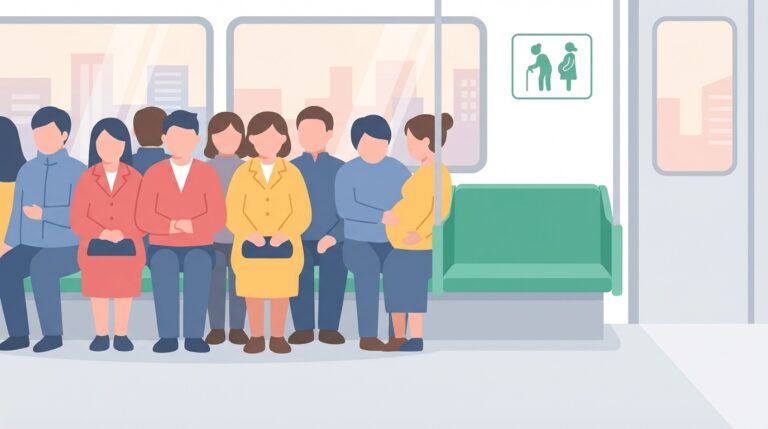
Phase 1: Empathy (The K-Culture Cold Open)
Hello! I’m your Daily Hangul Editor.
Imagine this: You’re in Seoul. It’s 6:30 PM on a Friday. You’ve just squeezed yourself onto Subway Line 2, affectionately known as the ‘Circle of Hell’ during rush hour. You are exhausted. Your feet ache from walking around Myeongdong all day. And then… a miracle! At the very end of the train car, there is one completely empty seat.
You rush over, sit down with a sigh of relief, and suddenly—you feel it. The collective, piercing stares of ten Korean ajummas (middle-aged women). You check your zipper. You check your shoes. What did you do wrong?
Welcome to the ultimate Korean subway sin: sitting in the 노약자석 (Priority Seating).
In textbooks, they teach you how to buy a ticket. But they rarely teach you the unwritten social rules that save you from getting scolded in public! This guide is based on real panicked text messages I’ve received from my expat students. Today, we’re going to navigate the unspoken rules of Korean public transport etiquette so you can ride the subway like a true local.
Phase 2: Core Expressions Deep Dive
1. 여기는 노약자석이에요. (This is priority seating.)
- Pronunciation: yeogineun noyakjaseogieyo [yeo-gi-neun no-yak-ja-seo-gi-e-yo]
- Meaning:
- Literal: This place is the elderly/weak seat.
- Real nuance: “You really shouldn’t sit there, please stand up.”
- K-Culture Moment: You’ll often hear the automated subway announcement chime in with this, or a kind Korean stranger might whisper it to you if they notice you’re a clueless tourist about to make a mistake.
- Editor’s Insight: This isn’t just an informational sentence; it’s a gentle warning. Koreans use the passive statement of fact (“This is…”) rather than a direct command (“Don’t sit!”) to save your face while pointing out a mistake.
- Situation Spectrum:
- Friends (Casual): ✅ (They’d drop the ‘yo’)
- Coworkers (Semi-formal): ⚠️
- Elders (Formal): 🚫 (You wouldn’t correct an elder on this!)
- 🤔 Think About It: Why do Koreans prefer saying “This is a reserved seat” instead of “Get up”? How does indirect communication play a role in Korean politeness?
2. 여기 앉으세요! (Please sit here!)
- Pronunciation: yeogi anjeuseyo [yeo-gi ahn-joo-seh-yo / ‘anjeu’ sounds like you’re saying ‘Ahn-Jew’]
- Meaning:
- Literal: Sit here.
- Real nuance: “Please take my seat, I insist.”
- K-Culture Moment: Picture a K-Drama where the warm-hearted protagonist immediately jumps up from their regular seat the moment an elderly person boards the bus. They gesture to the seat with both hands and smile.
- Editor’s Insight: This is your golden ticket to earning massive respect in Korea. Offering your regular seat to the elderly, pregnant, or disabled is a highly praised action.
- Situation Spectrum:
- Friends (Casual): 🚫 (Too polite)
- Coworkers (Semi-formal): ✅
- Elders/Strangers (Formal): ✅ (Perfect!)
- 🤔 Think About It: Notice the “~세요 (~seyo)” ending? It’s an honorific command. How does your native language change when speaking to someone much older?
3. 비워두는 게 좋아요. (It’s better to leave it empty.)
- Pronunciation: biwoduneun ge joayo [bee-wo-doo-neun geh jo-ah-yo]
- Meaning:
- Literal: Leaving it empty is good.
- Real nuance: “Seriously, don’t sit there, even if the train is empty.”
- K-Culture Moment: When you’re traveling with a Korean friend and you point to the empty pink seat (for pregnant women) in an otherwise empty train car. They will pull your arm back and say this.
- Editor’s Insight: The ending “~는 게 좋아요” means “It is better to…” It’s the standard Korean way to give advice without sounding bossy.
- Situation Spectrum:
- Friends (Casual): ✅ (As ‘비워두는 게 좋아’)
- Coworkers (Semi-formal): ✅
- Elders (Formal): 🚫
Phase 3: Textbook vs. Real Korean
[Scenario 1: Telling a friend not to sit in the priority seat]
* 📖 Textbook Korean: 노약자석에는 앉으면 안 됩니다. (You must not sit in the priority seat.)
* 🗣️ Real Korean: 야, 거긴 비워둬. (Hey, leave that empty.)
* 💡 Why the difference?: Textbooks teach strict instructional grammar. Among friends, Koreans use short, direct action verbs (비워둬 – leave it empty) for efficiency.
[Scenario 2: Offering your seat to an elder]
* 📖 Textbook Korean: 제 자리에 앉으시겠습니까? (Would you like to sit in my seat?)
* 🗣️ Real Korean: 할머니/할아버지, 여기 앉으세요! (Grandma/Grandpa, please sit here!)
* 💡 Why the difference?: Asking “Would you like to…” can make the elder feel like they are burdening you. Just standing up and enthusiastically telling them to sit is considered much more polite and warm.
Bottom Note: For B1 learners, using “여기 앉으세요” with a warm smile is your safest, most natural bet!
Phase 4: Cultural Context — K-Culture Deep Dive
4-1. Non-Verbal Cues: The Art of Standing Up
When you offer your seat to someone in Korea, words are only half the battle. If you stare at them while saying “Sit here,” it can feel confrontational. The Korean way is a mix of Nunchi (눈치) and swift action. You make brief eye contact, say “여기 앉으세요!”, stand up immediately, and physically move away from the seat. This removes the awkwardness and allows them to sit without feeling like they forced you up.
4-2. The Pink Seats (임산부 배려석)
If you’ve traveled on the Seoul subway, you’ve definitely noticed the bright pink seats. These are exclusively for pregnant women. Unlike the priority seats at the ends of the cars which sometimes have flexible rules depending on the exact generation, the unwritten rule for the pink seats is incredibly strict among the younger generation: Never, ever sit there unless you are pregnant. Even if the train is packed like sardines and you are exhausted, that pink seat remains an untouchable island. It’s a striking visual representation of Korean community values.
Phase 5: Real-Life Roleplay Scenario
Setting: Line 2, Gangnam Station. 7:00 PM. The train doors open and a massive wave of people pushes you inside. You are standing next to your Korean coworker, Minsoo.
Characters:
* YOU: An expat working in Seoul, exhausted after a long day.
* Minsoo (32): Your friendly coworker who acts as your local guide.
Dialogue:
YOU: 와, 사람 진짜 많네요. 다리가 너무 아파요.
(wa, saram jinjja manneyo. dariga neomu apayo.)
[Wow, there are so many people. My legs hurt so much.]
Minsoo: 그러니까요. 지옥철이에요 완전.
(geureonilkkayo. jiokcheorieyo wanjeon.)
[I know, right? It’s totally the hell-train.]
YOU: 어! 저기 끝에 자리 하나 있어요!
(eo! jeogi kkeute jari hana isseoyo!)
[Oh! There’s one seat at the end over there!]
(🎭 Stage Direction: You take a step toward the empty corner seat.)
Minsoo: 아, 거기는 노약자석이에요. 비워두는 게 좋아요.
(a, geogineun noyakjaseogieyo. biwoduneun ge joayo.)
[Ah, that’s priority seating. It’s better to leave it empty.]
YOU: 아, 진짜요? 아무도 없는데 앉으면 안 돼요?
(a, jinjjayo? amudo eomneunde anjeumeun an dwaeyo?)
[Oh, really? No one is there, can’t I sit?]
Minsoo: 네, 한국에서는 보통 비워둬요.
(ne, hangugeseoneun botong biwoduwoyo.)
[Yeah, in Korea we usually leave them empty.]
🔀 Your Turn! How do you respond?
* A) “너무 피곤한데 그냥 앉을게요.” (I’m too tired, I’ll just sit.)
* B) “아, 몰랐어요. 알려줘서 고마워요!” (Ah, I didn’t know. Thanks for letting me know!)
* C) “비켜요! 내 자리야!” (Move! It’s my seat!)✅ Best Choice: B — Acknowledging the cultural rule gracefully.
⚠️ Choice A Analysis: Doing this will make Minsoo extremely uncomfortable, and you will definitely get scolded by the next elder who boards.
Phase 6: 10-Second Shadowing Drill
Practice this until it flows naturally. Pay attention to the pauses (/)!
😊 할머니, / 여기 / 앉으세요!
(halmeoni, / yeogi / anjeuseyo!)
“Grandma, please sit here!” (Bright, polite, and welcoming)
😤 여기는 / 노약자석이니까 / 비워두는 게 / 좋아요.
(yeogineun / noyakjaseoginikka / biwoduneun ge / joayo.)
“Because this is priority seating, it’s better to leave it empty.” (Informative and firm)
Phase 7: K-Culture Mini Dictionary
| Korean | Romanization | English | Cultural Context |
|---|---|---|---|
| 노약자석 | noyakjaseok | Priority Seating | Literally means “seats for the old and weak.” Usually located at the extreme ends of subway cars. |
| 임산부 배려석 | imsanbu baeryeoseok | Pregnant Women’s Seat | The pink seats in the middle rows. Highly respected by the younger generation. |
| 지옥철 | jiokcheol | Hell Train | A slang combining ‘Hell’ (jiok) and ‘Subway’ (jihacheol). Refers to insanely crowded rush hour trains. |
| 양보하다 | yangbohada | To yield / give way | The core virtue of giving up your seat or letting someone go first. |
| 눈치 | nunchi | Social Awareness | The ability to ‘read the room.’ Not sitting in an empty priority seat is peak Nunchi. |
Phase 8: Traveler Survival Kit
Navigating Korean public transport? Here are the top expressions you need!
🆘 Survival Expressions
* 🇰🇷 “내릴게요!” (naerilkkeyo!)
* 🗣️ Pronunciation: [nae-ril-kke-yo!]
* 📍 Where to use: When you need to push through a crowded bus or subway to get off.
* 💡 Pro Tip: Say this loudly as you approach the door. People will part like the Red Sea for you!
- 🇰🇷 “이 버스 [명동] 가요?” (i beoseu [myeongdong] gayo?)
- 🗣️ Pronunciation: [ee buh-seu myeong-dong ga-yo?]
- 📍 Where to use: Asking the bus driver if the bus goes to your destination.
📌 Editor’s Travel Note
* Useful Apps: Download KakaoMetro and Naver Map. Google Maps does not work well for walking/transit directions in Korea!
* T-Money Card: Buy this at any convenience store. Tap it when you get ON and when you get OFF the bus/subway to avoid extra charges.
* Silence is Golden: Unlike in some Western countries, talking loudly on the phone on Korean public transport is a huge faux pas.
Phase 9: Critical Thinking — “One Step Deeper”
🧠 Think Deeper: Language, Space, and Confucianism
In Korean culture, respect for elders (경로사상) isn’t just something you hear in the language through honorifics (존댓말); it is physically built into the infrastructure of the city. The fact that the noyakjaseok remains empty even when dozens of exhausted commuters are standing around it shows that the physical space itself is sacred. It’s a monument to social hierarchy. In many Western cultures, a priority seat is simply yielded when someone needs it. In Korea, the space is often left empty in anticipation of an elder. It reflects a society that values collective duty over individual comfort.
💬 Your Turn: In your home country, do people leave priority seats empty, or do they sit and wait until someone needs it? Share your culture in the comments!
Phase 10: FAQ & Avoiding Mistakes
Q: What if the priority seat is the ONLY empty seat and the train is totally empty? Can I sit?
A: Technically, yes. If the train is completely empty, nobody will arrest you. However, as a cultural best practice, most Koreans still avoid it because you might fall asleep and not notice an elder boarding later.
Q: Does “halmeoni/harabeoji” (grandma/grandpa) offend people if they aren’t actually my grandparents?
A: No! In Korea, calling elderly strangers “Halmeoni” or “Harabeoji” is a standard, affectionate way to address them. Just make sure they actually look elderly (70+), otherwise, they might be offended that you think they look old!
❌ Common Mistake #1: Sitting in the Pink Seat because you have a heavy backpack.
✅ Do this instead: Put your heavy backpack on the overhead racks provided in the subway cars, but keep that pink seat empty!
Phase 11: Summary & Action Items
- One-Liner Summary: In Korea, standing up for others is great, but leaving the priority seat (노약자석) empty from the start is true nunchi!
🚀 Action Mission 3 Steps:
* 🥉 Bronze (Solo): Stand in front of your mirror and practice the 10-second shadowing phrase with a warm smile.
* 🥈 Silver (Online): Comment below with a time you made a public transport mistake in a foreign country!
* 🥇 Gold (Real-world): Next time you ride the Seoul subway, locate the pink seats and the priority seats. Try offering your regular seat using “여기 앉으세요!”
📺 K-Culture Mission:
Watch one episode of Extraordinary Attorney Woo or My Mister (dramas with lots of subway scenes). Spot the priority seating and notice who is sitting there!
Phase 12: Interactive Challenge — Quiz Time!
1. You are on a crowded bus. A pregnant woman boards. You are sitting in a normal seat. What should you do?
* A) Avoid eye contact and pretend to sleep.
* B) Stand up, smile, and say “여기 앉으세요!”
* C) Tell her to go find the pink seat.
2. True or False: It is perfectly acceptable to talk loudly on FaceTime while riding the Seoul subway, as long as you are not in the priority seat.
3. Fill in the blank: “아, 거기는 __________ 이에요. 비워두는 게 좋아요.” (Ah, that is priority seating. It’s better to leave it empty.)
(Answers: 1. B, 2. False! Keep your voice down and text instead, 3. 노약자석)
Frequently Asked Questions (FAQ)
Q: What does "여기는 노약자석이에요. (This is priority seating.)" mean in Korean and how do you pronounce it?
A: In Korean, "여기는 노약자석이에요. (This is priority seating.)" is pronounced [yeogineun noyakjaseogieyo [yeo-gi-neun no-yak-ja-seo-gi-e-yo] and means: Literal: This place is the elderly/weak seat.
Q: What does "여기 앉으세요! (Please sit here!)" mean in Korean and how do you pronounce it?
A: In Korean, "여기 앉으세요! (Please sit here!)" is pronounced [yeogi anjeuseyo [yeo-gi ahn-joo-seh-yo / 'anjeu' sounds like you're saying 'Ahn-Jew'] and means: Literal: Sit here.
Q: What does "비워두는 게 좋아요. (It's better to leave it empty.)" mean in Korean and how do you pronounce it?
A: In Korean, "비워두는 게 좋아요. (It's better to leave it empty.)" is pronounced [biwoduneun ge joayo [bee-wo-doo-neun geh jo-ah-yo] and means: Literal: Leaving it empty is good.







