

Packing for Korea? Don’t Let the K-Drama Weather Fool You!
Phase 1: Welcome to the Real Korean Weather 🌤️
Hello! I’m the Lead Editor at Daily Hangul, your veteran tutor and local Seoulite friend.
Picture this: You’re watching your favorite K-Drama. It’s a crisp autumn evening by the Han River. The male lead notices the heroine shivering in her beautiful but thin blouse. With a swoon-worthy gaze, he gracefully takes off his tailored wool coat and drapes it over her shoulders. The music swells. It’s peak romance.
But as someone who has lived in Seoul for over a decade, whenever I see that scene, my first thought isn’t “How romantic!” It’s actually: “Why didn’t she check the weather app? The daily temperature difference in Seoul is brutal!”
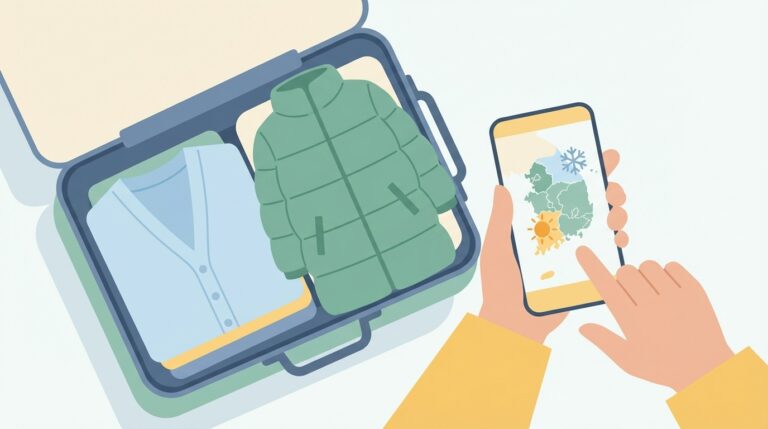
If you’re planning a trip to Korea, packing clothes can be surprisingly tricky. Korea has four distinct seasons, but the transitions between them can be wild. If you just look at the daytime high on your weather app, you might find yourself freezing at a night market or sweating on the subway.
Today, we are going to learn the absolute survival phrases for packing and dealing with Korean weather. Knowing these won’t just keep you comfortable; they’ll make your Korean friends realize, “Wow, this person really knows Korea.” Let’s dive in!
Phase 2: Core Expressions Deep Dive 🤿
Here are the top three expressions you will hear constantly from concerned Korean friends when you are planning your outfits.
1. 일교차가 커요. (The daily temperature range is big.)
- Pronunciation: ilgyochaga keoyo [eel-gyo-cha-ga co-yo]
- Meaning: (Lit.) The daily temperature difference is big. / (Real nuance) It’s warm during the day but freezing at night, so don’t be fooled by the afternoon sun!
- K-Culture Moment: You’ll hear this on every morning news broadcast in spring and autumn. If you tell a Korean coworker you’re going to a baseball game in April, their immediate reflex will be, “일교차가 커요!”
- Editor’s Insight: This phrase sounds a bit scientific in English, but in Korea, it’s an everyday conversational staple. It’s a way of showing care.
- Situation Spectrum:
- Casual (Friends): ✅ (일교차 커!)
- Semi-formal (Coworkers): ✅
- Formal (Elders/Boss): ✅ (일교차가 큽니다)
- 🤔 Think About It: Why do Koreans love giving weather advice? Similar to asking “Have you eaten?” (밥 먹었어요?), warning someone about the weather is a cultural way of showing affection and concern for their well-being.
2. 겉옷 챙기세요. (Bring an outer layer.)
- Pronunciation: geotot chaenggiseyo [go-dot cheng-gi-se-yo]
- Meaning: (Lit.) Please pack/take outer clothes. / (Real nuance) Bring a cardigan or jacket, you’re going to need it later.
- K-Culture Moment: When K-Pop idols do live streams before heading out for a schedule, they constantly tell their fans: “오늘 추우니까 겉옷 꼭 챙기세요!” (It’s cold today, so make sure to bring a jacket!)
- Editor’s Insight: ‘겉옷’ (outerwear) and ‘챙기다’ (to pack/take care of) are a match made in heaven. Koreans rarely leave the house in spring or fall without a cardigan folded in their bags.
- Situation Spectrum:
- Casual (Friends): ✅ (겉옷 챙겨!)
- Semi-formal (Coworkers): ✅
- Formal (Elders/Boss): ⚠️ (Use ‘겉옷 챙기십시오’ or ‘따뜻하게 입으세요’)
- 🤔 Think About It: Notice the verb ‘챙기다’. It means to pack, but also to ‘take care of’. Does your language have a word that beautifully blends packing items and taking care of oneself?
3. 껴입는 게 좋아요. (It’s better to dress in layers.)
- Pronunciation: kkyeo-imneun ge joayo [kkyeo-im-neun ge jo-ah-yo]
- Meaning: (Lit.) Putting on layers is good. / (Real nuance) Layer up because you’ll be peeling them off and putting them back on all day.
- K-Culture Moment: Korean winters are freezing outside, but public transport and cafes have the heating set to maximum. If you wear one giant thick sweater under your coat, you will melt on the subway. Layering (껴입기) is a survival tactic.
- Editor’s Insight: ‘껴’ (from 끼이다, to be wedged/layered) + ‘입다’ (to wear). The double consonant ‘ㄲ’ sounds sharp, like you are tightly packing clothes onto your body!
- Situation Spectrum:
- Casual (Friends): ✅ (여러 겹 껴입어)
- Semi-formal (Coworkers): ✅
- Formal (Elders/Boss): 🚫 (Too casual. Say ‘따뜻하게 입으세요’)
Phase 3: Textbook vs. Real Korean 🥊
How does real-life Korean differ from what you study?
[When the weather is freezing]
* 📖 Textbook: 날씨가 매우 춥습니다. (The weather is very cold.)
* 🗣️ Real Korean: 오늘 완전 롱패딩 각이에요. (Today is totally long-padding weather.)
* 💡 Why the difference?: ‘각이다’ (It’s an angle for…) originated from gaming slang to mean “It’s the perfect situation for…”. The “Long Padding” (ankle-length puffer jacket) is the unofficial winter uniform of Korea.
[When telling someone to dress warmly]
* 📖 Textbook: 옷을 따뜻하게 입으십시오. (Please wear warm clothes.)
* 🗣️ Real Korean: 감기 안 걸리게 단디 입어! (Dress warmly so you don’t catch a cold!)
* 💡 Why the difference?: ‘단디’ is a dialect word (Satoori) from the Busan/Gyeongsang region meaning ‘firmly’ or ‘properly’, but it’s widely used cutely across Korea to say “wrap up well!”
Bottom Note: For B1 learners, using ‘겉옷 챙기세요’ is perfectly natural and polite. Try casually dropping ‘롱패딩 각이에요’ with your Korean friends for some guaranteed laughs!
Phase 4: Cultural Context — K-Culture Deep Dive 🌊
4-1. Non-verbal Context: The “Nunchi” of AC and Heating
In Korea, packing for the weather isn’t just about the outdoors; it’s about the indoors too. In summer, Korean cafes, subways, and offices blast the air conditioning (에어컨) so strongly that it feels like a refrigerator. Even in August, bringing a light cardigan requires good Nunchi (눈치 – situational awareness) because you will likely freeze while sipping your iced Americano inside.
4-2. K-Drama vs. Real Life Survival
Let’s talk about Korean fashion. In K-Dramas, actors wear stylish wool coats and thin turtlenecks in the dead of winter. Do not copy them. Korean winters (especially in Seoul) bring biting winds from Siberia.
By mid-November, a massive shift happens: almost the entire population transforms into giant, walking black sleeping bags. This is the 롱패딩 (Long padding) phenomenon. It’s not about fashion; it’s about pure survival. If you visit Korea in winter, pack your thickest coat, or better yet, buy a long padding jacket as soon as you arrive!
Phase 5: Real-Life Roleplay Scenario 🎬
Setting: It’s a Thursday evening. You are sitting in a cozy cafe in Hongdae with your Korean friend, Minji. You are planning a weekend trip to Jeju Island. You have your suitcase open on your phone screen.
Characters:
– YOU: A traveler excited for your first Jeju trip.
– Minji (28): Your helpful, practical Korean friend who acts like a protective older sister.
Dialogue:
Minji: 주말 제주도 여행, 짐 다 쌌어? 🧳
(jumal jejudo yeohaeng, jim da ssasseo?)
(Did you finish packing for the Jeju trip this weekend?)
YOU: 거의 다 쌌어! 예쁜 반팔 위주로 챙겼지.
(geoui da ssasseo! yeppeun banpal wijuro chaenggyeotji.)
(Almost! I mainly packed pretty short-sleeves.)
Minji: 반팔? 제주도는 바람이 얼마나 많이 부는데!
(banpal? jejudoneun barami eolmana mani buneunde!)
(Short-sleeves? Do you know how windy Jeju is!)
YOU: 일기예보 보니까 낮에는 25도던데? ☀️
(ilgi-yebo bonikka najeneun isib-dodeonde?)
(I checked the weather forecast and it’s 25 degrees during the day?)
Minji: 야, 제주는 바닷바람 때문에 체감 온도가 낮아.
(ya, jejuneun badatbaram ttaemune chegam ondoga naja.)
(Hey, the ‘feels like’ temperature in Jeju is lower because of the sea breeze.)
YOU: 아, 진짜? 밤에는 많이 추워?
(a, jinjja? bameneun mani chuwo?)
(Oh, really? Is it very cold at night?)
Minji: 응, 요즘 일교차가 커서 밤에는 쌀쌀해. 겉옷 챙기세요 고객님!
(eung, yojeum ilgyochaga keoseo bameneun ssalssalhae. geotot chaenggiseyo gogaengnim!)
(Yeah, the daily temp difference is big lately so it’s chilly at night. Pack an outer layer, dear customer!)
🔀 Your Turn! How do you respond?
– A) “알겠어. 두꺼운 겨울 패딩 하나 챙겨야겠다!” (Okay. I should pack a thick winter padding jacket!)
– B) “그래? 그럼 얇은 가디건 하나 챙겨야겠다.”
– C) “나는 열이 많아서 겉옷 안 입어!”✅ Best Choice: B — “Really? Then I should pack a light cardigan.” (geurae? geureom yalbeun gadigeon hana chaenggyeoyagetda.)
Reason: A thick winter jacket in 25-degree weather will make you sweat. A cardigan is the perfect Korean travel essential!
⚠️ Choice C Analysis: Saying you have a lot of body heat (열이 많다) is a natural Korean phrase, but refusing a jacket entirely will just make your friend worry more!
Minji: 빙고! 얇은 거 여러 개 껴입는 게 좋아.
(binggo! yalbeun geo yeoreo gae kkyeoimneun ge joa.)
(Bingo! It’s better to layer several thin ones.)
YOU: 꿀팁 고마워! 다시 싸야겠다.
(kkultip gomawo! dasi ssayagetda.)
(Thanks for the sweet tip! I should repack.)
Phase 6: 10-Second Shadowing Drill ⏱️
Practice this sentence to sound like a caring local!
😊 아침저녁으로 / 일교차가 크니까 / 겉옷을 꼭 챙기세요!
(achimjeonyeogeuro / ilgyochaga keunikka / geotoseul kkok chaenggiseyo!)
(The daily temp difference is big morning and evening, so make sure to bring an outer layer!)
- Intonation Tip: Raise your pitch slightly at ‘크니까’ (because it’s big) and say ‘꼭’ (make sure) with a firm, caring emphasis! 😊
Phase 7: K-Culture Mini Dictionary 📖
| Korean | Romanization | English | Context |
|---|---|---|---|
| 일교차 | ilgyocha | Daily temp difference | The gap between the lowest and highest temperature in a day. |
| 겉옷 | geotot | Outerwear | Jackets, coats, cardigans. |
| 간절기 | ganjeolgi | In-between seasons | The awkward transitional period between seasons (e.g., late Feb, late Oct) where no one knows what to wear. |
| 롱패딩 | rongpaeding | Long padding jacket | Ankle-length puffer jacket. The national winter uniform of Korea. |
| 체감 온도 | chegam ondo | “Feels like” temperature | Crucial in Korea due to strong winds or high humidity. |
| 얼죽아 | eoljuga | Eol-juk-a | Slang: “Even if I freeze to death, Iced Americano!” Shows Koreans’ love for cold coffee even in winter. |
Phase 8: Traveler’s Survival Kit 🎒
If you packed wrong and find yourself freezing or sweating, don’t panic!
🆘 Survival Phrases for Buying Clothes/Gear
– 🇰🇷 “가장 두꺼운/얇은 거 어디 있어요?” (gajang dukkeoun/yalbeun geo eodi isseoyo?)
– Where are the thickest/thinnest ones?
– 🇰🇷 “이거 입어봐도 돼요?” (igeo ibeobwado dwaeyo?)
– Can I try this on?
– 📍 Where to use: SPA brands (Topten, Uniqlo, SPAO), Underground shopping malls (e.g., Gangnam station).
– 💡 Pro Tip: In underground malls, trying on white t-shirts or thin tops is often not allowed to prevent makeup stains. Always ask first!📌 Editor’s Travel Note
– Sudden Rain? Just go to the nearest convenience store (CU, GS25) or Daiso and grab a cheap transparent umbrella (투명 우산).
– Too Cold? Go to a pharmacy (약국) or convenience store and buy a ‘핫팩’ (Hot pack). You shake it, put it in your pocket, and it stays warm for 12 hours!
– Weather Apps: Don’t just use your default phone app. Download Naver Weather (네이버 날씨) for hyper-local accuracy and fine dust (미세먼지) warnings.
Phase 9: Critical Thinking — “One Step Deeper” 🧠
Media vs. Reality: The K-Drama Wardrobe Illusion
If you watch K-Dramas, winter in Seoul looks incredibly chic. The leads wear fitted pastel coats, stylish scarves, and somehow their ears are never red from the cold.
However, this creates a dangerous illusion for tourists. Real Korean winters are heavily influenced by Siberian winds. The beautiful outfits on TV are worn by actors who have heated vans waiting just off-camera. In reality, practically every Korean prioritizes warmth over style from December to February, wrapping themselves in identical black long-padding jackets.
💬 Your Turn: Have you ever visited a country and realized the weather or fashion was completely different from what you saw in movies? Share your story in the comments!
Phase 10: FAQ & Avoiding Misunderstandings 🛑
Q: “Can I wear shorts or tank tops in the summer?”
A: Yes, summer in Korea is incredibly hot and humid. However, Korean fashion is slightly conservative when it comes to the upper body. Short skirts or shorts are completely normal, but exposing a lot of cleavage or shoulders might get you some stares, especially from older generations.
Q: “If an older person tells me ‘옷 따뜻하게 입어’ (Dress warmly), are they criticizing my outfit?”
A: Not at all! This is a classic Korean expression of affection. They are just worried you might catch a cold. Just smile and reply, “네, 감사합니다!” (Yes, thank you!).
❌ Common Mistake: Checking only the daytime temperature in April or October.
✅ Do This Instead: Look at the temperature at 8 PM. If it drops below 15°C, pack a jacket!
Phase 11: Summary & Action Items 🎯
- One-Liner Summary: Korean weather changes dramatically from day to night, so always remember to pack layers and bring your outer garments (겉옷 챙기세요)!
Your Action Mission for Today:
– 🥉 Bronze (Solo): Look at your closet and say “겉옷 챙기세요” 3 times while holding a jacket.
– 🥈 Silver (Online): Check the current weather in Seoul on your phone. Write a comment below telling us if it’s “가디건 날씨” (Cardigan weather) or “롱패딩 날씨” (Long padding weather)!
– 🥇 Gold (Real-Life): The next time your Korean friend is heading out, tell them “일교차 크니까 겉옷 챙겨!” (Temp difference is big, bring a jacket!). Watch their eyes go wide in surprise!
Phase 12: Quiz — Interactive Challenge 🧩
Test your Korean survival skills!
1. Fill in the Blank:
You are going to Jeju Island. Your friend warns you that the temperature drops sharply at night.
Friend: “요즘 ________가 커요. 감기 조심해!”
A) 일교차 (ilgyocha)
B) 체감 온도 (chegam ondo)
C) 간절기 (ganjeolgi)
2. True or False – K-Culture Edition:
“In the middle of August in Korea, you will never need a cardigan.”
3. Situational Judgment:
You are freezing on the subway in summer because the AC is too strong. You want to buy a light jacket at an underground mall. What do you ask the staff?
A) “가장 두꺼운 패딩 있어요?”
B) “얇은 겉옷 있어요?”
C) “얼죽아 주세요.”
👉 Click here for the Answers!
- A (일교차 – Daily temperature difference is big!)
- False (Korean indoor Air Conditioning is notoriously strong. A light cardigan is a must-have even in summer!)
- B (얇은 겉옷 있어요? – Do you have a thin outer layer? A is for thick padding, and C is ordering an iced coffee!)
Frequently Asked Questions (FAQ)
Q: What does "일교차가 커요. (The daily temperature range is big.)" mean in Korean and how do you pronounce it?
A: In Korean, "일교차가 커요. (The daily temperature range is big.)" is pronounced [ilgyochaga keoyo [eel-gyo-cha-ga co-yo] and means: (Lit.) The daily temperature difference is big. / (Real nuance) It’s warm during the day but freezing at night, so don't be fooled by the afternoon sun!
Q: What does "겉옷 챙기세요. (Bring an outer layer.)" mean in Korean and how do you pronounce it?
A: In Korean, "겉옷 챙기세요. (Bring an outer layer.)" is pronounced [geotot chaenggiseyo [go-dot cheng-gi-se-yo] and means: (Lit.) Please pack/take outer clothes. / (Real nuance) Bring a cardigan or jacket, you’re going to need it later.
Q: What does "껴입는 게 좋아요. (It's better to dress in layers.)" mean in Korean and how do you pronounce it?
A: In Korean, "껴입는 게 좋아요. (It's better to dress in layers.)" is pronounced [kkyeo-imneun ge joayo [kkyeo-im-neun ge jo-ah-yo] and means: (Lit.) Putting on layers is good. / (Real nuance) Layer up because you'll be peeling them off and putting them back on all day.







